Have you ever wondered whether acknowledgment or acknowledgement is the correct spelling? While Acknowledgment vs Acknowledgement may look like a small spelling difference, the choice usually depends on the type of English, country, and spelling convention you follow.
Acknowledgment and acknowledgement have the same meaning. Both refer to recognizing, accepting, or showing appreciation for something or someone. Acknowledgment is the standard spelling in American English, while acknowledgement is more common in British English and other varieties that follow British spelling conventions.
Examples:
- She sent an acknowledgment of the payment.
- He received an acknowledgement from the university.
The confusion is understandable. People often search for acknowledgment vs acknowledgement, acknowledgment or acknowledgement, which spelling is correct, or acknowledgement meaning because both spellings are accepted, yet they follow different regional conventions. And here’s the kicker: neither spelling changes the word’s meaning or pronunciation.
In this guide, you’ll learn the complete difference between Acknowledgment vs Acknowledgement, including their meaning, pronunciation, origin, correct spelling, and usage. You’ll also discover which spelling to use in American English vs British English, along with clear examples to help you choose the right form.
Acknowledgment vs Acknowledgement: What’s the Difference?
The difference between acknowledgment and acknowledgement is primarily one of spelling.
The two words have the same basic meaning and perform the same grammatical function. They’re both nouns formed from the verb acknowledge.
Consider these two sentences:
- US English: The author included an acknowledgment of her editor’s help.
- British English: The author included an acknowledgement of her editor’s help.
The message doesn’t change. The only visible difference is the extra e in acknowledgement.
Cambridge defines acknowledgment as the act or fact of accepting that something is true or recognizing its existence. It also uses the word for something given to thank someone and for a letter or email confirming that something has been received.
Acknowledgment
Acknowledgment is the spelling you’ll generally want when writing in US English.
For example:
The researcher included an acknowledgment of the funding agency’s support.
I received an acknowledgment confirming that the application had arrived.
Her acknowledgment of the mistake helped resolve the dispute.
The noun can therefore cover several closely related ideas:
- recognizing a fact
- admitting something is true
- recognizing someone’s contribution
- expressing thanks
- confirming receipt of something
American English doesn’t require the extra e before -ment in this word.
Acknowledgement
Acknowledgement is the spelling commonly associated with British English.
For example:
The researcher included an acknowledgement of the university’s support.
We received an acknowledgement of the documents we submitted.
His acknowledgement of her contribution appeared in the published report.
British spelling keeps the e between the g and m.
That doesn’t make acknowledgement a different word. It simply reflects a different spelling convention.
Is Acknowledgment or Acknowledgement Correct?
Both acknowledgment and acknowledgement are correct.
That’s the simplest answer.
If you’re writing in American English, acknowledgment is the natural choice. If you’re writing in British English, acknowledgement is common and widely accepted.
Cambridge’s entries are particularly useful here because the dictionary explicitly identifies acknowledgement as an alternative to acknowledgment. Its US entry uses acknowledgment, while its UK entry for acknowledgement identifies the latter as a UK form.
This means you shouldn’t treat the spelling difference as you would a genuine spelling mistake.
For example, writing:
The report contains an acknowledgement of the team’s contribution.
isn’t automatically wrong simply because you’re accustomed to American English.
Likewise, this sentence:
The report contains an acknowledgment of the team’s contribution.
isn’t wrong because a British reader expects the longer form.
The key is consistency.
If a document uses American English throughout, switching randomly to acknowledgement can make the writing look inconsistent. The same applies in reverse when a document follows British English.
Acknowledgment vs Acknowledgement in American and British English
Regional spelling is the easiest way to understand the difference.
| Feature | Acknowledgment | Acknowledgement |
| US English | Common/standard form | Also recognized |
| British English | Used occasionally | Common form |
| Meaning | Same | Same |
| Part of speech | Noun | Noun |
| Base verb | Acknowledge | Acknowledge |
| Extra e before -ment | No | Yes |
| Plural | Acknowledgments | Acknowledgements |
The distinction doesn’t stop at ordinary prose. You’ll see it in books, academic papers, business correspondence, reports, and other formal writing.
For instance, the Chicago Manual of Style uses Acknowledgments as the heading for its own section. Its current 18th edition also discusses where acknowledgments should appear in books, noting that Chicago now generally prefers placing them in the back matter for most books.
That example illustrates an important point: style guides make choices.
A style guide may favor one spelling even when another spelling remains valid English.
Acknowledgment in American English
When you’re following US English, use acknowledgment unless a particular publication or organization specifies something else.
Common examples include:
- acknowledgment of receipt
- acknowledgment of responsibility
- acknowledgment of support
- acknowledgment of assistance
- acknowledgment of a contribution
- acknowledgment of an error
- acknowledgment section
- acknowledgments page
Acknowledgement in British English
When you’re following British English, acknowledgement is a common choice.
Examples include:
- acknowledgement of receipt
- acknowledgement of support
- acknowledgement of assistance
- acknowledgement of responsibility
- acknowledgement of a contribution
- acknowledgements section
- acknowledgements page
The difference is orthographic rather than conceptual.
Acknowledgment vs Acknowledgement Grammar
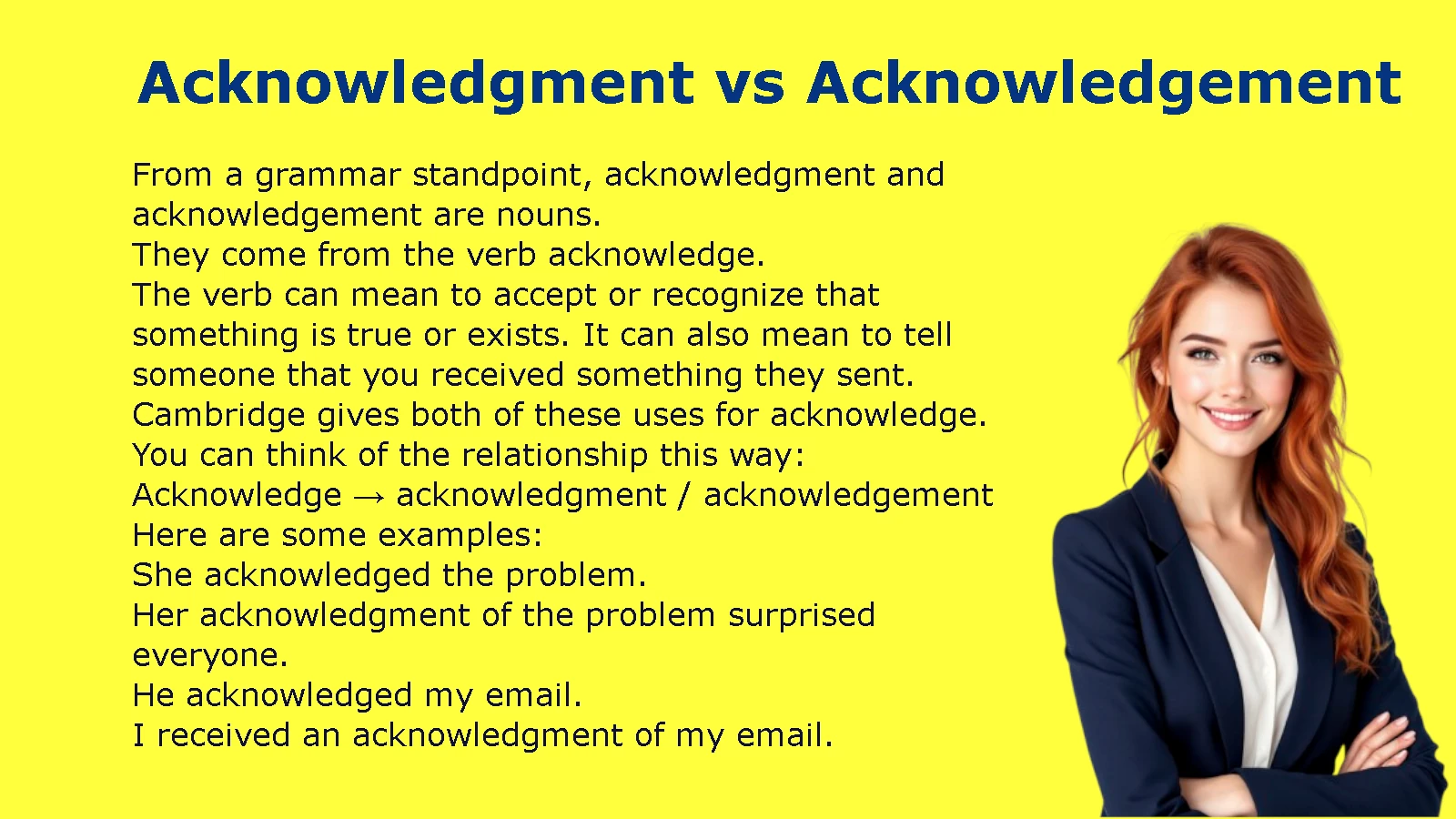
From a grammar standpoint, acknowledgment and acknowledgement are nouns.
They come from the verb acknowledge.
The verb can mean to accept or recognize that something is true or exists. It can also mean to tell someone that you received something they sent. Cambridge gives both of these uses for acknowledge.
You can think of the relationship this way:
Acknowledge → acknowledgment / acknowledgement
Here are some examples:
- She acknowledged the problem.
- Her acknowledgment of the problem surprised everyone.
- He acknowledged my email.
- I received an acknowledgment of my email.
The verb describes the action. The noun names that action, recognition, or confirmation.
Acknowledgment as a Noun
In a sentence such as:
His acknowledgment of the mistake came quickly.
Acknowledgment is the noun referring to the act of recognizing or admitting the mistake.
You can also use it for recognition:
The award was an acknowledgment of her years of service.
Here, the word describes recognition of someone’s work.
Acknowledgement as a Noun
The British spelling works in exactly the same grammatical role:
His acknowledgement of the mistake came quickly.
The award was an acknowledgement of her years of service.
Changing the spelling doesn’t change the grammar.
Acknowledgment vs Acknowledgement Examples
Examples make the difference much easier to see because you can compare the two forms in real sentences.
Examples With Acknowledgment
Here are several common uses in US English:
- Recognition of a fact:
The report contains an acknowledgment that the original estimate was inaccurate. - Recognition of someone’s help:
The author included an acknowledgment of her editor’s assistance. - Confirmation of receipt:
We received an acknowledgment of the application by email. - Recognition of responsibility:
His acknowledgment of responsibility ended the argument. - Academic thanks:
The dissertation contains an acknowledgment of the research team’s support. - Recognition of an achievement:
The award served as an acknowledgment of her contribution to the project. - Professional communication:
Please send an acknowledgment when you receive the documents.
Examples With Acknowledgement
The same ideas work with the British spelling:
- The report contains an acknowledgement that the original estimate was inaccurate.
- The author included an acknowledgement of her editor’s assistance.
- We received an acknowledgement of the application by email.
- His acknowledgement of responsibility ended the argument.
- The dissertation contains an acknowledgement of the research team’s support.
- The award served as an acknowledgement of her contribution to the project.
- Please send an acknowledgement when you receive the documents.
Notice what stays the same: the meaning, grammar, and sentence structure.
Only the spelling changes.
Acknowledgment vs Acknowledgement Side by Side
| US English | British English |
| The book includes an acknowledgment. | The book includes an acknowledgement. |
| We received an acknowledgment of receipt. | We received an acknowledgement of receipt. |
| Her work deserves acknowledgment. | Her work deserves acknowledgement. |
| The paper contains several acknowledgments. | The paper contains several acknowledgements. |
This is a useful pattern to remember: don’t change the meaning when you change the spelling.
Acknowledgment vs Acknowledgement in Research
Research writing creates one of the most common situations where people hesitate between these spellings.
Academic papers, dissertations, theses, books, and research reports often include an acknowledgment or acknowledgement section where the author recognizes people and organizations that contributed to the work.
That section may mention:
- research supervisors
- academic advisers
- laboratory staff
- research assistants
- colleagues
- universities
- libraries or archives
- funding organizations
- grant programs
- study participants
- editors
- technical specialists
- collaborators
The exact content depends on the type of research and the institution’s requirements.
Which Spelling Should You Use in Research?
There isn’t one spelling that every researcher must use.
Instead, follow the spelling convention required by your university, journal, publisher, or style guide.
For example, a US university using American English may prefer:
Acknowledgments
A British university may use:
Acknowledgements
The same principle applies to journal submissions. If the journal’s author guidelines specify a particular style, follow those guidelines rather than choosing a spelling based solely on personal preference.
Research Example
Imagine a US researcher has completed a dissertation with help from a supervisor, laboratory team, and funding organization.
An American-style heading could be:
Acknowledgments
The opening might say:
I would like to thank my adviser for her guidance throughout this project and the research team for their technical assistance.
A British English dissertation might use:
Acknowledgements
The content could remain essentially identical.
The spelling doesn’t tell you what kind of research was conducted. It tells you which spelling convention the writer or institution follows.
Acknowledgement or Acknowledgements in a Thesis?
If you’re writing a thesis, both the singular and plural forms can appear, but Acknowledgments or Acknowledgements is commonly used as the heading for the section.
The choice depends on the style being followed.
| Form | Use |
| Acknowledgment | Singular noun |
| Acknowledgments | US plural form, often used for a section thanking multiple people |
| Acknowledgement | British singular noun |
| Acknowledgements | British plural form, often used for a thesis or book section |
The plural is particularly natural when the section contains multiple expressions of thanks or recognizes several people.
Cambridge defines acknowledgments as the short text at the beginning or end of a book in which the writer names people or works that helped with the book. It also lists acknowledgements as the alternative plural form.
Acknowledgment vs Acknowledgement in a Dissertation
Suppose you’re preparing a dissertation for an American institution.
A heading such as:
Acknowledgments
would fit American spelling.
For a British institution, you might see:
Acknowledgements
The safest approach is simple: check your university’s thesis or dissertation guidelines before choosing the heading.
Don’t let an online spelling debate override a specific institutional requirement.
Acknowledgement vs Acknowledgment in Legal Writing
Legal writing can make the spelling question feel more complicated than it really is.
In ordinary legal or professional English, acknowledgment and acknowledgement retain their ordinary meanings. The spelling itself doesn’t automatically create a different legal concept.
For example:
The agreement includes an acknowledgment of receipt.
The same sentence can appear in British spelling as:
The agreement includes an acknowledgement of receipt.
In both cases, the noun refers to recognition or confirmation.
Why Legal Context Requires Extra Care
Legal documents often follow a particular jurisdiction, drafting convention, court requirement, or organizational style.
That means you shouldn’t choose a spelling simply because one version looks more formal.
Instead, check:
- the jurisdiction
- the organization’s drafting style
- the court or agency’s requirements
- the applicable style guide
- the terminology used elsewhere in the document
Consistency matters especially in formal documents.
If a contract or legal publication has established British spelling throughout, introducing an American spelling halfway through can create unnecessary inconsistency.
The reverse is also true.
Is Acknowledgement the British Spelling?
Yes. Acknowledgement is the common British spelling.
British English commonly retains the e in this word:
acknowledgement
American English commonly uses:
acknowledgment
Cambridge’s dictionary specifically identifies acknowledgement as a UK noun and gives acknowledgment as the alternative form.
However, “British spelling” doesn’t mean every British writer must use it in every circumstance. Publishers, universities, companies, and individual style guides can establish their own preferences.
That’s why a particular document’s style guide always deserves attention.
Why Is It Acknowledgment in American English?
The shorter spelling is a standard American form.
One useful way to remember it is:
US English: acknowledge + ment → acknowledgment
The spelling removes the e before the suffix.
This pattern is part of the broader differences that exist between American and British spelling. English has developed multiple conventions over time, and publishers and dictionaries don’t always make the same choices.
It’s therefore better to learn the spelling as a regional convention than to assume that one version is a typo.
A Simple Memory Trick
If you’re writing for a US audience, remember:
American = acknowledgment
If you’re writing for a British audience, remember:
British = acknowledgement
The extra e points you toward the British form.
What Is the Plural of Acknowledgment and Acknowledgement?
The plural forms are straightforward.
- Acknowledgment → acknowledgments
- Acknowledgement → acknowledgements
Examples:
The book contains several acknowledgments.
The thesis begins with acknowledgements to the research team and supervisors.
The plural doesn’t introduce a new spelling rule. You simply add -s.
Acknowledgments in American English
US English normally uses:
Acknowledgments
For example:
The author thanked her editor, publisher, and research assistants in the acknowledgments.
Chicago itself uses Acknowledgments as the title of its acknowledgments section.
Acknowledgements in British English
British English commonly uses:
Acknowledgements
For example:
The author thanked her supervisors and colleagues in the acknowledgements.
Cambridge recognizes acknowledgments and acknowledgements as the two plural forms.
Acknowledgment vs Acknowledgement vs Acceptance
Searches for acknowledgement vs acceptance can create another point of confusion because the words overlap in some contexts.
They aren’t exact synonyms.
Acknowledgment can mean recognizing that something is true, recognizing someone’s contribution, or confirming receipt of something.
Acceptance generally refers to agreeing to receive, approve, adopt, or accept something.
Compare these sentences:
Her acknowledgment of the problem came after the meeting.
Her acceptance of the proposal came after the meeting.
The first sentence focuses on recognizing or admitting the problem.
The second focuses on agreeing to or approving the proposal.
Cambridge lists acceptance and recognition among words related to some meanings of acknowledgment, but the words aren’t interchangeable in every sentence.
When Acknowledgment Means Confirmation
Consider an email:
We sent an acknowledgment that your application had arrived.
Here, the word means confirmation of receipt.
You wouldn’t normally replace it with acceptance unless the organization had actually accepted the application.
That’s an important distinction.
Receipt isn’t the same as approval.
An organization can acknowledge that it received your application without accepting your application.
Acknowledgment vs Acknowledgement Pronunciation
The two spellings generally have the same pronunciation.
Cambridge gives the pronunciation for the noun in both US and UK forms and does not treat the extra written e in acknowledgement as an additional syllable.
In other words, don’t pronounce the British spelling as though the extra e creates another sound.
The main pronunciation difference you’ll encounter is more likely to come from the American versus British accent, rather than from the spelling difference itself.
For practical writing purposes, you can treat the two spellings as pronunciation equivalents.
Common Mistakes With Acknowledgment and Acknowledgement
The spelling itself is simple. The confusion usually comes from using the two forms inconsistently.
Using Both Spellings in the Same Document
This is one of the easiest mistakes to avoid.
Imagine a report that contains:
The acknowledgments section thanks the research team.
Later, the same report says:
The acknowledgement from the publisher arrived yesterday.
Neither word is inherently wrong. The problem is that the document may appear to switch spelling systems without a reason.
Pick the convention that fits your audience and stick with it.
Assuming One Spelling Is Always Wrong
A common misconception is:
“Acknowledgement is misspelled because acknowledgment is correct.”
That’s not accurate.
Both forms are established English spellings. Cambridge explicitly records both forms.
The better question is:
Which spelling does this document need?
Confusing Acknowledgment With Acknowledge
Remember the grammatical difference:
- Acknowledge = verb
- Acknowledgment = noun
- Acknowledgement = noun
For example:
Please acknowledge receipt of the letter.
Please send an acknowledgment of receipt.
The first sentence asks someone to perform an action.
The second refers to the confirmation itself.
Confusing Acknowledgment With Acceptance
Don’t use acknowledgment when you actually mean approval.
For example:
We acknowledge receipt of your application.
This means the application was received.
It doesn’t necessarily mean:
We accept your application.
Those statements communicate different things.
Forgetting Regional Consistency
If the rest of your document uses American spellings such as color, organization, and center, then acknowledgment will usually fit better.
If the document uses British forms such as colour, organisation, and centre, then acknowledgement will generally fit the same system.
The broader lesson is simple: spelling works as a system, not as a collection of isolated words.
Acknowledgment vs Acknowledgement in Formal Writing
Both spellings work in formal writing.
The choice depends on the English variety and the required editorial style.
You can use either form in contexts such as:
- academic papers
- research reports
- business letters
- professional emails
- books
- dissertations
- theses
- legal documents
- government correspondence
- technical documentation
What matters is that the spelling matches the surrounding style.
Formal Example in US English
The authors would like to express their acknowledgment of the assistance provided by the research team.
Formal Example in British English
The authors would like to express their acknowledgement of the assistance provided by the research team.
Both sentences communicate the same idea.
However, in polished professional writing, you should also consider whether acknowledgment of is the most natural phrase for your particular meaning. Sometimes recognition, confirmation, or thanks may communicate the idea more precisely.
Acknowledgment vs Acknowledgement: A Practical Decision Guide
When you’re unsure which spelling to use, don’t overthink it.
Use this checklist:
If You’re Writing for an American Audience
Choose:
Acknowledgment
Examples:
- acknowledgment letter
- acknowledgment of receipt
- acknowledgment section
- acknowledgments page
If You’re Writing for a British Audience
Choose:
Acknowledgement
Examples:
- acknowledgement letter
- acknowledgement of receipt
- acknowledgement section
- acknowledgements page
If You’re Writing an Academic Paper
Check the requirements from:
- your university
- your department
- your journal
- your publisher
- your required style guide
If those sources don’t specify a preference, use the English variety you’ve adopted throughout the paper.
If You’re Editing Someone Else’s Document
Don’t automatically replace one spelling with the other.
First determine which variety of English the document follows.
If You’re Writing for an International Audience
Either spelling can work.
The safest approach is to choose one consistent convention based on the publication or organization you’re writing for.
Consistency beats unnecessary switching.
Acknowledgment vs Acknowledgement: A Real-World Style Guide Example
Style guides demonstrate why “correct spelling” isn’t always a simple one-word answer.
The Chicago Manual of Style uses the spelling Acknowledgments for its own section. Its 18th edition also provides updated guidance about where acknowledgments should appear in books.
That doesn’t mean every English-language publisher must use acknowledgments.
It means Chicago has established a convention for works following Chicago style.
This is exactly why academic and professional writers should check the relevant style guide instead of relying on a general internet spelling rule.
Case Study: A Thesis
Imagine two students writing similar theses.
Student A studies at a US university whose guidelines use American English.
Their section is titled:
Acknowledgments
Student B studies at a UK university whose guidelines use British English.
Their section is titled:
Acknowledgements
Neither student needs to change the spelling simply because another English-speaking institution uses the other form.
The spelling reflects the editorial system surrounding the work.
Case Study: A Confirmation Email
Now consider a company confirming receipt of an application.
An American company might write:
Thank you. We have sent an acknowledgment confirming receipt of your application.
A British company might write:
Thank you. We have sent an acknowledgement confirming receipt of your application.
Again, the spelling changes. The communicative purpose does not.
Is Acknowledgment the American Spelling?
Yes. Acknowledgment is the standard American spelling.
It is the form you’ll commonly encounter in US English, including formal writing and editorial contexts.
That said, acknowledgement isn’t meaningless or incomprehensible to American readers. Cambridge’s American Dictionary also records acknowledgement as an alternative form.
So if you see the longer spelling in an American publication, don’t assume the writer made a basic spelling error.
It may reflect:
- a quoted source
- a publisher’s preference
- an international publication
- a writer following British English
- an established organizational style
Is Acknowledgement the British Spelling?
Yes. Acknowledgement is the common British spelling.
The British form retains the e:
acknowledge → acknowledgement
The American form generally removes it:
acknowledge → acknowledgment
Cambridge’s UK dictionary entry identifies acknowledgement as the UK form and lists acknowledgment as an alternative.
This makes the spelling distinction especially easy to remember.
US: acknowledgment
UK: acknowledgement
Why Are There Two Spellings?
English spelling has never operated as one perfectly uniform system.
Different varieties of English developed different conventions. American English adopted and standardized a number of spelling forms that differ from British usage, while British English retained other conventions.
The acknowledgment/acknowledgement distinction fits into that broader pattern.
However, it would be misleading to treat the word as though there were one universal rule saying that American English always removes an e before -ment.
English spelling contains many individual conventions and exceptions.
That’s why memorizing the established forms is more useful than trying to force every word into a single spelling formula.
Acknowledgment vs Acknowledgement: Quick Comparison
| Question | Answer |
| Are acknowledgment and acknowledgement both correct? | Yes |
| Which spelling is common in US English? | Acknowledgment |
| Which spelling is common in British English? | Acknowledgement |
| Do they have different meanings? | No |
| Are they different parts of speech? | No |
| Are they pronounced differently because of the extra e? | Generally no |
| Plural of acknowledgment | Acknowledgments |
| Plural of acknowledgement | Acknowledgements |
| Can both appear in formal writing? | Yes |
| Which should you use in academic writing? | Follow the required style |
| Which should you use in legal writing? | Follow the relevant jurisdiction or style |
| Is acknowledgment the US form? | Yes |
| Is acknowledgement the British form? | Yes |
Frequently Asked Questions About Acknowledgment vs Acknowledgement
Is acknowledgment or acknowledgement correct?
Both are correct. Acknowledgment is the standard US spelling, while acknowledgement is common in British English.
Is acknowledgement British or American?
Acknowledgement is primarily associated with British English. American English generally prefers acknowledgment, although dictionaries also recognize the longer spelling as an alternative.
Is acknowledgment American English?
Yes. Acknowledgment is the standard American spelling.
What is the difference between acknowledgment and acknowledgement?
The difference is mainly spelling. Acknowledgment drops the e, while acknowledgement retains it. Their meanings and grammatical roles are essentially the same.
What is the plural of acknowledgment?
The plural is acknowledgments.
The author thanked her colleagues in the acknowledgments.
What is the plural of acknowledgement?
The plural is acknowledgements.
The author thanked her colleagues in the acknowledgements.
Which spelling should I use in a thesis?
Use the spelling required by your university, department, publisher, or style guide. If no specific rule exists, match the English variety used throughout your thesis.
Which spelling should I use in research?
Use the spelling required by the journal, institution, or style guide. Acknowledgment fits US English, while acknowledgement fits British English.
Is acknowledgment the same as acceptance?
Not always. Acknowledgment can mean recognition, admission, thanks, or confirmation that something was received. Acceptance generally means agreeing to receive, approve, or accept something.
For example, acknowledging receipt of an application doesn’t necessarily mean accepting the application.
Does the extra e change the pronunciation?
Generally, no. The extra e in acknowledgement doesn’t create an additional syllable. Differences you hear are more likely to reflect regional pronunciation.
Final Answer: Acknowledgment vs Acknowledgement
The choice between acknowledgment and acknowledgement comes down to English variety and style, not meaning.
Acknowledgment is the standard US English spelling.
Acknowledgement is the common British English spelling.
Both forms can refer to recognizing a fact, admitting something, recognizing someone’s contribution, thanking someone, or confirming receipt of something. Cambridge recognizes both spellings and documents these uses across its English dictionaries.
For academic writing, check your university or journal requirements. For books and professional publications, follow the publisher’s style guide. In legal or business writing, match the conventions required by the relevant organization or jurisdiction.
If you’re simply writing ordinary US English and have no special style requirement, choose acknowledgment.
If you’re writing British English, choose acknowledgement.
The golden rule is simple: pick the spelling that matches your English variety, then use it consistently.




