When you’re writing about something that happened in the past, you may wonder whether caught or cought is the correct spelling. The difference between Caught vs Cought can be confusing because the two forms look and sound similar, but only one is a standard English word.
Caught is the correct spelling. It is the past tense and past participle of catch, meaning to grab, capture, stop, or become aware of something. Cought is not a standard English spelling and is generally considered a misspelling of caught.
Examples:
- She caught the ball before it hit the ground.
- I caught the bus just before it left.
The confusion is understandable. People often search for caught vs cought, caught or cought, which spelling is correct, or cought meaning because the two spellings can seem interchangeable when heard in conversation. And here’s the kicker: although caught and cought may sound similar in many varieties of English, only caught is the accepted spelling.
In this guide, you’ll learn the complete difference between Caught vs Cought, including their meaning, pronunciation, origin, correct spelling, and usage. You’ll also see why cought is incorrect, along with clear examples to help you use caught correctly in your writing.
Caught vs Cought: Quick Answer
The difference between caught and cought is mainly a matter of correct versus incorrect spelling in standard English.
| Word | Standard spelling? | Meaning | Example |
| caught | Yes | Past tense and past participle of catch | I caught the ball. |
| cought | No, in standard modern English | Usually a misspelling of caught | I cought the ball. ❌ |
Caught can describe many different situations. You can catch a ball, catch a bus, catch a person, catch a cold, catch someone’s attention, or get caught doing something wrong.
For example:
I caught the last train home.
She caught the ball with one hand.
The teacher caught him cheating.
In each sentence, caught is the correct form.
What Does Caught Mean?
Caught is the simple past and past participle of the irregular verb catch. Cambridge and Oxford both identify it as the past form of catch.
The word can carry several related meanings depending on the sentence.
Caught Means Grabbed or Held Something
One of the most basic meanings involves stopping and holding something that is moving.
You might catch a ball, a falling glass, a set of keys, or something someone throws toward you.
Examples:
- I caught the ball before it hit the ground.
- She caught the keys as they fell.
- He caught the glass just in time.
- The dog caught the stick in its mouth.
This use comes directly from the central meaning of catch: taking hold of something that is moving. Oxford gives examples involving keys, a person who trips, and a dog catching a stick.
Caught Means Captured or Stopped Someone
Caught can also mean that someone was captured or prevented from escaping.
For example:
- The police caught the thief.
- The dog caught the rabbit.
- The goalkeeper caught the ball.
- The security guard caught the intruder.
Here, caught doesn’t necessarily mean physically grabbing someone with your hands. It can mean successfully pursuing, stopping, or capturing a person or animal.
That broader meaning explains why English speakers can say someone was “caught” even when no literal grabbing occurred.
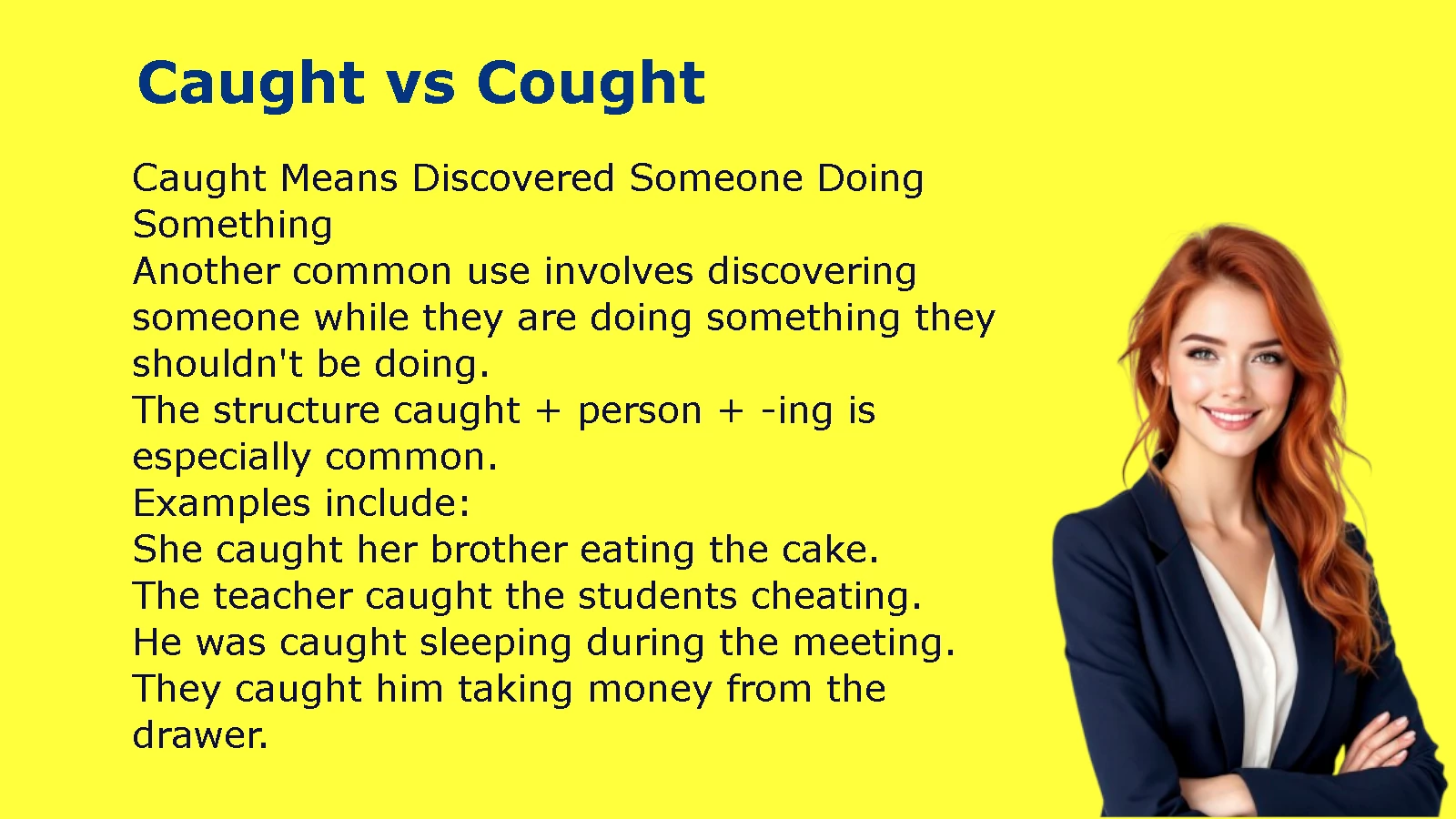
Caught Means Discovered Someone Doing Something
Another common use involves discovering someone while they are doing something they shouldn’t be doing.
The structure caught + person + -ing is especially common.
Examples include:
- She caught her brother eating the cake.
- The teacher caught the students cheating.
- He was caught sleeping during the meeting.
- They caught him taking money from the drawer.
In these sentences, caught means discovered or found someone in the middle of an action.
Cambridge specifically includes this sense of catch: discovering someone doing something wrong or something they were trying to keep secret.
Caught Means Reached or Got Onto Transportation
English speakers also use caught when someone successfully gets on a bus, train, plane, or other scheduled form of transportation.
Examples:
- I caught the 8:30 bus.
- She caught the last train home.
- We caught an early flight to Chicago.
- He ran to the station and caught the train.
This meaning is particularly useful because catch doesn’t literally mean “grab” a bus or train.
Instead, catch a bus means to arrive in time to board it.
Oxford lists this as a standard meaning of catch: being in time for a bus, train, plane, or similar service and getting on it.
Caught Means Became Infected With an Illness
You can also catch an illness. The past form is caught.
Examples:
- I caught a cold last week.
- She caught the flu from her brother.
- He caught a stomach bug while traveling.
This doesn’t mean you physically grabbed an illness. Instead, catch developed a broader meaning related to becoming affected by something that can spread from one person to another.
Cambridge lists catch a cold and similar illness-related uses among the meanings associated with catch.
Caught Means Noticed or Understood Something
Sometimes caught means that you noticed, heard, or understood something.
For example:
- I didn’t catch what you said.
- She caught the mistake immediately.
- Did you catch that joke?
- He caught the meaning behind her comment.
In everyday conversation, I didn’t catch that often means I didn’t hear or understand that.
That’s why someone might say:
“Sorry, I didn’t catch your last sentence.”
They’re not talking about physically catching anything. They’re saying they didn’t hear or understand it clearly.
Caught Means Attracted Someone’s Attention
The verb catch also appears in the familiar expression catch someone’s attention.
Examples:
- The bright sign caught my attention.
- Her unusual answer caught the teacher’s attention.
- The headline caught my eye.
- His speech caught everyone’s interest.
Here, caught means something successfully attracted or gained attention.
Is Cought a Word?
Cought is not the standard spelling of the past tense or past participle of catch.
If you’re writing standard English, use caught.
That distinction matters because unusual spellings can sometimes appear in historical texts, dialect writing, names, creative works, or other specialized contexts. The existence of an unusual form somewhere doesn’t make it the standard spelling for everyday English.
For normal writing, the rule is simple:
Catch → caught
Not:
Catch → cought
So these sentences are correct:
- I caught the ball.
- She caught a cold.
- He caught the train.
- They caught the mistake.
These are not standard spellings:
- I cought the ball. ❌
- She cought a cold. ❌
- He cought the train. ❌
- They cought the mistake. ❌
When a spelling checker marks cought as an error, it’s usually identifying exactly this problem.
Why Do People Spell Caught as Cought?
The main reason is pronunciation.
The present form catch is pronounced /kætʃ/ in both UK and US English according to Cambridge. The past form caught has a different vowel and ending sound. Cambridge gives /kɔːt/ for British English and /kɑːt/ for its US pronunciation entry.
That creates a spelling problem for learners.
If someone hears caught without seeing it written, cought can look like a reasonable guess. English spelling, however, doesn’t work as a simple sound-to-letter system.
Consider these forms:
catch → caught
The spelling changes substantially because catch is an irregular verb.
You can’t simply attach -ed:
- catch + ed = ❌ catched
- catch + ed = ❌ catcht
- catch → caught = ✅
The correct form has to be learned as part of the verb.
A Useful Way to Remember It
Instead of trying to spell caught from its sound, remember the verb as a group:
catch → caught → caught
That small pattern is much more reliable.
Caught Pronunciation
Pronunciation can vary by accent, but the spelling remains caught.
Cambridge gives the following pronunciations:
| Variety | IPA |
| British English | /kɔːt/ |
| US English | /kɑːt/ |
The difference between accents can make English spelling even more confusing. Some speakers distinguish caught from cot, while others pronounce the two words very similarly or identically because of the cot–caught merger.
The spelling doesn’t change with the accent.
Whether a speaker says caught with a British /ɔː/ vowel or uses an American pronunciation that sounds closer to /ɑː/, the standard spelling remains caught.
Caught Grammar: Verb Forms
The easiest way to understand caught is to see where it fits in the complete verb pattern.
| Verb form | Correct word | Example |
| Base form | catch | I catch the bus every morning. |
| Third-person singular | catches | She catches the early train. |
| Simple past | caught | She caught the early train yesterday. |
| Past participle | caught | She has caught the early train before. |
| -ing form | catching | She is catching the train now. |
Oxford lists catch, catches, caught, and catching as the relevant forms of the verb.
Catch vs Caught
The biggest grammatical difference is time and verb form.
Use catch for the base or present form:
I catch the bus at 8:00 every morning.
Use caught for a completed past action:
I caught the bus at 8:00 yesterday.
The distinction becomes clearer when the sentences appear side by side.
| Present | Past |
| I catch the ball. | I caught the ball. |
| They catch the train. | They caught the train. |
| She catches mistakes quickly. | She caught the mistake quickly. |
| We catch colds easily. | We caught colds last winter. |
The important point is that caught isn’t simply another spelling of catch. It is a different grammatical form of the same verb.
Caught as a Past Participle
Caught also functions as a past participle.
That means it appears after auxiliary verbs in structures such as have caught, has caught, and had caught.
Examples:
- I have caught the mistake.
- She has caught three buses today.
- They had caught the thief before sunset.
- He had already caught the train.
It also appears in passive constructions:
- The thief was caught.
- The ball was caught by the goalkeeper.
- He was caught cheating.
Cambridge explicitly identifies caught as both the past simple and past participle of catch.
Caught vs Cought Examples
Seeing the words in context makes the difference much easier to remember.
Correct Examples With Caught
Physical action
- She caught the ball with one hand.
- I caught the keys before they hit the floor.
- The dog caught the stick.
Transportation
- We caught the last bus home.
- He caught the 7:15 train.
- They caught an early flight.
Capture
- The police caught the suspect.
- The farmer caught the escaped goat.
- The goalkeeper caught the ball.
Discovery
- The teacher caught him cheating.
- She caught her son sneaking into the kitchen.
- He was caught copying another student’s work.
Illness
- I caught a cold during the winter.
- She caught the flu at school.
Understanding
- I didn’t catch what you said.
- Did you catch that last point?
Attention
- The unusual headline caught my attention.
- Her bright jacket caught everyone’s eye.
All of these use caught, not cought.
Incorrect and Correct Examples
| Incorrect | Correct |
| I cought the ball. | I caught the ball. |
| She cought a cold. | She caught a cold. |
| He cought the train. | He caught the train. |
| The police cought the thief. | The police caught the thief. |
| I cought what you said. | I caught what you said. |
| She was cought cheating. | She was caught cheating. |
The pattern never changes: caught is the standard spelling.
Common Expressions With Caught
The word caught appears in many established English expressions. Learning these phrases can help you recognize the correct spelling naturally.
Caught Red-Handed
Caught red-handed means discovered while doing something wrong.
The employee was caught red-handed taking money from the register.
The phrase doesn’t require an actual red hand. It refers to being discovered in the act.
Caught Off Guard
Caught off guard means surprised by something unexpected.
The sudden question caught me off guard.
Someone can be prepared for a normal situation but still be caught off guard by something unexpected.
Caught by Surprise
This expression means that something happened unexpectedly.
The announcement caught everyone by surprise.
Caught in the Act
Caught in the act means discovered while doing something, usually something improper.
He was caught in the act of copying the answers.
This is closely related to the grammatical pattern caught + -ing.
Caught in the Middle
Someone who is caught in the middle becomes involved between two opposing people or sides.
She felt caught in the middle of her parents’ argument.
The expression doesn’t describe literal physical capture. Instead, it describes being stuck between competing positions.
Caught Up In
Caught up in can mean becoming deeply involved in something, sometimes without intending to.
He got caught up in the excitement of the game.
She was caught up in a complicated argument.
Cambridge includes caught up in something as an established phrase associated with catch.
Caught Someone’s Attention
This means that something made someone notice or focus on it.
The unusual photograph caught my attention.
The expression is extremely common in everyday and professional English.
Caught vs Cought in Different Sentence Structures
Understanding sentence structure helps you use caught naturally instead of simply memorizing its spelling.
Caught in an Active Sentence
In an active sentence, the subject performs the action.
The boy caught the ball.
The boy performs the catching.
Another example:
The police caught the suspect.
The police performed the action of catching.
Caught in a Passive Sentence
In a passive sentence, the person or thing affected by the action becomes the subject.
The ball was caught by the boy.
The suspect was caught by the police.
Passive sentences are useful when the result matters more than who performed the action.
Caught + -ing
The pattern caught + object + -ing is especially useful when describing someone discovered during an action.
She caught him lying.
The manager caught the employee sleeping.
The teacher caught the student using a phone during the test.
This structure is one reason caught appears so often in everyday English.
Caught + Noun
Some common expressions place a noun immediately after caught.
I caught a cold.
She caught the bus.
He caught the ball.
The meaning changes according to the noun that follows it.
Caught + Preposition
The word can also form common combinations with prepositions.
Examples include:
- caught in traffic
- caught in the rain
- caught between two choices
- caught by surprise
- caught off guard
- caught up in a problem
For example:
We got caught in traffic and arrived late.
I was caught in the rain without an umbrella.
These expressions show how flexible the verb catch can be.
Common Mistakes With Caught
Writing Cought Instead of Caught
This is the central mistake.
The incorrect form often comes from trying to represent the sound with familiar spelling patterns.
Remember:
catch → caught
Not:
catch → cought
Using Catched Instead of Caught
Another common error occurs when writers try to make catch regular.
I catched the ball. ❌
I caught the ball. ✅
Catch is irregular, so its past tense isn’t formed with -ed.
Using Catch Instead of Caught
A sentence about a completed past action usually needs caught.
Compare:
I catch the bus every morning.
with:
I caught the bus yesterday.
The first sentence describes a habitual action. The second describes a completed event.
Confusing Caught and Catching
These forms also have different grammatical jobs.
I caught the ball.
The action is completed.
I am catching the ball.
The action is presented as ongoing.
The difference is small in appearance but important in meaning.
Confusing Caught and Cot
Some accents pronounce caught and cot similarly or identically. That can create another spelling challenge.
However, the words have different meanings:
- caught = past tense of catch
- cot = a small bed or a baby’s bed in many varieties of English
Context usually makes the difference clear.
A Simple Case Study: Choosing the Correct Form
Consider this short situation:
Maya throws a tennis ball toward Daniel. Daniel grabs it successfully. Later, Daniel tells his friend about what happened.
He could say:
I caught the ball.
He shouldn’t write:
I cought the ball.
Why?
Because caught is the established past form of catch. The spelling isn’t created by guessing from the sound.
Now change the situation:
Daniel regularly practices with his friend.
He might say:
I catch the ball every morning.
If the action is happening right now:
I am catching the ball.
And if the action happened earlier:
I caught the ball.
This gives you the complete pattern:
| Situation | Correct form | Example |
| General/present | catch | I catch the ball. |
| Third-person present | catches | She catches the ball. |
| Completed past | caught | She caught the ball. |
| Present perfect | caught | She has caught the ball. |
| Ongoing action | catching | She is catching the ball. |
Once you understand that pattern, cought becomes much easier to reject.
How to Remember the Correct Spelling of Caught
A good memory trick is to learn the entire irregular verb rather than focusing on the pronunciation.
Remember the Three-Part Pattern
catch → caught → caught
The first caught is the simple past.
The second caught is the past participle.
For example:
Yesterday, I caught the bus.
I have caught the bus many times.
Both sentences use caught.
Don’t Spell It by Sound
This is the most important habit.
If you try to build the spelling from what you hear, cought may seem plausible. Instead, connect the word directly to its dictionary form:
catch = present
caught = past
caught = past participle
That approach works far better than trying to predict the letters from pronunciation.
Use a Familiar Sentence
Pick one sentence that sticks in your mind:
I caught the ball.
Once the spelling becomes familiar, you can transfer it to other expressions:
- caught a bus
- caught a cold
- caught a mistake
- caught someone’s attention
- caught the thief
- caught in traffic
Caught vs Cought in Formal and Informal Writing
Caught is the form to use in standard writing regardless of the setting.
That includes:
- school assignments
- college papers
- professional emails
- business documents
- blog posts
- resumes and cover letters
- reports
- applications
- social media posts
- everyday messages
Using cought can make a sentence look like it contains a spelling mistake.
For example:
The teacher caught the student cheating.
looks standard and natural.
By contrast:
The teacher cought the student cheating.
contains a spelling error that a reader will likely notice.
The mistake doesn’t change the intended meaning in most cases, but it can reduce the clarity and credibility of formal writing.
Caught vs Cought: Comparison Table
| Feature | Caught | Cought |
| Standard English spelling | Yes | No |
| Related verb | Catch | Catch |
| Simple past of catch | Yes | No |
| Past participle of catch | Yes | No |
| Used in standard writing | Yes | No |
| Common dictionary form | Yes | No |
| Example | I caught the ball. | I cought the ball. ❌ |
The difference is therefore not a subtle difference in meaning. Caught is the standard form you should use.
Why English Has Spelling Confusions Like This
The caught/cought problem is a good example of a larger feature of English: spelling and pronunciation don’t always line up neatly.
English developed from several historical language sources, and its spelling system preserves many older patterns. As pronunciation changed over time, spelling didn’t always change with it.
That means you can’t always hear an English word and reliably reconstruct its spelling.
Consider the basic verb forms:
catch → caught
The pronunciation changes, the spelling changes, and the grammatical form changes at the same time.
That’s very different from a regular verb such as:
walk → walked
The regular form gives you a useful spelling pattern.
With catch, you simply need to know the irregular form.
This is why learning irregular verbs as complete word families can be more effective than trying to apply a regular spelling rule to every verb.
Frequently Asked Questions About Caught vs Cought
Is caught or cought correct?
Caught is the correct standard spelling.
Cought is generally a misspelling when someone intends the past tense or past participle of catch.
Is cought a real word?
Cought isn’t the standard modern English form of the past tense of catch. In ordinary contemporary writing, use caught.
Unusual historical, dialectal, or specialized forms can exist in English without becoming standard everyday spellings. For normal writing, caught is the appropriate choice.
What is the past tense of catch?
The past tense of catch is caught.
Present: I catch the ball.
Past: I caught the ball.
Oxford lists caught as both the past simple and past participle of catch.
What is the past participle of catch?
The past participle is also caught.
For example:
I have caught the bus.
She has caught a cold.
They had caught the mistake.
Why do people spell caught as cought?
The spelling error likely comes from trying to spell the word based on how it sounds.
Because caught doesn’t resemble catch very closely in pronunciation, a writer may create a spelling such as cought.
However, English irregular verbs often require memorization rather than phonetic spelling.
How do you pronounce caught?
Cambridge gives /kɔːt/ for British English and /kɑːt/ for US English.
Regional accents can produce additional variation. The spelling remains caught.
Is caught an irregular verb?
Caught is an irregular form of the verb catch.
The past tense isn’t made by adding -ed.
The verb changes from:
catch → caught
rather than:
catch → catched
What is the difference between catch and caught?
Catch is the base form of the verb, while caught is its simple past and past participle.
Compare:
I catch the bus every day.
I caught the bus yesterday.
Can I use cought in a sentence?
If you’re writing standard modern English, don’t use cought as the past tense of catch.
Use caught instead:
I caught the ball.
not:
I cought the ball.
Is caught pronounced the same everywhere?
No. Pronunciation varies between English accents.
Cambridge lists /kɔːt/ for UK English and /kɑːt/ for US English. Some American accents also participate in the cot–caught merger, which can make caught and cot sound alike.
The spelling caught remains standard.
Final Takeaway: Caught vs Cought
The caught vs cought question has a simple answer: caught is the correct standard spelling.
The word caught serves as both the simple past and past participle of catch. It can describe grabbing something, capturing someone, discovering someone doing something, reaching transportation, becoming ill, noticing something, or gaining someone’s attention. Major dictionaries consistently identify caught as the past and past participle form of catch.
The incorrect form cought usually appears because the writer tries to spell the word according to its pronunciation. That approach doesn’t work well here because catch is an irregular verb.
The easiest pattern to remember is:
Catch → Caught → Caught
So, when you’re deciding between the two spellings, keep it simple:
I caught the ball. ✅
I cought the ball. ❌
Caught is the spelling to use in standard English.




