If you’ve ever hesitated between existence and existance, you’re not alone. The two spellings look almost identical, and the ending can easily cause confusion. However, there is a clear answer: existence is the correct spelling. Existance is a common misspelling.
The correct word is existence, a noun that refers to the state or fact of existing. You can use it when talking about the reality, presence, or continued being of a person, object, idea, problem, organization, or other thing.
For example:
The evidence confirmed the existence of the ancient settlement.
The spelling existance does not serve as a standard alternative. If you’re writing an essay, article, email, report, or academic paper, use existence.
| Spelling | Correct? | Meaning |
| Existence | ✅ Correct | The state or fact of existing |
| Existance | ❌ Incorrect | Common misspelling of existence |
The easiest way to remember the correct form is to connect it directly to the verb exist:
exist → existence
That small connection can save you from one of English spelling’s sneaky little traps.
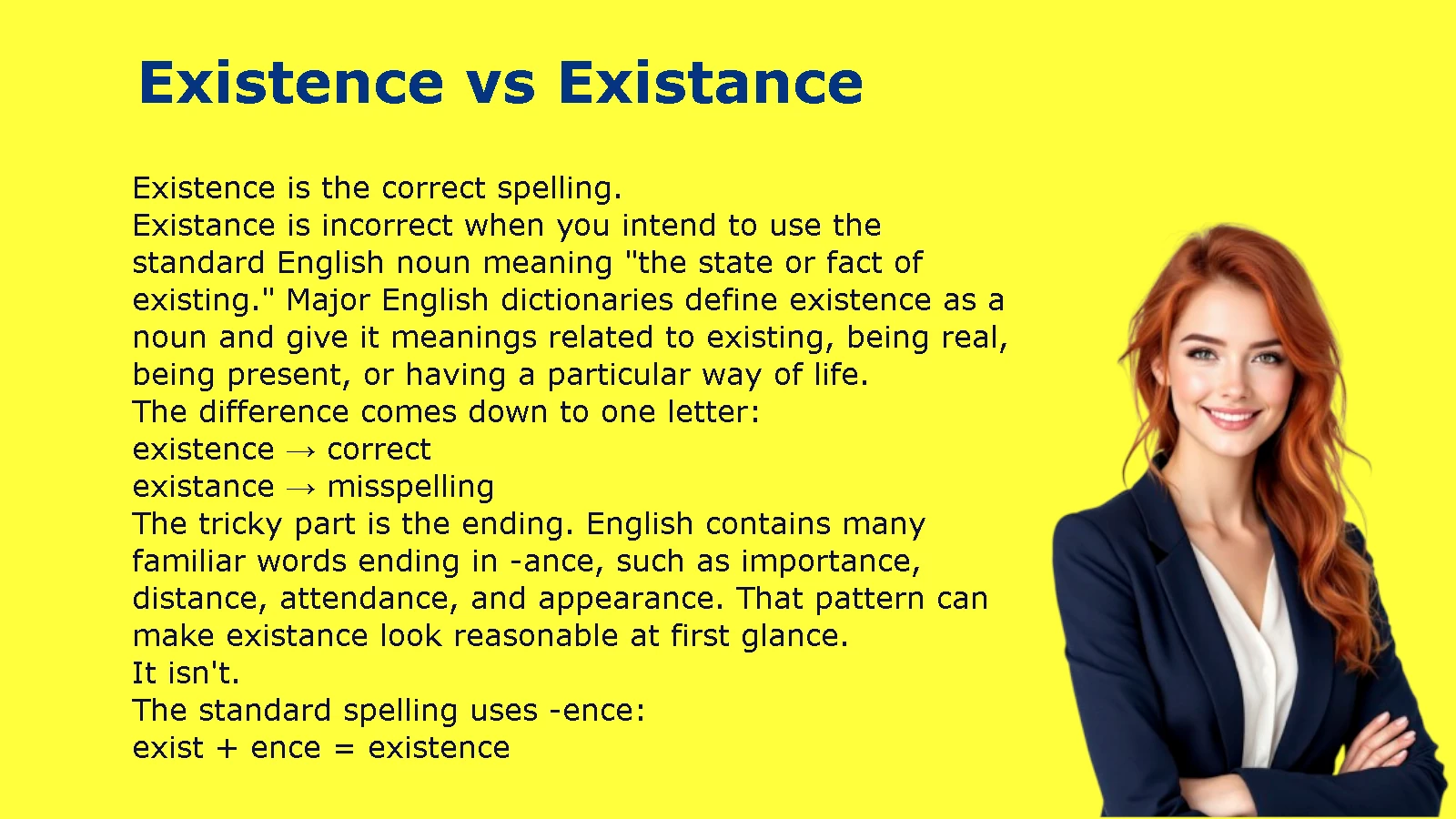
Existence vs Existance: Which Spelling Is Correct?
Existence is the correct spelling.
Existance is incorrect when you intend to use the standard English noun meaning “the state or fact of existing.” Major English dictionaries define existence as a noun and give it meanings related to existing, being real, being present, or having a particular way of life.
The difference comes down to one letter:
- existence → correct
- existance → misspelling
The tricky part is the ending. English contains many familiar words ending in -ance, such as importance, distance, attendance, and appearance. That pattern can make existance look reasonable at first glance.
It isn’t.
The standard spelling uses -ence:
exist + ence = existence
This relationship also makes the correct spelling easier to remember. Instead of memorizing the entire word as a separate unit, keep exist in mind and build from it.
Quick answer
If you’re choosing between the two spellings, use:
Existence ✅
Not:
Existance ❌
What Does Existence Mean?
Existence means the state or fact of existing. In simple terms, it refers to the condition of being real, being present, or being there.
Cambridge Dictionary gives several related senses. It can describe the fact that someone or something exists. It can also refer to a particular way of life, especially when that life has distinctive or difficult conditions.
Consider these examples:
- Scientists searched for evidence of the existence of water on the planet.
- The company has been in existence for more than 50 years.
- Nobody could deny the existence of the problem.
- She lived a quiet existence in the countryside.
The word can therefore work in both factual and broader descriptions of life.
Existence as the fact of being real
This is one of the most common uses.
The discovery provided evidence for the existence of the species.
Here, existence refers to the fact that the species actually exists.
The same construction appears in scientific, legal, historical, philosophical, and everyday writing:
- the existence of life
- the existence of evidence
- the existence of a problem
- the existence of a relationship
- the existence of a species
- the existence of a law
Existence as a way of life
The word can also describe someone’s particular manner or condition of living.
For example:
They led a simple existence in a small mountain village.
Here, existence doesn’t merely mean “being alive.” It describes the kind of life they lived.
Cambridge specifically recognizes this use as a particular way of life and notes that it often appears with descriptions such as miserable, isolated, or peaceful.
Existence in a Sentence
The best way to understand existence is to see how it behaves in real sentences.
Examples of correct usage
- Scientists found evidence supporting the existence of the species.
- The report questioned the existence of a connection between the two events.
- The organization has been in existence since 1985.
- Nobody could prove the existence of the alleged treasure.
- Human existence has been a subject of philosophical debate for centuries.
- The discovery changed our understanding of the planet’s existence.
- The government finally acknowledged the existence of the problem.
- The small community maintained a peaceful existence.
- Astronomers continue to investigate the possible existence of life beyond Earth.
- The company struggled to survive during its first few years of existence.
Notice how naturally existence follows words such as prove, question, confirm, acknowledge, and support.
Those combinations are especially useful in formal writing.
Why Is Existence Spelled With -ence?
The spelling becomes much easier when you look at the word’s relationship to exist.
The basic pattern is:
exist → existence
The noun doesn’t change the central exist- part. It adds the -ence ending.
That gives you:
exist + ence = existence
The spelling existance incorrectly replaces -ence with -ance.
Why the mistake feels natural
English spelling doesn’t always provide an obvious clue from pronunciation. In normal speech, the ending of existence may not sound dramatically different from endings found in words such as resistance or distance.
That can create a false spelling pattern.
For example:
- distance
- resistance
- attendance
- importance
- assistance
All use -ance.
But:
- existence
- evidence
- confidence
- difference
- independence
use -ence.
You can’t always predict the spelling simply by listening to the final syllable. That’s why connecting the noun to exist gives you a more reliable memory aid.
A Simple Trick to Remember the Spelling
Here’s the easiest rule:
If you can write exist, you can remember existence: exist + ence.
Think of the word in two pieces:
EXIST + ENCE
The first part remains exist.
Then add -ence.
Quick memory test
When you’re unsure, ask yourself:
“What is the base word?”
The answer is:
exist
Now complete it:
exist + ence = existence
This is more useful than trying to remember whether the final sound “feels” like -ance or -ence.
Why Do People Spell Existence as Existance?
The misspelling existance probably feels plausible because English contains many common nouns that use -ance.
Writers may also spell the word based on pronunciation rather than its word family. Since English has no single rule that lets you hear every -ance or -ence spelling perfectly, this strategy can fail.
Another factor is visual similarity.
Compare:
- existence
- resistance
- persistence
- assistance
- instance
These words have related-looking structures. It’s easy to transfer the ending from one familiar word to another.
However, existence has a useful clue that some of those words don’t: its base word is clearly exist.
The practical lesson
Don’t memorize:
existance ❓
Memorize:
exist → existence ✅
Once you recognize that connection, the spelling becomes much less mysterious.
Existence vs Existance Examples
Seeing the wrong and right forms side by side can make the distinction stick.
| Incorrect | Correct |
| The existance of life on the planet remains uncertain. | The existence of life on the planet remains uncertain. |
| They questioned the existance of the organization. | They questioned the existence of the organization. |
| Scientists confirmed its existance. | Scientists confirmed its existence. |
| The evidence proves the existance of the substance. | The evidence proves the existence of the substance. |
| Nobody denied the existance of the problem. | Nobody denied the existence of the problem. |
The mistake doesn’t change the intended meaning. It changes the spelling.
That’s important because readers will usually understand what existance is supposed to mean. Nevertheless, understanding a misspelling doesn’t make it standard English.
Correct Examples With Existence
Different contexts can help you understand exactly where existence belongs.
Science
Scientists are searching for evidence of the existence of life elsewhere in the universe.
Here, existence refers to whether something is actually real or present.
History
The document provided new evidence of the existence of the settlement.
Again, the word refers to the fact that something existed.
Business
The company has remained in existence for more than three decades.
In this context, the word refers to the continued life or operation of the company.
Everyday conversation
I wasn’t even aware of the existence of that restaurant.
Here, existence means the fact that the restaurant exists.
Philosophy
Philosophers have debated the nature of human existence for centuries.
This use is broader. It concerns human being and life itself.
Problems and situations
The manager finally acknowledged the existence of the issue.
The issue isn’t necessarily new. The sentence emphasizes the fact that the issue is real or present.
Existence Meaning and Usage
Existence is a noun. Its most common grammatical role is to identify the fact or state of something existing.
One of the most useful structures is:
the existence of + noun
For example:
The researchers confirmed the existence of a previously unknown species.
This construction works across many subjects.
Common grammatical patterns
| Pattern | Example |
| the existence of + noun | The study confirmed the existence of the problem. |
| prove the existence of | The evidence helped prove the existence of the substance. |
| question the existence of | They questioned the existence of a connection. |
| deny the existence of | The company denied the existence of any agreement. |
| confirm the existence of | Scientists confirmed the existence of the compound. |
| support the existence of | The findings support the existence of a relationship. |
| come into existence | The organization came into existence in 1998. |
| in existence | The tradition has been in existence for generations. |
These phrases are particularly useful because they occur naturally in formal and informational writing.
Common Phrases With Existence
Some expressions appear frequently enough to be worth learning as complete phrases.
The existence of
This is probably the most useful pattern.
The investigation revealed the existence of several errors.
Come into existence
This means to begin to exist.
The organization came into existence after the merger.
In existence
This means existing or continuing to exist.
The tradition has been in existence for hundreds of years.
Human existence
This refers to human life or the condition of being human.
Questions about human existence appear throughout philosophy and literature.
Physical existence
This usually refers to something having a material or bodily reality.
The experiment tested whether the particle had a measurable physical existence.
A miserable existence
This describes a difficult or unhappy way of life.
The workers endured a miserable existence under harsh conditions.
Cambridge’s examples and collocations show that existence can describe both the bare fact of something being real and a particular condition or way of living.
Is Existance a Word?
In standard English usage, existance is not the accepted spelling of the noun existence.
If you’re writing:
- a school assignment
- a business report
- an academic paper
- a website article
- an email
- a formal document
you should write existence.
The fact that people sometimes type existance doesn’t turn it into a standard alternative spelling. Search engines, informal posts, user-generated content, and spelling errors can all contain nonstandard forms.
A useful distinction is:
A word can appear in real-world writing without being the correct standard spelling.
That’s exactly what happens with many common misspellings.
For this particular comparison, there is no standard spelling choice between the two forms. You don’t need to decide which version fits American English and which fits British English.
Existence is the standard spelling in both.
Existence Pronunciation
The standard pronunciation of existence is approximately:
ig-ZIS-tuhns
Cambridge gives the US pronunciation as /ɪɡˈzɪs.təns/.
The stress falls on the second syllable:
ex-IS-tence
The pronunciation can contribute to spelling confusion because the final vowel sound isn’t strongly pronounced. When you say the word quickly, the ending may not clearly tell you whether to write -ence or -ance.
That’s another reason the base-word strategy works better than relying on sound alone.
The History and Origin of Existence
The word existence has a long history.
Etymological sources trace it to Old French existence and Medieval Latin existentia/exsistentia. Those forms connect to Latin existere/exsistere, meaning such things as “stand forth,” “come out,” “emerge,” “appear,” and eventually “exist” or “be.”
Etymonline dates the noun existence in English to the late 14th century, originally with the sense of “reality.” The related verb exist entered English later, around the beginning of the 17th century.
That history explains why existence belongs to a larger family of words built around the idea of being or appearing.
Word family
| Word | Part of speech | Meaning |
| exist | Verb | To be real or have being |
| existence | Noun | The state or fact of existing |
| existent | Adjective | Existing or having existence |
| existential | Adjective | Relating to existence or human existence |
| nonexistence | Noun | The state of not existing |
| coexistence | Noun | Existing together |
This word family provides another reason to remember the spelling of existence.
Existence vs Exist
Although these words are related, they don’t perform the same grammatical job.
Exist is a verb.
Existence is a noun.
Compare these sentences:
Some rare species still exist.
Scientists are investigating the existence of rare species.
The first sentence uses an action or state verb.
The second uses a noun to refer to the fact or condition of existing.
Simple comparison
| Word | Part of speech | Example |
| exist | Verb | Some ancient traditions still exist. |
| existence | Noun | The existence of those traditions is well documented. |
This distinction matters when you’re building a sentence. You can’t simply substitute one for the other.
Existence vs Essence
Both look somewhat similar, but their meanings differ sharply.
Existence concerns the fact that something is.
Essence concerns the fundamental nature or most important quality of something.
Compare:
The evidence proves the existence of the organization.
This means the organization is real.
Now consider:
Trust is the essence of their relationship.
This means trust represents a fundamental quality of that relationship.
| Word | Meaning |
| Existence | The state or fact of being real or present |
| Essence | The basic or defining nature of something |
Mixing these words can change the meaning of a sentence completely.
Existence vs Presence
Both sometimes overlap, but they aren’t interchangeable in every sentence.
Existence focuses on the fact that something exists.
Presence often focuses on something being in a particular place, situation, or condition.
For example:
Scientists confirmed the existence of the organism.
This says the organism is real.
Now:
Scientists confirmed the presence of the organism in the sample.
This says the organism was found in that particular sample.
The distinction becomes especially useful in scientific, medical, technical, and formal writing.
Compare the two
| Existence | Presence |
| Focuses on whether something exists | Often focuses on where or whether something is present |
| The existence of the species | The presence of the species in the region |
| The existence of a problem | The presence of a problem in the report |
The words can overlap in some contexts, but existence has a broader sense.
Common Mistakes to Avoid
The most obvious mistake is writing existance instead of existence. However, a few related errors can also cause trouble.
Mistake: Using existance
❌ The study proves the existance of the substance.
✅ The study proves the existence of the substance.
Mistake: Treating existance as an alternative spelling
❌ Both existence and existance are correct.
✅ Existence is the standard spelling.
Mistake: Confusing existence with exist
❌ The existence in several forms.
✅ The word exists in several forms.
Or:
✅ The existence of several forms has been documented.
The correct choice depends on the grammatical role of the word.
Mistake: Confusing existence with essence
❌ The essence of the company was confirmed by the documents.
If the intended meaning is that the company is real, this should be:
✅ The existence of the company was confirmed by the documents.
A Quick Case Study: Why the Wrong Spelling Looks Right
Imagine you’re writing this sentence:
Researchers confirmed the ______ of a previously unknown species.
You know the word means “the fact of existing.” You might first think of exist, then try to form the noun.
The correct result is:
exist → existence
But another familiar pattern may interfere:
- distance
- attendance
- importance
- resistance
- assistance
Several of these use -ance, so existance can look convincing.
That’s the trap.
The solution isn’t to memorize dozens of unrelated spelling patterns. Instead, use the word family:
exist → existence → existent → existential
Once existence becomes anchored to exist, the incorrect existance starts to look much stranger.
How to Remember Existence vs Existance
A short spelling rule is enough:
Existence contains “exist.”
Break it apart:
EXIST + ENCE
Don’t change the -ence to -ance.
The three-second spelling check
When you type the word, pause for a moment and ask:
Does it contain “exist”?
If yes, you’re on the right track:
existence
If you’ve written:
existance
look again.
The middle and final letters should be:
-ence
Memory formula
EXIST + ENCE = EXISTENCE
That’s the most useful takeaway from this entire spelling comparison.
Existence vs Existance: Quick Comparison
| Feature | Existence | Existance |
| Standard spelling | ✅ Yes | ❌ No |
| Part of speech | Noun | — |
| Related verb | Exist | — |
| Meaning | State or fact of existing | Intended as a misspelling of existence |
| Used in formal writing | ✅ Yes | ❌ No |
| Used in standard dictionaries as this noun | ✅ Yes | ❌ No |
| Example | The evidence supports its existence. | Incorrect spelling |
There is no real meaning difference to learn here. Unlike comparisons such as affect vs effect, this isn’t a case of choosing between two legitimate words.
It’s a correct spelling vs. misspelling question.
Frequently Asked Questions About Existence vs Existance
Is existence or existance correct?
Existence is correct. Existance is a misspelling.
The correct form uses -ence at the end:
existence
Is existance a correct English word?
No. Existance isn’t the standard spelling of the noun meaning the state or fact of existing. Use existence instead.
What is the meaning of existence?
Existence means the state or fact of existing. It can also describe a particular way or condition of life. Cambridge recognizes both the sense of “existing” and the sense of a particular way of life.
How do you spell existence?
Spell it:
E-X-I-S-T-E-N-C-E
A useful memory trick is:
exist + ence = existence
Why is existence spelled with ence?
The word belongs to a word family built around exist and historically traces back through French and Latin forms related to existing or coming into being. The standard English noun uses the -ence ending.
What is the difference between existence and exist?
Exist is a verb. Existence is a noun.
Some traditions exist today.
The existence of those traditions is well documented.
Can existence be plural?
Yes. Existences can function as the plural when the context refers to multiple distinct ways or conditions of existence. Cambridge’s dictionary examples include plural uses such as existences in contexts involving different lives or conditions.
However, the singular existence is much more common in ordinary writing.
What is the opposite of existence?
The general opposite is nonexistence, meaning the absence or lack of existence. Etymonline traces non-existence/nonexistence to the 17th century as a formation from non- + existence.
Is existence used in American English?
Yes. Existence is standard in American English. Cambridge’s American Dictionary lists it as a noun with meanings including the state of being real, being present, and a particular way of living.
Is existance an American or British spelling?
Neither. Existance isn’t a standard American-versus-British spelling difference. The standard spelling is existence in both varieties.
Final Takeaway: Existence vs Existance
When choosing between existence and existance, there isn’t a complicated rule to memorize.
Existence is correct. Existance is a misspelling.
The word existence refers to the state or fact of existing. It can describe the reality of something, its presence, or a particular way of life. Dictionaries recognize uses such as the existence of a problem, come into existence, and in existence.
The simplest spelling trick is to connect the noun with its related verb:
exist → existence
Remember that -ence ending and you’ll avoid the most common mistake.
So, if you’re ever staring at Existence vs Existance on your screen, choose the first one:
Existence ✅
Existance ❌




