Have you ever had an experience that taught you something you could never learn from a book? While Experience Meaning may seem simple, this word can describe different things depending on the context, situation, and how it is used.
Experience generally means something that happens to you and affects what you know, feel, or understand. It can also refer to the knowledge or skill you gain by doing something over time. For example, a person can have experience at work, while traveling, or through important events in life.
Examples:
- She has five years of experience in teaching.
- Traveling abroad was an unforgettable experience.
The confusion is understandable. People often search for what does experience mean, experience meaning in English, experience meaning in a sentence, or experience meaning in life because the word can refer to an event, personal knowledge, practical skill, or something you have lived through. And here’s the kicker: experience can be both a thing that happens to you and the knowledge you gain from it.
In this guide, you’ll learn the complete Experience Meaning, its definition, pronunciation, word origin, correct usage, and examples in sentences. You’ll also discover the difference between experience as a noun and verb, common synonyms, related words, and how to use experience correctly in everyday English.
Experience Meaning
The simplest experience meaning is knowledge, skill, or understanding gained by doing or going through something.
The word also has another important meaning: an event or situation that you personally live through.
As a verb, experience means to have something happen to you or to feel something.
Here are the three core uses:
| Use | Meaning | Example |
| Noun | Knowledge or skill gained through doing | She has experience in teaching. |
| Noun | An event or situation you live through | The trip was a wonderful experience. |
| Verb | To go through or feel something | He experienced serious difficulties. |
Merriam Webster similarly describes experience as direct participation or observation that produces knowledge, practical skill gained through participation, or something personally encountered or lived through.
So, when you see the word experience, look at the surrounding sentence. Context usually tells you which meaning the writer intends.
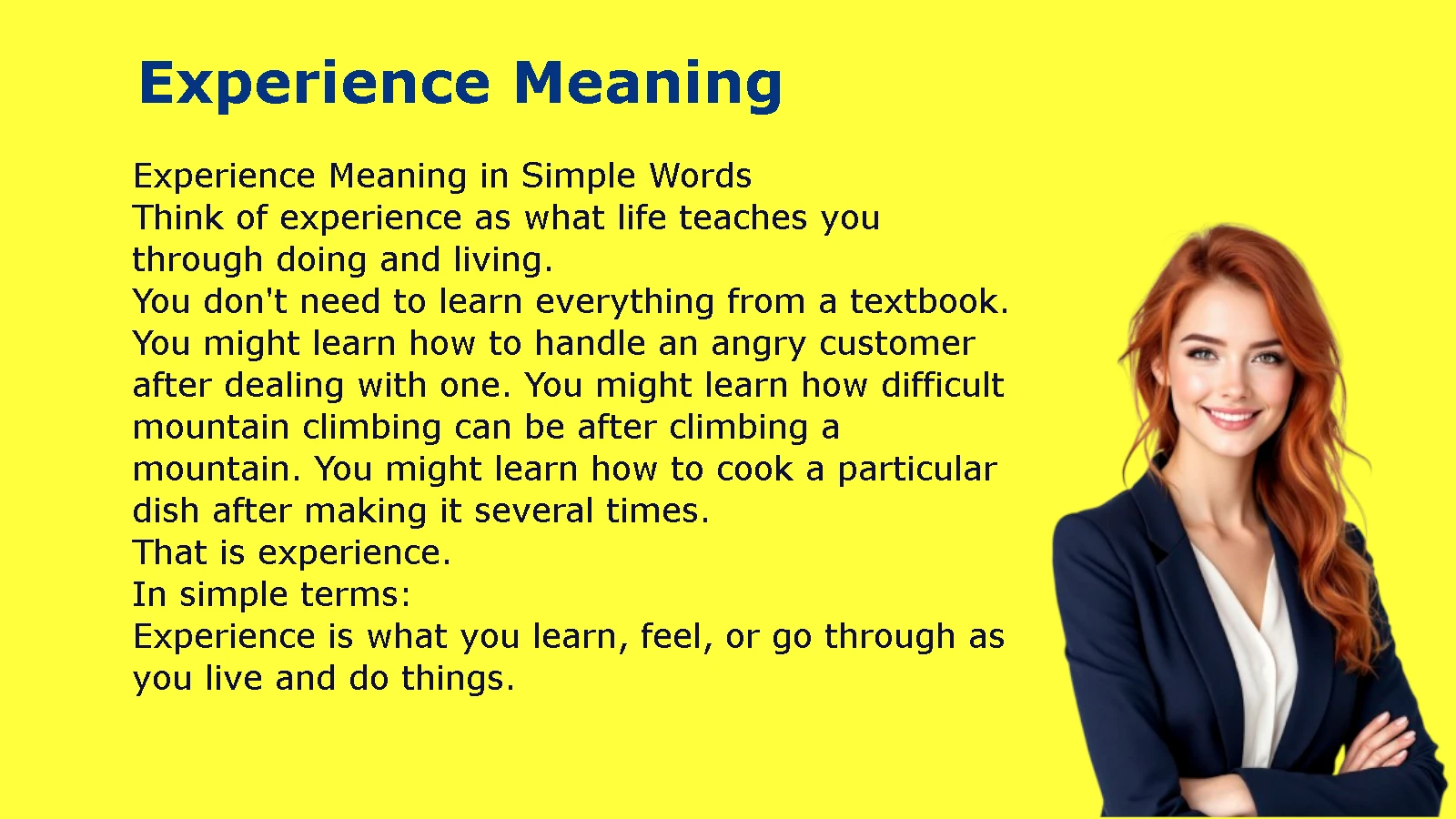
Experience Meaning in Simple Words
Think of experience as what life teaches you through doing and living.
That is experience.
In simple terms:
The noun has both uncountable and countable uses. Understanding this distinction helps you use the word naturally.
Experience as Knowledge or Skill
When experience means general knowledge or skill gained from doing something, it is normally uncountable.
For example:
- She has experience in accounting.
- He has experience working with children.
- The company wants someone with sales experience.
- I gained valuable experience during my internship.
You generally don’t say:
- She has three experiences in accounting.
Instead, say:
- She has three years of experience in accounting.
Cambridge marks this meaning as uncountable and connects it with knowledge or skill gained through doing, seeing, or feeling things.
Experience as an Event
When experience means a particular event or situation that happens to someone, it can be countable.
For example:
- It was an exciting experience.
- The accident was a frightening experience.
- Traveling alone was a valuable experience.
- She shared her experiences as a teacher.
Here, an experience means one particular event.
You can also use the plural experiences when discussing several events:
- His experiences abroad changed his outlook.
- She has had many interesting experiences.
- The students shared their experiences during the trip.
This distinction is worth remembering:
Experience = general knowledge or skill
An experience = one particular event
Experience Meaning as a Verb
The word experience also works as a verb.
As a verb, it means to have something happen to you, to feel something, or to go through something. Cambridge classifies this use as a transitive verb, meaning it normally takes an object.
Consider these examples:
- The company experienced rapid growth.
- She experienced severe pain.
- They experienced several problems.
- Many students experience stress before exams.
- He experienced a major change in his career.
In each sentence, something happens to the subject.
Experience as a Verb in Everyday English
The verb can describe positive, negative, or neutral situations.
Positive:
- We experienced incredible hospitality.
- She experienced a new sense of freedom.
Negative:
- The business experienced financial problems.
- He experienced significant stress.
Neutral:
- The city experienced rapid population growth.
- The software experienced several updates.
The verb often appears in formal or professional writing. In casual conversation, people may sometimes choose simpler expressions such as go through, feel, have, or see.
For example:
- Formal: The company experienced significant growth.
- More conversational: The company grew quickly.
Both can be correct. The best choice depends on the context.
Experience vs. Experiences
One of the most common questions about experience meaning involves the difference between experience and experiences.
The answer depends on whether you’re talking about general knowledge or individual events.
| Word | Typical meaning | Example |
| Experience | General knowledge or skill | She has experience in design. |
| An experience | One event | The interview was an unusual experience. |
| Experiences | Several events | Her experiences shaped her career. |
When to Use Experience
Use experience when you mean accumulated knowledge or skill.
- He has extensive experience in sales.
- You need experience to perform this job well.
- Practical experience can improve your skills.
When to Use Experiences
Use experiences when you’re referring to separate events or situations.
- Her experiences taught her important lessons.
- The children shared their experiences.
- His travel experiences influenced his writing.
A useful test is to ask:
Can I count the individual events?
If yes, experience may be countable.
If you’re talking about knowledge or ability gained over time, use experience as an uncountable noun.
Experience in a Sentence
Seeing experience meaning in real sentences makes the distinction much easier.
Uncountable Noun
- She has five years of experience in marketing.
- He gained experience through volunteer work.
- The position requires previous experience.
- Practical experience is valuable in this field.
- I don’t have much experience with this software.
Countable Noun
- The concert was an unforgettable experience.
- That was a strange experience.
- She described her experiences abroad.
- Working with the team was a positive experience.
- The students had several memorable experiences.
as a Verb
- The company experienced rapid growth.
- She experienced difficulty finding a suitable apartment.
- Many people experience anxiety before public speaking.
- The region experienced heavy rainfall.
- He experienced a major change in his life.
Notice how the grammar changes while the central idea remains connected to something being learned, felt, encountered, or lived through.
Types of Experience
Experience appears in many areas of life. The exact meaning becomes clearer when you look at the phrase around it.
Work Experience
Work experience refers to knowledge and skills gained through employment or workplace activities.
For example:
The applicant has three years of work experience in customer service.
Work experience can include paid employment, internships, apprenticeships, and in some contexts relevant volunteer work.
Employers often look for experience because practical work can demonstrate abilities that a qualification alone doesn’t always show.
Professional Experience
Professional experience usually refers to experience gained while working in a particular profession or career field.
For example:
- She has extensive professional experience in finance.
- The role requires five years of professional experience.
The phrase often appears in resumes, job descriptions, applications, and interviews.
Practical Experience
Practical experience means learning through actual practice rather than only studying theory.
For example:
Students need practical experience before entering the workplace.
A person may understand how something works in theory but still need practice before they can perform it confidently.
Personal Experience
Personal experience refers to something an individual has directly lived through or encountered.
For example:
From personal experience, she knew how difficult the process could be.
Personal experience often appears when someone is explaining an opinion based on something that happened to them.
Life Experience
Life experience refers broadly to knowledge and understanding developed through events and situations throughout a person’s life.
Someone with extensive life experience may have learned from relationships, work, travel, challenges, mistakes, successes, and other situations.
It doesn’t necessarily mean professional expertise.
Firsthand Experience
Firsthand experience means direct personal experience.
For example:
The researcher had firsthand experience of working in the community.
You personally witnessed, participated in, or went through the situation.
This differs from secondhand information, which comes from another person’s account.
Customer Experience
Customer experience describes how a customer perceives and feels about their interactions with a business.
It can include:
- Finding information
- Buying a product
- Speaking with support
- Using a website
- Receiving an order
- Returning an item
- Resolving a problem
A company may improve its customer experience by making these interactions easier, faster, and more helpful.
Learning Experience
A learning experience is an activity or situation that helps someone gain knowledge or develop a skill.
For example:
The internship gave students a valuable learning experience.
The phrase can apply to classrooms, workplaces, training programs, workshops, and personal development.
Common Phrases With Experience
Certain expressions appear again and again in English.
Experience in
Use experience in before a field, subject, or area.
- experience in marketing
- experience in education
- experience in software development
Example:
She has extensive experience in digital marketing.
Experience with
Use experience with when talking about a particular tool, system, type of work, or situation.
- experience with Excel
- experience with children
- experience with customer complaints
Example:
Do you have experience with project management software?
Experience as
Use experience as before a role or occupation.
- experience as a teacher
- experience as a manager
- experience as a designer
Example:
He has ten years of experience as an engineer.
Gain Experience
Gain experience means to develop knowledge or skill through practice.
Example:
Internships allow students to gain experience before entering the workforce.
Get Experience
Get experience has the same basic idea but sounds more conversational.
Example:
She wants to get more experience before applying for senior positions.
From Experience
From experience means based on something you’ve personally learned or encountered.
Example:
I know from experience that preparation saves time.
By Experience
By experience means through doing or living through something.
Example:
People often learn by experience.
Cambridge lists structures such as experience in, experience as, from experience, by experience, and in someone’s experience among common patterns.
In My Experience
In my experience introduces an observation based on personal experience.
Example:
In my experience, clear instructions prevent most misunderstandings.
It doesn’t mean the statement is universally true. Instead, it tells the reader that the speaker is drawing from personal knowledge.
Experience in Work and Careers
In professional settings, experience often carries a very specific meaning.
When a job posting says “two years of experience required,” it usually means the employer wants evidence that the applicant has already performed relevant work or developed relevant skills.
Common Career Phrases
| Phrase | Meaning |
| Work experience | Experience gained through work |
| Professional experience | Experience within a profession |
| Relevant experience | Experience related directly to the position |
| Previous experience | Experience gained earlier |
| Prior experience | Experience obtained before the current situation |
| Practical experience | Knowledge gained through actual practice |
| Hands-on experience | Direct involvement in doing something |
| Extensive experience | A large amount of experience |
| Entry-level experience | Experience suitable for someone beginning a career |
Why Experience Matters on a Resume
Experience gives employers evidence of what you’ve actually done.
Compare:
“I understand customer service.”
with:
“I have three years of experience handling customer inquiries and resolving service issues.”
The second statement provides concrete information.
However, experience isn’t simply about the number of years. Relevance matters. Someone with two years of highly relevant experience may be a stronger candidate than someone with ten years in an unrelated field.
Experience vs. Knowledge vs. Skill
These three words overlap, but they aren’t interchangeable.
| Word | Meaning | Example |
| Experience | Knowledge gained through doing or living through something | She has experience managing teams. |
| Knowledge | Information or understanding about a subject | She has knowledge of management theory. |
| Skill | Ability to perform a task effectively | She has strong leadership skills. |
Imagine someone learning to drive.
The three concepts often reinforce each other.
Experience can build knowledge. Knowledge can support skill. Skill can improve future experience.
Experience Synonyms
The right synonym depends on which meaning of experience you intend.
Synonyms for Experience as Knowledge or Skill
- Expertise
- Proficiency
- Practice
- Familiarity
- Know-how
- Skill
For example:
She has extensive experience in graphic design.
Possible alternatives include:
She has extensive expertise in graphic design.
However, experience and expertise aren’t identical. A person can have experience without being highly skilled.
Merriam Webster lists skills, expertise, and proficiency among synonyms related to the noun sense of experience.
Synonyms for Experience as an Event
Depending on context, you might use:
- Event
- Encounter
- Episode
- Situation
- Occurrence
For example:
The meeting was an unusual experience.
Depending on what you mean, you might say:
The meeting was an unusual event.
But the words don’t always carry exactly the same emotional meaning.
Synonyms for Experience as a Verb
Depending on the sentence, alternatives include:
- Undergo
- Feel
- Encounter
- Face
- Endure
- Witness
- Go through
For example:
She experienced serious difficulties.
You could write:
She faced serious difficulties.
Merriam Webster includes undergo, have, endure, see, feel, know, witness, and taste among verb synonyms.
Antonyms of Experience
The most direct opposite depends on the meaning.
When experience means knowledge or skill, common opposites include:
- Inexperience
- Unfamiliarity
- Lack of practice
- Ignorance
For example:
Her experience helped her solve the problem quickly.
The opposite idea would be:
His inexperience made the task more challenging.
Inexperience is especially useful when describing someone who hasn’t yet developed practical knowledge through doing something.
Common Mistakes With Experience
Even though the word is common, several usage mistakes appear regularly.
Using “Experiences” for General Skill
Incorrect:
She has five years of experiences in teaching.
Better:
She has five years of experience in teaching.
When experience means general knowledge or skill, it normally stays uncountable.
Using Experience and Experiment as Synonyms
These words are related in spelling but have different meanings.
Experience involves what you personally know, feel, do, or go through.
Experiment is a test designed to discover or demonstrate something.
Compare:
She has experience working in a laboratory.
The scientist conducted an experiment in the laboratory.
The first sentence describes knowledge gained through work. The second describes a controlled test.
Choosing the Wrong Preposition
These structures aren’t interchangeable in every situation.
Experience in:
He has experience in marketing.
Experience with:
He has experience with marketing software.
Experience as:
He has experience as a marketing manager.
The noun after the preposition determines which structure sounds natural.
Assuming Experience Always Means Expertise
Experience can contribute to expertise, but the words don’t mean exactly the same thing.
Someone might have ten years of experience doing a job without being the best person in the field.
Experience describes what someone has done or lived through. Expertise emphasizes a high level of knowledge or ability.
Experience vs. Experiment
The difference becomes easy when you focus on purpose.
| Experience | Experiment |
| Something you live through | A test performed to learn something |
| Can produce knowledge through practice | Designed to test an idea or question |
| Can happen naturally | Usually planned |
| Can be personal or professional | Common in science and research |
| She has experience in biology. | She conducted a biology experiment. |
Consider this simple example.
A student spends six months working in a laboratory. That student gains experience.
The student mixes two substances to test whether they react under a particular condition. That activity is an experiment.
The student may gain experience by conducting experiments. The two concepts can therefore appear together without meaning the same thing.
Experience Pronunciation and Word Forms
In American English, experience is pronounced approximately:
/ɪkˈspɪr.i.əns/
The main stress falls on the second syllable. Cambridge gives the US pronunciation as /ɪkˈspɪr.i.əns/ and distinguishes it from the UK pronunciation.
Word Forms
| Form | Example |
| Experience | She has experience. |
| Experiences | She shared her experiences. |
| Experienced | He experienced a major setback. |
| Experiencing | They are experiencing difficulties. |
The adjective experienced describes someone who has gained skill or knowledge through experience.
For example:
She is an experienced teacher.
Merriam Webster traces the noun’s first known use to the 14th century and the verb to the 16th century.
Experience Meaning in Different Contexts
The surrounding words can change the practical meaning of experience.
In Everyday Conversation
That was quite an experience.
This often suggests that something was unusual, memorable, difficult, exciting, or surprising.
The speaker doesn’t necessarily mean they gained a professional skill.
In Education
Students need practical experience.
Here, experience means knowledge or ability gained through doing.
In the Workplace
The company requires three years of experience.
Here, experience means relevant professional knowledge and skill.
In Personal Stories
Her experience changed the way she viewed the world.
Here, experience refers to something she personally went through.
In Business
The company wants to improve the customer experience.
Here, experience refers to the customer’s overall interaction with and perception of the business.
As a Verb
The region experienced heavy rainfall.
Here, experienced means that the region underwent or had the event.
A Simple Case Study: How Experience Builds Skill
Consider a new employee named Maya.
On her first day in customer service, Maya knows the company’s policies. That’s knowledge.
After several weeks of answering customers, she becomes faster at identifying problems and finding solutions. She’s developing skill.
After a year, she’s dealt with hundreds of different customer situations. She knows how to handle difficult conversations, recognize recurring problems, and respond calmly under pressure.
That’s experience.
The progression looks like this:
Learning → Practice → Real situations → Reflection → Greater experience → Stronger skill
Experience becomes valuable because it connects theory with reality.
A textbook can explain how a customer complaint should be handled. Actual conversations reveal the messy details that no textbook can fully predict.
Why Experience Can Be Valuable
Experience doesn’t automatically make someone right or skilled. However, meaningful experience can provide lessons that are difficult to gain through theory alone.
It can help you:
- Recognize patterns
- Avoid repeated mistakes
- Make faster decisions
- Understand practical problems
- Develop confidence
- Adapt to unexpected situations
- Improve technical abilities
- Understand how people respond
- Apply theoretical knowledge
- Build professional judgment
The key is what you learn from the experience.
Repeating the same action without reflection doesn’t necessarily create useful expertise. Experience becomes more valuable when you notice what happened, understand why it happened, and adjust your approach.
How to Use “Experience” Naturally
If you’re unsure whether your sentence sounds natural, identify which meaning you’re trying to express.
If You Mean Knowledge or Skill
Use:
- have experience
- gain experience
- get experience
- relevant experience
- practical experience
- experience in
- experience with
Example:
She has practical experience in web design.
If You Mean an Event
Use:
- an experience
- a memorable experience
- a difficult experience
- a positive experience
- a valuable experience
- share an experience
Example:
The internship was a valuable experience.
If You Mean Going Through Something
Use experience as a verb.
Example:
The team experienced several technical problems.
This simple distinction can prevent many grammar and vocabulary errors.
Frequently Asked Questions About Experience Meaning
What is the simple meaning of experience?
Experience means knowledge or skill gained by doing something or living through situations. It can also mean a particular event that happens to you.
What does experience mean as a noun?
As a noun, experience can mean knowledge or skill gained through practice. It can also mean an event or situation that someone personally lives through.
What does experience mean as a verb?
As a verb, experience means to have something happen to you, to feel something, or to go through something.
Example:
She experienced several difficulties during the project.
Is experience countable or uncountable?
It can be both.
Use uncountable experience for general knowledge or skill:
He has experience in sales.
Use countable experience for individual events:
It was a memorable experience.
What is an example of experience?
Working at the restaurant gave her valuable experience in customer service.
Here, experience means knowledge and skill gained through practical work.
What is the difference between experience and experiences?
Experience often refers to general knowledge or skill.
Experiences usually refers to multiple individual events or situations.
What is another word for experience?
Depending on context, alternatives include expertise, skill, proficiency, practice, encounter, event, situation, undergo, feel, and face.
No synonym works perfectly in every sentence, so always consider the intended meaning.
What is the opposite of experience?
When experience means acquired knowledge or skill, the closest opposite is usually inexperience.
What does “from experience” mean?
From experience means based on something you’ve personally learned or encountered.
Example:
I know from experience that rushing usually causes mistakes.
What does “in my experience” mean?
In my experience means based on what has happened to the speaker personally.
Example:
In my experience, clear communication solves many workplace problems.
What does “experience in” mean?
Experience in introduces a field, area, or type of work.
Example:
She has experience in accounting.
What does “experience with” mean?
Experience with usually introduces a particular tool, system, activity, or type of situation.
Example:
He has experience with customer relationship software.
Key Takeaways About Experience Meaning
The word experience connects knowledge with real life. It describes what you learn through doing, what you personally encounter, and what you feel or go through.
The most important points are:
- Experience can mean knowledge or skill gained through practice.
- An experience can mean a particular event or situation.
- Experiences can refer to multiple individual events.
- Experience works as both a noun and a verb.
- As a verb, it means to go through, feel, or have something happen to you.
- Use experience in for a field or area.
- Use experience with for a tool, activity, or type of situation.
- Use experience as for a role or occupation.
- General skill or knowledge is normally uncountable.
- Individual events can be countable.
- Experience differs from knowledge and skill, although the three are closely related.
- Experience also differs from experiment, which refers to a test designed to discover something.
- In professional writing, phrases such as work experience, relevant experience, practical experience, and professional experience are especially common.
Ultimately, experience meaning depends on context, but its central idea stays remarkably consistent: something you do, feel, observe, or live through can teach you something and become part of what you know.




