
Have you ever heard someone describe an idea as “nuanced” and wondered what they really meant? While Nuanced Meaning may sound complex, the word simply describes something that has subtle differences, details, or shades of meaning that aren’t always obvious at first.
Nuanced is an adjective used to describe something that has small but important distinctions. It often applies to opinions, emotions, arguments, conversations, writing, and situations where the meaning isn’t simply black or white.
Examples:
- Her nuanced opinion considered both sides of the issue.
- The actor gave a nuanced performance filled with subtle emotions.
The confusion is understandable. People often search for what does nuanced mean, nuanced meaning in simple terms, nuanced meaning in a sentence, or even what does it mean to be nuanced because the word can change slightly depending on the context. In everyday language, calling something nuanced usually suggests that it has depth, complexity, and subtle details rather than being straightforward or one dimensional.
In this guide, you’ll learn the complete Nuanced Meaning, its definition, pronunciation, synonyms, correct usage, and examples in sentences. You’ll also discover what nuanced means in everyday conversation, writing, opinions, and relationships, along with the difference between nuanced, complex, subtle, and other related words.

6
What Does “Nuanced” Mean?
Nuanced is an adjective used to describe something that contains very slight differences in meaning, expression, appearance, sound, feeling, or interpretation.
Cambridge Dictionary defines nuanced as something “made slightly different in appearance, meaning, sound, etc.”
Oxford gives a closely related definition: something nuanced has very slight differences in meaning or expression.
Put simply:
Nuanced = detailed enough to recognize small but important differences.
The word comes from nuance, a noun that refers to a slight distinction or shade of meaning. Cambridge describes a nuance as a “very slight difference” in appearance, meaning, or sound.
Nuanced meaning in one sentence
A nuanced statement recognizes that something may have several sides, conditions, shades, or interpretations instead of reducing it to one simple idea.
For example:
- Simple: “Exercise is good.”
- Nuanced: “Regular exercise can improve fitness and well being, but the right type and amount depend on a person’s goals and circumstances.”
The second statement doesn’t reject the first idea. It simply adds important detail.
Nuanced Meaning in Simple Words
If the word nuanced feels too formal, think of it as “carefully detailed” or “not black and white.”
Imagine a box of crayons.
If you have only black and white, you can represent two extremes. Add gray, silver, charcoal, and dozens of other shades, and you can describe much more detail.
That’s how nuance works with ideas.
A person might not be simply kind or unkind. They could be generous with friends, impatient under pressure, thoughtful toward strangers, and occasionally selfish.
A movie might not be simply good or bad. It could have a weak plot but excellent acting. A business decision might increase profits while creating another problem.
A nuanced description captures those differences.
A simple comparison
| Basic statement | Nuanced statement |
| “The book was good.” | “The book had strong characters, although its middle section moved slowly.” |
| “He is a bad manager.” | “He struggles with communication, but he gives his team considerable freedom.” |
| “The plan failed.” | “The plan missed its main target, although it reduced costs in other areas.” |
| “The painting is blue.” | “The painting uses several shades of blue that create a calm but slightly melancholic mood.” |
| “She was angry.” | “She sounded frustrated rather than genuinely angry.” |
The nuanced versions provide distinctions. Those distinctions help the reader form a more accurate picture.
What Is the Meaning of “Nuanced”?
The deeper meaning of nuanced comes from the idea of a nuance.
A nuance may be tiny, but that doesn’t mean it’s unimportant. Oxford explains that nuances can involve differences in meaning, sound, color, or feelings that aren’t usually obvious.
That gives the word a useful quality: small does not mean insignificant.
Consider the words “confident” and “arrogant.”
Both can describe someone who believes strongly in their abilities. Yet the emotional meaning differs. Confidence tends to suggest healthy self assurance. Arrogance suggests an inflated sense of superiority.
The difference may be subtle in some situations, but it changes the meaning considerably.
Nuance can change interpretation
Consider these two sentences:
“She looked at him.”
“She glanced at him and quickly looked away.”
The second sentence gives more information. The reader may infer embarrassment, discomfort, shyness, attraction, or another emotion depending on the context.
That additional layer creates nuance.
However, nuance isn’t the same as simply adding more words. A long explanation can still be simplistic. A short sentence can contain considerable nuance.
What Is a Nuanced Opinion?
A nuanced opinion recognizes relevant details instead of treating an issue as completely one sided.
For example:
Unnuanced opinion:
“Working from home is better than working in an office.”
Nuanced opinion:
“Working from home can improve flexibility and reduce commuting time, while office work may make spontaneous collaboration easier. The better option depends on the job and the person.”
The second opinion doesn’t avoid making a judgment. It identifies the conditions that influence the judgment.
That’s an important point.
Nuance doesn’t mean refusing to choose
Some people mistakenly use nuanced to mean neutral, indecisive, or unwilling to take a position. That’s not necessarily correct.
A person can have a firm opinion and still express it with nuance.
For example:
“The policy should remain in place, but its current enforcement creates unnecessary problems.”
That’s a clear position. It simply recognizes that the issue has more than one relevant dimension.
A nuanced opinion asks:
- What evidence supports this view?
- Are there important exceptions?
- Does the situation change under different conditions?
- What assumptions are being made?
- Are two apparently opposing ideas both partly true?
- What details could change the conclusion?
Those questions make an opinion more precise.
What Is a Nuanced Argument?
A nuanced argument goes beyond a broad claim and examines the factors that make the issue more complicated.
Imagine someone says:
“Technology makes people less social.”
That’s a broad claim.
A more nuanced argument might say:
“Some forms of technology can reduce face to face interaction, but digital communication also allows people to maintain relationships across long distances. Its social effect depends partly on how people use it.”
The second argument introduces conditions and distinctions.
It doesn’t merely say, “Both sides are right.” Instead, it explains when and why each side may have merit.
What makes an argument nuanced?
A nuanced argument often includes:
- Context
- Evidence
- Qualifications
- Relevant exceptions
- Competing factors
- Clear distinctions
- Limits on the main claim
- Recognition of uncertainty when uncertainty genuinely exists
This approach is especially useful in academic writing, journalism, research, business analysis, and serious discussions.
What Is a Nuanced Perspective?
A nuanced perspective is a way of looking at something that recognizes its finer details and competing influences.
Imagine a company has falling sales.
A simplistic explanation might be:
“The product isn’t good enough.”
A nuanced perspective asks what else could be happening:
- Has the price changed?
- Did competitors launch better alternatives?
- Has customer demand shifted?
- Did distribution problems affect sales?
- Did marketing reach the wrong audience?
- Was the decline temporary or long term?
The goal isn’t to make the explanation unnecessarily complicated. The goal is to avoid blaming one factor when several factors may matter.
Nuanced perspective vs. balanced perspective
These ideas overlap, but they aren’t identical.
A balanced perspective often gives attention to more than one side.
A nuanced perspective goes further by examining the specific differences within those sides.
For example, “There are advantages and disadvantages to remote work” is balanced.
“Remote work improves flexibility for some employees, while certain roles benefit from physical collaboration and rapid access to specialized equipment” is more nuanced.
What Does It Mean to Call a Person Nuanced?
When someone describes a person as nuanced, they usually mean that the person’s personality, behavior, motivations, or beliefs contain several layers.
A nuanced person isn’t necessarily mysterious or complicated.
They may simply resist easy labels.
For example, someone could be:
- Generous but cautious
- Confident but willing to admit mistakes
- Serious at work but playful with friends
- Highly competitive but supportive of teammates
- Independent while still valuing close relationships
Real people rarely fit perfectly into one adjective.
That’s why nuanced descriptions often feel more realistic than labels.
What Is a Nuanced Character?
In literature and film, a nuanced character has believable depth.
Such a character might have:
- Conflicting motivations
- Strengths and weaknesses
- Emotional contradictions
- Personal history that influences behavior
- Believable changes over time
- Values that sometimes conflict with their actions
Compare these two character descriptions:
One dimensional:
“The villain is cruel because he enjoys hurting people.”
Nuanced:
“The character behaves cruelly because he believes control protects him from betrayal, yet his actions repeatedly damage the people he claims to protect.”
The second character gives readers more to think about.
The character’s behavior still may be wrong. However, the motivation has greater depth.
Nuanced Examples in a Sentence
Here are practical examples showing how nuanced works in different contexts.
| Context | Example |
| Opinion | “She offered a nuanced opinion on the controversial issue.” |
| Argument | “His essay presents a nuanced argument rather than a simple conclusion.” |
| Analysis | “The report provides a nuanced analysis of the company’s declining sales.” |
| Perspective | “We need a more nuanced perspective on the problem.” |
| Understanding | “The discussion gave us a more nuanced understanding of the situation.” |
| Character | “The novel presents a nuanced character with conflicting motivations.” |
| Performance | “The actor gave a nuanced performance that revealed the character’s uncertainty.” |
| Writing | “Her writing captures the nuanced emotions of the relationship.” |
| Language | “The two expressions have nuanced differences in meaning.” |
| Interpretation | “The poem allows for a nuanced interpretation.” |
| Decision | “The committee took a nuanced approach to the difficult decision.” |
| Response | “He gave a nuanced response instead of reacting immediately.” |
Cambridge’s examples similarly use nuanced with ideas such as arguments, understanding, research, positions, and performances.
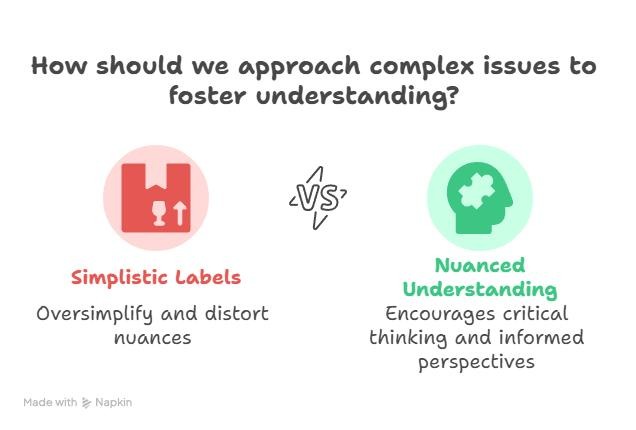
Nuanced vs. Simple or Black and White
One of the clearest ways to understand nuanced meaning is to compare it with black and white thinking.
Black and white thinking treats an issue as having two rigid possibilities:
good or bad
right or wrong
success or failure
friend or enemy
useful or useless
A nuanced approach asks whether the reality sits somewhere between those extremes.
Example
Suppose a student receives a low grade.
A black and white interpretation might be:
“I’m bad at this subject.”
A nuanced interpretation might be:
“I understood the concepts, but I lost points because I rushed the written section and misunderstood two questions.”
The second explanation identifies specific causes.
That difference matters because a precise explanation leads to a more useful response.
Nuanced vs. Subtle
Nuanced and subtle overlap, but they don’t mean exactly the same thing.
Cambridge defines subtle as something that may not be obvious or noticeable. It can also describe something that is small but important.
Nuanced, meanwhile, emphasizes fine distinctions or variations, particularly in meaning, expression, interpretation, or quality.
| Word | Main idea | Example |
| Subtle | Difficult to notice or detect | “There was a subtle change in her tone.” |
| Nuanced | Contains fine distinctions or layers | “Her response offered a nuanced view of the issue.” |
You can describe something as subtle because it’s hard to notice.
You can describe something as nuanced because it contains meaningful distinctions.
Sometimes both words work:
“The actor gave a subtle, nuanced performance.”
Here, subtle describes the restrained quality of the performance, while nuanced highlights the layers in the portrayal.
Nuanced vs. Complex
Complex and nuanced also overlap, but they focus on different things.
Complex usually means something has many connected parts or factors.
Nuanced focuses more closely on the fine distinctions within those parts.
For example:
“The machine has a complex design.”
The machine may contain hundreds of components.
But:
“The character has a nuanced personality.”
The character may have conflicting emotions, motivations, and traits.
Something can even be simple but nuanced.
Consider a short sentence:
“I understand, but I don’t agree.”
It’s simple. Yet depending on tone and context, it can communicate an important distinction between understanding someone’s position and accepting that position.
Quick comparison
| Word | What it emphasizes |
| Simple | Few parts or little difficulty |
| Complex | Many interconnected parts |
| Subtle | Difficult to notice |
| Nuanced | Fine and meaningful distinctions |
| Detailed | A lot of specific information |
| Multifaceted | Several different aspects |
These words aren’t interchangeable in every sentence.
Synonyms for “Nuanced”
There isn’t one perfect synonym for nuanced in every context. The best replacement depends on what you want to emphasize.
When you mean “subtle”
- Subtle
- Fine
- Delicate
- Slight
- Refined
“layered”
- Layered
- Multifaceted
- Multidimensional
- Complex
- Sophisticated
“carefully considered”
- Thoughtful
- Measured
- Considered
- Qualified
- Balanced
“detailed”
- Detailed
- Precise
- Refined
- Elaborate
- Discerning
Cambridge lists nicety, refinement, shade, and subtlety as related words for nuance.
However, don’t replace nuanced mechanically.
For example, “a subtle argument” and “a nuanced argument” can suggest different things. The first may emphasize that the argument isn’t immediately obvious. The second suggests that the argument recognizes fine distinctions.
How to Use “Nuanced” Correctly
The word nuanced commonly appears before nouns that involve thought, interpretation, expression, or judgment.
Common patterns include:
- A nuanced argument
- A nuanced opinion
- A nuanced perspective
- A nuanced understanding
- A nuanced approach
- A nuanced analysis
- A nuanced interpretation
- A nuanced response
- A nuanced portrayal
- A nuanced performance
- A nuanced discussion
- A nuanced view
Examples
“The article offers a nuanced analysis of the issue.”
“She has a nuanced understanding of the subject.”
“The director created a nuanced portrayal of grief.”
“His answer was more nuanced than the original proposal.”
The word usually describes how carefully something represents distinctions, rather than simply saying that something is intelligent or impressive.
That distinction is important.
Calling something nuanced doesn’t automatically mean it’s correct.
A person can make a nuanced but inaccurate argument. Likewise, a detailed explanation can contain many distinctions while still reaching a poor conclusion.
Common Phrases With “Nuanced”
Some combinations occur naturally because they describe areas where subtle distinctions matter.
Nuanced understanding
A nuanced understanding recognizes details that a basic understanding might miss.
“Reading the original documents gave her a more nuanced understanding of the historical event.”
Nuanced perspective
A nuanced perspective considers more than one factor or interpretation.
“The study offers a nuanced perspective on consumer behavior.”
Nuanced approach
A nuanced approach adjusts the response according to the circumstances.
“The company needs a more nuanced approach to customer complaints.”
Nuanced analysis
A nuanced analysis separates different factors instead of treating them as one issue.
“The report provides a nuanced analysis of the market.”
Nuanced portrayal
A nuanced portrayal presents a person, event, or idea with multiple layers.
“The novel gives a nuanced portrayal of family conflict.”
What Does “More Nuanced” Mean?
More nuanced means that something recognizes more fine distinctions, conditions, or layers than another explanation.
For example:
“The first report blamed the decline on pricing. The second report offered a more nuanced explanation by examining pricing, competition, customer behavior, and distribution.”
The second explanation is more nuanced because it distinguishes among several factors.
Oxford notes that important decisions are often “highly nuanced” rather than simply black and white.
Does “more nuanced” always mean better?
No.
More nuance can improve an explanation when the extra distinctions are relevant and accurate.
But adding unnecessary complications doesn’t automatically make an argument stronger.
Compare:
“The product failed because customers didn’t like it.”
with:
“The product’s performance resulted from an extraordinarily intricate constellation of interrelated socioeconomic, psychological, technological, and behavioral variables.”
The second sentence sounds sophisticated, but it doesn’t actually explain much.
A genuinely nuanced explanation would identify specific factors and show how they matter.
Nuance is not verbal fog.
What Does “Highly Nuanced” Mean?
Highly nuanced emphasizes a strong degree of subtlety, distinction, or layered meaning.
For example:
“The novel offers a highly nuanced exploration of family relationships.”
This suggests that the author doesn’t portray family relationships in simple terms. Instead, the work explores competing emotions, motivations, misunderstandings, and circumstances.
Similarly:
“Her highly nuanced performance revealed the character’s conflicting emotions.”
The phrase suggests considerable depth in the performance.
However, highly nuanced should describe something that genuinely contains multiple meaningful distinctions. It shouldn’t become a fancy substitute for good, smart, or detailed.
What Is the Opposite of Nuanced?
There isn’t one universal opposite of nuanced.
The best contrast depends on the context.
Possible opposites include:
- Simplistic
- Oversimplified
- One dimensional
- Black and white
- Absolute
- Rigid
- Crude
- Unqualified
Nuanced vs. simplistic
This distinction matters.
Simple isn’t necessarily bad.
A simple explanation can be accurate and useful.
Simplistic, however, suggests that an explanation ignores important complexity or distinctions.
For example:
“The instructions are simple.”
This can be positive.
But:
“The explanation is simplistic.”
This may suggest that the explanation leaves out important information.
So the opposite of nuanced isn’t always simple. In many contexts, simplistic or oversimplified is more accurate.
Nuanced Meaning in Different Contexts
The word becomes easier to understand when you see how widely it applies.
Nuanced meaning in language
Language contains countless small distinctions.
Consider:
- House vs. home
- Confident vs. arrogant
- Curious vs. nosy
- Frugal vs. cheap
- Persistent vs. pushy
The words may overlap, but their emotional or contextual meanings differ.
Oxford specifically describes nuances as differences in meaning, sound, color, or feelings.
Nuanced meaning in writing
Good writing often depends on choosing the exact word.
Compare:
“He was angry.”
with:
“He sounded disappointed and slightly irritated.”
The second sentence narrows the emotional meaning.
It doesn’t simply add decoration. It gives the reader a more precise interpretation.
Nuanced meaning in art
A painting can contain nuanced differences in:
- Color
- Texture
- Light
- Shadow
- Expression
- Composition
- Mood
A painter might use several nearly identical shades to create depth.
Cambridge gives examples of nuance involving appearance and expression, while Oxford notes nuances of color and texture.
Nuanced meaning in relationships
Relationships are full of mixed signals and competing emotions.
Someone can be:
- Happy for a friend but jealous of their success.
- Angry about an action but still care about the person.
- Excited about a new relationship but nervous about getting hurt.
- Proud of someone while disagreeing with their decision.
A nuanced description doesn’t force those feelings into one category.
Nuanced meaning in literature
Literature often relies on nuance because people rarely behave according to simple labels.
A character might do something selfish for a reason that readers understand. That doesn’t make the action right. It makes the character more fully developed.
Nuanced Meaning vs. Hidden Meaning
A nuanced meaning isn’t necessarily a hidden meaning.
These concepts can overlap, but they’re different.
A hidden meaning is something deliberately concealed or not directly stated.
A nuance is a subtle distinction that may affect interpretation.
For example:
“Fine.”
Depending on context and tone, fine might mean genuinely okay, reluctant acceptance, annoyance, or resignation.
The meaning isn’t necessarily hidden. The context and delivery create different shades of meaning.
That’s nuance.
A Practical Case Study: Making a Statement More Nuanced
Consider this statement:
“The restaurant is expensive.”
It’s understandable, but it lacks context.
A slightly more nuanced version might be:
“The restaurant is more expensive than most places nearby, but the larger portions and table service may justify the price for some customers.”
Now the reader knows:
- The price is relatively high.
- The comparison is with nearby restaurants.
- There may be reasons for the higher cost.
- Different customers may judge the value differently.
The statement hasn’t become unnecessarily long. It has simply become more precise.
Another example
Basic claim:
“Online learning is better.”
More nuanced claim:
“Online learning offers greater flexibility for many students, but students who need hands on instruction or frequent face to face support may benefit more from traditional classes.”
The second statement doesn’t weaken the idea. It makes it conditional and specific.
That’s often what nuance does best.
How to Make Your Own Writing More Nuanced
You don’t need complicated vocabulary to add nuance.
Instead, examine your claims and ask what important details they leave out.
Try these techniques
Add conditions.
Instead of:
“This strategy works.”
Try:
“This strategy works well when the team has enough time to implement it.”
Distinguish similar ideas.
Instead of:
“He was nervous.”
Try:
“He wasn’t afraid of the presentation itself. He was worried about forgetting the technical details.”
Acknowledge relevant limitations.
Instead of:
“The change improved productivity.”
Try:
“The change improved productivity during the first month, although the long term effect remains unclear.”
Use precise comparisons.
Instead of:
“This option is expensive.”
Try:
“This option costs more upfront, but its lower maintenance costs may make it cheaper over several years.”
Separate cause from correlation.
Instead of:
“The new policy caused sales to fall.”
Try:
“Sales fell after the new policy was introduced, although seasonal demand and increased competition may also have contributed.”
These techniques make writing more credible because they show that the writer has considered the boundaries of the claim.
Why Nuance Matters
Nuance matters because reality rarely fits perfectly into neat categories.
A single explanation can be tempting because it’s easy to understand. Sometimes it’s also correct. But when several factors affect an outcome, reducing everything to one cause can produce a misleading picture.
Nuance helps you:
- Communicate more precisely
- Avoid oversimplification
- Understand opposing viewpoints
- Interpret language more accurately
- Describe emotions more realistically
- Analyze evidence carefully
- Write stronger arguments
- Develop believable characters
- Make better distinctions
- Explain complicated subjects without losing important details
It also improves everyday communication.
Consider the difference between:
“You don’t understand me.”
and:
“I think you understand what I’m saying, but you may be interpreting my intention differently.”
The second statement creates room for clarification instead of turning a disagreement into a dead end.
Common Mistakes When Using “Nuanced”
Using “nuanced” to mean “good”
A nuanced argument isn’t automatically a good argument.
It still needs sound reasoning and evidence.
Assuming nuance means neutrality
A nuanced writer can strongly support one position.
The key is accuracy and distinction, not indecision.
Treating nuance as unnecessary complexity
Nuance should clarify meaningful differences.
If extra details make an explanation harder to understand without adding useful information, they aren’t helping.
Using “subtle” and “nuanced” as exact synonyms
The words overlap, but their focus differs.
Subtle often concerns what is difficult to notice.
Nuanced often concerns distinctions in meaning, expression, interpretation, or quality.
Thinking simple statements can’t be nuanced
A short statement can contain a meaningful distinction.
For example:
“I understand your point, but I disagree.”
That’s brief, yet it separates understanding from agreement.
Frequently Asked Questions About Nuanced Meaning
What does nuanced mean in simple terms?
Nuanced means showing small but meaningful differences or layers. It describes something that goes beyond a basic or black and white explanation.
Does nuanced mean complicated?
Not necessarily. Something can be nuanced without being difficult to understand. Nuance concerns meaningful distinctions, while complexity concerns the number or interconnectedness of parts.
Does nuanced mean subtle?
They overlap, but they’re not identical. Subtle often means difficult to notice, while nuanced emphasizes fine distinctions or layers in meaning, expression, interpretation, or quality.
What is an example of a nuanced opinion?
“The new policy could reduce costs, but it may also create problems for smaller departments.”
This opinion recognizes both the potential benefit and an important limitation.
What is a nuanced argument?
A nuanced argument makes a claim while recognizing relevant evidence, conditions, exceptions, or competing factors.
What does a nuanced person mean?
A nuanced person is someone whose personality, motivations, or behavior cannot be accurately described with one simple label.
What is a nuanced character?
A nuanced character has believable layers, such as conflicting motivations, strengths, weaknesses, emotions, and values.
What is the opposite of nuanced?
Depending on context, possible opposites include simplistic, oversimplified, one dimensional, rigid, absolute, and black and white.
Is nuanced positive or negative?
Nuanced is generally neutral, although it often carries a positive implication when used to praise careful thinking, detailed analysis, or sophisticated expression. Context determines the exact tone.
What does “more nuanced” mean?
More nuanced means that one explanation, position, or portrayal recognizes more meaningful distinctions than another.
What does “highly nuanced” mean?
Highly nuanced means something contains many fine distinctions or layers that contribute to its meaning or interpretation.
Final Takeaway: Nuanced Meaning Explained
The simplest way to remember nuanced meaning is this:
If something recognizes small but meaningful differences instead of reducing everything to one simple answer, it is nuanced.
Most importantly, nuance isn’t about making things complicated for the sake of sounding intelligent. It’s about getting the details right.
When a situation has shades of meaning, context matters. When two ideas seem similar, the distinction between them may matter. And when a simple label fails to capture the whole picture, a nuanced explanation can fill in the missing pieces.
That is the heart of the word nuanced: small distinctions that make a meaningful difference.




