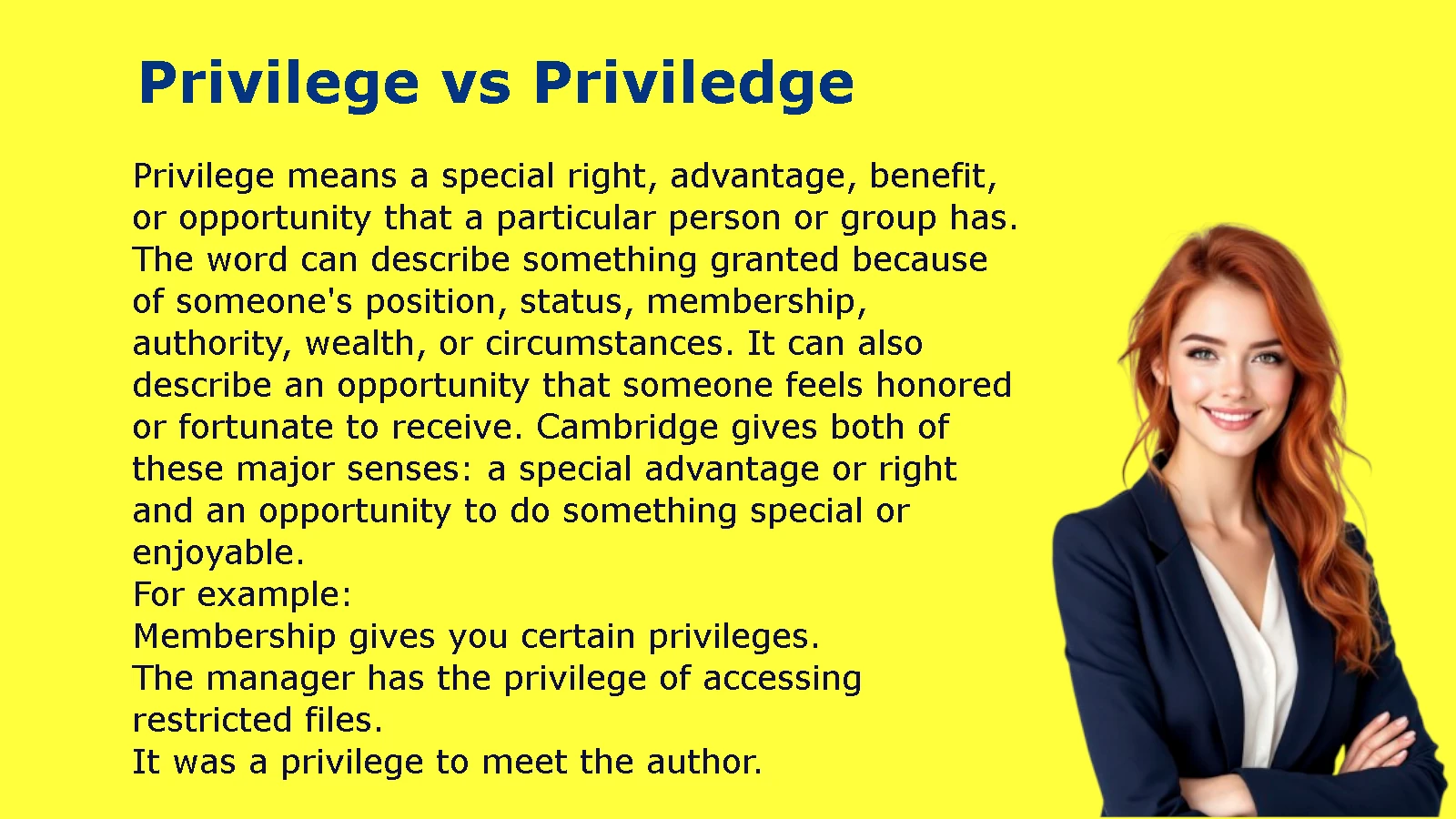
Have you ever hesitated over whether privilege or priviledge is the correct spelling? The difference between Privilege vs Priviledge is easy to miss, especially because the extra d can make the incorrect form look perfectly natural at first glance.
Privilege is the correct spelling, while priviledge is a common misspelling. The word privilege refers to a special right, advantage, or benefit that a person or group has, often because of their position, status, or circumstances. The incorrect spelling priviledge does not have a separate meaning or usage in standard English.
Examples:
- It was a privilege to work with such an experienced team.
- Some people have privileges that others do not have.
The confusion is understandable. People often search for privilege vs priviledge, privilege or priviledge, which spelling is correct, or how to spell privilege because the word’s pronunciation can make the extra d seem as though it belongs in the spelling. And here’s the kicker: privilege is pronounced without a clear d sound, which may contribute to the common misspelling priviledge.
In this guide, you’ll learn the complete difference between Privilege vs Priviledge, including their meaning, pronunciation, correct spelling, origin, and usage. You’ll also see why priviledge is incorrect, along with clear examples and a simple way to remember the correct spelling.
Privilege Meaning
Privilege means a special right, advantage, benefit, or opportunity that a particular person or group has.
The word can describe something granted because of someone’s position, status, membership, authority, wealth, or circumstances. It can also describe an opportunity that someone feels honored or fortunate to receive. Cambridge gives both of these major senses: a special advantage or right and an opportunity to do something special or enjoyable.
For example:
- Membership gives you certain privileges.
- The manager has the privilege of accessing restricted files.
- It was a privilege to meet the author.
- Some people grow up with social privilege.
- The court recognized the attorney-client privilege.
The meaning depends heavily on context. That’s one reason privilege can appear in everyday conversation, social discussions, workplaces, and legal writing.
Simple Meaning of Privilege
In simple terms, privilege is a special advantage, right, or opportunity that isn’t available to everyone.
Think of it as getting access to something that others don’t automatically receive.
For instance, imagine a private club where members can use facilities that nonmembers can’t access. That access is a privilege.
The word can also describe an experience rather than a material benefit. If someone says, “It was a privilege to work with you,” they mean the experience was an honor or something they feel fortunate to have had.
What Does Privilege Mean?
Privilege can have several closely related meanings.
| Meaning | Explanation | Example |
| Special advantage | A benefit available to a particular person or group | Employees receive parking privileges. |
| Special right | Permission or authority that others may not have | The official has certain legal privileges. |
| Honor or opportunity | Something valuable that you’re grateful to experience | It was a privilege to speak with her. |
| Social advantage | Benefits associated with social position or circumstances | The discussion focused on economic privilege. |
| Legal protection | A recognized protection connected with a particular role or relationship | Attorney-client privilege protects certain communications. |
Oxford similarly identifies privilege as a special right or advantage, the rights and advantages associated with wealth and power, an opportunity that feels like an honor, and certain specialized legal rights.
Privilege as an Advantage
In everyday language, privilege often means an advantage that other people don’t have.
For example:
Employees with senior status may receive additional workplace privileges.
The privilege could involve access to a private office, special facilities, flexible arrangements, or other benefits.
The important idea is unequal access to an advantage.
Privilege as an Honor
Privilege doesn’t always carry a negative meaning.
Consider:
It was a privilege to meet the scientist.
Here, privilege means an honor or valued opportunity. The speaker isn’t talking about social inequality or special treatment. They’re expressing gratitude.
Oxford specifically recognizes this use, defining privilege as something a person feels proud or fortunate to have the opportunity to do.
Privilege as Social Advantage
In social discussions, privilege can describe advantages associated with a person’s circumstances or social position.
For example:
The course examines how wealth and social privilege can affect access to education.
This use treats privilege as a broader social condition rather than one isolated benefit.
Cambridge includes this sense when describing the advantages that people with wealth, high social status, or particular social characteristics may have compared with others.
Privilege Definition
A concise definition of privilege is:
Privilege is a special right, advantage, benefit, or opportunity available to a particular person or group.
As a noun, privilege can refer to something someone has, receives, enjoys, uses, abuses, or loses.
Common combinations include:
- have a privilege
- enjoy a privilege
- receive a privilege
- grant a privilege
- exercise a privilege
- abuse a privilege
- lose a privilege
- revoke a privilege
- protect a privilege
- special privilege
- legal privilege
- social privilege
- professional privilege
The word also works as a verb, although that use is more formal.
As a verb, to privilege means to give someone or something special rights or advantages or to give something greater importance than another option. Oxford lists this verb use as formal.
For example:
The policy privileges experienced workers over new applicants.
That means the policy gives experienced workers an advantage.
Privilege or Priviledge: Which Is Correct?
Privilege is correct. Priviledge is incorrect.
This is the central spelling distinction:
| Spelling | Correct? | Use it? |
| privilege | ✅ Yes | Yes |
| priviledge | ❌ No | No |
The correct spelling contains privilege, not priviledge.
Notice the ending:
privilege
Not:
priviledge
The incorrect version inserts a d between the i and g near the end of the word.
Why Do People Write Priviledge?
The mistake is easy to understand when you hear the word spoken.
The ending of privilege sounds somewhat like “lij”. Because English has many words in which a written d contributes to a similar sound, writers sometimes insert a d where it doesn’t belong.
Dictionary.com specifically notes that privilege can be difficult to spell because people may insert an extra d based on the pronunciation.
There’s another reason, too: English spelling isn’t always a perfect guide to pronunciation.
Words can sound as if they contain letters that never appear in their spelling. That’s why relying only on sound can lead you into a spelling trap.
Is Priviledge a Word?
Priviledge is not the standard English spelling of the word.
If you encounter priviledge in an email, essay, website, social media post, or other piece of writing, treat it as a misspelling of privilege.
The correct dictionary form is privilege. Cambridge and Oxford both list privilege as the standard noun and verb.
This doesn’t mean you’ll never see priviledge in real-world writing. Misspellings appear everywhere. A word can occur thousands of times online without becoming an accepted spelling.
That’s an important distinction:
Being frequently typed doesn’t make a misspelling correct.
Priviledge vs Privilege at a Glance
Incorrect:
It was a priviledge to work with you.
Correct:
It was a privilege to work with you.
Incorrect:
He abused his priviledge.
Correct:
He abused his privilege.
Incorrect:
Everyone should have equal priviledges.
Correct:
Everyone should have equal privileges.
Privilege vs Priviledge
The difference between privilege and priviledge is spelling, not meaning.
There isn’t a separate definition for priviledge. Writers who use it almost always intend to write privilege.
| Feature | Privilege | Priviledge |
| Standard English word | Yes | No |
| Correct spelling | Yes | No |
| Dictionary entry | Yes | No as the standard form |
| Meaning | Special right, advantage, or opportunity | Intended as privilege |
| Recommended in formal writing | Yes | No |
| Correct plural | privileges | Not applicable |
So if you’re editing a document and see priviledge, replace it with privilege.
Why Is Priviledge Incorrect?
The simplest explanation is that privilege does not contain a d before the final g.
Break the word into its written form:
p-r-i-v-i-l-e-g-e
The troublesome part is:
lege
Not:
ledge
That single-letter difference separates the correct spelling from the common error.
How to Spell Privilege Correctly
The correct spelling is:
P-R-I-V-I-L-E-G-E
A useful visual pattern is:
PRIVI + LEGE
The word has two i’s before the final section and no d before the g.
Dictionary.com even offers a spelling reminder built around the two i’s in privilege.
A Simple Memory Trick
Try remembering:
Privilege has two i’s and no d.
Or picture the word this way:
privi-lege
The second half starts with lege, not ledge.
Common Spelling Variations to Watch
Several errors can appear because people spell the word according to how they think it sounds.
| Incorrect form | Correct form |
| priviledge | privilege |
| privelege | privilege |
| priveledge | privilege |
| privilage | privilege |
| privlege | privilege |
The most relevant mistake in this article is priviledge, but the others can appear when writers rely on pronunciation rather than the established spelling.
Privilege in American and British English
The spelling privilege is used in both American English and British English.
There is no American spelling priviledge and British spelling priviledge distinction.
Both varieties use:
privilege
Cambridge provides both US and UK pronunciations for the word while retaining the same spelling.
Is It Privilege or Priviledge in the UK?
In British English, the correct spelling is:
privilege ✅
priviledge ❌
For example:
It was a privilege to attend the ceremony.
British English doesn’t add the d.
Is It Privilege or Priviledge in the US?
American English also uses:
privilege ✅
priviledge ❌
For example:
The members receive several privileges.
Again, the spelling stays the same.
American vs British Usage
The spelling doesn’t change, although pronunciation can vary slightly between speakers.
Cambridge lists the same basic phonetic form for UK and US English while also showing an American pronunciation variant in its American Dictionary.
So there’s no spelling rule such as:
- American: priviledge
- British: privilege
That distinction is simply incorrect.
Privilege Plural: Privileges or Priviledges?
The correct plural of privilege is:
privileges ✅
Priviledges is incorrect.
To form the plural, simply add -s:
privilege → privileges
Notice that the original word still contains no d.
| Singular | Plural |
| privilege | privileges |
| right | rights |
| advantage | advantages |
| opportunity | opportunities |
For example:
Club members enjoy several privileges.
The employee lost some of her workplace privileges.
Merriam-Webster identifies privileges as the plural of privilege.
Why Is Priviledges Wrong?
The incorrect form priviledges carries the same spelling mistake as priviledge.
Adding -s doesn’t make the incorrect spelling correct.
The transformation is:
privilege + s = privileges
Not:
priviledge + s = priviledges
A quick check helps: if the singular form has no d, the ordinary plural won’t suddenly gain one.
How to Use Privilege in a Sentence
Privilege works in several sentence patterns. Learning these patterns makes the word much easier to use naturally.
Privilege as a Special Right
Members have the privilege of using the private lounge.
The manager revoked his parking privilege.
Students earned the privilege of leaving early.
Here, privilege refers to a benefit or permission given to a particular person or group.
Privilege as an Honor
It was a privilege to meet the author.
It has been a privilege to work with this team.
She considered it a privilege to represent her school.
This construction is common in speeches, professional communication, and polite expressions of gratitude.
Privilege as Social Advantage
The book explores how social privilege can affect people’s opportunities.
Economic privilege can influence access to education and housing.
This use treats privilege as a broader condition rather than a single permission.
Privilege in Legal Language
The word also appears in specialized legal contexts.
Examples include:
- attorney-client privilege
- executive privilege
- parliamentary privilege
- legal privilege
- privileged information
Oxford notes that some uses of privilege refer to special legal rights or protections.
Privilege Examples
The best way to understand privilege is to see how its meaning changes with context.
Everyday Examples
It was a privilege to be invited to the ceremony.
Meaning: The speaker felt honored to receive the invitation.
Only premium members have access to this privilege.
Meaning: The benefit is restricted to premium members.
Don’t abuse the privilege of working from home.
Meaning: Don’t misuse a benefit or permission you’ve been given.
Workplace Examples
Senior employees receive additional workplace privileges.
The company removed his administrative privileges.
Employees must use their system privileges responsibly.
In technology and workplace contexts, privilege often refers to permissions or access.
For example, an administrator might have privileges that an ordinary user doesn’t have.
Social Examples
The discussion focused on wealth and social privilege.
Her background gave her certain educational privileges.
Here, the word refers to broader advantages rather than a single formal right.
Formal Examples
The organization granted him the privilege of speaking at the event.
She regarded the opportunity as a privilege rather than an obligation.
Formal writing often pairs privilege with words such as grant, exercise, enjoy, abuse, and revoke.
My Privilege Meaning
The phrase “my privilege” can have different meanings depending on context.
It may refer to a special advantage or right that belongs to the speaker.
For example:
My privilege allows me to access these records.
Here, privilege means a special right or permission.
However, “my privilege” can also refer to a personal advantage that someone recognizes they possess.
For example:
I recognize my privilege in having access to these opportunities.
In this context, the speaker is acknowledging an advantage connected with their circumstances.
“It’s My Privilege” Meaning
A particularly common expression is:
“It’s my privilege.”
This usually means “I’m honored to do it” or “I’m pleased and honored to have this opportunity.”
For example:
“Thank you for inviting me to speak.”
“It’s my privilege.”
Here, privilege has a positive meaning. The speaker isn’t saying they have superior social status. They’re expressing appreciation for the opportunity.
Oxford recognizes this sense of privilege as an opportunity that makes someone feel proud or fortunate.
Privilege vs Entitlement
Privilege and entitlement overlap, but they aren’t always interchangeable.
A privilege is generally a special right, advantage, benefit, or opportunity. Entitlement can refer to a right or benefit that someone is considered to have a legitimate claim to receive. In everyday use, entitlement can also describe an attitude in which someone expects special treatment.
Privilege vs Entitlement Table
| Privilege | Entitlement |
| A special right or advantage | A right or benefit someone has a claim to |
| May be granted by an organization or authority | Often arises from rules, status, agreement, or law |
| Can be temporary | Can be an established right |
| Can be revoked | May be enforceable depending on the context |
| Doesn’t necessarily imply expectation | Can describe an expectation of receiving something |
Consider a workplace example.
Employees have the privilege of using the company gym.
That sounds like a benefit the employer provides.
Now consider:
Employees are entitled to overtime pay under the applicable rules.
That describes a recognized right or claim.
The two concepts can overlap, but the underlying idea differs.
A Simple Way to Remember the Difference
Think of privilege as:
“You get this special benefit.”
Think of entitlement as:
“You have a recognized claim to this.”
Context still matters. A privilege can become an established right under certain circumstances, and people sometimes use the two words loosely in everyday conversation.
Privilege Synonyms
The best synonym depends on which meaning of privilege you intend.
Synonyms for Privilege as an Advantage
- advantage
- benefit
- perk
- favor
- special treatment
- concession
Synonyms for Privilege as a Right
- right
- entitlement
- prerogative
- authorization
- permission
- immunity
- exemption
Words That Mean Privilege as an Honor
- honor
- pleasure
- opportunity
- distinction
- pleasure
Merriam-Webster’s thesaurus includes words such as honors, concessions, rights, prerogatives, entitlements, immunities, exemptions, grants, and boons among related terms for privileges.
Be careful, though. Synonyms aren’t interchangeable in every sentence.
For example:
It was a privilege to meet her.
You could naturally say:
It was an honor to meet her.
But replacing privilege with immunity would completely change the meaning.
Common Mistakes With Privilege
Privilege causes several spelling and usage mistakes. The good news is that most are easy to fix once you know what to watch for.
Mistake: Writing Priviledge
Wrong:
It was a priviledge to meet you.
Right:
It was a privilege to meet you.
The extra d doesn’t belong.
Mistake: Writing Priviledges
Wrong:
Members receive special priviledges.
Right:
Members receive special privileges.
The plural follows the correct singular spelling.
Mistake: Writing Privelege
Wrong:
She was given a privelege.
Right:
She was given a privilege.
The word contains privi-, not prive-.
Mistake: Assuming the Word Always Means Social Advantage
Privilege has a much broader meaning.
It can describe:
- a special right
- an organizational benefit
- a legal protection
- an opportunity
- an honor
- a social advantage
So a sentence like “It was a privilege to meet you” doesn’t necessarily have anything to do with social class or inequality.
Mistake: Treating Privilege and Entitlement as Exact Synonyms
The words overlap, but their meanings aren’t identical.
Privilege emphasizes a special benefit, advantage, right, or opportunity.
Entitlement often emphasizes a recognized claim to something or an expectation of receiving it.
Choosing the right word depends on the context.
A Quick Privilege Spelling Guide
When you’re unsure how to spell the word, use this checklist:
- Privilege is correct.
- Priviledge is incorrect.
- The word contains two i’s.
- There is no d before the final g.
- The plural is privileges.
- American and British English use the same spelling.
- Privilege can function as both a noun and a formal verb.
- The meaning can be positive, neutral, legal, or social depending on context.
Privilege Word Family
Understanding related forms can also help reinforce the spelling.
| Word | Part of speech | Example |
| privilege | noun | She received a special privilege. |
| privileges | plural noun | Members enjoy several privileges. |
| privilege | verb | The system may privilege certain users. |
| privileged | adjective | He came from a privileged background. |
| privileging | verb form | The policy is privileging one group. |
Oxford lists privileged as an adjective meaning someone has special rights or advantages and also uses it for someone who feels honored to have an opportunity.
The History of the Word Privilege
The spelling becomes easier to understand when you look at the word’s history.
Privilege comes through Middle English and Old French from the Latin privilegium, meaning a law or legal measure affecting an individual. Oxford traces the word through Old French to Latin and connects it with Latin privus, meaning private or individual, and lex, meaning law.
Etymonline similarly traces the English noun through Old French privilege to Latin privilegium, which referred to a law applying to one person or an ordinance favoring an individual.
That history helps explain the older legal sense of the word.
Over time, privilege developed broader meanings involving:
- special legal rights
- exemptions from ordinary rules
- special advantages
- social benefits
- valued opportunities or honors
The word therefore has a long history of describing something that gives a person or group a distinction from others.
Privilege in Different Contexts
One reason privilege appears so often is its flexibility.
Education
Scholarship students may receive certain privileges on campus.
Here, privilege refers to a special benefit or permission.
Employment
The manager has administrative privileges on the company’s network.
This refers to access or authority.
Law
The attorney-client privilege protects certain confidential communications.
This is a specialized legal use.
Social Discussion
The article examines economic and social privilege.
Here, the word refers to broader advantages associated with social circumstances.
Personal Conversation
It was a privilege to spend the afternoon with your family.
This expresses gratitude and honor.
Same word. Different context. The surrounding words tell you which meaning applies.
Case Study: Choosing the Right Meaning of Privilege
Consider these three sentences:
The administrator has special privileges.
She grew up with considerable privilege.
It was a privilege to attend the ceremony.
At first glance, all three sentences use the same word in the same way. They don’t.
In the first sentence, privileges means special permissions or access.
In the second, privilege describes broader social or economic advantages.
This small comparison shows why dictionary definitions alone aren’t enough. Context determines the specific sense.
Frequently Asked Questions
What does privilege mean?
Privilege means a special right, advantage, benefit, or opportunity that a particular person or group has. It can also mean an honor or valued opportunity, such as saying, “It was a privilege to meet you.”
Is Priviledge a correct spelling?
No. Priviledge is an incorrect spelling. The correct spelling is privilege.
Is Priviledge a word?
Priviledge is not the standard spelling of the English word. It is a common misspelling of privilege.
Is it privilege or priviledge in the UK?
The correct British English spelling is privilege. Priviledge is incorrect.
Is it privilege or priviledge in the US?
The correct American English spelling is also privilege. American English does not use priviledge as an alternative spelling. Cambridge lists privilege in its American English dictionary as well.
What is the plural of privilege?
The plural is privileges.
privilege → privileges
Priviledges is incorrect.
How do you spell privilege?
Spell it:
P-R-I-V-I-L-E-G-E
Remember: privilege has two i’s and no d before the final g.
What does “my privilege” mean?
“My privilege” can mean a special right or advantage that belongs to the speaker. In a phrase such as “It’s my privilege,” it usually means “I’m honored or pleased to have this opportunity.”
What is the difference between privilege and entitlement?
A privilege is a special right, advantage, benefit, or opportunity. Entitlement generally refers to a recognized claim to something or, in some contexts, an expectation of receiving something. The words overlap but aren’t exact synonyms.
Is privilege a noun or a verb?
Privilege can be both a noun and a verb.
As a noun:
The position comes with certain privileges.
As a verb:
The policy privileges experienced applicants.
The verb is relatively formal and means to give someone or something a special advantage or greater importance.
Does privilege always have a negative meaning?
No. Privilege can be positive, neutral, or negative depending on context.
Compare:
It was a privilege to work with her.
with:
The system gave certain groups greater privilege.
The first expresses honor. The second describes an advantage or unequal access.
Is “privilege” a formal word?
Not necessarily. Privilege works in casual conversation, professional writing, academic discussions, and specialized legal contexts.
For example:
It’s a privilege to be here.
sounds perfectly natural in ordinary speech.
At the same time, phrases such as parliamentary privilege and attorney-client privilege belong to more specialized contexts.
Final Answer: Privilege vs Priviledge
The spelling question has a simple answer:
Privilege ✅
Priviledge ❌
Privilege is the correct English word. It can mean a special right, advantage, benefit, opportunity, or honor, depending on context. It works in both American and British English, and its plural form is privileges.
The easiest spelling reminder is:
Privilege = two i’s + no d before the g.
Once that pattern sticks, priviledge becomes much easier to spot as a misspelling.
Quick Reference
| Question | Answer |
| Correct spelling? | Privilege |
| Is priviledge correct? | No |
| Meaning? | A special right, advantage, benefit, opportunity, or honor |
| Plural? | Privileges |
| US spelling? | Privilege |
| UK spelling? | Privilege |
| Can it be a verb? | Yes |
| Common misspelling? | Priviledge |
| Easy spelling tip? | Two i’s, no d before g |




