When you’re writing the word reference, that extra e can be easy to overlook, especially when you’re typing quickly. This often leads to the common spelling mistake referance. So, when comparing Reference vs Referance, which spelling is actually correct, and why does the incorrect form look so convincing?
Reference is the correct spelling, while referance is a misspelling. Reference can mean a source of information, a mention of something, or a person who can provide information about someone’s qualifications or character. Referance does not have a separate meaning or usage in standard English.
Examples:
- Please include a reference for the information in your report.
- My former manager agreed to provide a reference for my job application.
The confusion is understandable. People often search for reference vs referance, reference or referance, which spelling is correct, or referance meaning because the two forms look and sound similar. However, only reference is considered the standard English spelling. The incorrect referance form usually comes from confusing the spelling pattern with words such as appearance, clearance, or acceptance.
In this guide, you’ll learn the complete difference between Reference vs Referance, including their meaning, pronunciation, correct spelling, origin, and usage. You’ll also see why referance is incorrect, how to remember the correct spelling, and clear examples to help you avoid this common spelling mistake.
Reference vs Referance: What’s the Difference?
The difference is simple: reference is correct, while referance is incorrect.
| Word | Correct? | Meaning |
| Reference | ✅ Yes | A mention, source, recommendation, or act of referring to something |
| Referance | ❌ No | A misspelling of reference |
Reference has several established meanings in English. Dictionaries define it as, among other things, an act of mentioning something, a source consulted for information, and a person who can provide information about someone’s qualifications or character.
By contrast, referance doesn’t give you a separate meaning. If you see it in an email, essay, application, or document, the intended word is almost certainly reference.
The Correct Form at a Glance
- ✅ reference
- ❌ referance
- ✅ references
- ❌ referances
- ✅ referenced
- ❌ referanced
The easiest thing to remember is the ending:
reference → -ence
Not:
referance → -ance
That small vowel makes the difference between the standard spelling and a spelling error.
Is Reference or Referance Correct?
Reference is the correct spelling.
The word is spelled:
R-E-F-E-R-E-N-C-E
The incorrect form referance replaces the second e in the ending with a.
That mistake is easy to make because English contains many familiar words ending in -ance, such as importance, attendance, and performance. However, you can’t choose -ance simply because it sounds plausible.
For reference, the standard spelling uses -ence.
Correct Spelling of Reference
The correct spelling is:
reference
You can break it into a useful visual pattern:
refer + ence = reference
The final part is -ence, just as you see in words such as:
- preference
- difference
- evidence
- existence
- experience
This doesn’t mean every word ending in -ence follows exactly the same spelling history. It simply gives you a useful visual reminder when reference is the word you’re trying to spell.
Reference Spelling Check
If you’re performing a reference spelling check, the answer is straightforward:
Correct
Reference
Incorrect
Referance
Here are the most useful related forms:
| Correct form | Incorrect form |
| reference | referance |
| references | referances |
| referenced | referanced |
| referencing | referancing |
The same basic spelling pattern carries through the word family.
For example:
“Please check the reference before submitting the report.”
“The paper contains several references.”
“The author referenced three earlier studies.”
“The researcher is referencing the original source.”
Once you remember reference with -ence, the related forms become much easier to recognize.
What Does Reference Mean?
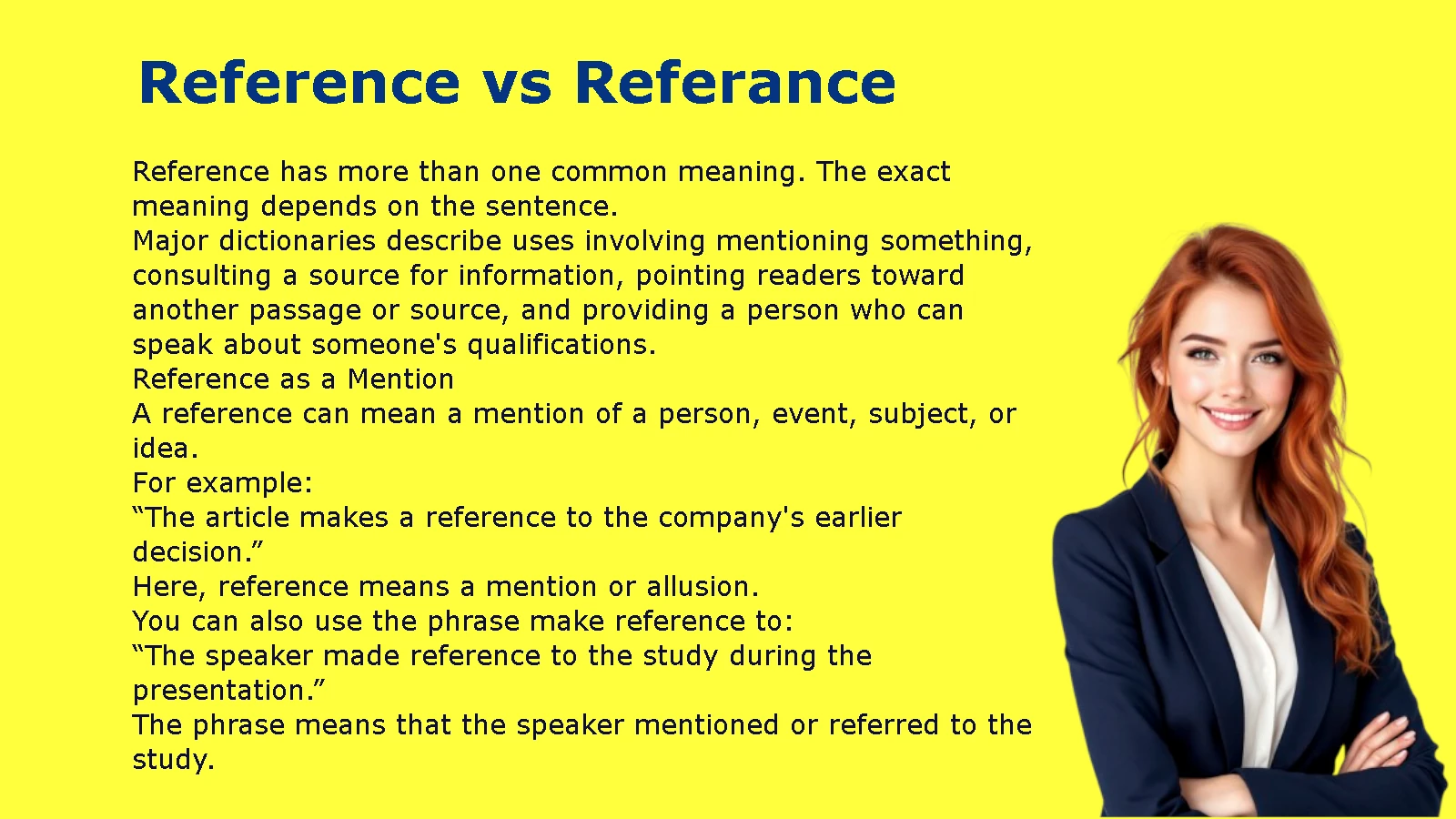
Reference has more than one common meaning. The exact meaning depends on the sentence.
Major dictionaries describe uses involving mentioning something, consulting a source for information, pointing readers toward another passage or source, and providing a person who can speak about someone’s qualifications.
Reference as a Mention
A reference can mean a mention of a person, event, subject, or idea.
For example:
“The article makes a reference to the company’s earlier decision.”
Here, reference means a mention or allusion.
You can also use the phrase make reference to:
“The speaker made reference to the study during the presentation.”
The phrase means that the speaker mentioned or referred to the study.
Reference as a Source of Information
A reference can also be something you consult when you need information.
For example:
“I kept the dictionary as a reference.”
A reference book is designed to provide information that readers can consult when they need specific facts or explanations. Dictionaries, encyclopedias, manuals, and specialized guides can all serve as reference works.
You might also hear:
- reference material
- reference guide
- reference book
- reference source
- reference work
The central idea is the same: you use the material to find or verify information.
Reference as a Recommendation
In employment and professional situations, a reference can mean a person who can provide information about someone’s character, skills, qualifications, or work history.
For example:
“The company asked her to provide two professional references.”
A job application might ask for:
- a former manager
- a supervisor
- a professional colleague
- another appropriate person who knows your work
In this context, reference doesn’t mean a book or citation. It refers to a person or statement used to support someone’s qualifications or character.
Reference as a Number or Identifier
In business communication, reference can refer to a number or combination of letters and numbers used to identify a document, transaction, case, or communication.
For example:
“Please include your reference number when contacting customer service.”
A reference number helps an organization connect your message with the correct record.
Cambridge specifically lists this business use for a set of numbers or letters on a document that identifies what the document relates to.
Common examples include:
- reference number
- reference code
- order reference
- case reference
- payment reference
References Example
References is simply the plural of reference.
Use reference when you’re talking about one item, person, mention, or source.
Use references when you’re talking about more than one.
| Singular | Plural |
| one reference | two references |
| a reference source | several reference sources |
| one professional reference | three professional references |
| one academic reference | multiple academic references |
References in a Job Application
Suppose an employer asks you for references. You might write:
“I have provided the contact details of two professional references.”
Here, references refers to multiple people.
Another example:
“The employer contacted my references after the interview.”
Again, more than one person is involved.
References in Academic Writing
Academic writing uses references in another important sense: sources that support or document information presented in a paper.
For example:
“The article includes references to several recent studies.”
A reference can identify a source that readers can locate and examine themselves.
Academic reference systems vary, but the basic purpose remains consistent: connect claims or ideas in the text with their supporting sources.
References in Everyday Writing
You can also use references in ordinary sentences:
“The report contains several references to previous research.”
“I checked the references before buying the book.”
“The presentation included references to historical events.”
The word doesn’t become a different spelling just because the context changes.
Reference or References in APA?
If you’re writing an APA-style paper, the distinction between reference and references matters.
The APA reference list uses the heading References because the section normally contains multiple sources. The American Psychological Association’s current guidance describes a dedicated Reference List section and provides rules for reference-list entries.
The APA’s guidance for student papers specifically states that the reference list uses the “References” section label and that the list contains the sources cited in the paper.
Reference vs References in APA
| Term | Meaning |
| reference | One source or citation entry |
| references | Multiple sources or the complete reference list |
| References | The heading used for the APA reference-list section |
For example, if you cite one book, that book provides one reference.
If your paper cites ten books, articles, websites, or other sources, your paper has multiple references, which appear together in the References section.
APA reference lists follow specific formatting rules. For example, entries are alphabetized by the surname of the first author, and reference-list entries use a hanging indent.
The important spelling point is easy to miss:
References, not Referances.
A Simple APA Example
A reference-list section might look conceptually like this:
References
Author, A. A. (2024). Title of the book. Publisher.
Author, B. B. (2025). Article title. Journal Name, 10(2), 20–30.
The exact format changes depending on the source type. APA provides separate guidance for books, journal articles, webpages, and other sources.
So if you’re preparing an APA paper, don’t write:
❌ Referances
Write:
✅ References
Referenced: Correct Spelling and Meaning
Referenced is the correct past-tense and past-participle form of the verb reference.
It means that someone mentioned, cited, pointed to, or drew attention to something.
For example:
“The researcher referenced an earlier study.”
The spelling follows the base word:
reference → referenced
It doesn’t become referanced.
How Do You Spell Referenced?
The correct spelling is:
R-E-F-E-R-E-N-C-E-D
So:
- ✅ referenced
- ❌ referanced
Notice what stays intact: reference keeps its -ence spelling before the -d.
For example:
“The report referenced several government publications.”
“The professor referenced the original research.”
“The article referenced data from an earlier survey.”
The same pattern applies regardless of whether you’re writing casually or formally.
Reference Word Forms
Understanding the related forms can help you avoid repeating the same spelling mistake in different places.
| Word form | Function | Example |
| refer | Verb | “Please refer to the instructions.” |
| reference | Noun/verb | “The report contains a reference to the study.” |
| references | Plural noun / verb form | “The paper contains several references.” |
| referenced | Past-tense verb | “The author referenced the study.” |
| referencing | Present participle/gerund | “The writer is referencing the original source.” |
Refer vs Reference
Refer and reference are related, but they aren’t always interchangeable.
Compare these sentences:
“Please refer to page 10.”
“The report contains a reference to page 10.”
In the first sentence, refer functions as a verb.
In the second, reference functions as a noun.
You can also use reference as a verb:
“The article references several earlier studies.”
That makes the word particularly flexible in modern English.
Why Is Referance Incorrect?
The spelling referance is incorrect because standard English spells this word with -ence, not -ance.
The mistake is especially understandable when you consider how many English words use -ance endings. However, spelling depends on the individual word rather than simply on how a suffix sounds.
Compare:
- reference
- preference
- difference
- evidence
with:
- importance
- attendance
- performance
- acceptance
Both endings occur in English, but reference belongs in the first group.
A spelling mistake doesn’t create a new version of the word. Writing referance in an application or academic paper still means you intended reference.
Reference vs Referance in Example Sentences
The fastest way to understand the difference is to see the correction in context.
| Incorrect | Correct |
| “Please provide a referance.” | “Please provide a reference.” |
| “I need the referance number.” | “I need the reference number.” |
| “She gave me three referances.” | “She gave me three references.” |
| “The study was referanced in the article.” | “The study was referenced in the article.” |
| “This dictionary is a useful referance.” | “This dictionary is a useful reference.” |
| “Check the referance list.” | “Check the reference list.” |
The pattern is consistent. The incorrect a in referance should be an e in reference.
Correct Examples With Reference
“The library has several useful reference books.”
“Please include the reference number in your reply.”
“The author made a reference to an earlier study.”
“She provided two professional references.”
“I used the dictionary as a reference.”
Correct Examples With Referenced
“The report referenced data from three previous studies.”
“The speaker referenced the original proposal.”
“The article referenced several historical documents.”
These examples also show why learning only the base spelling isn’t enough. The same error can reappear in references and referenced if you don’t recognize the underlying pattern.
Spelling of Preference and Reference
The spelling of preference can help you remember reference.
Both words contain the -ence ending:
- reference
- preference
For example:
“My preference is to use the original source.”
“The original source is an important reference.”
The words have different meanings, but their spelling provides a useful visual comparison.
Preference is spelled with -ence, not -ance. If that pattern is already familiar to you, it can make reference easier to remember.
Other useful comparisons include:
- difference
- evidence
- existence
- experience
- conference
Again, don’t assume that every similar-sounding word follows the same spelling rule. Use these words as visual reminders rather than as a universal suffix rule.
How to Remember the Spelling of Reference
A simple memory trick can save you from repeatedly checking the word.
Remember the E
Think:
refer + ENCE = reference
The key is the E in -ence.
You can also pair it mentally with:
preference → reference
Both contain -ence.
Another useful approach is to remember the word family:
- reference
- references
- referenced
- referencing
Once the base spelling becomes familiar, the related forms are much easier to recognize.
A Quick Spelling Test
If you’re unsure while writing, ask yourself:
Am I writing reference with -ence or referance with -ance?
Choose:
✅ reference
If you’re writing about multiple sources:
✅ references
If you’re describing something mentioned in the past:
✅ referenced
This takes only a second and prevents the same spelling error from appearing repeatedly.
Reference vs Referance: Common Spelling Mistakes
The most common mistake isn’t limited to the base word. People may carry the incorrect spelling into other forms.
Incorrect: Referance
❌ “Please check the referance.”
Correct: Reference
✅ “Please check the reference.”
Incorrect: Referances
❌ “The paper contains several referances.”
Correct: References
✅ “The paper contains several references.”
Incorrect: Referanced
❌ “The report referanced the study.”
Correct: Referenced
✅ “The report referenced the study.”
Incorrect: Referancing
❌ “The writer is referancing the original document.”
Correct: Referencing
✅ “The writer is referencing the original document.”
The important point is that the reference spelling remains recognizable throughout the word family.
When to Use Reference in Academic Writing
Academic writing gives reference a particularly important role.
A reference allows readers to identify the source behind information, an argument, quotation, data point, or idea. In APA style, for example, cited works appear in the reference list so readers can locate the sources.
A strong academic reference should contain accurate information about the source. Depending on the source, this can include details such as:
- author
- publication date
- title
- publisher or publication
- journal information
- DOI or URL when appropriate
APA’s official material describes reference entries in terms of core elements such as author, date, title, and source.
This is why spelling matters in academic work. A misspelled heading such as Referances immediately looks out of place in an otherwise carefully formatted paper.
When to Use Reference in Professional Writing
Professional communication uses reference in several practical ways.
Reference Number
“Your reference number is 84721.”
Professional Reference
“Please provide the names of two professional references.”
Reference to an Earlier Message
“With reference to your previous email, the requested document is attached.”
Reference Material
“The team used the manual as a reference during the training session.”
These contexts show why reference is much more than an academic term. You can encounter it in emails, applications, reports, customer-service conversations, business records, and everyday communication.
A Practical Case Study: Choosing the Right Form
Imagine you’re applying for a new job.
The application asks:
“Please provide two professional references.”
You enter two former supervisors.
Later, the employer contacts those people and asks about your experience. Those people serve as your references.
Now imagine the company sends you an email:
“Please include your application reference number.”
That’s a different meaning of reference, but the spelling stays exactly the same.
Finally, suppose the hiring manager writes:
“Your résumé referenced your previous management experience.”
Here, referenced functions as a verb.
Three contexts. Three uses. One spelling family:
reference → references → referenced
None becomes referance.
Reference vs Referance: Quick Comparison
| Question | Answer |
| Which spelling is correct? | Reference |
| Is referance correct? | No |
| What is the plural? | References |
| What is the past tense? | Referenced |
| What is the -ing form? | Referencing |
| Can reference be a noun? | Yes |
| Can reference be a verb? | Yes |
| Can reference mean a source? | Yes |
| Can reference mean a recommendation? | Yes |
| What heading does APA use for its reference list? | References |
Frequently Asked Questions About Reference vs Referance
Is referance a word?
Referance is a misspelling of reference in standard English. It isn’t the standard spelling for a separate meaning.
Which is correct, reference or referance?
Reference is correct.
✅ reference
❌ referance
What is the correct spelling of reference?
The correct spelling is:
R-E-F-E-R-E-N-C-E
The word ends in -ence.
How do you spell referenced?
The correct spelling is:
R-E-F-E-R-E-N-C-E-D
So the correct form is referenced, not referanced.
What is the plural of reference?
The plural is references.
For example:
“The report includes several references.”
Is reference singular or plural?
Reference is singular.
References is plural.
Compare:
“I found one useful reference.”
“I found five useful references.”
Is it Reference or References in APA?
For an APA reference list, the section is labeled References. APA’s official student-paper guidance identifies References as the section label for the list of sources.
An individual source is a reference, while the collection of sources is the reference list, commonly headed References.
What is the difference between refer and reference?
Refer is commonly used as a verb:
“Please refer to page 12.”
Reference can be a noun:
“The report contains a reference to page 12.”
It can also function as a verb:
“The report references the earlier study.”
Can reference be used as a verb?
Yes. Reference can function as a verb meaning to mention, cite, or point to something.
For example:
“The author referenced several previous studies.”
Is referencing spelled with an e?
Yes.
The correct spelling is referencing.
✅ referencing
❌ referancing
Reference or Referance: Final Answer
When you’re choosing between reference and referance, use reference.
Reference is the correct standard spelling. Referance is a misspelling.
The same pattern continues through its common forms:
- reference — singular noun or verb
- references — plural noun or third-person verb form
- referenced — past tense
- referencing — present participle or gerund
If you need one spelling trick to remember, focus on the ending:
REFERENCE = -ENCE
That spelling works whether you’re talking about a reference book, a professional reference, a reference number, an academic reference, or a source that someone referenced.
In short, when the choice is Reference vs Referance, the answer is clear: reference is the correct spelling.




