Skip means to move past, leave out, or avoid something. It can also mean to move by jumping lightly from one place to another. The meaning of skip depends on the context in which it is used.
If you’re searching for “skip meaning,” “what does skip mean,” or “skip definition,” you’re likely looking for its simple meaning and how to use it in a sentence. In everyday English, skip can describe avoiding something, leaving something out, or moving with light jumps. It can also refer to a skip, a large container used for collecting waste, especially in British English.
| Question | Answer |
|---|---|
| What does skip mean? | To move past, leave out, or avoid something. |
| What is the meaning of skip? | To omit something or move with light jumps. |
| Is skip a verb or noun? | It can be both a verb and a noun. |
| What is a synonym for skip? | Omit, miss, avoid, overlook, jump, or hop. |
What Does “Skip” Mean?
Skip generally means to leave something out, avoid doing something, miss something intentionally, or move with light hops or jumps.
The word has several established meanings. Major dictionaries recognize meanings involving movement, omission, avoidance, departure, and failure to attend. Merriam Webster also traces the verb back to Middle English skippen and gives its first known use as the 13th century.
Here are the main meanings:
| Meaning of “skip” | Explanation | Example |
| Leave something out | Not include or deal with something | “Skip the last question.” |
| Avoid doing something | Choose not to do something | “I skipped breakfast.” |
| Miss something | Fail to attend or participate | “She skipped class.” |
| Move with hops | Move using light jumping steps | “The child skipped home.” |
| Leave quickly | Depart, sometimes secretly | “They skipped town.” |
| Jump over a rope | Perform a rope jumping activity | “The children skipped rope.” |
| Bounce across a surface | Move or cause something to bounce | “He skipped a stone across the lake.” |
The key idea is passing something by. Sometimes you pass over an activity. Sometimes you pass over a section of a book. In the physical sense, you move from one point to another with a light, bouncing motion.
Cambridge defines the movement sense as moving “lightly and quickly” with a small jump after each step. It also lists skip as meaning not doing something that you usually do or should do.
Skip Meaning in Simple English
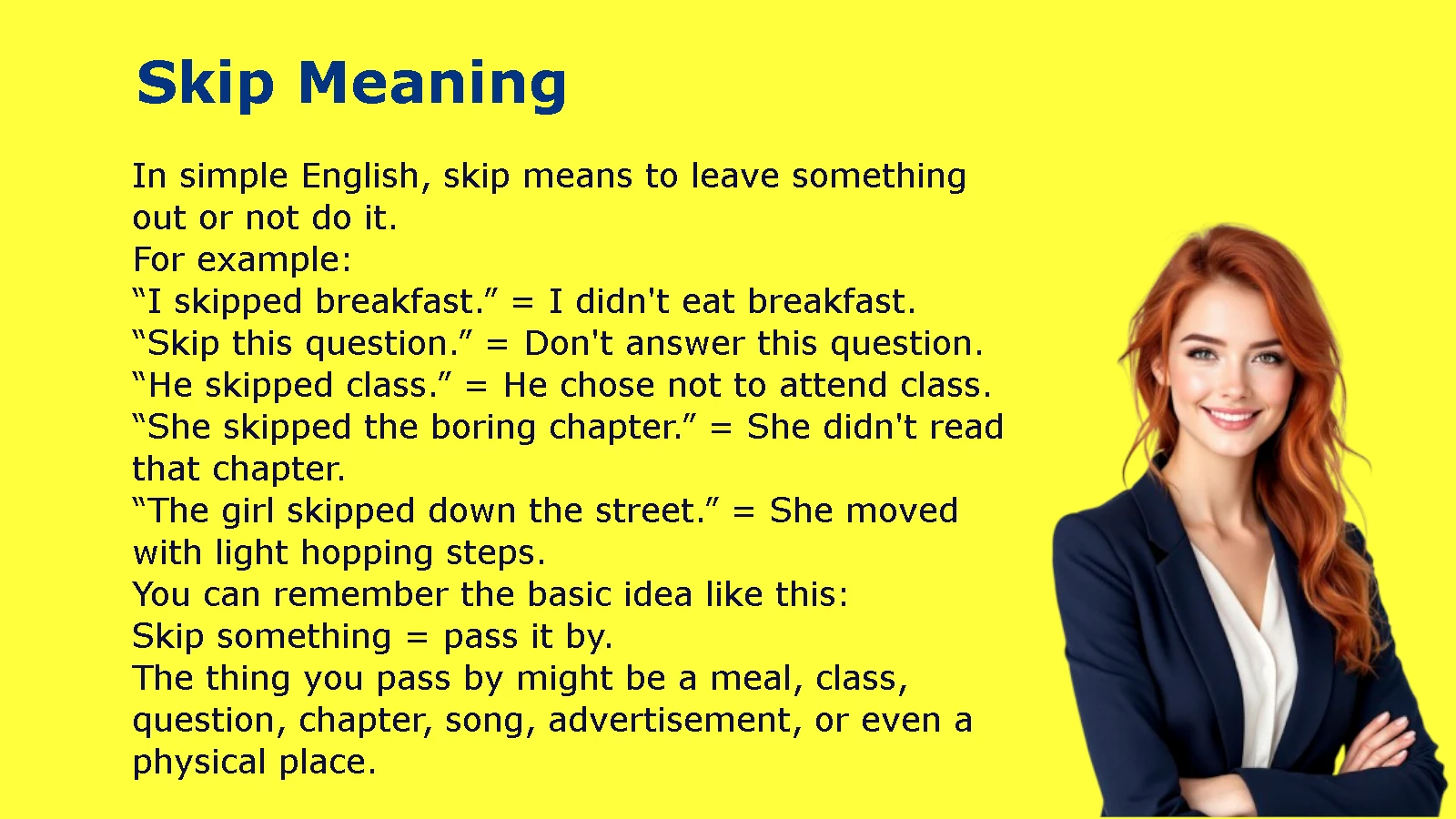
In simple English, skip means to leave something out or not do it.
For example:
- “I skipped breakfast.” = I didn’t eat breakfast.
- “Skip this question.” = Don’t answer this question.
- “He skipped class.” = He chose not to attend class.
- “She skipped the boring chapter.” = She didn’t read that chapter.
- “The girl skipped down the street.” = She moved with light hopping steps.
You can remember the basic idea like this:
Skip something = pass it by.
The thing you pass by might be a meal, class, question, chapter, song, advertisement, or even a physical place.
Skip as a Verb
Skip is most commonly used as a verb. Its meaning changes according to the object or phrase that follows it.
Skip Meaning “Leave Out”
When skip means leave out, you deliberately pass over something instead of including or completing it.
For example:
- “You can skip the introduction.”
- “Skip question five.”
- “I skipped the last page.”
- “She skipped several steps in the process.”
- “Let’s skip that part for now.”
This use appears frequently in instructions. A teacher might tell students to skip a difficult question and return to it later. A video tutorial might tell viewers to skip a section they already understand.
In each case, skip means to move past something without dealing with it.
Skip Meaning “Avoid”
Skip can also mean choosing not to do something that you normally do or might be expected to do.
Consider these examples:
- “I skipped lunch.”
- “He skipped his workout.”
- “She skipped the meeting.”
- “We skipped dessert.”
- “They skipped the formal ceremony.”
Cambridge specifically lists this sense as avoiding something or choosing not to do or have it.
The word often suggests a choice, although context determines whether that choice was deliberate.
Skip Meaning “Miss”
In everyday American English, skip commonly describes deliberately failing to attend an activity.
For example:
- “He skipped school.”
- “She skipped class.”
- “They skipped the meeting.”
- “We skipped the event.”
This meaning differs slightly from simply missing something.
If someone says, “I missed the bus,” the situation may have happened accidentally. If someone says, “I skipped the bus,” the intended meaning could be that the person deliberately chose not to take it.
The same distinction appears with school:
- “I missed class.” This doesn’t necessarily tell you why.
- “I skipped class.” This strongly suggests that the person intentionally didn’t attend.
Skip Meaning “Move by Hopping”
The physical meaning of skip is quite different.
To skip means to move forward with a series of light hops or small jumps. The movement usually alternates between the feet and has a playful or energetic quality.
Examples include:
- “The little girl skipped down the sidewalk.”
- “The children skipped across the playground.”
- “He skipped happily toward his friends.”
- “She skipped through the garden.”
Cambridge describes this as moving lightly and quickly with a small jump after each step.
This meaning often creates a cheerful image. A person who skips usually doesn’t appear to be walking in an ordinary, serious manner.
Skip vs. Walk
Walking involves ordinary steps. Skipping adds a repeated hopping or bouncing motion.
Compare:
“She walked down the hallway.”
This gives a neutral picture.
“She skipped down the hallway.”
Now the movement feels lighter, faster, or more playful.
The difference isn’t just physical. Skip can also add emotion and energy to a sentence.
Skip Meaning “Jump Rope”
In American English, skip can refer to jumping over a rope repeatedly, although jump rope is the more common American expression for the activity itself.
Cambridge notes that British English commonly uses skip for jumping over a rope repeatedly, while American English commonly uses jump rope.
Examples:
- “The kids were skipping rope.”
- “She practices jump rope every morning.”
- “He learned to skip rope at school.”
This is another physical meaning connected to repeated jumping.
Skip Meaning “Leave Quickly”
Another established meaning of skip is to leave a place quickly, sometimes secretly.
For example:
- “He skipped town.”
- “They skipped out after the argument.”
- “She skipped off without saying goodbye.”
The expression skip town is especially common. It means to leave an area, often suddenly because someone wants to avoid a problem, responsibility, or consequence.
Merriam Webster lists skip town under the sense of departing quickly or secretly.
Skip Meaning “Bounce Across a Surface”
Skip can describe an object bouncing repeatedly across a surface.
One familiar example involves a flat stone thrown across water:
“He skipped a stone across the lake.”
The stone hits the water, rises, hits it again, and continues in a series of small bounces.
Cambridge identifies this as another American English use and notes that British English commonly uses skim for this action.
The same general idea can describe objects moving unpredictably from one point to another.
Skip as a Noun
Although skip is often a verb, it can also function as a noun.
One noun meaning refers to a light hopping or bounding movement.
For example:
- “She gave a little skip of joy.”
- “He crossed the room with a skip in his step.”
Merriam Webster defines this noun as a light bounding step or a gait involving alternating hops and steps.
Skip as a Waste Container
In British English, a skip can also mean a large metal container used for rubbish, construction debris, or other unwanted material.
For example:
“They ordered a skip for the renovation waste.”
This meaning has nothing to do with hopping or omission. Context makes the difference clear.
Cambridge describes this noun as a large metal container used for unwanted objects, building waste, or garden waste. In American English, Dumpster is the more familiar term for a similar container.
Skip Definition With Examples
The following table brings the major meanings together:
| Use | Meaning | Example |
| Skip a question | Leave it unanswered | “Skip question six and continue.” |
| Skip a chapter | Leave it unread | “He skipped the final chapter.” |
| Skip breakfast | Choose not to eat | “I skipped breakfast this morning.” |
| Skip class | Choose not to attend | “They skipped class to go to the beach.” |
| Skip work | Avoid going to work | “He skipped work without telling his manager.” |
| Skip down the street | Move with hops | “The children skipped down the street.” |
| Skip rope | Jump repeatedly over a rope | “She skips rope for exercise.” |
| Skip town | Leave quickly | “The suspect skipped town.” |
| Skip a stone | Bounce a stone across water | “We skipped stones at the lake.” |
| A skip | Large waste container in British English | “The builders filled the skip.” |
How to Use “Skip” in a Sentence
Knowing the definition is only half the job. The surrounding words tell you which meaning applies.
Skip Meaning “Leave Out”
Use skip + noun when you want to say that someone should leave something out.
Examples:
- “Skip the first paragraph.”
- “You can skip this step.”
- “She skipped the difficult question.”
- “Let’s skip the details.”
- “He skipped several pages.”
You can also use skip over:
- “She skipped over the introduction.”
- “The speaker skipped over several important details.”
- “Don’t skip over the instructions.”
Skip over often emphasizes passing through something without giving it enough attention.
Skip Meaning “Miss”
When skip means intentionally not attending something, it commonly appears before words such as:
- class
- school
- work
- a meeting
- an event
- practice
- a ceremony
Examples:
- “He skipped class yesterday.”
- “She skipped practice.”
- “They skipped the meeting.”
- “I skipped work because I wasn’t feeling well.”
The construction is simple, but the implication can be important: skip often suggests an active decision.
Skip vs. Miss
Skip and miss overlap, but they don’t always communicate the same thing.
| Word | Typical implication | Example |
| Skip | Deliberately avoid or leave something | “I skipped class.” |
| Miss | Fail to attend, experience, or catch something | “I missed class.” |
Imagine that a student decides to stay home because they don’t want to attend class.
“I skipped class.”
The sentence clearly suggests a choice.
Now imagine that the student arrives late because their car breaks down.
“I missed class.”
The sentence doesn’t suggest that the student intended to stay away.
That’s why skip can sound more intentional than miss.
However, context can soften or change that implication. English words rarely live in isolation. The surrounding sentence does a lot of work.
Skip vs. Omit
Skip and omit can both mean leave something out, but their tone differs.
Omit sounds more formal and is especially common in writing, instructions, academic work, and professional communication.
Skip sounds more natural in everyday conversation.
Compare:
“You may skip this section.”
with:
“You may omit this section.”
Both are grammatical. The first sounds more conversational. The second sounds more formal or technical.
When to Use “Skip”
Use skip for casual or direct communication:
- “Skip this step.”
- “I skipped lunch.”
- “Let’s skip that topic.”
When to Use “Omit”
Use omit when precision or formality matters:
- “Please omit unnecessary details.”
- “The report omitted several important figures.”
- “The editor decided to omit the final paragraph.”
The two words overlap, but they’re not interchangeable in every context.
Skip vs. Jump
These words both involve movement, but skip has a more specific rhythm.
A jump usually means pushing off the ground and becoming airborne.
A skip involves a repeated pattern of steps and light hops.
Compare:
- “The athlete jumped over the hurdle.”
- “The child skipped down the path.”
The first sentence focuses on getting over an obstacle. The second describes a repeated way of moving.
A useful memory trick is simple:
Jump = one or more leaps.
Skip = a rhythmic series of steps and hops.
Common Phrases With “Skip”
The word skip appears in many established expressions.
Skip Class
Skip class means deliberately not attending a class.
Example:
“He skipped class and went to the park.”
This phrase is common in American English and usually carries the idea of intentional absence. Cambridge gives skip class as an example of the “avoid” sense.
Skip School
Skip school means deliberately not attending school.
Example:
“The students skipped school without telling their parents.”
Skip Work
Skip work means intentionally not going to work or not performing expected work.
Example:
“She skipped work without notifying her supervisor.”
Depending on context, this can sound casual or critical.
Skip Breakfast
Skip breakfast means not eating breakfast.
Example:
“I usually skip breakfast when I’m in a hurry.”
This construction can describe a routine rather than a one-time decision.
Skip a Step
Skip a step means failing to complete one stage of a process.
Example:
“Don’t skip a step when installing the software.”
This phrase is particularly common in instructions and tutorials.
Skip a Beat
Skip a beat has a literal connection to rhythm, but it is often figurative.
The expression “my heart skipped a beat” means that someone experienced a sudden emotional reaction such as excitement, fear, or surprise.
Example:
“My heart skipped a beat when I saw the final score.”
It doesn’t normally mean that the heart literally stopped working.
Skip Over Something
Skip over means to pass over something without discussing, reading, or considering it fully.
Examples:
- “The article skips over the main issue.”
- “Don’t skip over the final instructions.”
- “The teacher skipped over that topic.”
Skip Ahead
Skip ahead means move forward to a later point.
You might:
- skip ahead in a video
- skip ahead in a book
- skip ahead in a presentation
- skip ahead in a tutorial
For example:
“You can skip ahead to the final section if you’ve already completed the exercise.”
Skip Out on Someone or Something
Skip out on means leaving or avoiding someone or something, often in an irresponsible or unfair way.
Example:
“He skipped out on his responsibilities.”
The phrase is informal, so it fits casual conversation better than formal reports.
Skip Forms and Grammar
The verb skip follows a regular pattern.
| Grammar form | Word |
| Base form | skip |
| Third person singular | skips |
| Present participle | skipping |
| Past tense | skipped |
| Past participle | skipped |
Examples:
- “I skip breakfast.”
- “She skips breakfast.”
- “They are skipping lunch.”
- “He skipped class.”
- “She has skipped several meetings.”
Cambridge lists skipping as the present participle and skipped as both the past tense and past participle.
Why Is “Skipped” Spelled With Two Ps?
The spelling changes because English doubles the final consonant in certain short words before adding endings such as -ed and -ing.
So:
- skip → skipped
- skip → skipping
The doubled p keeps the short vowel sound in the base word.
You can see the same general spelling pattern in words such as:
- stop → stopped
- plan → planned
- run → running
The spelling skiped is incorrect.
Synonyms for Skip
The best synonym depends on which meaning you want.
Synonyms for Skip Meaning “Leave Out”
Useful alternatives include:
- omit
- leave out
- exclude
- bypass
- pass over
These words aren’t perfect substitutes in every sentence.
For example:
“Skip the last question.”
could become:
“Leave out the last question.”
But “omit the last question” sounds more formal.
Synonyms for Skip Meaning “Avoid”
Depending on context, you might use:
- avoid
- pass on
- forgo
- bypass
For example:
“I skipped dessert.”
could become:
“I passed on dessert.”
Both can indicate a deliberate choice.
Synonyms for Skip Meaning “Hop”
Possible alternatives include:
- hop
- bound
- prance
However, these words create different images. Hop usually emphasizes a single jump or movement on one foot. Prance suggests an energetic, high stepping motion. Skip has its own recognizable rhythm.
Antonyms of Skip
There isn’t one universal opposite of skip because the word has several meanings.
When skip means leave out, useful opposites include:
- include
- add
- cover
- complete
- address
Example:
“Don’t skip the final step.”
The opposite would be:
“Complete the final step.”
When skip means miss an activity, possible opposites include:
- attend
- participate
- join
- appear
Example:
“She skipped the meeting.”
Opposite idea:
“She attended the meeting.”
When skip describes physical movement, the opposite depends on the situation. Walk, stand, or remain still may work better than one fixed antonym.
Is “Skip” Formal or Informal?
Skip works in both casual and formal English, but some uses sound more conversational than others.
For everyday speech, these are completely natural:
- “I skipped lunch.”
- “Skip this part.”
- “He skipped class.”
- “Let’s skip the meeting.”
In formal writing, you may prefer omit, exclude, bypass, or fail to attend, depending on the exact meaning.
For example:
Casual:
“We skipped a few details.”
More formal:
“The report omitted several details.”
Neither sentence is automatically better. The right choice depends on the audience and tone.
Common Mistakes With “Skip”
Using “Skip” When “Miss” Is More Accurate
If an absence wasn’t intentional, miss may be clearer.
Less precise:
“I skipped my flight.”
If the person arrived late and couldn’t board, “I missed my flight” is more natural.
Confusing “Skip” With “Omit”
Both can mean leaving something out, but omit often suits formal writing better.
“Please omit unnecessary information.”
sounds more professional than:
“Please skip unnecessary information.”
The second sentence isn’t necessarily wrong, but it has a more conversational tone.
Confusing “Skip” With “Skim”
These words are easy to confuse.
Skip means to leave something out or pass over it.
Skim means to read or look through something quickly to get the general idea.
Compare:
“I skipped the article.”
This means you didn’t read it or passed it by.
“I skimmed the article.”
This means you read it quickly without examining every detail.
That’s an important distinction.
“Skip” in Different Varieties of English
Most major meanings of skip are shared across American and British English. Some uses, however, differ in frequency or preferred wording.
For example, American English commonly uses jump rope, while British English commonly uses skip for the activity. Cambridge identifies this difference directly.
Another notable difference appears with the noun skip.
In British English, a skip can mean a large metal waste container. American English commonly uses Dumpster for a similar container.
There is also a difference in the stone throwing sense. Cambridge lists skip a stone for American English and notes skim as the British equivalent.
These differences don’t make one version correct and the other incorrect. They simply show how vocabulary develops across varieties of English.
Skip Meaning in Digital and Everyday Contexts
Modern technology has made skip even more common.
You may see:
- Skip ad
- Skip intro
- Skip song
- Skip this step
- Skip to content
- Skip ahead
- Skip this video
The underlying meaning stays remarkably consistent: move past something instead of continuing through it.
For example, when a streaming service displays “Skip Intro,” it gives you the option to pass over the opening section and begin the main content.
Likewise, “Skip ad” means move past the advertisement.
This is a good example of how a basic physical idea develops into a broader abstract meaning.
“My heart skipped a beat when I heard the news.”
The phrase often conveys surprise, excitement, nervousness, or fear.
Skip Town
Skip town means leave a place quickly, often to avoid a problem or responsibility.
“He skipped town before the investigation began.”
Skip Out
Skip out can mean leave suddenly or secretly.
“She skipped out without saying goodbye.”
Skip Over
Skip over means pass over something without giving it full attention.
“The report skips over an important detail.”
Examples of “Skip” in Everyday Sentences
Skip Meaning “Leave Out”
- “Skip the first question.”
- “You can skip this paragraph.”
- “She skipped several details.”
- “Let’s skip the introduction.”
- “Don’t skip this step.”
- “He skipped the final chapter.”
- “I skipped breakfast.”
- “She skipped class.”
- “They skipped practice.”
- “He skipped the meeting.”
- “We skipped the ceremony.”
- “She skipped work yesterday.”
- “The children skipped across the playground.”
- “She skipped down the sidewalk.”
- “The little boy skipped toward his mother.”
- “He skipped happily through the garden.”
- “You can skip the advertisement.”
- “Skip the intro if you’ve seen it before.”
- “Skip ahead to the next section.”
- “Tap here to skip the tutorial.”
- “You can skip this song.”
Case Study: How Context Changes the Meaning of “Skip”
Consider these three sentences:
“She skipped the meeting.”
Here, skip means she didn’t attend the meeting, probably by choice.
Now change the object:
“She skipped the final chapter.”
The meaning changes. She left that section unread.
Now change the sentence again:
“She skipped across the room.”
This time, skip has nothing to do with omission or absence. It describes a physical movement involving light hops.
The word stays the same. The context does the heavy lifting.
This is why dictionary definitions alone aren’t enough when learning vocabulary. Seeing a word inside real sentences helps you understand which meaning fits.
Facts About the Word “Skip”
A few useful language facts make the word easier to understand:
- Skip can function as both a verb and a noun.
- Its major verb meanings include movement, omission, avoidance, departure, and failure to attend.
- The past tense is skipped, not skiped.
- The present participle is skipping.
- Merriam Webster traces the main verb to Middle English and gives its first known use as the 13th century.
- In British English, skip can refer to a large waste container.
- In American English, skip can describe throwing a flat stone so that it bounces across water.
- Skip and miss can overlap when talking about attendance, but skip often suggests intentional avoidance.
- Skip and omit can overlap when talking about leaving something out, but omit generally sounds more formal.
Frequently Asked Questions About Skip Meaning
What is the simple meaning of “skip”?
The simple meaning of skip is to leave something out, avoid doing something, or move past it. It can also mean moving with light hops.
What does “skip” mean in a sentence?
Its meaning depends on context. “Skip the question” means leave the question unanswered, while “skip down the street” means move with light hopping steps.
What does “skip class” mean?
Skip class means intentionally not attend a class. It usually suggests that the person chose not to go.
Does “skip” mean “miss”?
Sometimes. Skip can mean intentionally fail to attend something, while miss can describe failing to attend or experience something without necessarily suggesting a deliberate choice.
Is “skip” a verb or noun?
Skip can be both a verb and a noun. As a verb, it can mean to leave something out or move with hops. As a noun, it can describe a hopping movement or, in British English, a large waste container.
What is the past tense of “skip”?
The past tense is skipped.
Example:
“She skipped lunch yesterday.”
Is “skipped” spelled with two Ps?
Yes. The correct spelling is skipped, with two p’s.
The present participle is also spelled with two p’s:
skipping
What is the difference between “skip” and “omit”?
Both can mean leave something out. Skip is more common in everyday speech, while omit often sounds more formal.
What does “skip a beat” mean?
Skip a beat usually means experiencing a sudden emotional reaction such as surprise, excitement, fear, or nervousness. In “my heart skipped a beat,” the phrase is generally figurative.
What does “skip town” mean?
Skip town means to leave a place quickly, often to avoid trouble, responsibility, or an unwanted situation.
What does “skip” mean in British English?
In British English, skip can mean a large metal container used for rubbish, construction debris, or other waste. British English also commonly uses skip for the activity Americans usually call jump rope.
Final Thoughts on Skip Meaning
The word skip looks simple, but it carries several useful meanings.
Most uses connect to one central idea: passing something by. You can pass over a question, avoid a meal, miss a class, move past an introduction, leave a place quickly, or move forward with light hops.
The easiest way to remember the major meanings is:
- Skip something = leave it out.
- Skip an activity = choose not to do it.
- Skip class = deliberately not attend.
- Skip down the street = move with light hops.
- Skip over something = pass over it without dealing with it fully.
- Skip town = leave quickly.
- Skip a stone = make it bounce across water.
Once you pay attention to the words around skip, its meaning becomes much easier to identify. Context is the key. A single word can wear several hats, and skip happens to have quite a collection.




