Have you ever come across the word “subsequent” in a book, email, or conversation and wondered exactly what it means? While subsequent meaning may seem simple, this word can sometimes be confusing because it describes something that happens after another event, action, or point in time.
Subsequent is an adjective that means coming after something else in time, order, or sequence. It is often used when one event follows another. You may see it in formal writing, news reports, academic texts, and everyday conversations.
Examples:
- Subsequent events changed the course of the project.
- She missed the first meeting but attended the subsequent sessions.
The confusion is understandable. People often search for what does subsequent mean, subsequent meaning in a sentence, subsequent meaning in English, or subsequent meaning in text because the word can sound more formal than common alternatives such as later, following, or afterward. And here’s the kicker: once you understand the sequence it describes, “subsequent” becomes much easier to use.
In this guide, you’ll learn the complete subsequent meaning, its definition, pronunciation, correct usage, synonyms, and examples in sentences. You’ll also discover how to use subsequent in different contexts and understand the difference between subsequent, previous, preceding, and other related words.
What Does “Subsequent” Mean?
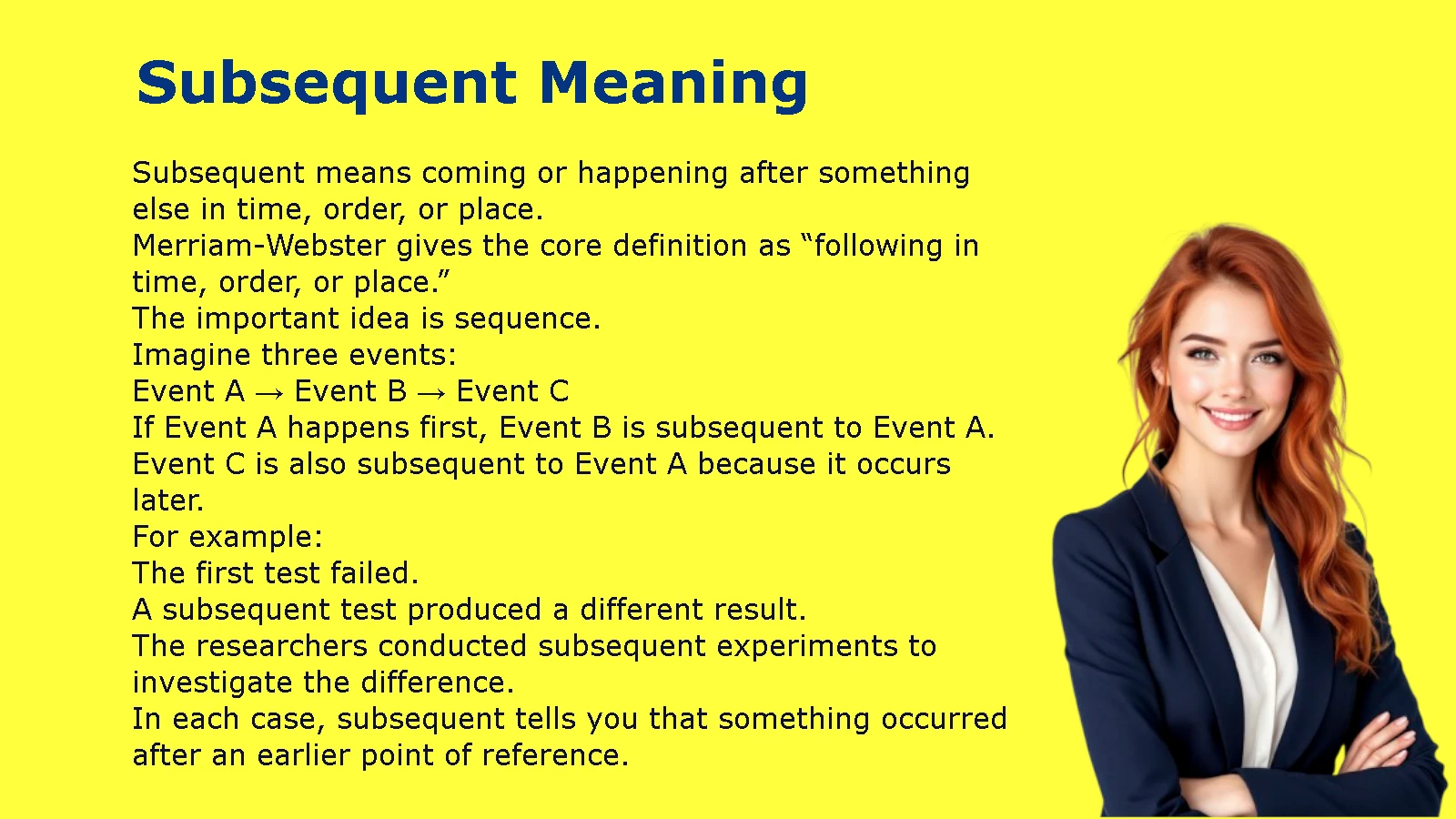
Subsequent means coming or happening after something else in time, order, or place.
Merriam-Webster gives the core definition as “following in time, order, or place.”
The important idea is sequence.
Imagine three events:
Event A → Event B → Event C
If Event A happens first, Event B is subsequent to Event A. Event C is also subsequent to Event A because it occurs later.
For example:
- The first test failed.
- A subsequent test produced a different result.
- The researchers conducted subsequent experiments to investigate the difference.
In each case, subsequent tells you that something occurred after an earlier point of reference.
Subsequent Meaning in Simple English
The easiest way to remember the meaning is:
Subsequent = later or coming after.
Here are some simple examples:
- subsequent meeting = a meeting that happens later
- subsequent years = years that follow an earlier period
- subsequent changes = changes made afterward
- subsequent events = events that happen later
- subsequent attempts = attempts made after an earlier attempt
Suppose you submit an application on Monday and receive an interview invitation on Wednesday. The interview is a subsequent event to the application.
That doesn’t mean the interview necessarily caused the application. It simply means the interview came afterward.
That distinction matters.
What Is the Definition of Subsequent?
The dictionary definitions agree on the central idea, although they phrase it slightly differently.
| Source | Meaning |
| Cambridge Dictionary | Happening after something else |
| Merriam-Webster | Following in time, order, or place |
| Oxford Learner’s Dictionaries | Happening or coming after something else |
These definitions establish three useful dimensions:
- Time: something happens later.
- Order: something appears later in a sequence.
- Place: something can follow another thing in an arrangement or position.
Merriam-Webster also notes that subsequent can resemble following or later while carrying a more formal tone.
Does Subsequent Always Mean Immediately After?
No.
This is one of the most important points about the word.
Subsequent means after, but it doesn’t necessarily mean immediately after.
For example:
“The company introduced several subsequent changes.”
This sentence doesn’t tell us that the changes happened one minute, one day, or even one year later. It simply places those changes after an earlier event or period.
Compare that with:
“The next meeting begins at 10 a.m.”
Next often points to the immediately following item. Subsequent is broader.
You can therefore think of the distinction this way:
next → usually the immediately following item
subsequent → something that comes later
What Part of Speech Is “Subsequent”?
Subsequent is an adjective.
Oxford identifies it as a formal adjective and notes that it is used before a noun.
That means it normally describes a person, thing, event, period, or other noun.
Examples include:
- subsequent events
- subsequent generations
- subsequent reports
- subsequent attempts
- subsequent changes
- subsequent investigations
- subsequent meetings
- subsequent developments
Notice the pattern:
subsequent + noun
For example:
“The subsequent investigation uncovered additional evidence.”
Here, subsequent modifies investigation.
It tells the reader that this particular investigation occurred after something previously discussed.
Is “Subsequent” an Adverb?
No.
Subsequent is an adjective.
The corresponding adverb is subsequently.
Compare these sentences:
“The subsequent investigation uncovered new evidence.”
“The investigators subsequently uncovered new evidence.”
In the first sentence, subsequent describes investigation.
In the second, subsequently modifies the action uncovered.
That small grammatical difference makes a big difference in sentence structure.
How to Use “Subsequent” in a Sentence
The most common structure is:
subsequent + noun
For example:
“The subsequent report contained additional information.”
You can also use the formal expression:
subsequent to + noun or noun phrase
For example:
“Subsequent to the meeting, the team changed its strategy.”
In this construction, subsequent to means after or following. Oxford lists subsequent to as a formal preposition meaning “after; following.”
Examples of the Basic Pattern
- The subsequent meeting lasted two hours.
- The subsequent investigation revealed several errors.
- The subsequent report explained what had happened.
- The subsequent changes improved the process.
- The subsequent edition corrected the mistake.
- The subsequent years brought significant changes.
- The subsequent events surprised everyone.
- The subsequent attempts were more successful.
The word works especially well when the earlier event has already been established.
Subsequent Examples in Sentences
Seeing the word in different contexts makes its meaning much easier to grasp.
Everyday Examples of Subsequent
Although subsequent sounds formal, the meaning is not complicated.
- “Her first trip was difficult, but her subsequent visits were much easier.”
- “The first attempt failed, while subsequent attempts succeeded.”
- “He changed his opinion during subsequent conversations.”
- “The original plan was modified in subsequent weeks.”
- “She learned from the experience and made better decisions in subsequent situations.”
In casual conversation, however, you might naturally choose later or next instead.
Instead of:
“We discussed the matter during a subsequent conversation.”
A friend might simply say:
“We talked about it later.”
Both communicate the basic idea. The first sounds more formal.
Academic Examples
Academic writing frequently uses subsequent because researchers often need to describe events, experiments, observations, or publications in sequence.
- “The researchers conducted subsequent experiments to test the hypothesis.”
- “The subsequent analysis produced different results.”
- “The original findings were supported by subsequent studies.”
- “The researchers discussed these limitations in a subsequent section.”
- “The model was revised after subsequent testing.”
The word is useful because it establishes chronology without forcing the writer to repeat phrases such as after the first study or later in the research process.
Workplace Examples
You may also see subsequent in reports, policies, emails, and business documents.
- “The issue was discussed during a subsequent meeting.”
- “The company made several subsequent changes to its policy.”
- “A subsequent review found no additional problems.”
- “The manager explained the decision in a subsequent email.”
- “The team recorded the results in a subsequent report.”
For everyday workplace communication, though, don’t use subsequent simply because it sounds sophisticated.
If later works, it may be better.
Good writing isn’t about choosing the fanciest word in the toolbox. It’s about choosing the word that fits.
Formal and Legal Examples
Formal documents often use subsequent to establish a relationship between two points in time.
Examples include:
- “Any subsequent amendments must be approved by both parties.”
- “The parties reached an agreement, followed by subsequent negotiations.”
- “The policy applies to subsequent violations.”
- “The court considered the subsequent developments.”
- “The agreement was revised in a subsequent version.”
The word is especially useful when precision matters and the writer needs to establish an earlier reference point.
What Does “Subsequent To” Mean?
Subsequent to means after or following something.
For example:
“Subsequent to the meeting, the company released a statement.”
This means:
“After the meeting, the company released a statement.”
Merriam-Webster defines subsequent to as occurring at a time later than something else.
Oxford also labels the construction as formal and defines it as after; following.
Examples of “Subsequent To”
- “The policy was changed subsequent to the review.”
- “Several issues emerged subsequent to the merger.”
- “The company issued a correction subsequent to the investigation.”
- “The employee received additional training subsequent to the incident.”
- “Further developments occurred subsequent to the announcement.”
Is “Subsequent To” Formal?
Yes.
In many situations, after sounds more natural.
Compare:
“Subsequent to the meeting, we changed the schedule.”
and:
“After the meeting, we changed the schedule.”
The second sentence sounds more conversational. The first sounds like something you might find in a formal report, legal document, or official statement.
Neither is inherently better. Audience and purpose decide.
Subsequent vs. Subsequently
This is one of the most common points of confusion.
Subsequent
Subsequent is an adjective.
“The subsequent decision surprised the committee.”
It describes decision.
Subsequently
Subsequently is an adverb meaning afterward or later. Cambridge and Oxford both define it as an adverb referring to something that happens after another event.
“The committee subsequently changed its decision.”
It modifies the action changed.
Here’s the difference at a glance:
| Word | Part of speech | Meaning | Example |
| subsequent | Adjective | Coming afterward | The subsequent report was longer. |
| subsequently | Adverb | Afterward or later | The report was subsequently revised. |
A useful trick is to look at what follows the word.
If you’re describing a noun, you probably need subsequent.
If you’re describing an action, you may need subsequently.
More Examples
Correct:
“The subsequent investigation revealed new evidence.”
Correct:
“The investigators subsequently found new evidence.”
Incorrect:
“The subsequently investigation revealed new evidence.”
Why? Because investigation needs an adjective here. Subsequently is an adverb.
Likewise:
Incorrect:
“The investigators subsequent found new evidence.”
The action found needs the adverb subsequently.
Subsequent vs. Previous
These words point in opposite directions.
Previous refers to something that came before.
Subsequent refers to something that came after.
| Word | Direction | Example |
| previous | Before | The previous report contained errors. |
| subsequent | After | The subsequent report corrected them. |
Imagine reading a series of reports:
Report 1 → Report 2 → Report 3 → Report 4
If you’re discussing Report 3:
- Report 2 is previous.
- Report 4 is subsequent.
Oxford explicitly lists previous as the opposite of subsequent.
This makes the pair especially useful when explaining a timeline.
Subsequent vs. Following
Following is one of the closest alternatives to subsequent.
Cambridge lists following as a synonym.
Compare:
“The subsequent meeting lasted three hours.”
“The following meeting lasted three hours.”
Both can mean that the meeting came after an earlier one.
The main difference is tone and usage.
Following is generally more flexible and natural in everyday English.
Subsequent sounds more formal.
For example:
“The following week, we moved to a new office.”
sounds more natural than:
“The subsequent week, we moved to a new office.”
The second isn’t necessarily impossible, but it feels stiff.
In formal reports, however, subsequent can fit very comfortably:
“The subsequent investigation revealed additional evidence.”
Subsequent vs. Later
Later is one of the simplest alternatives to subsequent.
Both can refer to something that happens afterward.
However, their grammar differs.
You can say:
“We discussed the issue later.”
You can also say:
“We discussed the issue during a subsequent meeting.”
You wouldn’t normally replace subsequent with later while keeping exactly the same structure:
“during a later meeting”
This sentence is grammatical, but the meaning and tone shift slightly.
Later is broad and everyday.
Subsequent is more formal and often explicitly connects a noun to an earlier event.
Subsequent vs. Next
The words overlap, but next often carries a stronger sense of immediate sequence.
Consider:
“We attended the next meeting.”
This usually means the meeting immediately following the current or previously mentioned one.
Now consider:
“We attended a subsequent meeting.”
This means a later meeting. It doesn’t necessarily emphasize that it was the immediately next meeting.
That’s an important distinction.
| Word | Main idea |
| next | The item that comes immediately after |
| subsequent | Something that comes later |
For example:
“The next chapter explains the theory.”
This identifies a specific chapter immediately following the current one.
“Subsequent chapters explain the theory in greater detail.”
This can refer to chapters that come later in the book without necessarily focusing on one immediate chapter.
Subsequent vs. Consequent
These two words cause confusion because they look and sound similar.
The difference is important:
Subsequent = follows in time or order.
Consequent = follows as a result.
Merriam-Webster specifically distinguishes the two by explaining that subsequent concerns sequence, while consequent can indicate a result or causal relationship.
Compare:
“The subsequent investigation lasted six months.”
This tells us the investigation happened afterward.
Now:
“The consequent investigation caused further delays.”
Here, consequent suggests that the investigation was a result of what came before.
A Simple Test
Ask:
Am I talking about when something happened?
Use subsequent.
Am I emphasizing that something happened because of an earlier event?
Consequent may be appropriate.
For example:
“The storm and subsequent flooding damaged several roads.”
Here, subsequent places the flooding after the storm.
But:
“The flooding was a consequent effect of the storm.”
Here, the focus is on the relationship of cause and result.
Don’t assume that subsequent automatically means caused by. It doesn’t.
Subsequent vs. Consecutive
Consecutive means following one after another in an uninterrupted series.
Oxford defines consecutive as “following one after another in a continuous series.”
That makes it narrower than subsequent.
For example:
“She worked for five consecutive days.”
This means she worked five days in a row.
Now:
“She worked on five subsequent projects.”
This only tells us that the projects came later. They don’t necessarily form an uninterrupted sequence.
Compare the Meaning
| Word | What it emphasizes |
| Subsequent | Coming afterward |
| Consecutive | Following continuously without interruption |
Consider this timeline:
Monday → Wednesday → Friday
If meetings occur on all three days:
- Wednesday is subsequent to Monday.
- Friday is subsequent to Wednesday.
- The meetings aren’t necessarily consecutive days because Tuesday and Thursday interrupt the sequence.
This is why replacing subsequent with consecutive can change the meaning.
Common Synonyms for Subsequent
Several words can express a similar idea, but they’re not perfect replacements in every sentence.
| Synonym | Basic meaning | Tone or nuance |
| following | Coming after | Neutral and flexible |
| later | At a later time | Everyday |
| next | Immediately following | Often emphasizes order |
| ensuing | Following after an event | Often formal |
| succeeding | Following in sequence | Formal or less common |
| afterward | At a later time | Adverb |
| subsequently | Afterward | Formal adverb |
The safest everyday alternatives are usually following and later.
However, the grammar matters. You can’t replace subsequent with an adverb such as afterward without restructuring the sentence.
For example:
“The subsequent meeting was canceled.”
can become:
“The meeting that followed was canceled.”
But you can’t simply write:
“The afterward meeting was canceled.”
That doesn’t work.
Common Phrases With “Subsequent”
Some combinations occur frequently because the meaning fits naturally.
Subsequent Events
Subsequent events are events that happen after an earlier event.
“The report examined the initial decision and the subsequent events.”
Subsequent Years
Subsequent years means years that followed a particular year or period.
“In subsequent years, the organization expanded its services.”
Subsequent Changes
These are changes made after an earlier decision or development.
“The company introduced several subsequent changes to the policy.”
Subsequent Attempts
These are attempts made after an earlier attempt.
“The first attempt failed, but subsequent attempts were successful.”
Subsequent Generations
This refers to generations that come after a particular generation.
“The tradition continued through subsequent generations.”
Subsequent Reports
A later report in a sequence is a subsequent report.
“The subsequent report provided additional details.”
Subsequent Developments
This phrase refers to developments that occur later.
“Subsequent developments changed the direction of the project.”
These combinations are common because subsequent efficiently establishes a timeline without repeating after the original event.
Is “Subsequent” Formal or Casual?
Subsequent is formal.
Oxford explicitly labels it formal, and its examples include academic and institutional contexts.
You are likely to encounter it in:
- Academic papers
- Research reports
- Legal documents
- Government documents
- Business reports
- News writing
- Official statements
- Technical documentation
You can use it in ordinary conversation, but it may sound unnecessarily formal.
For example:
“I saw him at a subsequent meeting.”
This is perfectly understandable.
But in casual conversation, you might naturally say:
“I saw him at a later meeting.”
Or:
“I saw him at the next meeting.”
The best word depends on your audience.
Formal vs. Conversational Examples
| Formal | More conversational |
| The subsequent meeting | The next meeting |
| Subsequent changes were made | Later, we made some changes |
| The subsequent investigation found errors | A later investigation found errors |
| In subsequent years | In later years |
| Subsequent to the discussion | After the discussion |
This isn’t a rule that says subsequent should only appear in formal writing. It’s a matter of register.
Use the word when its formal precision helps. Don’t sprinkle it into every sentence just to make your writing sound impressive.
Common Mistakes With “Subsequent”
Understanding what the word doesn’t mean is just as useful as memorizing its definition.
Confusing Subsequent With Subsequently
Remember:
- subsequent = adjective
- subsequently = adverb
Correct:
“The subsequent decision surprised everyone.”
Correct:
“The committee subsequently changed its position.”
Confusing Subsequent With Consequent
Don’t automatically interpret subsequent as resulting from.
“The subsequent meeting occurred on Friday.”
This tells us about timing.
It doesn’t necessarily say why the meeting occurred.
Assuming Subsequent Means Immediately Next
It doesn’t.
A subsequent event may happen much later.
“Subsequent research published over the next decade challenged the original theory.”
The research is subsequent, even though it wasn’t immediate.
Using Subsequent When a Simpler Word Works Better
Formal vocabulary isn’t automatically better vocabulary.
Compare:
“Subsequent to our conversation, I sent the file.”
with:
“After our conversation, I sent the file.”
The second version is shorter and more natural for an ordinary email.
Choose subsequent when the formal register makes sense.
Word Forms Related to “Subsequent”
The most useful related forms are subsequent and subsequently.
| Word | Part of speech | Meaning |
| subsequent | Adjective | Coming afterward |
| subsequently | Adverb | Afterward or later |
There is also the noun subsequence, although it is much less common in everyday English.
The underlying word family traces back to Latin subsequi, meaning to follow closely or come after. Etymonline dates subsequent in English to the mid-15th century and connects it through Old French to Latin.
That history fits the modern meaning neatly: the central idea has remained connected to following.
A Closer Look at the Word’s History
The word subsequent entered English in the mid-15th century. It came through Old French from the Latin subsequentem, related to subsequi, meaning to follow closely or come after.
Its history also explains why the word feels closely connected to words built around the idea of following.
The Latin root sequi means “to follow.” Etymonline connects this root with a broad family of English words associated with following, sequence, or succession.
So although subsequent may look intimidating, its central idea is remarkably straightforward:
Something comes after something else.
Practical Usage Case Studies
The easiest way to understand subtle vocabulary differences is to place them in realistic situations.
Case Study: An Academic Research Project
Imagine a researcher conducts an initial experiment.
The first experiment produces an unexpected result. The researcher then conducts three more experiments.
A natural sentence would be:
“The subsequent experiments produced similar results.”
Why does subsequent work?
Because the writer has already established the first experiment. The later experiments now have a clear reference point.
You could also write:
“The later experiments produced similar results.”
That’s more conversational.
The choice depends on the tone of the document.
Case Study: A Business Report
Imagine a company launches a new product in January. During the following months, it changes the packaging, pricing, and marketing strategy.
A formal report might say:
“The company introduced several subsequent changes to its marketing strategy.”
The word efficiently connects those changes to the original launch.
A simpler version would be:
“The company made several changes later.”
The first version sounds more precise and report-like. The second sounds more conversational.
Case Study: A Timeline
Suppose a timeline contains these events:
January: Policy introduced
March: Policy reviewed
June: Policy revised
September: New policy issued
The June revision is subsequent to the January introduction.
The September policy is also subsequent to the January introduction.
However, the September policy is not necessarily the next event after January because several things happened between them.
That’s where subsequent becomes especially useful.
Quick Comparison: Subsequent and Similar Words
| Word | Meaning | Example |
| Subsequent | Coming after | Subsequent reports provided more detail. |
| Following | Coming after | The following report was shorter. |
| Later | At a later time | We discussed it later. |
| Next | Immediately following | The next meeting starts at noon. |
| Consecutive | Following continuously | They worked three consecutive days. |
| Consequent | Resulting from something | The consequent problems were serious. |
| Subsequently | Afterward | The policy was subsequently revised. |
| Previous | Coming before | The previous report had errors. |
The easiest way to remember the differences is to focus on the relationship each word describes.
Subsequent focuses on what comes after.
Previous focuses on what came before.
Consecutive focuses on an uninterrupted sequence.
Consequent focuses on a result.
Subsequently focuses on an action that happens afterward.
Facts About the Word “Subsequent”
Here are the key facts worth remembering:
- Part of speech: Adjective
- Basic meaning: Coming or happening after something else
- Pronunciation: /ˈsʌb.sɪ.kwənt/ in Cambridge’s pronunciation notation
- Tone: Formal
- Common position: Before a noun
- Related adverb: Subsequently
- Formal construction: Subsequent to
- Common synonyms: Following, later
- Common opposite: Previous
- Core concept: Sequence rather than automatic cause and effect
- English history: The word dates to the mid-15th century
- Dictionary status: Oxford, Cambridge, and Merriam-Webster all recognize its core meaning as something that follows another thing in time or order.
Frequently Asked Questions About Subsequent Meaning
What does subsequent mean in simple words?
Subsequent means later or coming after something else.
For example:
“Subsequent events changed the situation.”
This means that events that happened later changed the situation.
Does subsequent mean next?
Not always.
Next often refers to the immediately following item.
Subsequent simply means that something comes afterward. It may occur immediately or much later.
Is subsequent a formal word?
Yes. Major learner dictionaries such as Oxford classify it as formal.
It works especially well in academic, legal, professional, and official writing.
What is the opposite of subsequent?
The most direct opposite is previous, meaning something that came before.
For example:
“The previous report contained errors, while the subsequent report corrected them.”
Oxford lists previous as the opposite of subsequent.
What is the difference between subsequent and subsequently?
Subsequent is an adjective:
“the subsequent decision”
Subsequently is an adverb:
“The decision was subsequently reversed.”
Both refer to something that happens later, but they perform different grammatical jobs.
What does subsequent to mean?
Subsequent to means after or following.
For example:
“Subsequent to the meeting, the team revised the proposal.”
In plain English:
“After the meeting, the team revised the proposal.”
It is a formal construction.
What is another word for subsequent?
Depending on the sentence, alternatives include:
- following
- later
- next
- ensuing
- succeeding
However, these words aren’t interchangeable in every grammatical structure.
Does subsequent imply cause and effect?
No.
Subsequent primarily establishes a relationship of sequence.
If you need to emphasize that one thing happened because of another, a different word such as consequent may be more appropriate.
Merriam-Webster specifically distinguishes subsequent from consequent on this point.
Can subsequent refer to people?
Yes, although it more commonly modifies things such as events, generations, reports, years, and developments.
For example:
“Subsequent generations inherited the tradition.”
Here, subsequent describes generations that came later.
Can subsequent mean immediately after?
Not necessarily.
It means afterward or following. It doesn’t inherently specify how much time passes between two events.
Is “subsequent to” grammatically correct?
Yes.
Subsequent to is a recognized formal construction meaning after or following.
For example:
“Several changes occurred subsequent to the agreement.”
Final Takeaway: What Does Subsequent Mean?
The simplest definition of subsequent is coming or happening after something else.
It’s an adjective, so it normally describes a noun:
the subsequent meeting
subsequent events
subsequent years
subsequent changes
The word is particularly useful in formal writing because it establishes a clear relationship between an earlier point and something that comes later. Oxford classifies it as formal, while Cambridge and Merriam-Webster emphasize its connection with events, order, and time.
Remember these four distinctions:
- Subsequent = comes after
- Subsequently = happens afterward
- Previous = came before
- Consequent = follows as a result
And don’t forget the simplest rule of all: subsequent tells you about sequence, not necessarily cause.
When you see subsequent in a sentence, look backward. Find the earlier event or reference point. Then ask, “What came after it?”




