Have you ever noticed something that seems small or hard to notice but still carries a deeper meaning? That is where the Subtle Meaning comes in. While subtle may sound like a simple word, it can describe ideas, feelings, changes, hints, or differences that are not obvious at first glance.
Subtle is an adjective that means delicate, indirect, slight, or difficult to notice or understand. It is often used when something has a quiet effect or meaning rather than being clear or obvious.
Examples:
- She gave him a subtle smile.
- There was a subtle change in his voice.
The confusion is understandable. People often search for what does subtle mean, subtle meaning in text, subtle meaning in a sentence, or subtle meaning in conversation because the word can describe many different things depending on the context, tone, and situation. And here’s the kicker: something subtle isn’t necessarily unimportant. Sometimes the smallest hint can say the most.
In this guide, you’ll learn the complete Subtle Meaning, its definition, pronunciation, correct usage, and examples in sentences. You’ll also discover common synonyms for subtle, different meanings of the word in everyday conversation, and the difference between subtle, obvious, and other related words.
What Does “Subtle” Mean?
Subtle is an adjective used to describe something that isn’t immediately obvious, noticeable, strong, or direct.
It can describe a physical quality, a difference, an emotion, a message, a behavior, or even a clever strategy.
Here are the main meanings of subtle:
| Meaning | Explanation | Example |
| Not obvious | Difficult to notice or detect | There was a subtle change in his expression. |
| Small but important | A minor difference that still matters | There is a subtle difference between the two designs. |
| Delicate or restrained | Not strong, bright, loud, or overpowering | The dish has a subtle flavor. |
| Indirect | Communicated without being stated openly | She gave him a subtle hint. |
| Clever or skillful | Done quietly without attracting attention | He used a subtle strategy to solve the problem. |
The central idea connects all these meanings: something subtle tends to work below the surface rather than demanding immediate attention.
That’s why the word works in so many situations. A scent can be subtle. A joke can be subtle. A change in someone’s mood can be subtle. Even an argument can have subtle differences that become clear only after careful thought.
Subtle Meaning in Simple English
If you’re looking for the subtle meaning in simple English, the easiest definition is:
Subtle means something that is hard to notice, understand, or recognize because it isn’t obvious or strong.
Think about two people standing in a room.
One person suddenly shouts. That’s obvious.
The other person becomes slightly quieter and avoids eye contact. That’s subtle.
You can see the difference:
| Obvious | Subtle |
| A loud shout | A slight change in tone |
| A bright red color | A soft change in shade |
| A direct request | An indirect hint |
| A major change | A small but meaningful change |
| Open criticism | Indirect criticism |
| A dramatic reaction | A slight facial expression |
The important point is that subtle doesn’t always mean unimportant.
In fact, something subtle can be extremely important. A tiny change in someone’s behavior may reveal a major shift in how they feel. A small difference between two words may completely change the meaning of a sentence.
The Different Meanings of “Subtle”
The word subtle has several related meanings. Understanding these differences makes it much easier to use the word correctly.
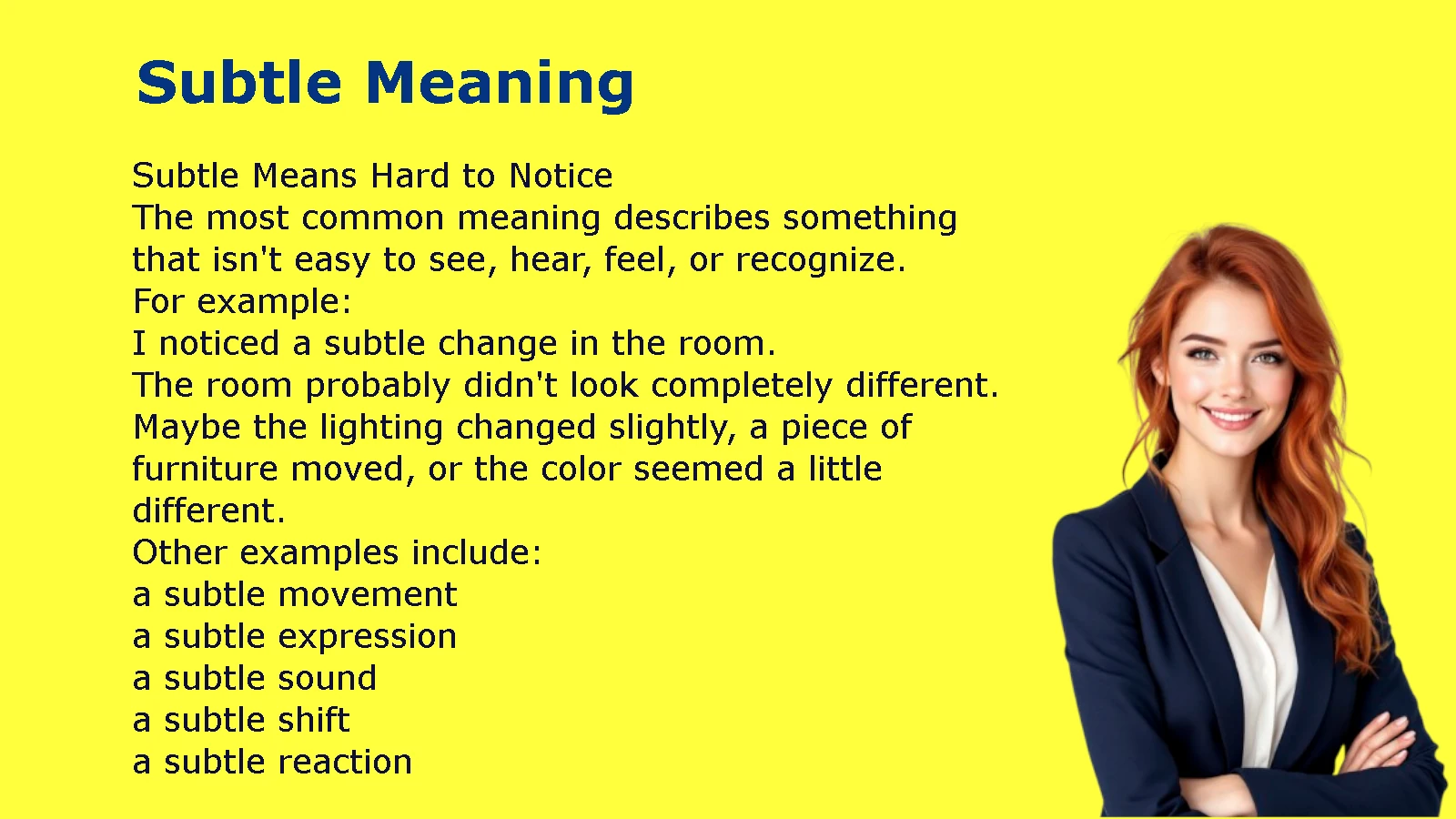
Subtle Means Hard to Notice
The most common meaning describes something that isn’t easy to see, hear, feel, or recognize.
For example:
I noticed a subtle change in the room.
The room probably didn’t look completely different. Maybe the lighting changed slightly, a piece of furniture moved, or the color seemed a little different.
Other examples include:
- a subtle movement
- a subtle expression
- a subtle sound
- a subtle shift
- a subtle reaction
- a subtle change in behavior
Cambridge describes this sense as something that isn’t loud, bright, noticeable, or obvious.
Subtle Means Small but Important
Sometimes subtle describes a difference that appears minor but still matters.
Consider these sentences:
There is a difference between the two sentences.
That’s a general statement.
There is a subtle difference between the two sentences.
Now the sentence suggests that the difference is small and may require careful attention to identify.
This meaning appears frequently when people discuss:
- language
- art
- design
- science
- behavior
- opinions
- arguments
- plans
- pronunciation
A subtle difference isn’t necessarily a trivial difference. It can change how something is understood.
Subtle Means Delicate or Understated
Subtle can also describe something that isn’t strong or overpowering.
For example:
The perfume has a subtle floral scent.
The scent exists, but it isn’t intense.
You might also hear:
- subtle flavor
- subtle fragrance
- subtle color
- subtle lighting
- subtle makeup
- subtle texture
- subtle sound
In this sense, subtle often suggests restraint. The quality is present, but it doesn’t dominate everything around it.
Subtle Means Indirect
A person can also communicate something subtly.
Imagine someone wants their friend to leave a party.
A direct statement would be:
We should leave now.
A subtle suggestion might be:
It’s getting pretty late.
The second person hasn’t directly said, “Let’s leave.” The listener has to understand the implied message.
That’s why phrases such as subtle hint, subtle suggestion, and subtle message are so common.
Subtle Can Mean Clever or Skillful
In some contexts, subtle describes an intelligent or skillful approach that doesn’t attract much attention.
For example:
She used a subtle strategy to change his mind.
The strategy wasn’t obvious. She didn’t simply tell him what to think. Instead, she guided the conversation carefully.
Cambridge includes this sense when something is achieved quietly without drawing attention and may therefore be clever or effective.
Subtle Examples in Sentences
The best way to understand subtle meaning is to see the word in different contexts.
Everyday Examples
- I noticed a subtle change in his attitude.
- She gave me a subtle smile.
- There was a subtle difference between the two shirts.
- He made a subtle change to the design.
- The room had a subtle blue tint.
Communication Examples
- She gave him a subtle hint to stop talking.
- His subtle criticism was easy to miss.
- The question contained a subtle suggestion.
- She made a subtle reference to the earlier conversation.
- His message had a subtle meaning that wasn’t obvious at first.
Sensory Examples
- The soup has a subtle garlic flavor.
- I noticed a subtle floral fragrance.
- The painting uses subtle shades of green.
- A subtle melody played in the background.
- The fabric has a subtle texture.
Emotional Examples
- There was a subtle sadness in her voice.
- He showed a subtle reaction to the news.
- I noticed a subtle change in her expression.
- His smile contained a subtle hint of disappointment.
- The conversation created a subtle tension in the room.
Notice how the word changes slightly with each noun. The basic idea stays the same, but the context tells you whether subtle means slight, indirect, delicate, or difficult to detect.
What Does “Subtle Difference” Mean?
A subtle difference is a small distinction that may not be immediately noticeable.
For example:
There is a subtle difference between these two shades of blue.
The colors may look almost identical at first. However, closer inspection reveals that one has a slightly different tone.
The same idea applies to language:
There is a subtle difference between “angry” and “annoyed.”
Both words describe negative emotions. However, they don’t communicate exactly the same level or type of feeling.
You can find subtle differences in:
- word meanings
- pronunciation
- colors
- facial expressions
- behavior
- writing styles
- opinions
- sounds
- flavors
- designs
Cambridge specifically gives “small but important” as one meaning of subtle and uses subtle difference as an example.
Why a Subtle Difference Can Matter
A difference doesn’t need to be large to matter.
Imagine two sentences:
I don’t think that’s a good idea.
and
I’m not sure that’s the best idea.
The difference is subtle. Both express doubt. However, the second sentence may sound softer and less direct.
That’s the power of subtle differences in language. A small change can affect tone, emotion, politeness, certainty, or intention.
What Does “Subtle Hint” Mean?
A subtle hint is an indirect suggestion that allows someone to understand an idea without hearing it stated directly.
Suppose you want your friend to close the window.
A direct request would be:
Could you close the window?
A subtle hint might be:
It’s getting pretty cold in here.
The second statement doesn’t explicitly ask the person to close the window. The intended message is implied.
Here are more examples:
- “I have an early meeting tomorrow.”
Possible subtle hint: I’d like to leave. - “This room could use a little cleaning.”
Possible subtle hint: Please clean the room. - “I haven’t eaten all day.”
Possible subtle hint: I’d like something to eat. - “That’s an interesting shirt.”
Depending on tone, this could subtly communicate approval, surprise, or even criticism.
Context matters enormously. A subtle hint isn’t just about the words. Tone, timing, facial expression, and the situation can change the intended meaning.
What Does “Subtle Message” Mean?
A subtle message is an idea that isn’t expressed openly but can be understood from context, wording, imagery, behavior, or other clues.
For example:
The advertisement sends a subtle message about confidence.
The advertisement may never say, “This product will make you confident.” Instead, it may show confident people using the product.
The message exists beneath the obvious information.
Subtle messages commonly appear in:
- advertising
- movies
- books
- speeches
- social conversations
- artwork
- political communication
- marketing
- personal relationships
However, a subtle message isn’t necessarily secret. It’s simply less direct.
What Does “Subtle” Mean When Describing a Person?
When subtle describes a person, the meaning depends heavily on context.
Someone may be described as subtle because they communicate indirectly or use clever methods rather than making everything obvious.
For example:
She’s very subtle when she wants something.
This could mean that she doesn’t openly ask for what she wants. Instead, she gives hints or guides the conversation.
Another example:
He has a subtle sense of humor.
This means his humor may not rely on loud jokes or obvious punchlines. The humor might depend on word choice, timing, irony, or a small detail.
Calling someone subtle can therefore be positive. It can suggest intelligence, restraint, sophistication, or cleverness.
In another context, though, it could suggest that someone is being indirect or deliberately difficult to read.
Subtle vs. Obvious
Subtle and obvious sit near opposite ends of the same spectrum.
| Subtle | Obvious |
| Difficult to notice | Easy to notice |
| Indirect | Direct |
| Slight | Strong or pronounced |
| Understated | Noticeable |
| May require attention | Usually understood quickly |
| Can work beneath the surface | Usually appears openly |
Compare these examples:
Subtle:
She gave him a subtle hint that she wanted to go home.
Obvious:
She told him directly that she wanted to go home.
Or:
Subtle:
There was a subtle change in his expression.
Obvious:
His expression changed dramatically.
The distinction isn’t always absolute. Something can start as subtle and become obvious over time.
For instance, a small crack in a wall might be subtle when it first appears. If it grows larger, it becomes much more noticeable.
Subtle vs. Slight
Subtle and slight overlap, but they don’t emphasize exactly the same thing.
Slight usually focuses on degree or amount. It means something is small, minor, or limited.
Subtle focuses more on noticeability, delicacy, or indirectness.
Compare:
There was a slight increase in temperature.
This tells you the increase was small.
There was a subtle change in temperature.
This suggests the change was difficult to notice or detect.
Sometimes both words work:
There was a slight difference between the colors.
There was a subtle difference between the colors.
The first emphasizes the size of the difference. The second emphasizes how difficult it is to notice.
Subtle vs. Nuanced
These words often appear together, but they’re not identical.
Subtle usually describes something that is difficult to notice, recognize, or understand.
Nuanced describes something with fine distinctions, layers, or variations.
For example:
The artist made a subtle change to the lighting.
The change is difficult to notice.
The article presents a nuanced view of the issue.
The article recognizes several different sides, distinctions, or complications.
You can also use both:
The novel explores the nuanced and subtle differences between the characters.
Here, nuanced highlights the layers of difference while subtle emphasizes that those differences aren’t always immediately obvious.
Synonyms for “Subtle”
The best synonym depends on which meaning of subtle you need.
When Subtle Means Hard to Notice
- faint
- slight
- delicate
- barely noticeable
- understated
- inconspicuous
Example:
There was a faint smell of smoke.
This can replace subtle when the scent is weak or barely detectable.
When Subtle Means Indirect
- indirect
- implied
- discreet
- understated
- suggestive
- implicit
Example:
She made an indirect suggestion.
This emphasizes that she didn’t state the idea openly.
When Subtle Means Clever
- clever
- skillful
- refined
- sophisticated
- ingenious
- nuanced
These aren’t perfect replacements in every sentence. For example, ingenious usually emphasizes clever invention rather than something being difficult to notice.
Antonyms of “Subtle”
The opposite of subtle depends on the context.
Common antonyms include:
- obvious
- clear
- direct
- noticeable
- pronounced
- blatant
- conspicuous
- strong
- explicit
Consider the difference:
She gave him a subtle hint.
Opposite:
She gave him a direct instruction.
For color:
The room has a subtle shade of green.
Opposite:
The room has a bright, striking shade of green.
For criticism:
He made a subtle criticism.
Opposite:
He made a blunt criticism.
So there isn’t always one perfect antonym. Context determines the best choice.
How to Pronounce “Subtle”
The pronunciation of subtle causes problems because the spelling contains a b that isn’t pronounced.
In American English, Cambridge gives the pronunciation as:
/ˈsʌt̬.əl/
A simple pronunciation guide is:
SUT-ul
The b is silent.
So don’t pronounce it like:
sub-tle
Instead, say:
SUT-ul
The word may look as if it should contain a pronounced b, but English spelling doesn’t always behave like a tidy instruction manual.
Is the B Silent in “Subtle”?
Yes.
The b in subtle is silent.
This is one of the most common pronunciation questions about the word.
You may hear:
subtle = SUT-ul
rather than:
subtle = SUB-tul
Cambridge’s American pronunciation is listed as /ˈsʌt̬.əl/.
Subtle Word Forms
The word family includes several useful forms.
| Word | Part of Speech | Meaning | Example |
| subtle | Adjective | Not obvious or direct | It was a subtle change. |
| subtly | Adverb | In a subtle way | She subtly changed the subject. |
| subtlety | Noun | The quality or detail of being subtle | I appreciated the subtlety of the design. |
| subtler | Comparative adjective | More subtle | The second version is subtler. |
| subtlest | Superlative adjective | Most subtle | That was the subtlest clue. |
What Is the Noun Form of Subtle?
The noun form is subtlety.
For example:
The subtlety of the painting makes it interesting.
Subtlety can refer to the quality of being subtle or to a small but important detail. Cambridge recognizes both uses.
The plural form is subtleties:
The subtleties of the language can be difficult for beginners.
This means the small distinctions or details within the language.
Common Phrases With “Subtle”
Some combinations with subtle appear especially often in everyday English.
| Phrase | Meaning | Example |
| subtle difference | A small but meaningful distinction | There’s a subtle difference in tone. |
| subtle hint | An indirect suggestion | She gave me a subtle hint. |
| subtle change | A small or hard-to-notice change | I noticed a subtle change in his voice. |
| subtle message | An indirectly communicated idea | The film contains a subtle message. |
| subtle smile | A slight or restrained smile | He gave her a subtle smile. |
| subtle shift | A small change in position, opinion, or direction | We saw a subtle shift in policy. |
| subtle flavor | A mild or delicate taste | The sauce has a subtle garlic flavor. |
| subtle scent | A delicate or faint smell | The flowers have a subtle scent. |
| subtle color | A soft or understated color | The walls have a subtle shade of gray. |
| subtle criticism | Indirect criticism | His comment contained subtle criticism. |
| subtle suggestion | An indirect recommendation or idea | She made a subtle suggestion. |
| subtle distinction | A fine difference | The two terms have a subtle distinction. |
These phrases work because the adjective adds the idea of restraint, indirectness, or fine distinction to the noun.
How to Use “Subtle” in a Sentence
The most common pattern is:
subtle + noun
Examples:
- a subtle change
- a subtle difference
- a subtle hint
- a subtle message
- a subtle smile
- a subtle flavor
- a subtle shift
You can also use subtly with a verb:
She subtly changed the subject.
The lighting subtly affects the mood.
He subtly suggested that we leave.
Here, subtly tells you how the action happened.
Another useful structure uses subtlety:
The subtlety of the message was easy to miss.
The artist is known for the subtlety of her work.
A Simple Grammar Test
If you’re unsure whether to use subtle or subtly, ask whether you’re describing a thing or an action.
Thing:
It was a subtle change.
Action:
She subtly changed the subject.
That simple distinction will solve many common usage problems.
Common Mistakes With “Subtle”
Pronouncing the B
The first common mistake is pronouncing the b.
Correct:
SUT-ul
Not:
SUB-tul
Assuming Subtle Always Means Small
A subtle thing can be small, but smallness isn’t the whole meaning.
A subtle hint isn’t necessarily physically small. It’s indirect.
A subtle argument isn’t necessarily short. It may be complex and carefully constructed.
A subtle flavor isn’t necessarily a small amount of food. The flavor simply isn’t overpowering.
Treating Subtle and Slight as Exact Synonyms
The words overlap, but they focus on different ideas.
- Slight → small in amount or degree
- Subtle → difficult to notice, delicate, understated, or indirect
Using Subtle for Something Completely Obvious
Calling something subtle when everyone can immediately notice it creates a contradiction.
For example:
The giant flashing sign was a subtle message.
Unless the sentence is deliberately humorous or ironic, subtle doesn’t fit well here.
A giant flashing sign is practically the opposite of subtle.
Subtle Meaning in Different Contexts
The context often determines which sense of subtle applies.
| Context | What “subtle” usually means | Example |
| Conversation | Indirect or understated | a subtle hint |
| Emotions | Difficult to detect | a subtle feeling |
| Appearance | Delicate or restrained | subtle makeup |
| Food | Mild or delicate | a subtle flavor |
| Fragrance | Faint or delicate | a subtle scent |
| Art | Understated or difficult to notice | subtle details |
| Writing | Indirect or layered | a subtle message |
| Behavior | Slight or difficult to detect | a subtle reaction |
| Differences | Small but meaningful | a subtle distinction |
| Strategy | Clever and unobtrusive | a subtle approach |
Subtle in Conversation
In conversation, subtle often refers to something communicated indirectly.
For example:
“You might want to check the time.”
Depending on the situation, that could be a subtle way of saying:
“We should leave.”
The words themselves don’t contain the entire message. The listener uses context to interpret them.
Subtle in Food
When someone describes a flavor as subtle, they usually mean it isn’t intense.
For example:
The sauce has a subtle lemon flavor.
The lemon is noticeable, but it doesn’t overwhelm the other ingredients.
This is different from saying:
The sauce has a strong lemon flavor.
The first suggests balance and restraint. The second emphasizes intensity.
Subtle in Art
In art, subtle often describes details that reward careful observation.
A painting might use:
- slight changes in color
- delicate shadows
- understated expressions
- small shifts in texture
- restrained contrasts
A viewer may not notice these details immediately. After looking longer, however, they become clearer.
That’s one reason subtlety can make creative work feel richer. The viewer has something to discover rather than receiving every detail at full volume.
A Practical Case Study: Understanding Subtle Communication
Consider a workplace conversation.
A manager says:
“It would be great if we could have this report a little earlier next time.”
At first glance, the sentence sounds polite.
However, the manager may be communicating a stronger message:
Please submit the report earlier in the future.
The message is subtle because the manager doesn’t issue a direct command.
Now compare it with:
“Submit the report by 3 p.m. next time.”
This version is direct.
The two statements can have similar practical goals. The difference lies in how directly the message is communicated.
This example shows why understanding subtle language requires more than looking at individual words. You also need to consider:
- context
- tone
- relationship
- timing
- social expectations
- what was said before and afterward
A Practical Case Study: Subtle Differences in Meaning
Consider these two sentences:
She looked at him.
She glanced at him.
The difference may seem small, but the verbs create different impressions.
Looked is broad and neutral.
Glanced suggests a brief look.
Now consider:
He was angry.
He seemed annoyed.
The second sentence doesn’t necessarily communicate the same emotional intensity.
These are examples of subtle differences in meaning. The words may describe related ideas, but their emotional force, duration, or implication can differ.
That’s why subtle distinctions matter in writing. Choosing one word over another can quietly change how a reader interprets a sentence.
The Origin of the Word “Subtle”
The history of subtle helps explain why the modern word carries several seemingly different meanings.
The English word appeared around the beginning of the 14th century. Etymonline traces it through Old French forms to Latin subtilis, meaning fine, thin, delicate, or finely woven. The word later developed figurative meanings connected with precision, refinement, cleverness, and intricate thinking.
That history connects surprisingly well with modern English.
A finely woven thread is delicate and difficult to notice. Likewise, a subtle idea may contain fine distinctions that aren’t immediately visible.
The word also developed senses associated with cleverness and craftiness. That helps explain expressions in which a person uses a subtle strategy or makes a subtle maneuver.
The noun subtlety has a similarly old history. Etymonline traces it to Old French and Latin forms associated with fineness, skill, cleverness, and later small or difficult details.
What Is the Difference Between “Subtle” and “Understated”?
These words are closely related.
Understated usually means something deliberately avoids attracting attention or avoids excessive expression.
Subtle has a broader range.
For example:
The design is understated.
This suggests the design is restrained and doesn’t try to stand out.
The design contains subtle details.
This suggests the details may be delicate or difficult to notice.
Something can be both:
The room has an understated design with subtle decorative details.
Cambridge defines understated as something that isn’t intended to be obvious or doesn’t try to attract attention.
What Is the Difference Between “Subtle” and “Implicit”?
Implicit means something is suggested or understood without being directly stated.
Subtle can describe that quality, but it isn’t limited to language.
For example:
The criticism was implicit.
The criticism was suggested rather than directly stated.
But:
The color change was subtle.
A color cannot be “implicit” in the same sense. It can be subtle because the difference is difficult to notice.
So implicit focuses strongly on unstated meaning, while subtle covers a much wider range of situations.
What Is the Difference Between “Subtle” and “Blatant”?
These words form a useful contrast.
Subtle describes something restrained, indirect, or difficult to notice.
Blatant describes something obvious, open, and often unashamed.
Compare:
He made a subtle criticism of the proposal.
with:
He made a blatant criticism of the proposal.
The first may require interpretation.
The second is unmistakable.
This contrast is particularly useful when describing behavior, advertising, criticism, persuasion, or bias.
Frequently Asked Questions About Subtle Meaning
What does subtle mean in simple words?
Subtle means not easy to notice, understand, or recognize. It can also mean slight, delicate, understated, or indirect depending on the context.
Does subtle mean small?
Not always. Subtle can mean small or slight, especially when describing a difference or change. However, it can also mean indirect, delicate, or difficult to detect.
What is an example of something subtle?
A slight change in someone’s facial expression is subtle. A quiet hint that someone wants to leave is also subtle.
What is a subtle hint?
A subtle hint is an indirect suggestion. Instead of saying exactly what you want, you communicate the idea in a way that allows the other person to infer it.
What is the opposite of subtle?
Common opposites include obvious, direct, noticeable, blatant, pronounced, and explicit. The best choice depends on the context.
Is the B silent in subtle?
Yes. The b is silent. In American English, subtle is pronounced approximately SUT-ul. Cambridge lists the US pronunciation as /ˈsʌt̬.əl/.
What is the noun form of subtle?
The noun form is subtlety.
For example:
The subtlety of the argument makes it difficult to understand.
What is the adverb form of subtle?
The adverb is subtly.
For example:
She subtly changed the subject.
What is the difference between subtle and slight?
Slight usually means small in degree or amount. Subtle usually emphasizes something that is difficult to notice, delicate, understated, or indirect.
Can subtle be positive?
Yes. Subtle is often positive when it describes elegance, intelligence, restraint, sophistication, or careful communication.
For example:
The artist used subtle colors to create a calm atmosphere.
Can subtle have a negative meaning?
Yes. Context can give it a negative sense.
For example:
He made a subtle attempt to manipulate the conversation.
Here, subtle suggests that the manipulation wasn’t obvious.
Final Takeaway: What Does “Subtle” Really Mean?
The easiest way to remember the subtle meaning is this:
Subtle describes something that doesn’t reveal itself immediately.
It may be hard to notice, small but meaningful, delicate, understated, or indirect.
The word also appears in many useful expressions, including subtle difference, subtle hint, subtle message, subtle change, subtle shift, subtle flavor, subtle smile, and subtle suggestion.
Remember the key distinctions:
- Subtle = not obvious, delicate, slight, or indirect
- Slight = small in amount or degree
- Nuanced = containing fine distinctions or layers
- Understated = deliberately restrained
- Implicit = understood without being directly stated
- Obvious = easy to notice or understand
- Blatant = extremely obvious and open
And don’t forget the pronunciation: the b is silent.




