Have you ever seen the word “Toady” and wondered what it really means? While Toady Meaning may look unfamiliar at first, this word describes a person who tries too hard to please someone powerful or important, usually to gain favor or an advantage.
Toady is a noun that means a person who flatters or behaves obediently toward someone in authority for personal benefit. It can also be used as a verb meaning to act like a toady. The word usually carries a negative or critical tone.
Examples:
- He was known as a toady who always agreed with his boss.
- She refused to toady to powerful people for career benefits.
The confusion is understandable. People often search for what does toady mean, Toady meaning in English, Toady definition, or Toady meaning in a sentence because the word can be mistaken for similar terms or even the word “today.” And here’s the kicker: toady has nothing to do with the current day. It refers to someone who uses excessive flattery to win another person’s approval.
In this guide, you’ll learn the complete Toady Meaning, its definition, pronunciation, origin, correct usage, synonyms, and examples in sentences. You’ll also discover the difference between toady, sycophant, flatterer, and yes man, along with simple examples to help you understand the word clearly.
What Does Toady Mean?
The simplest toady definition is:
A toady is a person who excessively flatters or tries to please someone powerful in order to gain an advantage.
The key idea isn’t ordinary kindness. It isn’t genuine admiration either. The word suggests self serving flattery.
Imagine an employee who tells a manager, “That was the smartest decision anyone has ever made,” even when the decision clearly has serious problems. If the employee keeps doing this because they want a promotion or special treatment, calling that employee a toady makes sense.
Cambridge labels the noun as disapproving, which tells you something important about its tone. Calling someone a toady usually criticizes their behavior.
Toady Definition in Simple English
In everyday language, a toady is basically a person who sucks up to someone powerful for personal gain.
The person may:
- Give excessive compliments
- Agree with almost everything the powerful person says
- Avoid criticism even when criticism is justified
- Act unusually friendly toward someone with influence
- Seek favors, promotions, money, access, or protection
- Change their opinions to match the person they want to impress
- Show excessive obedience or submission
The important point is motive.
Someone can praise a boss because the boss genuinely did excellent work. That doesn’t automatically make the employee a toady. The word becomes appropriate when the praise appears excessive, artificial, or strategically motivated.
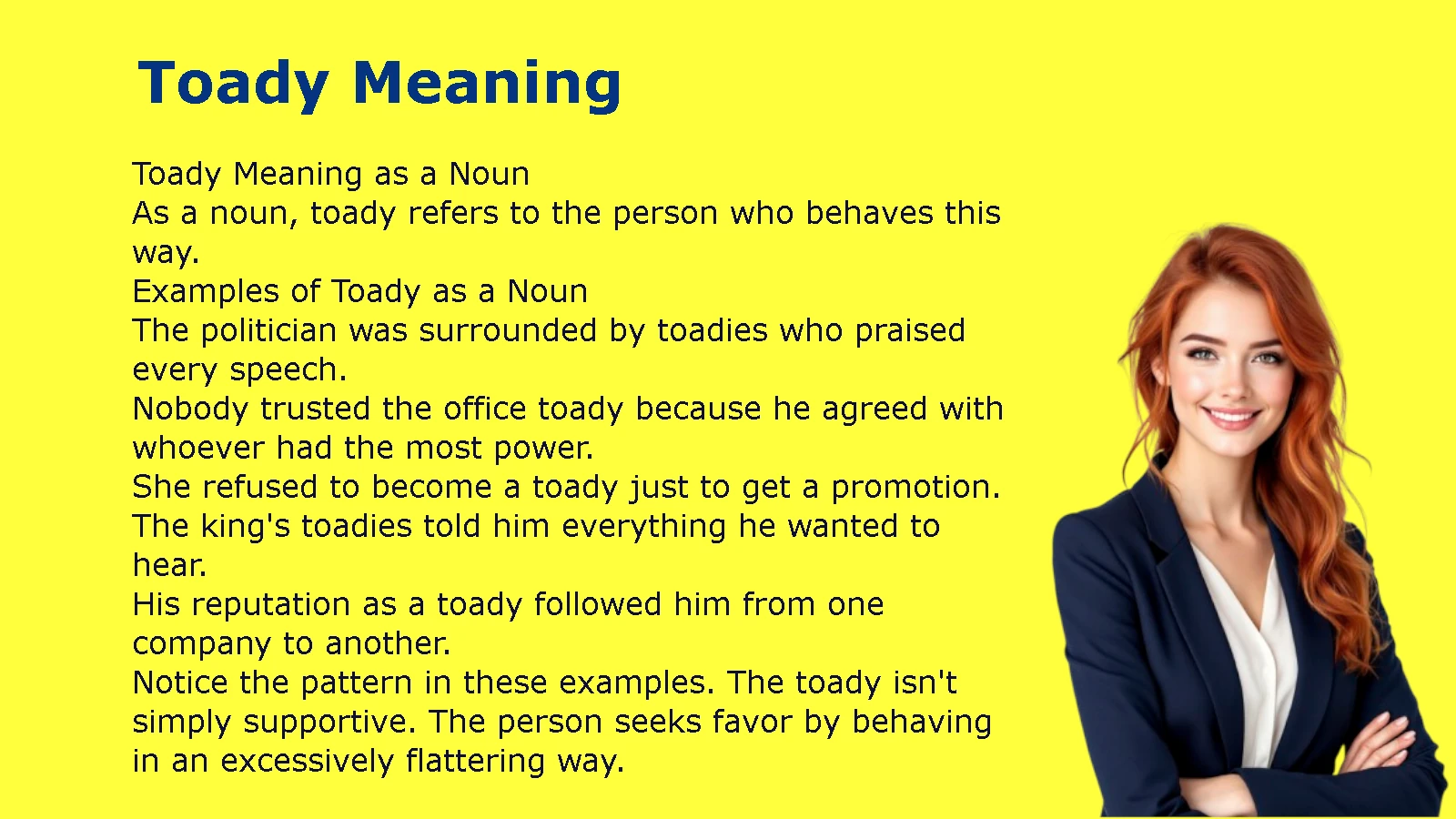
Toady Meaning as a Noun
As a noun, toady refers to the person who behaves this way.
Examples of Toady as a Noun
- The politician was surrounded by toadies who praised every speech.
- Nobody trusted the office toady because he agreed with whoever had the most power.
- She refused to become a toady just to get a promotion.
- The king’s toadies told him everything he wanted to hear.
- His reputation as a toady followed him from one company to another.
Notice the pattern in these examples. The toady isn’t simply supportive. The person seeks favor by behaving in an excessively flattering way.
That distinction matters.
A loyal employee can disagree with a manager while still supporting the team. A toady tends to avoid disagreement when doing so might threaten their access to power or rewards.
Toady Meaning as a Verb
Toady also functions as a verb. When you toady to someone, you behave like a toady toward that person.
In other words, you flatter or please someone excessively because you want something from them.
Examples of Toady as a Verb
- He constantly toadies to senior executives.
- She refused to toady to the director just to secure a better position.
- Some advisers toady to powerful leaders instead of giving honest opinions.
- The employee spent years toadying to anyone who could influence his career.
The verb often appears with to:
toady to someone
For example:
He toadies to the CEO whenever promotion decisions approach.
The structure makes the relationship clear: one person performs excessive pleasing behavior toward another person who has power or influence.
What Does It Mean to Be a Toady?
Being a toady involves more than giving compliments. It usually combines several behaviors.
Excessive Praise
A toady may praise someone far beyond what seems natural.
For example:
“Your presentation was brilliant. Honestly, nobody else in this company understands the business like you do.”
One compliment doesn’t make someone a toady. However, if the person makes exaggerated statements every time the boss enters the room, the behavior starts to look like toadying.
Seeking Favor
A toady usually has something to gain.
That advantage could involve:
- A promotion
- A pay increase
- Special treatment
- Access to influential people
- Protection from criticism
- A desirable assignment
- Political influence
- Social status
- Personal favors
The advantage doesn’t have to be immediate. Someone may flatter a powerful person because they hope that relationship will help them later.
Artificial Friendliness
The word also involves artificial pleasantness. Cambridge specifically includes this idea in its definition.
A person may behave warmly around an influential individual while treating everyone else very differently.
That’s one reason the word carries such a sharp edge. It suggests that the person’s friendliness isn’t entirely genuine.
Avoiding Honest Disagreement
A toady may also avoid saying what they really think.
Suppose a manager proposes a poor strategy. Five employees quietly point out the risks. One employee immediately says:
“It’s perfect. I wouldn’t change a thing.”
If that employee consistently behaves this way because they want to stay in the manager’s good graces, toady may accurately describe the pattern.
Toady Pronunciation
The American English pronunciation of toady is:
TOH-dee
The IPA pronunciation is /ˈtoʊ.di/. Cambridge gives the same American pronunciation while showing /ˈtəʊ.di/ for British English.
Break it into two parts:
TOH + dee
The word has two syllables, with the stress on the first syllable.
Is Toady Pronounced Like Today?
No.
Although the words look similar, toady and today have different meanings and slightly different pronunciation patterns.
| Word | Meaning | Pronunciation |
| toady | A person who excessively flatters someone powerful | TOH-dee |
| today | The current day | tuh-DAY |
| toddy | A type of drink or palm based alcoholic beverage | TAH-dee in US English |
The difference may look small on paper, but the meanings have nothing to do with each other.
Toady vs. Today
Toady and today are easy to confuse because they share almost the same letters.
They aren’t related in meaning.
Today is an adverb or noun referring to the current day.
For example:
I have a meeting today.
Toady, on the other hand, describes a person who flatters someone powerful for personal advantage.
The manager’s toady praised every decision she made.
A simple way to remember the distinction is:
today = this day
toady = a flatterer seeking favor
Common Spelling Mistake
If someone searches for toady meaning but accidentally types today meaning, they may land on an entirely different word.
The extra a matters:
- today
- toady
Don’t treat them as spelling variations. They are separate words.
Toady vs. Toddy
Another word that causes confusion is toddy.
Unlike toady, toddy refers to a drink. Cambridge defines it as a drink made from spirits mixed with hot water and sugar. The word can also refer to an alcoholic drink made from the sap of certain palm trees.
For example:
They ordered hot toddies on a cold evening.
The three words become much easier to distinguish when placed side by side:
| Word | Meaning |
| Today | The current day |
| Toady | A person who excessively flatters someone powerful |
| Toddy | A drink made with spirits, hot water, and sugar, or a palm sap drink |
These words may look like linguistic cousins, but their meanings take completely different paths.
Is Toady a Negative Word?
Yes. Toady is normally a negative word.
Calling someone a toady usually means you’re criticizing the person’s behavior.
The insult comes from the idea that the person sacrifices independence or honesty to gain favor.
For example:
He isn’t a loyal adviser. He’s a toady who tells the president whatever he wants to hear.
The speaker isn’t praising the adviser. The sentence suggests that the adviser values personal advantage over honest advice.
Cambridge places toady among vocabulary connected with insincere or overly eager praise.
Toady vs. Genuine Admirer
This distinction prevents one of the most common mistakes with the word.
| Genuine admirer | Toady |
| Gives sincere praise | Gives excessive or strategic praise |
| Can disagree | Often avoids disagreement |
| Doesn’t necessarily want anything | Usually seeks an advantage |
| Treats the person consistently | May act differently around powerful people |
| Respects the person’s qualities | Focuses heavily on pleasing the person |
A genuine admirer might say:
“I liked your proposal. The cost analysis was especially strong.”
A toady might say:
“Everything you do is brilliant. Nobody else here could possibly match you.”
The second statement sounds exaggerated because the praise has moved beyond ordinary appreciation.
Toady Synonyms
Several English words overlap with toady, but each carries its own shade of meaning.
Sycophant
Sycophant is probably the closest common synonym.
A sycophant uses excessive praise or submission to gain favor from someone influential.
The CEO quickly became surrounded by sycophants.
Both toady and sycophant usually imply insincere praise and personal gain.
Flatterer
A flatterer gives excessive or insincere praise.
However, the word doesn’t always imply a relationship with someone powerful. Someone can flatter another person for many reasons.
Therefore, flatterer has a broader meaning than toady.
Yes Man
A yes man is someone who agrees with a person in authority instead of expressing independent opinions.
The director needed honest advice, not a room full of yes men.
A yes man and a toady can be the same person, but the emphasis differs. Yes man focuses strongly on agreement, while toady focuses on flattering or pleasing someone for advantage.
Bootlicker
Bootlicker is an informal and strongly insulting word for someone who behaves submissively toward a powerful person.
It often sounds harsher than toady.
Brown Noser
Brown noser is an informal American expression for someone who tries to gain favor through excessive praise or obedience.
It works well in casual conversation but sounds less appropriate in formal writing.
Lackey
A lackey is a person who behaves like a servant or subordinate, especially for someone powerful.
The word can overlap with toady, but it doesn’t necessarily require excessive flattery.
Fawner
A fawner is someone who displays excessive admiration or praise.
It emphasizes the act of flattering rather than the broader relationship with authority.
Toady Synonyms Compared
| Synonym | Main emphasis | Tone |
| Toady | Flatters a powerful person for advantage | Negative |
| Sycophant | Excessive praise to gain favor | Strongly negative |
| Flatterer | Excessive or insincere praise | Negative or neutral |
| Yes man | Always agrees with authority | Negative |
| Bootlicker | Excessive submission | Very negative |
| Brown noser | Sucking up to gain favor | Informal, negative |
| Lackey | Servile subordinate | Negative |
| Fawner | Excessive admiration or praise | Negative |
Cambridge’s vocabulary around toady also includes terms such as bootlicker, crawler, grovel, obsequious, sycophantic, toadying, and truckle.
Toady vs. Sycophant
Toady and sycophant are close synonyms, but they aren’t always identical in feel.
A toady strongly suggests someone who attaches themselves to a person with power and tries to gain an advantage through flattering behavior.
A sycophant has a similar meaning and often sounds more formal.
Consider these examples:
The king was surrounded by toadies.
The CEO’s office attracted a new generation of sycophants.
Both sentences describe people who seek favor through excessive praise.
However, sycophant often appears in formal criticism, political commentary, academic writing, and serious discussion. Toady can sound more vivid and colorful.
How to Use Toady Correctly
The word works best when the context shows power, excessive pleasing, and personal advantage.
Use Toady When:
- Someone flatters a person in authority.
- The praise appears excessive or artificial.
- The person hopes to gain something.
- The relationship involves an obvious power imbalance.
- You want to criticize the person’s lack of independence.
Don’t Use Toady When:
- Someone simply gives a sincere compliment.
- An employee respectfully agrees with a manager.
- A friend genuinely admires another person.
- Someone offers helpful support without seeking special treatment.
- You have no reason to suggest that the person’s behavior is self serving.
Calling someone a toady makes a judgment. Use it when the evidence supports that judgment.
Toady Examples in Sentences
Here are examples across different situations.
Workplace Examples
- The supervisor’s toady praised every proposal without asking a single question.
- She wouldn’t toady to management just to receive a promotion.
- The company became unhealthy when honest employees were replaced by toadies.
- His habit of toadying to senior executives irritated his coworkers.
Political Examples
- The leader surrounded himself with political toadies who rarely challenged his decisions.
- The adviser was criticized for toadying to powerful officials.
- Independent voices disappeared as the leader promoted loyal toadies.
Social Examples
- He becomes a complete toady whenever wealthy guests arrive.
- She disliked people who toady to celebrities simply because they have influence.
Literary Examples
- The novel portrays the court toadies as ambitious people who trade honesty for access.
- The ruler’s toadies praised his decisions while ordinary citizens suffered the consequences.
These examples show why toady works especially well when describing relationships shaped by power.
Toadying Meaning
Toadying refers to the behavior of acting like a toady.
It describes excessive flattery, artificial friendliness, or submission toward someone who has power or influence.
For example:
The constant toadying around the chairman made honest discussion almost impossible.
The word focuses on the behavior, while toady can refer to the person.
| Word | What it describes |
| Toady | The person |
| Toadying | The behavior |
| Toadyish | Having qualities associated with a toady |
| Toady as a verb | The act of flattering someone for advantage |
Toadying can become especially damaging in organizations because leaders may stop receiving honest feedback.
If everyone around a decision maker agrees with everything, bad ideas can survive longer than they should.
Why Toadying Can Be a Problem
The word isn’t just an insult. It can describe a real problem in relationships involving unequal power.
Imagine a manager proposing an expensive project.
One employee says:
“The idea has potential, but the numbers don’t support it yet.”
Another employee says:
“It’s brilliant. You’re always five steps ahead of everyone else.”
If the second employee receives rewards for constant praise, other employees may learn an unfortunate lesson: honesty gets you ignored while flattery gets you noticed.
That environment encourages more toadying.
A Simple Workplace Case Study
Consider a fictional company with a senior executive who strongly dislikes criticism.
Three employees respond differently to a controversial proposal:
| Employee | Response | Likely role |
| Maya | Points out weaknesses and offers solutions | Independent adviser |
| Daniel | Agrees politely but raises concerns privately | Diplomatic employee |
| Chris | Praises every detail and asks for special access | Potential toady |
Chris isn’t necessarily a toady simply because he praises the executive. The pattern becomes important.
If Chris repeatedly exaggerates the executive’s brilliance, changes his opinions to match the executive, and seeks promotions through personal flattery, toady becomes a much more accurate description.
This illustrates an important feature of the word: context matters.
Toady and Power
The relationship between toadying and power sits at the heart of the word.
A person usually doesn’t toady to someone who has absolutely no influence over them. The target often has something the toady wants.
That power might come from:
- Wealth
- Political office
- Corporate authority
- Fame
- Social status
- Family influence
- Institutional control
- Professional connections
The person doesn’t always need formal authority. A celebrity, influential investor, popular leader, or well connected professional can attract toadies because their approval has value.
In this sense, toady describes a social strategy as much as a personality type.
The History and Etymology of Toady
The history of toady is unusually colorful.
Merriam Webster gives the first known use of the noun as 1826 and identifies its etymology as a shortened form related to toad eater.
The older expression toad eater appeared earlier. Etymological sources connect it with the idea of an assistant to a charlatan who supposedly ate a poisonous toad so that his master could demonstrate an ability to remove poison. The expression later developed the figurative meaning of a fawning flatterer.
Eventually, toad eater shortened to toady.
The timeline can be summarized like this:
| Period | Development |
| 1600s | Toad eater appears with a literal association involving supposed poison |
| 1700s | Toad eater develops the figurative sense of a fawning flatterer |
| 1826 | Toady appears as a noun meaning a servile flatterer or parasite |
| 19th century | The noun becomes established in English |
| Later | Toady develops regular verb forms such as toadying |
The history also explains why the word sounds more colorful than a straightforward term such as flatterer.
A Note About the Etymology
The commonly repeated explanation connects toady with toad eater, but historical sources note that the simple explanation isn’t completely certain. Etymological references also discuss possible influence from an older adjective toady, meaning loathsome, as well as an earlier noun referring to a young toad.
So the safest explanation is that toady is associated historically with toad eater, while the precise development has some uncertainty.
Toady Antonyms
There isn’t one perfect opposite for toady in every context.
The best opposite depends on which quality you want to emphasize.
Possible contrasts include:
- Independent person
- Truth teller
- Critic
- Nonconformist
- Straight shooter
- Independent thinker
- Outspoken adviser
For example:
The king preferred toadies, but his chief adviser was an independent thinker who challenged weak ideas.
Here, independent thinker provides a stronger contrast than simply using a dictionary style antonym.
The opposite of a toady isn’t necessarily someone who always disagrees. It’s someone who doesn’t abandon honest judgment merely to gain favor.
Toady in Different Contexts
Toady in the Workplace
Workplace use is common because offices naturally create differences in authority.
A toady might constantly praise a supervisor, volunteer for every task that brings visibility, or agree with management even when the evidence suggests otherwise.
The word works especially well when the behavior appears strategic.
Toady in Politics
Political writing frequently uses toady because political systems involve clear hierarchies and competing interests.
A politician, adviser, official, or commentator may be called a toady when critics believe that person flatters a powerful leader instead of offering independent judgment.
The term has appeared in political and historical contexts, including descriptions of people around rulers and governments. Cambridge’s corpus examples include political uses of toady and toadying.
Toady in Literature
Writers often use toady to reveal character quickly.
Calling a character a toady tells the reader several things at once:
- The character is connected to power.
- The character seeks approval.
- The character may lack independence.
- The character probably has a personal motive.
- The narrator or speaker disapproves of that behavior.
That’s a lot of information packed into five letters.
Common Mistakes With Toady
Mistake: Thinking Every Compliment Is Toadying
A sincere compliment isn’t automatically toadying.
Better distinction:
Sincere: “Your analysis helped me understand the problem.”
Toadying: “You’re the only person here capable of understanding anything.”
The second example contains exaggerated praise that may serve a strategic purpose.
Mistake: Using Toady as a Neutral Description
Toady is not normally neutral.
If you want a neutral term, consider:
- supporter
- admirer
- assistant
- follower
- colleague
- adviser
Use toady when you want to communicate criticism.
Mistake: Confusing Toady With Today
Remember:
today = the current day
toady = an excessive flatterer
Mistake: Assuming Toady Always Means “Servant”
A toady can act submissively, but servant isn’t an exact synonym.
The central idea involves flattery and gaining favor, not simply performing duties for another person.
Toady vs. Servile
The adjective servile describes someone who is too eager to serve or please another person in a way that suggests a lack of self respect. Cambridge marks this sense as disapproving as well.
These words overlap, but they aren’t interchangeable in every sentence.
Toady usually identifies a person who flatters someone powerful for advantage.
Servile focuses more broadly on excessive submission or eagerness to please.
For example:
He was a toady to the chairman.
This highlights his relationship with the chairman.
His servile behavior embarrassed his colleagues.
This highlights the submissive quality of his behavior.
Toady vs. Obsequious
Obsequious is another useful related word.
Someone who is obsequious is excessively eager to please someone important.
The difference is mainly grammatical and stylistic:
- toady is commonly a noun
- obsequious is an adjective
- toadying is a noun or participle describing the behavior
Examples:
The minister was a toady.
The minister was obsequious toward the president.
The minister’s toadying behavior drew criticism.
All three sentences describe related behavior, but each emphasizes something slightly different.
Quotes and Real Usage
Dictionary and corpus examples show that toady isn’t restricted to casual conversation. It appears in discussions of politics, government, leadership, workplaces, and social relationships.
Cambridge provides examples involving political toadies, government officials, and people who flatter powerful figures.
Merriam Webster also records the noun’s first known use as 1826, confirming that the modern noun has been established in English for roughly two centuries.
The historical record gives the word an interesting path: an expression involving a supposed toad eater eventually became a compact term for a person who flatters powerful people for personal gain.
Quick Facts About Toady
| Fact | Detail |
| Word | Toady |
| Primary meaning | A person who excessively flatters someone powerful for personal advantage |
| Part of speech | Noun and verb |
| US pronunciation | /ˈtoʊ.di/ |
| Common pronunciation | TOH-dee |
| Tone | Negative, disapproving |
| Plural | Toadies |
| Verb form | Toady |
| Present participle | Toadying |
| Past tense | Toadied |
| Close synonym | Sycophant |
| Related word | Toadying |
| First known noun use | 1826 |
| Common confusion | Today, toddy |
Frequently Asked Questions About Toady Meaning
What does toady mean in simple words?
Toady means a person who flatters someone powerful or influential to gain an advantage.
The word usually suggests that the person’s praise or friendliness isn’t completely sincere.
Is toady an insult?
Yes. Toady normally carries a negative or disapproving meaning.
Calling someone a toady suggests that they sacrifice honesty or independence to gain favor.
What is another word for toady?
Sycophant is one of the closest synonyms. Other possibilities include flatterer, yes man, bootlicker, brown noser, fawner, and lackey, although each has a slightly different emphasis or tone.
What does toady mean as a verb?
As a verb, toady means to behave like a toady by excessively flattering or trying to please someone who has power or influence.
For example:
He toadies to executives because he wants a promotion.
What does toadying mean?
Toadying means the act of behaving like a toady. It involves excessive flattery, artificial friendliness, or submission toward someone in a position of power.
Is toady the same as sycophant?
They’re very close in meaning.
Both describe people who use excessive praise or pleasing behavior to gain favor. Sycophant often sounds more formal, while toady can sound more vivid or pointed.
Is toady the same as today?
No.
Today means the current day.
Toady means a person who excessively flatters someone powerful for personal advantage.
Is toady the same as toddy?
No.
Toddy refers to a type of drink, including a hot alcoholic drink made with spirits, hot water, and sugar. It can also refer to a drink made from palm sap.
What is the opposite of a toady?
There isn’t one perfect antonym. Depending on context, independent thinker, truth teller, critic, or straight shooter can provide the clearest contrast.
Can you use toady for a woman?
Yes. Toady is not limited to men. You can use it for any person who behaves in the described way.
For example:
The executive had several toadies around her who competed for her approval.
What is the plural of toady?
The plural is toadies.
For example:
The ruler was surrounded by toadies.
The spelling changes from y to ies.
Final Takeaway: What Is the Meaning of Toady?
The toady meaning is straightforward once you understand the role of power and personal gain.
A toady is a person who excessively flatters or acts artificially pleasant toward someone in authority because they want an advantage. The word is normally negative and suggests that the person’s behavior lacks sincerity or independence.
As a noun, it identifies the person:
He is a toady who agrees with every decision his boss makes.
As a verb, it describes the behavior:
He constantly toadies to people in positions of power.
The closest everyday synonym is sycophant, although words such as yes man, flatterer, bootlicker, and brown noser can fit particular contexts.
Most importantly, don’t confuse toady with today or toddy. Today refers to the current day, while toddy refers to a type of drink. Toady, meanwhile, describes a person who uses excessive flattery to gain favor.
In short, when someone tells a powerful person exactly what they want to hear because they hope to get something in return, toady may be the word you’re looking for.




