Unactive or inactive: Inactive is the correct and widely accepted word in modern English. It describes someone or something that is not active, functioning, operating, or participating in an activity. Although unactive occasionally appears in older or unusual writing, it is uncommon and generally unsuitable for standard English. Whether you’re describing an inactive account, an inactive person, or an inactive machine, inactive is the word you should use.
The difference also involves English spelling rules, negative prefixes, adjectives, and related verbs such as activate and deactivate. Understanding these distinctions will help you choose the right word in everyday conversations, professional writing, emails, and technical descriptions.
| Question | Answer |
| Is it unactive or inactive? | Inactive is the standard and preferred spelling. |
| Is unactive a real word? | It is a rare, nonstandard form that you should generally avoid. |
| What does inactive mean? | Not currently active, operating, participating, or functioning. |
| What does inactive account mean? | An account that has experienced little or no activity for a period. |
| What is a synonym for inactive? | Dormant, idle, passive, unused, and unengaged. |
Unactive or Inactive: Which Is Correct?
Inactive is the correct choice in standard modern English. It describes a person, object, account, or system that is not currently active or functioning. The word unactive is occasionally encountered, but it is uncommon and does not sound natural in most contemporary English contexts.
For example:
- Correct: My social media account has been inactive for several months.
- Incorrect in standard usage: My social media account has been unactive for several months.
The distinction comes from how English forms negative words. The prefix in- commonly expresses the opposite of an adjective. Since active describes something that participates, operates, or performs an activity, adding in- creates its opposite: inactive.
Why Is Inactive the Correct Spelling?
The word inactive consists of two parts:
- In-: A negative prefix that expresses the opposite of something.
- Active: An adjective describing someone or something that participates, moves, works, or operates.
Together, they create a word that means not active.
Consider these related examples:
| Positive word | Negative form |
| Active | Inactive |
| Accurate | Inaccurate |
| Appropriate | Inappropriate |
| Complete | Incomplete |
| Visible | Invisible |
| Direct | Indirect |
| Effective | Ineffective |
These examples demonstrate a common English word-formation pattern. However, English does not use one negative prefix for every adjective. Some words take un-, others take in-, and some use im- or il-.
For example:
- Happy → Unhappy
- Possible → Impossible
- Legal → Illegal
- Active → Inactive
You cannot always create a standard English word by attaching un- to an existing adjective. The established form matters more than whether a newly created word seems logically understandable.
Practical tip: When you’re unsure about a negative adjective, check how established English usage forms its opposite instead of automatically adding un-.
Is Unactive a Real Word?
Unactive is a rare English formation that has appeared in historical and unusual usage. However, it is not the standard modern alternative to inactive. Most contemporary readers and writers expect inactive when they want to describe a lack of activity.
There is an important difference between a word being understandable and being appropriate in standard writing.
Someone might understand what you mean when you write unactive account. However, the conventional expression is inactive account. Using the established form makes your sentence clearer and more natural.
Here are some examples:
| Less natural usage | Standard usage |
| The account is unactive. | The account is inactive. |
| He became unactive after retirement. | He became inactive after retirement. |
| The machine remained unactive. | The machine remained inactive. |
| Several members are unactive. | Several members are inactive. |
You might encounter unactive in older texts, unusual word lists, or informal writing. That does not make it the preferred choice for contemporary communication.
Remember: Use inactive in academic assignments, business documents, website content, professional emails, and everyday writing.
Unactive vs. Inactive: Key Differences
Although both forms suggest the absence of activity, they differ significantly in standard usage and acceptance.
| Feature | Unactive | Inactive |
| Word status | Rare and generally nonstandard | Standard English |
| Modern usage | Uncommon | Very common |
| Meaning intended | Not active | Not active |
| Naturalness | Unnatural in most contexts | Natural and widely understood |
| Professional writing | Avoid | Recommended |
| Account descriptions | Not preferred | Correct |
| General recommendation | Avoid | Use |
The most important point is that you do not need unactive to communicate a separate meaning. Inactive already expresses the intended idea.
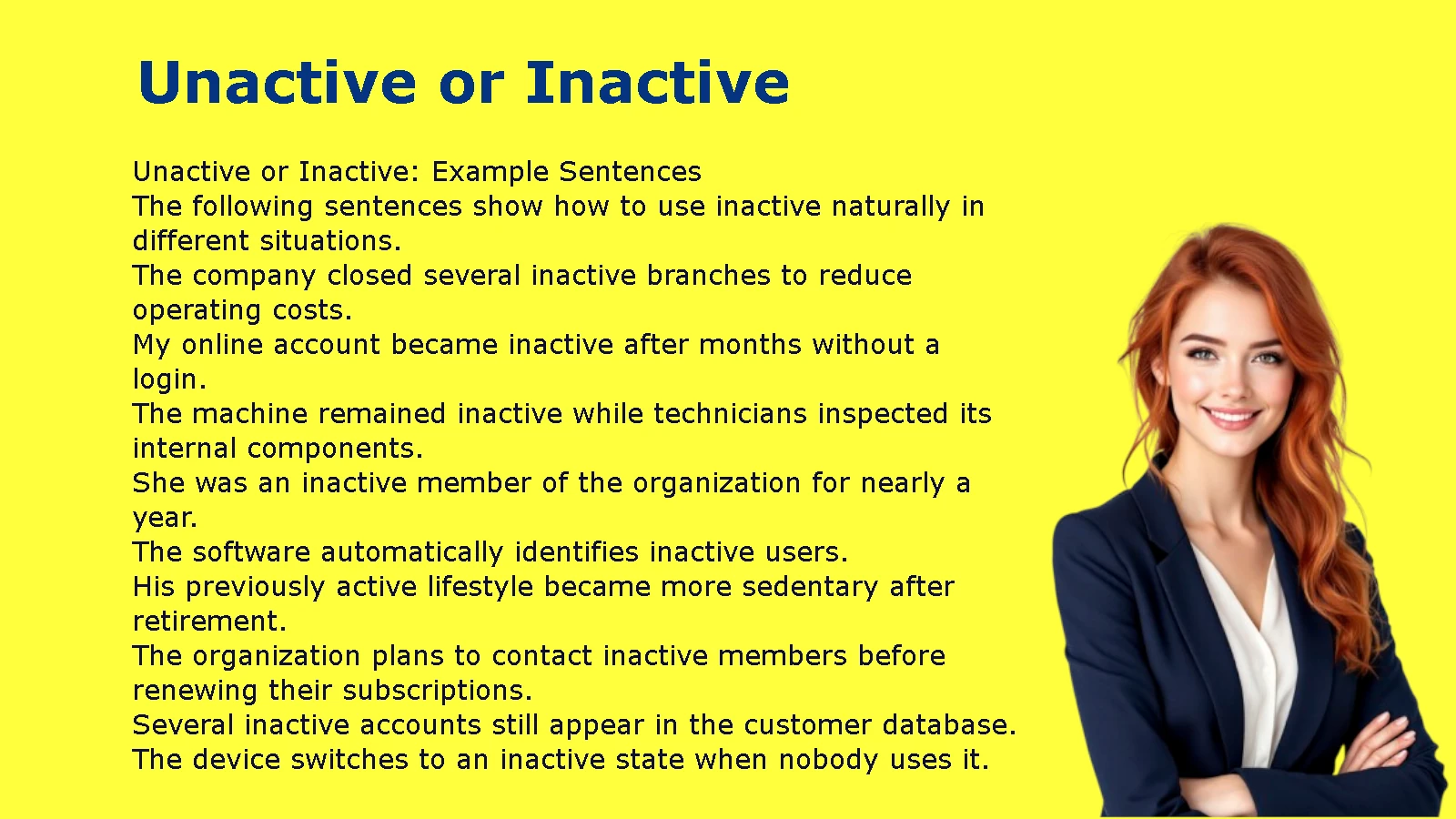
Unactive or Inactive: Example Sentences
The following sentences show how to use inactive naturally in different situations.
- The company closed several inactive branches to reduce operating costs.
- My online account became inactive after months without a login.
- The machine remained inactive while technicians inspected its internal components.
- She was an inactive member of the organization for nearly a year.
- The software automatically identifies inactive users.
- His previously active lifestyle became more sedentary after retirement.
- The organization plans to contact inactive members before renewing their subscriptions.
- Several inactive accounts still appear in the customer database.
- The device switches to an inactive state when nobody uses it.
- The club removed inactive participants from its current membership list.
Notice that inactive works with people, organizations, machines, devices, and accounts. Its meaning changes slightly according to the noun it describes, but the central idea remains the same.
Inactive Meaning and Definition
Inactive means not currently active, operating, functioning, moving, or participating in something. It describes a condition in which a person or thing does not engage in an expected activity. The word can refer to physical movement, social participation, business operations, technology, and account usage.
For example, an inactive employee may not participate in workplace activities, while an inactive machine may not be operating. An inactive bank or online account may have experienced no recent transactions or logins.
What Does Inactive Mean in Simple English?
In simple English, inactive means not doing anything or not taking part in an activity.
It does not always mean something has stopped working permanently. Sometimes inactivity is temporary. A person might take a break from exercise, a business might pause operations, or an online account might remain unused for several months.
Consider these simple examples:
- An inactive student does not participate in classroom activities.
- An inactive phone number is not currently being used.
- An inactive computer program is not running.
- An inactive club member does not regularly attend meetings.
- An inactive website has little or no recent activity.
The word can also describe something that remains available but is not currently being used.
For example, a spare computer in an office might remain inactive until an employee needs it. The computer still works, but nobody is using it at that moment.
Inactive Meaning in Different Contexts
The meaning of inactive depends on the subject. A person, account, machine, and organization can all be inactive for different reasons.
| Context | Inactive meaning | Example |
| Person | Not participating in an activity | He became inactive in the club. |
| Account | No recent usage or activity | Her account has been inactive for months. |
| Machine | Not currently operating | The inactive machine needs inspection. |
| Membership | Not participating regularly | The association contacted inactive members. |
| Business | Not currently conducting operations | The company has several inactive branches. |
| Lifestyle | Involving little physical activity | An inactive lifestyle can reduce fitness. |
| Website | Receiving little or no activity or updates | The website has remained inactive. |
| Software | Not currently running or engaged | The inactive application uses no active session. |
These distinctions matter because inactivity does not always mean the same thing as failure, deletion, or permanent closure.
For instance, an inactive account may still exist. An inactive machine may still function. An inactive employee may still hold their position.
Inactive Meaning in a Sentence
Here are additional examples that demonstrate how the adjective works naturally.
Everyday situations
- The park becomes inactive during the winter months.
- My old email account has remained inactive since 2022.
- The neighborhood association has several inactive members.
- He became less active after moving to a desk-based job.
Technology and business
- The system automatically marks inactive sessions after a period without activity.
- The company archived its inactive customer records.
- Several inactive applications need to be removed from the server.
- The software displays an inactive status beside unused accounts.
Education and organizations
- The teacher encouraged inactive students to participate in discussions.
- The organization removed inactive members from its mailing list.
- She returned to the club after two years of inactivity.
In each sentence, inactive describes a state rather than an action.
What Does an Inactive Account Mean?
An inactive account is an account that has experienced little or no activity for a particular period. The term commonly applies to banking, social media, email services, online platforms, subscriptions, and business systems. Each service determines inactivity according to its own policies, which may include login history, transactions, or other account activity.
For example, a social media platform might consider an account inactive when its owner stops logging in or interacting with content. A bank may use different criteria, such as the absence of customer-initiated transactions.
Unactive or Inactive Account: Which Is Correct?
The correct expression is inactive account, not unactive account.
Use inactive account when describing an account that has not been accessed, used, or engaged with recently.
Examples:
- Your account has been inactive for six months.
- The website automatically identifies inactive accounts.
- Please contact support if your account becomes inactive.
- We regularly review inactive customer accounts.
- The administrator removed several inactive accounts from the system.
In professional communication, this distinction is particularly important. Businesses use account-status descriptions to explain customer activity, subscription records, access permissions, and system maintenance.
For example, a customer support representative might write:
“Your account is currently inactive because we haven’t recorded any recent login activity.”
This sentence communicates the status without suggesting that the account has been permanently deleted.
What Happens When an Account Becomes Inactive?
An inactive account does not necessarily become unusable or permanently closed. What happens depends on the service provider and its account policies.
Some common possibilities include:
- Account notifications: The platform may send reminders asking the owner to sign in.
- Limited access: Certain services may restrict specific features after prolonged inactivity.
- Subscription changes: A subscription may expire or stop renewing under its terms.
- Security reviews: Some platforms may request additional verification before restoring access.
- Account deletion: Certain services may eventually remove accounts after extended inactivity, subject to their policies.
It is important to distinguish inactivity from account suspension.
An inactive account usually describes a lack of usage. A suspended account involves a restriction imposed by the service provider. A deleted account has been removed.
For example, someone who has not logged into an email account for a year might have an inactive account. However, someone whose account has been blocked for violating platform rules has a suspended account.
Difference Between Inactive, Dormant, and Disabled Accounts
These three terms often appear together in technology, banking, and customer management. However, they do not always describe the same situation.
| Term | Meaning | Example |
| Inactive account | An account with little or no recent activity | An email account unused for several months |
| Dormant account | An account that has remained unused for an extended period | A savings account with no qualifying activity |
| Disabled account | An account whose access or functionality has been restricted | A user account blocked by an administrator |
| Deleted account | An account that has been removed | A permanently removed social media profile |
Inactive vs. dormant: Inactive is a broad term. Dormant often suggests a longer period of inactivity, although the exact distinction depends on the organization.
Inactive vs. disabled: An inactive account may still work normally. A disabled account cannot perform certain functions because someone or something has restricted it.
Inactive vs. deleted: An inactive account still exists, whereas a deleted account has been removed.
Consider a practical example. A company might have 500 registered customers but notice that 80 have not logged in recently. Those 80 customers may be classified as inactive. The company could contact them before deciding whether to archive or remove their records.
Inactive Person Meaning
An inactive person is someone who does not regularly participate in a particular activity or engage in a specific situation. The expression can describe physical inactivity, limited social involvement, reduced workplace participation, or a lack of involvement in an organization.
However, it does not automatically mean that someone is lazy, careless, or unwilling to contribute. A person may be inactive because of personal circumstances, limited opportunities, changing priorities, or temporary breaks.
What Does It Mean When Someone Is Inactive?
When you describe someone as inactive, you mean that the person is not participating or engaging in an expected activity.
The exact interpretation depends on the context.
Physical inactivity
Someone who rarely exercises, walks, or participates in physical activities may have an inactive lifestyle.
Example: “He became physically inactive after switching to a remote office job.”
Social inactivity
A person who rarely attends gatherings, communicates with groups, or participates in social events may be socially inactive.
Example: “She has been inactive in the community group since moving to another city.”
Professional inactivity
An employee may be considered inactive in a particular project when they do not contribute to its activities.
Example: “The manager contacted inactive team members before assigning new responsibilities.”
Organizational inactivity
A member who stops attending meetings or contributing to an association may become inactive.
Example: “The club reviewed its inactive membership list before the annual election.”
These examples show why you should consider context before interpreting the word.
Examples of an Inactive Person
Here are practical sentences using inactive person and related expressions.
- An inactive person may spend most of the day sitting.
- The organization contacted every inactive member.
- He became inactive in the sports club after changing jobs.
- Several inactive participants returned to the program this year.
- The manager encouraged inactive employees to contribute their ideas.
- An inactive volunteer may still remain on the organization’s records.
You can also use the word in more specific expressions:
| Expression | Meaning |
| Physically inactive person | Someone who does little physical activity |
| Socially inactive person | Someone who rarely participates in social activities |
| Professionally inactive person | Someone not currently engaged in professional work |
| Politically inactive person | Someone who does not participate in political activities |
| Inactive member | A member who rarely participates in an organization |
Is Inactive the Same as Lazy?
No. Inactive and lazy do not mean exactly the same thing.
Inactive describes a person’s current level of participation or activity. Lazy suggests an unwillingness to make an effort or perform necessary work.
The distinction matters because inactivity does not always result from a lack of motivation.
For example:
- Someone recovering from an injury may be physically inactive but highly motivated.
- A retired employee may be professionally inactive but remain socially engaged.
- A club member may be inactive because they moved to another city.
- A student may be inactive in class because they feel uncomfortable speaking in groups.
Calling these people lazy would introduce an assumption that the word inactive does not contain.
Use inactive when you want to describe behavior without making a judgment about someone’s character.
Active and Inactive Meaning: What’s the Difference?
Active means participating, moving, working, or operating, while inactive means not currently participating, moving, working, or operating. These words are opposites, also known as antonyms. You can use them to describe people, accounts, machines, organizations, and many other situations.
For example, an active account receives regular usage, while an inactive account has little or no recent activity.
Active vs. Inactive Comparison Table
| Active | Inactive |
| Participating | Not participating |
| Operating | Not operating |
| Functioning | Not currently functioning |
| Engaged | Unengaged |
| Working | Idle |
| Involved | Not involved |
| Moving | Motionless |
| Regularly used | Unused |
The distinction is not always permanent. Something inactive today might become active tomorrow.
For example, an employee may be inactive during a holiday but return to work the following week. Similarly, a machine may remain inactive until an operator switches it on.
Active and Inactive Examples
The following examples show how these opposite words work in different contexts.
Accounts
- Active: The customer uses the account every week.
- Inactive: The customer has not accessed the account for several months.
Employees
- Active: She regularly contributes to team discussions.
- Inactive: He has not participated in recent project meetings.
Machines
- Active: The generator is supplying electricity.
- Inactive: The backup generator is not currently operating.
Memberships
- Active: Members attend meetings and participate in events.
- Inactive: Several members have stopped attending meetings.
Lifestyle
- Active: He walks, cycles, and exercises regularly.
- Inactive: He spends most of his day sitting.
When Should You Use Active or Inactive?
Choose between these words based on the actual condition you want to describe.
Use active when someone or something:
- Participates regularly.
- Performs a particular activity.
- Operates or functions.
- Shows engagement or involvement.
- Remains in use.
Use inactive when someone or something:
- Does not participate.
- Has stopped performing an activity.
- Is not currently operating.
- Shows little or no engagement.
- Remains unused for a period.
A useful writing technique is to ask yourself whether the subject is currently performing the action or simply exists without participating.
For example, an inactive employee is not necessarily unemployed. The person might still work for the company but have no involvement in a particular project.
Likewise, an inactive computer does not necessarily have a technical fault. It may simply be switched off.
Inactive Synonyms and Alternative Words
Common synonyms for inactive include dormant, idle, passive, unused, unengaged, motionless, and inoperative. However, these alternatives have slightly different meanings. The best choice depends on whether you are describing a person, account, machine, organization, or physical condition.
Choosing the right synonym can make your writing more precise and prevent misunderstandings.
Common Synonyms for Inactive
| Synonym | Meaning | Example |
| Dormant | Temporarily inactive or unused | The account remained dormant. |
| Idle | Not being used or occupied | The machine sat idle. |
| Passive | Not actively participating | He took a passive role. |
| Unused | Not currently being used | The equipment remained unused. |
| Motionless | Not moving | The object stayed motionless. |
| Inoperative | Not functioning | The device became inoperative. |
| Unengaged | Not involved in an activity | Several members remained unengaged. |
| Inert | Lacking movement or activity | The material remained inert. |
| Quiescent | Temporarily inactive or quiet | The system entered a quiescent state. |
| Disengaged | Not involved or connected | The employee became disengaged from the project. |
These alternatives are related, but they are not perfect replacements.
For example, motionless describes a lack of physical movement. It would not normally replace inactive when discussing a social media account.
Similarly, dormant suggests a period of inactivity during which something may become active again.
Best Synonyms for an Inactive Person
When describing a person, choose a synonym that explains the type of inactivity.
Idle
An idle person is not occupied with work or another activity.
Example: “The employees remained idle while the office equipment was being repaired.”
Passive
A passive person tends to avoid taking action or actively participating.
Example: “He played a passive role during the group discussion.”
Unengaged
An unengaged person shows little involvement or interest in a particular activity.
Example: “The instructor encouraged unengaged students to participate.”
Sedentary
A sedentary person spends much of their time sitting or doing very little physical activity.
Example: “A sedentary lifestyle can limit opportunities for regular movement.”
Uninvolved
An uninvolved person does not take part in a particular matter.
Example: “Several members remained uninvolved in the planning process.”
Notice that sedentary is more specific than inactive. It generally refers to physical behavior rather than a lack of social or professional participation.
Best Synonyms for an Inactive Account
For accounts and digital services, the most useful alternatives include:
- Dormant: An account that has remained unused for an extended period.
- Unused: An account that nobody currently uses.
- Disused: Something that was previously used but has fallen out of use.
- Unutilized: An account or resource that remains available but is not being used.
Examples:
- The dormant account requires a security review.
- Several unused profiles remain in the customer database.
- The company archived its disused accounts.
- The organization identified unutilized user licenses.
In most everyday situations, inactive account remains the clearest and most natural expression.
How to Choose the Right Synonym
Follow these steps before replacing inactive with another word.
Consider the subject. Are you describing a person, account, machine, or organization?
Identify the type of inactivity. Does the subject lack movement, participation, usage, or functionality?
Check the duration. Is the inactivity temporary, prolonged, or permanent?
Consider the tone. Words such as passive and disengaged may suggest behavior, while dormant and unused often describe a condition.
For example, if an account has not received any recent activity, dormant may work. If a machine is not operating because of a fault, inoperative is more precise.
Is Inactive a Verb or an Adjective?
Inactive is primarily an adjective, not a verb. It describes the condition of someone or something that is not active. When you want to express the action of making something inactive, use a verb such as deactivate, disable, or suspend, depending on the situation.
For example, “The account is inactive” describes its current condition, while “The administrator deactivated the account” describes an action.
What Part of Speech Is Inactive?
Inactive functions as an adjective because it describes a noun.
It can appear before a noun or after a linking verb.
Before a noun:
- The inactive account needs review.
- Several inactive members received reminders.
- An inactive machine remained in the storage room.
After a linking verb:
- The account is inactive.
- The system became inactive.
- Those members remain inactive.
In these examples, the adjective provides information about the condition of the noun.
You can also form the noun inactivity, which describes the state or period of being inactive.
Examples:
- Prolonged inactivity can affect productivity.
- The system entered a period of inactivity.
- The company reviewed its records after several months of inactivity.
Is Inactive a Verb?
No. In standard English, inactive is not normally used as a verb.
You should not write:
- The administrator will inactive the account.
- The company inactived the old system.
- Please inactive your membership.
Instead, use an appropriate verb:
- The administrator will deactivate the account.
- The company deactivated the old system.
- Please suspend your membership.
The verb depends on the action you want to describe.
Inactive vs. Deactivate: What’s the Difference?
These words are related, but they have different grammatical functions.
| Feature | Inactive | Deactivate |
| Part of speech | Adjective | Verb |
| Function | Describes a condition | Describes an action |
| Meaning | Not active | To make something inactive |
| Example | The account is inactive. | The administrator deactivated the account. |
Consider this practical example:
A business administrator decides to stop a former employee from accessing a company platform.
The administrator deactivates the employee’s account. After that action, the account becomes inactive.
The first word describes what the administrator does. The second describes the resulting condition.
Related Word Forms
Understanding related forms helps you use inactive correctly in different sentence structures.
| Word | Part of speech | Meaning | Example |
| Active | Adjective | Participating or operating | She is an active member. |
| Inactive | Adjective | Not participating or operating | She is an inactive member. |
| Activity | Noun | An action or process | Physical activity improves fitness. |
| Inactivity | Noun | The state of being inactive | Prolonged inactivity affected production. |
| Activate | Verb | To make something active | Activate your account to continue. |
| Deactivate | Verb | To make something inactive | Deactivate the unused account. |
| Actively | Adverb | In an active manner | She actively participates in meetings. |
| Activation | Noun | The process of making something active | Account activation takes a few minutes. |
| Deactivation | Noun | The process of making something inactive | Account deactivation requires approval. |
These word forms belong to the same word family, but you cannot use them interchangeably.
Common Mistakes When Using Inactive
Even though inactive is a straightforward word, writers sometimes confuse it with related terms or use it in the wrong grammatical form.
Understanding these mistakes will help you write more accurately.
Writing Unactive Instead of Inactive
The most common mistake is using unactive as a direct replacement for inactive.
Incorrect: The user has an unactive account.
Correct: The user has an inactive account.
Incorrect: The machine remained unactive overnight.
Correct: The machine remained inactive overnight.
Remember that the established negative form of active is inactive.
Confusing Inactive With Disabled
An inactive object is not necessarily disabled.
For example, a computer might be inactive because nobody is using it. However, a disabled computer account may have restricted access.
Compare these sentences:
- The employee’s account is inactive because they have not logged in recently.
- The administrator disabled the employee’s account after their departure.
The first describes a lack of activity. The second describes a deliberate restriction.
Using Inactive When You Mean Unavailable
Inactive and unavailable have different meanings.
An inactive service is not currently operating or being used. An unavailable service cannot be accessed or obtained at a particular time.
Examples:
- The website has been inactive for several months.
- The website is temporarily unavailable because of maintenance.
A website can be active overall but temporarily unavailable because of a technical problem.
Using Inactive and Dormant Interchangeably
Although these words overlap, they have slightly different implications.
Inactive broadly means not active. Dormant often suggests that something has remained inactive for an extended period but may become active again.
Examples:
- The account became inactive last week.
- The old account remained dormant for five years.
Use dormant when the longer period of inactivity matters. Use inactive when you simply want to describe the current status.
Frequently Asked Questions
Is It Unactive or Inactive?
Inactive is the correct and standard form in modern English. It describes someone or something that is not currently participating, functioning, or operating. Although unactive may appear in rare or unusual usage, inactive is the natural choice for everyday and professional writing.
Example: “My account has been inactive for three months.”
Is Unactive a Real Word?
Unactive is a rare English formation, but it is not the standard modern alternative to inactive. Most contemporary writers use inactive to describe something that is not active. Therefore, choose inactive in formal writing, business communication, academic work, and everyday conversations.
What Does Inactive Mean in Simple Words?
Inactive means not currently active or involved in something. It can describe a person who does not participate in activities, an account that is not being used, or a machine that is not operating.
For example, an inactive member does not regularly attend meetings.
What Does Inactive Mean for an Account?
An inactive account is an account that has experienced little or no activity for a certain period. A platform may use login history, transactions, or other activity to determine account status. Inactivity does not automatically mean that the account has been suspended or deleted.
What Is Another Word for Inactive?
Common alternatives include dormant, idle, passive, unused, unengaged, and inoperative. However, the best synonym depends on the context. Use dormant for something that has remained unused, idle for something not occupied, and inoperative for something that is not functioning.
Is Inactive a Verb?
No. Inactive is an adjective that describes a condition. The related verb deactivate means to make something inactive.
Example: “The account is inactive” describes a state, while “The administrator deactivated the account” describes an action.
Conclusion: Choose Inactive Instead of Unactive
When deciding between unactive or inactive, choose inactive. It is the established spelling in modern English and works naturally when describing people, accounts, machines, memberships, businesses, and systems.
The key is to understand how the word functions in a sentence. Inactive is an adjective, inactivity is a noun, and deactivate is a verb. Related words such as dormant, idle, and passive can also describe inactivity, but each carries a slightly different meaning.
Keep these points in mind:
- Use inactive, not unactive, in standard English.
- Write inactive account when describing an account with little or no recent activity.
- Use inactive person when someone does not participate in a particular activity.
- Remember that active and inactive are opposites.
- Use deactivate when describing the action of making something inactive.
Choose the established word, consider the context, and your writing will sound clearer and more natural.




