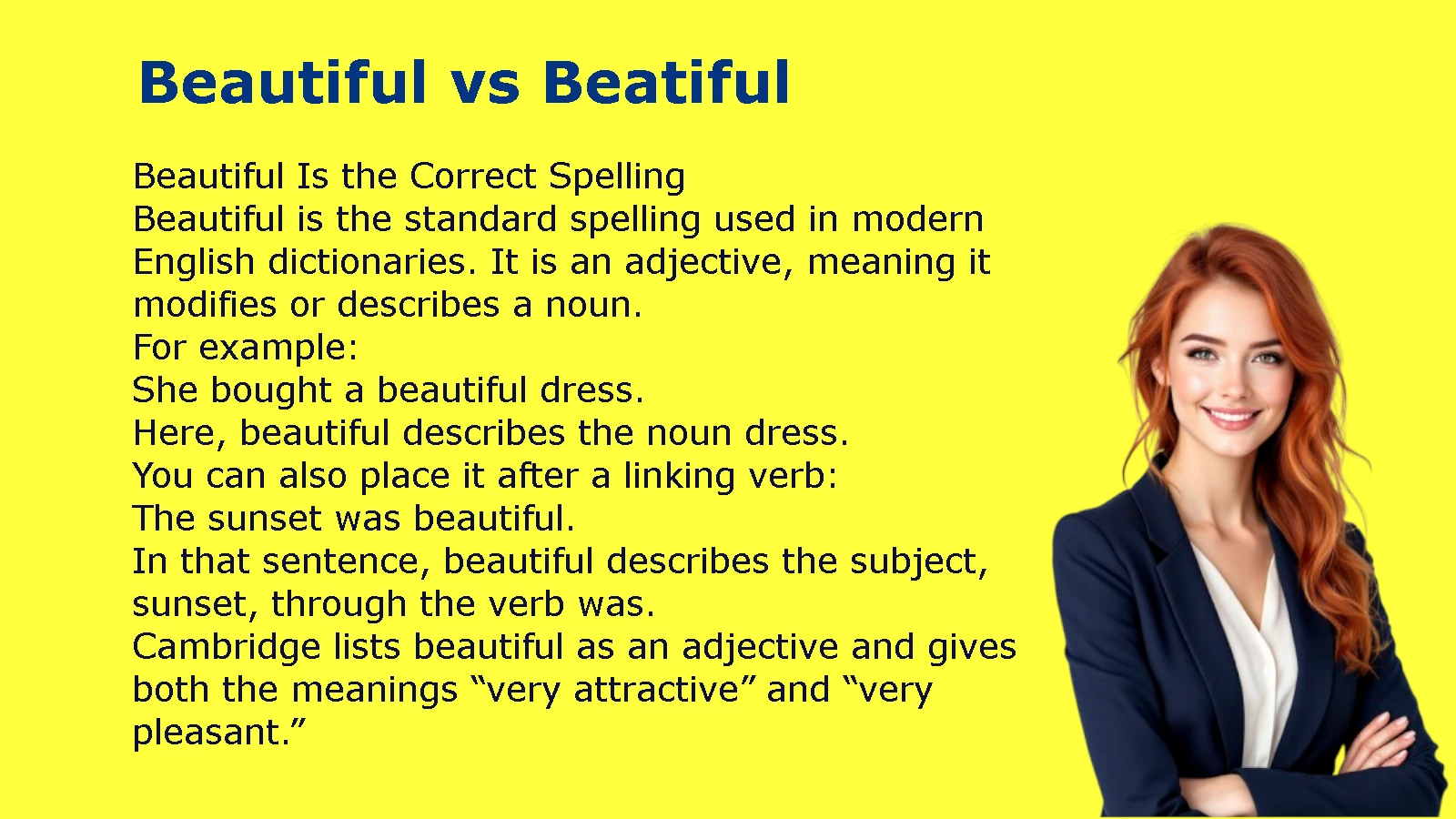
Beautiful is the correct spelling, while beatiful is a common misspelling of the word. If you’ve come across “beautiful” and “beatiful” and wondered which spelling is correct, the answer is straightforward: beautiful is the standard English spelling, and beatiful is incorrect. The word is commonly used to describe someone or something that is pleasing, attractive, or delightful.
The beautiful vs beatiful distinction is mainly a spelling issue. Beautiful is the correct adjective and can describe a person, place, object, experience, or quality. Beatiful does not have a separate meaning in standard English; it is usually written accidentally because the spelling of beautiful can be difficult to remember.
In this guide, you’ll learn whether “beautiful” or “beatiful” is correct, why “beatiful” is a common spelling mistake, what beautiful means, and how to use the correct spelling in sentences. You’ll also see clear examples, spelling tips, and related words to help you remember the correct form.
By the end, you’ll know exactly why beautiful is correct and how to avoid the common beatiful spelling mistake in your writing.
Beautiful vs Beatiful at a Glance
The answer is straightforward:
| Spelling | Correct? | Part of speech | Meaning |
| Beautiful | ✅ Yes | Adjective | Very attractive, pleasing, or admirable |
| Beatiful | ❌ No | — | Common misspelling of beautiful |
The correct spelling is beautiful
Beautiful contains all the letters in this order:
B-E-A-U-T-I-F-U-L
A useful way to visualize it is:
BEAU + TIFUL
The spelling begins with beau, not bea followed immediately by tiful.
Beatiful is a misspelling
Beatiful is missing the u after the a:
- ❌ beatiful
- ✅ beautiful
That missing letter is small, but it changes whether the spelling is standard English.
What does beautiful mean?
Beautiful generally describes something that produces a strong sense of attractiveness, pleasure, or admiration. Cambridge gives examples involving people, scenery, clothing, music, weather, and other things.
For example:
- She has beautiful eyes.
- We visited a beautiful beach.
- That was a beautiful piece of music.
- They live in a beautiful house.
- You wrote a beautiful poem.
- It was a beautiful gesture.
The word can therefore describe much more than physical appearance.
Beautiful Is the Correct Spelling
Beautiful is the standard spelling used in modern English dictionaries. It is an adjective, meaning it modifies or describes a noun.
For example:
She bought a beautiful dress.
Here, beautiful describes the noun dress.
You can also place it after a linking verb:
The sunset was beautiful.
In that sentence, beautiful describes the subject, sunset, through the verb was.
Cambridge lists beautiful as an adjective and gives both the meanings “very attractive” and “very pleasant.”
What Does Beautiful Mean?
The most common meaning of beautiful is very attractive or pleasing to look at.
It can describe:
- a person
- a landscape
- a building
- clothing
- artwork
- flowers
- photographs
- animals
For example:
The mountains looked beautiful after the snowfall.
However, beautiful isn’t limited to visual appearance.
It can describe something pleasing to hear:
She played a beautiful melody on the piano.
It can describe an enjoyable experience:
We had a beautiful evening together.
It can even describe an action or idea:
Helping someone in need was a beautiful thing to do.
Cambridge specifically notes that beautiful can also mean very pleasant and, in some uses, very kind.
How to Pronounce Beautiful
The pronunciation can also explain why some people find the spelling difficult.
Cambridge gives the UK pronunciation as approximately:
/ˈbjuː.tɪ.fəl/
and the US pronunciation as:
/ˈbjuː.t̬ə.fəl/.
In simple terms, you can think of it as:
BYOO-tuh-ful
The spelling contains several letters that aren’t pronounced as separate sounds. That’s one reason the written form isn’t always easy to predict from pronunciation alone.
Example Sentences With Beautiful
Here are examples showing how beautiful works in different contexts:
People
She wore a beautiful dress to the ceremony.
Nature
The lake looks beautiful at sunrise.
Places
They stayed in a beautiful village near the coast.
Objects
He gave her a beautiful necklace.
Music
The singer has a beautiful voice.
Writing
The author created a beautiful description of the countryside.
Experiences
We had a beautiful afternoon at the park.
Actions
It was beautiful of her to help the injured animal.
The important point is that beautiful can express aesthetic appeal, emotional pleasure, or admiration depending on context.
Why Is Beatiful Incorrect?
The spelling beatiful is incorrect because standard English spells the adjective beautiful.
The difference is only one letter:
BEATIFUL
BEAUTIFUL
The missing letter is U.
The Missing U in Beatiful
Compare the two spellings letter by letter:
| Position | Correct | Incorrect |
| 1 | B | B |
| 2 | E | E |
| 3 | A | A |
| 4 | U | — |
| 5 | T | T |
| 6 | I | I |
| 7 | F | F |
| 8 | U | U |
| 9 | L | L |
The first U is the problem.
Beautiful = B-E-A-U-T-I-F-U-L
Beatiful = B-E-A-T-I-F-U-L
So the easiest correction is simply:
Remember the U after A.
Why People Commonly Spell Beautiful as Beatiful
There are several practical reasons this mistake occurs.
First, pronunciation doesn’t clearly reveal every letter. The spoken word sounds roughly like “BYOO-tuh-ful,” so a learner may not naturally hear the written sequence -eau-.
Second, the word contains an unusual letter sequence. The combination eau isn’t as straightforward as many common English spelling patterns.
Third, typing quickly encourages omissions. When people already know what a word sounds like, they may type the sounds they expect rather than consciously reconstructing every letter.
Fourth, related words don’t provide a simple visual pattern. Someone may know beauty but still hesitate over beautiful.
This is why beatiful is understandable as a spelling mistake even though it isn’t the correct form.
Beautiful vs Beatiful Examples
Seeing the two forms side by side makes the distinction easier to remember.
Correct Examples With Beautiful
The garden is beautiful in the early morning.
She bought a beautiful painting for her living room.
What a beautiful sunset!
They live near a beautiful lake.
He gave a beautiful speech at the ceremony.
The children made a beautiful card for their teacher.
That was a beautiful song.
The old building has a beautiful design.
Incorrect Examples With Beatiful
These sentences contain the common spelling error:
❌ The garden is beatiful in the early morning.
She bought a beatiful painting.
❌ What a beatiful sunset!
The correction is simple:
✅ The garden is beautiful in the early morning.
She bought a beautiful painting.
✅ What a beautiful sunset!
A Quick Correction Test
Whenever you write beatiful, stop and check whether you included the first u:
BEA + U + TIFUL
If that U is missing, the spelling needs to be corrected.
How to Remember the Spelling of Beautiful
The biggest challenge with beautiful isn’t understanding its meaning. It’s remembering the unusual spelling.
Fortunately, you don’t need to memorize the whole word as one long sequence.
Break Beautiful Into Syllables
You can think of the word as:
BEAU-TI-FUL
Or, when focusing specifically on spelling:
BEAU + TIFUL
The first four letters are especially important:
B-E-A-U
That EAU sequence appears in several English words borrowed from French, although you shouldn’t assume every word containing these letters follows the same pattern.
For spelling practice, write:
beautiful
beautiful
beautiful
Then cover the word and reproduce it from memory.
A Simple Spelling Trick for Beautiful
A useful memory phrase is:
Beau is beautiful.
The beginning of beautiful is beau:
BEAU + TIFUL
You can also remember:
Beautiful has U twice.
Look closely:
B E A U T I F U L
There are two U’s:
- one after A
- another near the end, after F
That gives you a useful visual checkpoint:
BEA-U-TIF-U-L
This isn’t a formal spelling rule. It’s simply a memory aid.
Another Useful Connection: Beauty
The related noun beauty also begins with BEAU:
BEAUTY
BEAUTIFUL
That shared beginning can help reinforce the correct spelling.
Cambridge lists beauty and beautiful as related vocabulary, while its pronunciation guide gives beauty as /ˈbjuː.ti/ in British English and /ˈbjuː.t̬i/ in American English.
Beautiful in Different Forms
The word beautiful belongs to a broader family of related words. Understanding those forms makes it easier to use them correctly.
Beautiful as an Adjective
Beautiful is an adjective.
It describes a noun:
She has a beautiful voice.
We visited a beautiful city.
He bought a beautiful watch.
The adjective can appear before a noun or after a linking verb:
It was a beautiful day.
The day was beautiful.
Beautifully as an Adverb
Beautifully is the adverbial form.
It describes how an action is performed or how something happens.
She sings beautifully.
The room was beautifully decorated.
He explained the idea beautifully.
Cambridge defines beautifully as doing something in a very attractive or pleasant way.
Compare:
She has a beautiful voice.
Here, beautiful describes voice.
She sings beautifully.
Here, beautifully describes sings.
That’s the basic grammatical difference.
Beauty as a Noun
Beauty is a noun.
It refers to the quality or state associated with being beautiful.
The beauty of the mountains attracted thousands of visitors.
She admired the beauty of the painting.
The relationship is easy to see:
beauty → noun
beautiful → adjective
beautifully → adverb
Beautify as a Verb
Beautify is a verb meaning to make something more beautiful or attractive.
For example:
The city plans to beautify the public park.
They planted flowers to beautify the entrance.
This gives you a useful word family:
| Word | Part of Speech | Example |
| Beauty | Noun | The beauty of the landscape was remarkable. |
| Beautiful | Adjective | The landscape was beautiful. |
| Beautifully | Adverb | The landscape was beautifully photographed. |
| Beautify | Verb | They planted flowers to beautify the area. |
Beautiful Synonyms and Related Words
Beautiful has many synonyms, but they aren’t interchangeable in every sentence.
| Synonym | Typical use |
| Attractive | General physical appeal |
| Lovely | Pleasant, charming, or attractive |
| Gorgeous | Very attractive or impressive |
| Stunning | Extremely impressive or striking |
| Pretty | Attractive, often with a softer tone |
| Elegant | Attractive because of style or refinement |
| Glamorous | Attractive in a stylish or luxurious way |
| Magnificent | Extremely impressive, often because of size or grandeur |
| Charming | Pleasant and appealing, often in personality or character |
For example, beautiful and attractive overlap when describing appearance:
She is beautiful.
She is attractive.
However, beautiful can carry a broader emotional or aesthetic sense:
It was a beautiful gesture.
Calling the gesture attractive would not normally convey the same meaning.
Cambridge’s thesaurus groups words such as attractive, good-looking, handsome, pretty, and gorgeous around the meaning of a beautiful person or thing.
Beautiful vs Beauty vs Beautifully
These three words are closely related but perform different grammatical jobs.
| Word | Part of Speech | What it does | Example |
| Beautiful | Adjective | Describes a noun | She has a beautiful smile. |
| Beauty | Noun | Names a quality or concept | Her beauty was obvious. |
| Beautifully | Adverb | Describes an action or manner | She smiled beautifully. |
Beautiful
Use beautiful when you need to describe someone or something.
It is a beautiful painting.
Beauty
Use beauty when you are talking about the quality itself.
The beauty of the painting is difficult to describe.
Beautifully
Use beautifully when you need to describe how something is done.
The painting is beautifully displayed.
A useful test is to ask what you’re describing.
- Describing a thing → beautiful
- Naming a quality → beauty
- Describing how something happens → beautifully
Common Mistakes With Beautiful
Beatiful isn’t the only spelling error associated with this word.
Because beautiful has an unusual letter sequence, several variations can appear in informal writing.
Beatiful vs Beautiful
This is the mistake discussed throughout this article.
❌ beatiful
✅ beautiful
The incorrect version drops the first u.
Beautifull vs Beautiful
Some writers add an extra l:
❌ beautifull
✅ beautiful
The correct spelling ends with:
-ful
not:
-full
This is a useful distinction because the suffix -ful usually contains one l when added to a word.
For example:
- helpful
- useful
- careful
- beautiful
Beautifal vs Beautiful
Another possible spelling mistake is:
❌ beautifal
✅ beautiful
The ending is -ful, not -fal.
Beutiful vs Beautiful
Some writers transpose the letters near the beginning:
❌ beutiful
✅ beautiful
The correct beginning is:
BEAU
not:
BEU
These mistakes are different, but they all point toward the same solution: pay particular attention to the spelling of the first half of beautiful.
How to Use Beautiful in a Sentence
The flexibility of beautiful is one reason the word is so common.
Beautiful for People
Use it to describe someone’s appearance:
She looked beautiful in her new dress.
You can also use it for someone’s qualities in a broader sense:
She has a beautiful personality.
However, context matters. Beautiful can sound personal or complimentary when applied directly to someone, so the appropriate wording depends on your relationship and situation.
Beautiful for Places and Nature
This is one of the most common uses:
The valley is beautiful in autumn.
We saw a beautiful waterfall during the hike.
The beach was beautiful at sunset.
Natural scenery is frequently described as beautiful because the word conveys visual appeal and admiration.
Beautiful for Things and Experiences
The word can describe objects and experiences:
That’s a beautiful piece of jewelry.
We had a beautiful evening.
She gave me a beautiful gift.
In these examples, beautiful doesn’t necessarily mean visually perfect. It can communicate that something feels especially pleasing, meaningful, or memorable.
Beautiful for Ideas and Qualities
The word can also have a figurative meaning:
That’s a beautiful idea.
It was a beautiful gesture.
They created a beautiful solution to the problem.
Here, beautiful expresses admiration rather than physical appearance.
This broader use is important because treating beautiful as simply “pretty” misses part of its actual range.
Is Beatiful a Word?
Beatiful is not the standard spelling of the adjective beautiful.
If you are trying to write the adjective meaning attractive or pleasing, use:
beautiful
not:
beatiful
The confusion is understandable because beatiful differs from the correct form by only one letter. Nevertheless, in standard English writing, the missing u makes it a spelling error.
A dictionary search for the word you intend should therefore lead you to beautiful rather than treating beatiful as a separate standard adjective.
Where Does the Word Beautiful Come From?
The spelling becomes a little easier to understand when you look at the history of the word.
Beautiful dates to the mid-15th century, according to the Online Etymology Dictionary. It developed from beauty + -ful, with the historical sense referring to something pleasing to the eye, ear, mind, or soul.
The noun beauty itself has older French and Anglo-French roots. Etymonline traces it through Anglo-French and Old French forms ultimately connected with Latin bellus, meaning attractive, handsome, charming, or pretty.
That history helps explain the spelling connection between:
beauty → beautiful
Rather than thinking of beautiful as an arbitrary collection of letters, you can recognize that it developed from the older word beauty plus the suffix -ful.
This isn’t a modern spelling trick. It reflects the historical structure of the word.
Beautiful in Different Languages
The English word beautiful has equivalents in many languages, although exact translations depend on gender, number, context, and register.
Beautiful in Spanish
Common Spanish equivalents include:
- hermoso
- hermosa
- bello
- bella
- precioso
- preciosa
Cambridge lists hermoso, bello, and precioso among Spanish translations of beautiful.
The appropriate choice depends on the noun and the intended nuance.
Beautiful in French
Common French equivalents include:
- beau
- belle
- magnifique
- superbe
French changes some adjectives according to grammatical gender, so beau and belle are not interchangeable in every sentence.
The important point for English learners is that these translations don’t change the English spelling:
beautiful
Whether you’re translating from another language or learning English vocabulary, the standard English form remains beautiful.
A Simple Case Study: Correcting a Common Spelling Error
Consider this sentence:
“The view from the mountain was beatiful.”
At first glance, the sentence looks fine. The problem isn’t grammar, word choice, or punctuation. It is the spelling of the adjective.
Step 1: Identify the intended word
The writer means that the view was very attractive.
The intended word is beautiful.
Step 2: Compare the spelling
Written version:
BEATIFUL
Correct version:
BEAUTIFUL
Step 3: Find the missing letter
The incorrect version lacks the U after A.
Step 4: Correct the sentence
The view from the mountain was beautiful.
This example shows why proofreading can be more effective when you examine difficult words letter by letter rather than relying only on how they sound.
Beautiful Spelling Tips for Students and Writers
If beautiful is a word you frequently misspell, use a few practical habits.
Keep the BEAU Beginning
Remember:
BEAU + TIFUL
The first four letters are B-E-A-U.
Remember the Two U’s
There are two u letters in the standard spelling:
BEA U TIF U L
If you write beatiful, you’ve lost the first one.
Connect It to Beauty
Think:
beauty → beautiful
The words share the same beau beginning.
Don’t Spell by Sound Alone
The pronunciation doesn’t give you a perfect letter-by-letter map.
Cambridge’s pronunciation is approximately BYOO-tuh-ful in American English and BYOO-ti-ful in British English.
So if you try to construct the spelling entirely from the sounds, you’re more likely to leave out a letter.
Save the Correct Visual Pattern
For frequent writing, the most useful visual pattern is simply:
BEAUTIFUL
Seeing the correct form repeatedly helps build recognition, which is often faster than reconstructing the spelling from pronunciation every time.
Beautiful vs Beatiful: Quick Comparison
Here’s the answer in one final table:
| Feature | Beautiful | Beatiful |
| Standard English spelling | ✅ | ❌ |
| Dictionary adjective | ✅ | ❌ |
| Means attractive or pleasing | ✅ | ❌ |
| Contains the first U | ✅ | ❌ |
| Used in formal writing | ✅ | ❌ |
| Common spelling mistake | No | Yes |
If you’re unsure, choose beautiful.
Frequently Asked Questions About Beautiful vs Beatiful
Is it beautiful or beatiful?
The correct spelling is beautiful.
Beatiful is a misspelling because it leaves out the u after the a.
✅ She looks beautiful.
❌ She looks beatiful.
How do you spell beautiful correctly?
Spell it:
B-E-A-U-T-I-F-U-L
A useful memory trick is:
BEAU + TIFUL
You can also remember that beautiful contains two U’s.
Why is beautiful spelled with a “u”?
The spelling is connected to the historical development of the word from beauty + -ful. The Online Etymology Dictionary dates beautiful to the mid-15th century and traces it to this formation.
The u is therefore part of the established spelling of the word.
What is the meaning of beautiful?
Beautiful is an adjective meaning very attractive or pleasing. It can describe appearance, scenery, music, experiences, ideas, actions, and other things.
For example:
The flowers are beautiful.
She has a beautiful voice.
That was a beautiful gesture.
How do you pronounce beautiful?
Cambridge gives the UK pronunciation as /ˈbjuː.tɪ.fəl/ and the US pronunciation as /ˈbjuː.t̬ə.fəl/.
A simple approximation is:
BYOO-tuh-ful
What is the difference between beautiful and beauty?
Beautiful is an adjective:
It is a beautiful painting.
Beauty is a noun:
The beauty of the painting is remarkable.
In short:
beautiful = describes something
beauty = names the quality
What is the difference between beautiful and beautifully?
Beautiful is an adjective:
She has a beautiful voice.
Beautifully is an adverb:
She sings beautifully.
Cambridge defines beautifully as doing something in a very attractive or pleasant way.
Is beatiful a word?
Beatiful is not the standard spelling of the English adjective beautiful.
If you mean “very attractive” or “very pleasant,” the correct form is beautiful.
What are common misspellings of beautiful?
Common errors include:
- beatiful
- beutiful
- beautifull
- beautifal
The standard spelling is:
beautiful
What are some synonyms for beautiful?
Depending on context, possible synonyms include:
- attractive
- lovely
- gorgeous
- stunning
- pretty
- elegant
- charming
- magnificent
The best choice depends on what you’re describing and the tone you want.
Final Answer: Beautiful or Beatiful?
The correct spelling is beautiful.
Beatiful is a common misspelling caused mainly by leaving out the u after a.
Remember the correct pattern:
B-E-A-U-T-I-F-U-L
A simple way to memorize it is BEAU + TIFUL or to remember that beautiful has two U’s.
The word is an adjective meaning very attractive, pleasing, or admirable, and it can describe people, places, objects, music, experiences, ideas, and actions. Cambridge confirms its use for both things that are very attractive and things that are very pleasant.
So when you’re deciding between beautiful vs beatiful, there’s no need to hesitate:
Beautiful is correct. Beatiful is incorrect.




