The correct spelling is rhythm, while rythm is a common misspelling. If you’ve ever wondered whether to write “rhythm” or “rythm,” the confusion is understandable because the word has an unusual spelling and does not contain the vowel pattern many people expect. The term rhythm is commonly used when talking about music, beats, timing, movement, patterns, poetry, dance, and repeated sounds or actions.
The rhythm meaning refers to a regular pattern of sounds, beats, movements, or events that creates a sense of timing or flow. Rhythm is the standard and correct spelling in English, while rythm is not considered a standard English spelling. Similar terms such as beat, tempo, cadence, meter, pattern, and flow are related to rhythm, but they do not always mean exactly the same thing.
In this guide, you’ll learn whether “rhythm” or “rythm” is correct, why “rythm” is a common spelling mistake, what rhythm means, and how to use the word correctly in sentences. You’ll also see clear examples and comparisons to make the difference between the two spellings easy to remember.
By the end, you’ll know exactly why rhythm is correct, why rythm is incorrect, and how to use rhythm naturally and correctly in everyday English.
Rhythm vs Rythm at a Glance
Here is the quickest way to remember the difference:
| Word | Correct? | Meaning |
| Rhythm | Yes | A regular pattern of sounds, beats, movements, or changes |
| Rythm | No | Common misspelling of rhythm |
The correct spelling is rhythm
The standard spelling is:
R-H-Y-T-H-M
The incorrect form is:
R-Y-T-H-M
The main difference is the first h after r.
For example:
The drummer maintained a steady rhythm throughout the song.
Not:
The drummer maintained a steady rythm throughout the song.
Rhythm is the form you should use in school assignments, professional writing, articles, emails, academic work, and other standard English contexts.
Is rythm a word?
Rythm is not the standard English spelling of the word. If you intend to describe a pattern of beats, sounds, movements, or recurring events, use rhythm.
This distinction matters because a spell-checker may flag rythm even when the surrounding sentence is grammatically correct.
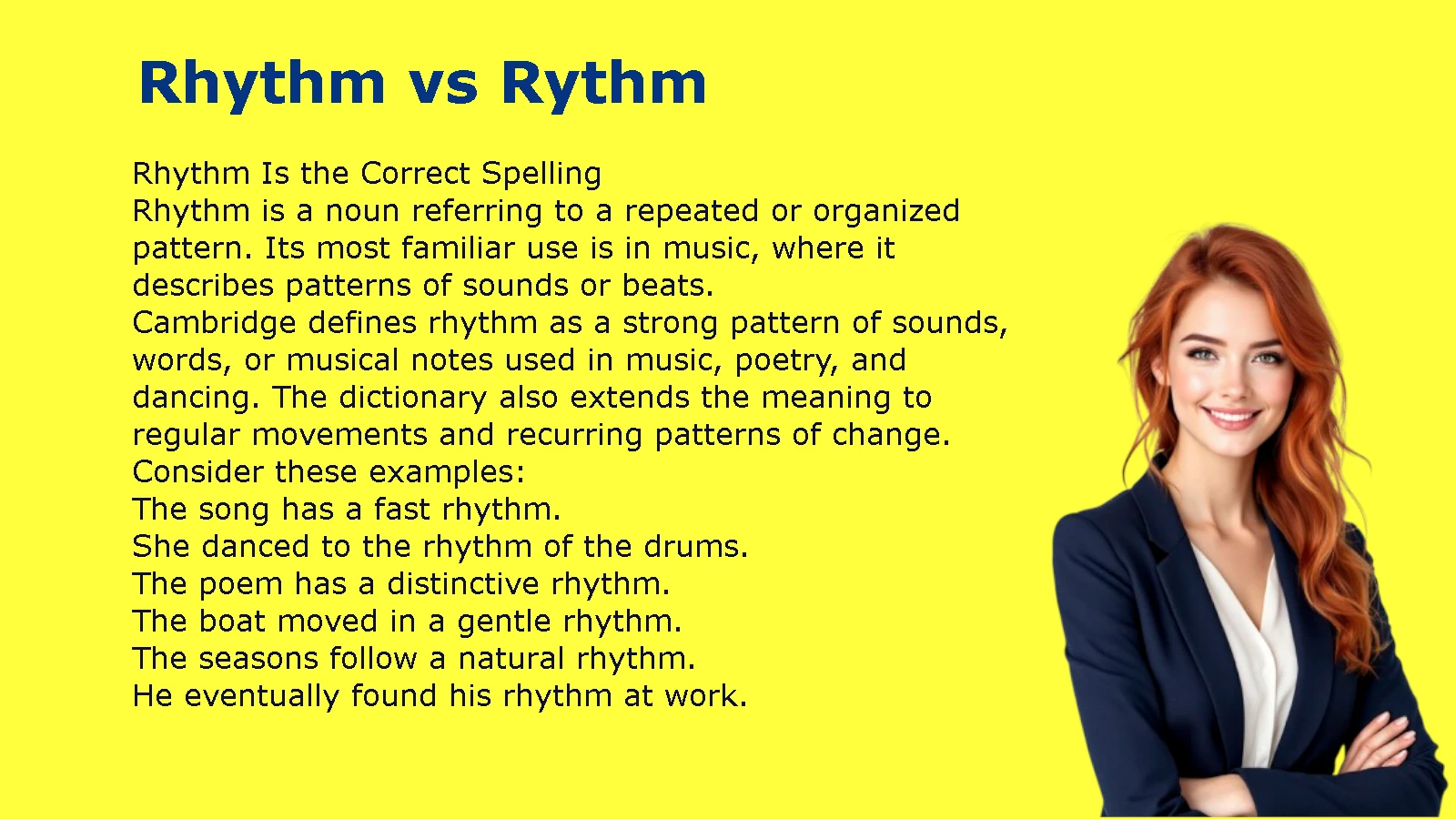
Rhythm Is the Correct Spelling
Rhythm is a noun referring to a repeated or organized pattern. Its most familiar use is in music, where it describes patterns of sounds or beats.
Cambridge defines rhythm as a strong pattern of sounds, words, or musical notes used in music, poetry, and dancing. The dictionary also extends the meaning to regular movements and recurring patterns of change.
Consider these examples:
- The song has a fast rhythm.
- She danced to the rhythm of the drums.
- The poem has a distinctive rhythm.
- The boat moved in a gentle rhythm.
- The seasons follow a natural rhythm.
- He eventually found his rhythm at work.
The word therefore isn’t limited to music. Its central idea is a pattern or flow that repeats or develops in an organized way.
Rhythm as a musical term
In music, rhythm concerns the organization of sounds and silences through time.
A song can have a simple rhythm or a highly complex one. Different rhythms can create different feelings of movement, tension, stability, or energy.
For example:
The percussion section gives the song its driving rhythm.
A listener may recognize a rhythmic pattern even without knowing anything about music theory.
Rhythm in poetry
Rhythm also plays an important role in poetry. The arrangement of stressed and unstressed syllables can create a recognizable pattern.
For instance, English poetry often uses metrical patterns such as iambic pentameter. Rhythm contributes to how a line sounds when spoken aloud.
That means rhythm and rhyme are not interchangeable. A poem can have rhythm without rhyming.
Rhythm as a recurring pattern
The word can also describe regular changes or movements outside art.
Cambridge gives examples involving biological rhythms and recurring patterns such as the rhythm of the seasons.
You might therefore say:
My sleep rhythm changed after starting the night shift.
Or:
The city has a completely different rhythm on weekends.
In both cases, the word refers to a recognizable pattern rather than a musical beat alone.
Why Is Rythm Incorrect?
The spelling rythm is usually created by leaving out the first h in rhythm.
Because the first h is not pronounced as a separate sound, it is easy to overlook when writing the word.
Compare the two:
- rhythm — correct
- rythm — incorrect
The pronunciation does not clearly reveal the spelling. You hear something close to RITH-um, but there is no obvious sound corresponding to the written h after the initial r.
That makes rhythm an unusually difficult spelling for many English learners and native speakers alike.
Why people write rythm
Several factors can contribute to the mistake:
- The word has an unusual consonant-heavy spelling.
- The first h is not pronounced independently.
- The vowel pattern is unfamiliar.
- The pronunciation does not closely mirror every letter.
- Writers may remember the sound rather than the visual spelling.
- Typing quickly can make the missing h easy to overlook.
The important point is that rythm does not represent a different meaning. In ordinary English writing, it is simply a misspelling of rhythm.
Rhythm vs Rythm Examples
Seeing the two forms side by side makes the distinction easier to remember.
Correct Examples With Rhythm
Here are examples using the correct spelling:
- The drummer established a steady rhythm.
- I love the rhythm of this song.
- She has an excellent sense of rhythm.
- The dancers moved with the rhythm of the music.
- The poem has a gentle rhythm.
- The waves created a calming rhythm.
- His daily rhythm changed after he started working remotely.
- The team finally found its rhythm during the second half.
- The baby fell asleep to the rhythm of the rocking chair.
- The changing seasons create a natural rhythm.
Each sentence uses rhythm because the word refers to a pattern of sound, movement, activity, or change.
Incorrect Examples With Rythm
These sentences contain the common spelling error:
- The song has a strong rythm.
- She struggled to follow the rythm of the music.
- The poem has an unusual rythm.
- He has a good sense of rythm.
The corrected versions are:
- The song has a strong rhythm.
- She struggled to follow the rhythm of the music.
- The poem has an unusual rhythm.
- He has a good sense of rhythm.
A useful editing habit is to look specifically for rhythm when proofreading. It is easy for a missing h to slip past a quick visual scan.
What Does Rhythm Mean?
The meaning of rhythm depends somewhat on context, but the underlying idea is a repeated or organized pattern.
Rhythm in music
In music, rhythm refers to the pattern of sounds and beats over time.
For example:
The drummer changed the rhythm before the chorus.
Here, rhythm concerns how the musical sounds are arranged in time.
It is related to the beat, but the two terms are not always identical. A beat can provide a regular underlying pulse, while rhythm can involve the particular arrangement of sounds around that pulse.
Rhythm in poetry
Poetic rhythm comes from the pattern created by syllables, stresses, pauses, and other elements of speech.
For example, reading a poem aloud can reveal a rhythm that may be less obvious when the words are viewed silently.
A writer may deliberately alter rhythm to make a line sound faster, slower, more dramatic, more conversational, or more musical.
Rhythm in movement
The word can describe repeated physical movement as well.
The boat rocked in a steady rhythm.
Here, the word does not refer to music. It describes the repeated movement of the boat.
Rhythm in daily life
English speakers frequently use rhythm metaphorically to describe routines and patterns.
You might say:
Once I settled into a regular work rhythm, I became more productive.
The meaning is close to routine, flow, or recurring pattern, depending on the context.
How Do You Spell Rhythm?
The correct spelling is:
R-H-Y-T-H-M
One useful way to break it down visually is:
RH + YTH + M
The most important thing to remember is that rhythm contains two h’s.
You can think of it as:
R H Y T H M
rather than trying to spell it from pronunciation.
A simple rhythm spelling trick
A popular mnemonic is:
Rhythm Helps Your Two Hips Move.
The first letters correspond to:
- R = Rhythm
- H = Helps
- Y = Your
- T = Two
- H = Hips
- M = Move
So the mnemonic gives you:
R H Y T H M
It is not necessary to use a mnemonic, but it can be useful because it reinforces the two h’s that people often forget.
Rhythm Pronunciation and Word Forms
Spelling becomes even more interesting when pronunciation enters the picture.
How to pronounce rhythm
Cambridge lists the US and UK pronunciation as:
/ˈrɪð.əm/
In simple terms, it sounds approximately like:
RITH-um
The first syllable contains the th sound heard in words such as this, rather than a separate pronunciation for every written letter.
That helps explain why spelling the word from sound can be difficult.
You do not hear:
“R-H-Y-T-H-M”
Instead, you hear a compact two-syllable pronunciation.
Rhythmic and other related forms
The adjective rhythmic means relating to or characterized by rhythm.
For example:
The dancer made several rhythmic movements.
Cambridge lists rhythmic as an adjective and gives its pronunciation separately from the noun.
Other related forms include:
- rhythmic
- rhythmical
- rhythmically
- rhythms
- rhythmless
Notice that the unusual spelling remains visible in these forms.
The plural is straightforward:
rhythm → rhythms
The adjective is:
rhythm → rhythmic
Understanding these related forms can make the original spelling easier to recognize.
Why Is Rhythm So Hard to Spell?
The difficulty comes from a combination of spelling and pronunciation.
Most English learners expect vowels to make words easier to pronounce and spell. Rhythm breaks that expectation because it contains no conventional written vowel after the initial r and before the final m.
The sequence rhythm looks unusual:
r-h-y-t-h-m
Yet its pronunciation is much smoother:
RITH-um
That gap between appearance and pronunciation is one reason the spelling causes trouble.
The unusual rh combination
The opening rh appears in some English words, including:
- rhyme
- rhetoric
- rhino
- rhombus
- rhinitis
However, the spelling pattern is still less familiar than common combinations such as th, sh, or ch.
The y can be confusing
The y in rhythm is particularly important because English readers may expect another vowel.
Instead, the spelling moves directly from:
rh → y → th → m
That is unusual enough to make the word worth memorizing as a visual pattern.
The second h matters too
Some writers remember the first part but forget the second h, producing another incorrect form such as rythm or rythym.
The safest approach is to memorize the complete sequence:
R-H-Y-T-H-M
Rhythm vs Rhyme
Rhythm and rhyme are sometimes confused because both are strongly associated with poetry and sound.
They are not the same thing.
| Feature | Rhythm | Rhyme |
| Main idea | Pattern of beats, stresses, sounds, or movement | Correspondence between ending sounds |
| Common in | Music, poetry, dance, movement | Poetry, songs, verse |
| Requires matching ending sounds? | No | Usually |
| Can exist without the other? | Yes | Yes |
A poem can have a strong rhythm without rhyming.
Likewise, two lines can rhyme even if their rhythm is very different.
For example, rhythm concerns the pattern and flow of the spoken language, while rhyme concerns matching or corresponding sounds, especially at the ends of lines.
Interestingly, the two words have historical connections. Etymonline traces rhythm to Latin rhythmus and Greek rhythmos, associated with measured movement or flow. It also explains that the English histories of rhythm and rhyme became intertwined in earlier forms of the language, even though the modern concepts are distinct.
Rhythm vs Beat vs Melody
The words rhythm, beat, and melody are closely related in music, but they describe different things.
| Term | Basic meaning | Simple example |
| Rhythm | Pattern of sounds and durations | The arrangement of long and short sounds |
| Beat | Regular underlying pulse | The steady pulse you tap your foot to |
| Melody | Sequence of musical notes forming a recognizable tune | The part you might sing or hum |
A simple way to picture the relationship is this:
Beat = pulse
Rhythm = pattern
Melody = tune
These elements can work together in the same piece of music.
For example, you might tap along with the beat, recognize a repeating drum rhythm, and sing the melody.
The terms overlap in everyday conversation, so they are sometimes used loosely. In more precise musical discussion, however, the distinctions matter.
Common Misspellings of Rhythm
Rythm is not the only spelling error people make.
Common incorrect forms include:
| Incorrect form | Correct form |
| rythm | rhythm |
| rythym | rhythm |
| rhythym | rhythm |
| rythum | rhythm |
| rythem | rhythm |
| rhytm | rhythm |
The exact mistake varies, but most errors come from trying to reproduce the pronunciation rather than remembering the written form.
Rythm vs rhythm
This is the specific comparison most people search for.
Rythm leaves out the first h.
Correct:
rhythm
Incorrect:
rythm
Rhythym vs rhythm
Some people add an extra y or rearrange letters because the spelling looks unusual.
Correct:
rhythm
Incorrect:
rhythym
Neither rythm nor rhythym is the standard spelling.
Rythum vs rhythm
Another common attempt is to insert a vowel:
rythum
That makes the word look more phonetically familiar, but it is still incorrect.
The standard spelling remains:
rhythm
How to Remember the Spelling of Rhythm
The best method is to remember the word visually rather than attempting to spell it from pronunciation.
Remember the two H’s
The most important detail is:
RH…TH…
There is an h after the first r and another h after the t.
So:
R H Y T H M
Use the mnemonic
Remember:
Rhythm Helps Your Two Hips Move.
The mnemonic gives you every letter in order.
Connect rhythm with rhythmic
Another useful technique is to remember the related word rhythmic.
For example:
The rhythmic movement matched the music.
Seeing the unusual spelling repeatedly across related words can reinforce the pattern.
Write it in context
Rather than writing the word repeatedly on its own, use complete sentences:
- I love the rhythm of this song.
- The poem has a natural rhythm.
- She has a strong sense of rhythm.
- The rhythm changed during the chorus.
Context makes the spelling easier to remember because you associate the word with its meaning.
Rhythm in Different Contexts
One reason rhythm is such a useful word is that it extends beyond music.
Rhythm in music
Music is probably the first context that comes to mind.
The rhythm of the drums became faster.
Here, rhythm describes the arrangement of sounds and beats over time.
Rhythm in poetry
Poetry uses rhythm to shape the sound and movement of language.
The poem’s rhythm makes it easy to read aloud.
Stress, syllable patterns, pauses, and timing can all contribute to poetic rhythm.
Rhythm in dance
Dance often responds directly to musical rhythm.
The dancers moved in rhythm with the percussion.
A dancer does not simply respond to individual sounds. Movement can follow larger repeating patterns.
Rhythm in everyday life
The word also works naturally when talking about routines.
It took me a week to get back into my normal rhythm.
Here, rhythm means a familiar pattern or flow of activity.
Rhythm in biology and nature
Natural processes can also have rhythms.
Cambridge specifically gives biological rhythms as an example and includes circadian rhythm among common collocations.
Examples include:
- sleep and wake cycles
- seasonal patterns
- recurring biological processes
- regular cardiac activity
This broader meaning shows why rhythm is not simply another word for musical beat.
Rhythm Synonyms and Related Words
Depending on the context, words related to rhythm include:
- beat
- cadence
- pulse
- meter
- pattern
- flow
- tempo
- cycle
However, these words are not perfect substitutes in every sentence.
Rhythm vs tempo
Tempo generally concerns the speed of a piece of music.
Rhythm concerns the pattern of sounds and durations.
A song can have the same tempo while using a completely different rhythm.
Rhythm vs cadence
Cadence can refer to the flow or rise and fall of sounds, especially in speech or writing. It can also have specific musical meanings.
In some contexts, cadence and rhythm overlap, but they are not identical.
Rhythm vs pattern
Pattern is much broader.
A repeated visual design can be a pattern, but it would not normally be called a rhythm unless the context involves movement, sound, timing, recurrence, or flow.
A Quick Case Study: Why Rythm Looks Right
Consider this sentence:
The band changed its rythm during the final section.
At first glance, the misspelling can be easy to overlook. The surrounding letters still resemble the correct word, and the pronunciation remains unchanged.
Now compare:
The band changed its rhythm during the final section.
The second version contains the complete standard spelling.
This illustrates an important proofreading issue: a misspelled word can still look familiar enough to escape a quick visual check.
When editing, it helps to search specifically for likely error forms such as rythm, rythym, and rhythym.
Quick Comparison: Rhythm vs Rythm
| Question | Rhythm | Rythm |
| Is it correctly spelled? | Yes | No |
| Is it a standard English word? | Yes | No |
| Can it refer to music? | Yes | No |
| Can it refer to poetry? | Yes | No |
| Can it describe recurring movement? | Yes | No |
| Can it describe recurring patterns? | Yes | No |
| Should you use it in formal writing? | Yes | No |
| Example | The rhythm is catchy. | The rythm is catchy. ❌ |
The choice is therefore straightforward:
Use rhythm. Do not use rythm.
Final Answer: Rhythm or Rythm?
Rhythm is the correct spelling.
Rythm is a misspelling.
If you are writing about music, poetry, dancing, movement, routines, or recurring patterns, use rhythm.
The correct spelling is:
R-H-Y-T-H-M
A simple memory aid is:
Rhythm Helps Your Two Hips Move.
The word’s unusual spelling is one reason the mistake occurs so often. Its pronunciation, roughly RITH-um, does not make every letter obvious. Cambridge lists the pronunciation as /ˈrɪð.əm/ in both US and UK English.
Once you remember the two h’s, the spelling becomes much easier to reproduce correctly.
FAQs About Rhythm vs Rythm
Is rhythm or rythm correct?
Rhythm is correct. Rythm is a common misspelling and should not be used in standard English writing.
Why is rhythm spelled with two h’s?
The spelling reflects the historical development of the English word rather than a simple sound-by-sound spelling. The modern form ultimately traces back through Latin rhythmus to Greek rhythmos.
Why do people spell rhythm as rythm?
The word is difficult to spell because its pronunciation does not clearly reveal all of its letters. The first h is particularly easy to omit because it does not have a separate sound in the pronunciation.
How do you spell rhythm correctly?
Spell it:
R-H-Y-T-H-M
A useful mnemonic is Rhythm Helps Your Two Hips Move.
What does rhythm mean?
Rhythm means a regular or organized pattern of sounds, beats, movements, or changes. It is commonly used in music, poetry, dance, routines, and biological processes.
How do you pronounce rhythm?
It is pronounced approximately RITH-um. Cambridge gives the pronunciation /ˈrɪð.əm/ for both US and UK English.
Is rythm a word?
Rythm is not the standard spelling of the English word. In standard writing, use rhythm.
What is the difference between rhythm and rhyme?
Rhythm concerns patterns of sounds, stresses, beats, or movement. Rhyme generally concerns corresponding sounds, especially at the ends of words or lines.
A poem can have rhythm without rhyme.
What is the difference between rhythm and beat?
A beat is generally a regular pulse, while rhythm is the pattern created by arranging sounds and durations around that pulse. The two terms are related but are not always interchangeable.
What is the adjective form of rhythm?
The most common adjective is rhythmic, meaning related to or characterized by rhythm.
For example:
The dancers performed a series of rhythmic movements.
Cambridge lists rhythmic as an adjective related to the noun rhythm.
Conclusion
When comparing rhythm vs rythm, there is no difference in meaning to choose between. The standard English spelling is rhythm, while rythm is a misspelling.
The correct form contains six letters:
R-H-Y-T-H-M
The word refers to patterns of sounds, beats, movements, or recurring changes. It appears in discussions of music and poetry, but it can also describe dancing, routines, biological processes, nature, and everyday patterns.
Its unusual spelling explains much of the confusion. The pronunciation, roughly RITH-um, does not make the written form easy to predict. Remembering the two h’s or using the mnemonic Rhythm Helps Your Two Hips Move can make the spelling much easier.
So, if you are deciding between rhythm or rythm, choose rhythm every time in standard English writing.




