Committed vs Commited is a common spelling confusion, especially because the word committed contains a double t before the ending. If you’ve wondered whether “commited” is a correct spelling or how to remember the difference, the answer is straightforward: committed is the correct spelling, while commited is a misspelling.
The committed vs commited distinction comes down to one missing letter. Committed is the correct past tense and past participle of commit, and it can mean dedicated to a person, cause, activity, or decision. It can also mean having carried out an action, especially in phrases such as “committed a crime.” By contrast, commited does not have a standard meaning in English because it is simply an incorrect spelling of committed.
In this guide, you’ll learn why “committed” is spelled with two t’s, why “commited” is incorrect, how to use “committed” in sentences, and how the spelling changes when adding endings to the verb “commit.” You’ll also see clear examples and simple spelling rules to help you remember the correct form.
By the end, you’ll know exactly when to use committed vs commited and why committed is the spelling you should use in formal writing, everyday communication, and professional contexts.
Committed vs Commited: Quick Answer
Committed is the correct spelling.
Commited is incorrect.
| Spelling | Correct? | Example |
| committed | Yes | She is committed to her career. |
| commited | No | She is commited to her career. |
The key difference is the number of ts before -ed:
- Correct: committed
- Incorrect: commited
The spelling can be broken down visually as:
commit + ted = committed
The important point is that the final t of commit is doubled before -ed is added.
Is “commited” ever an alternative spelling?
No. Commited is not a standard alternative spelling of committed in either American or British English.
If you are writing an essay, email, report, application, article, or professional document, use committed.
For example:
Correct: The company is committed to improving customer service.
Not:
Incorrect: The company is commited to improving customer service.
The difference is only one letter, but that missing t makes the spelling incorrect.
Why Is “Committed” Correct?
The easiest way to understand committed is to start with the base verb commit.
The word commit ends with t:
commit
When the past-tense or past-participle ending -ed is added, the final consonant is doubled:
commit → committed
This is why the word contains two consecutive t’s immediately before -ed.
The same pattern occurs in several other English verbs:
| Base verb | Correct past form |
| commit | committed |
| admit | admitted |
| omit | omitted |
| permit | permitted |
| submit | submitted |
| transmit | transmitted |
| regret | regretted |
This pattern is especially noticeable with short verbs ending in a stressed consonant-vowel-consonant sequence.
The spelling pattern behind “committed”
The word can be viewed as:
commit + -ed
But English spelling does not simply attach -ed mechanically to every verb. Certain verbs double their final consonant before a suffix beginning with a vowel.
In commit, the final consonant is t, so the result is:
commit + ed → committed
The doubling prevents the word from losing the spelling pattern associated with the stressed final syllable.
You do not need to memorize a complicated linguistic formula to spell the word correctly. For everyday writing, remembering the pattern commit → committed is enough.
Why Is “Commited” Incorrect?
Commited leaves out one of the two required ts.
A common mistake is to treat the word as though it were formed by simply adding -ed to the visible spelling:
commit + ed → commited
That looks superficially reasonable, but English spelling requires the final consonant to be doubled in this case.
The correct formation is:
commit + ed → committed
This is why spell-checkers, dictionaries, and standard English usage recognize committed rather than commited.
A simple comparison
| Incorrect | Correct |
| commited | committed |
| commiting | committing |
| commited to the project | committed to the project |
| commited relationship | committed relationship |
| commited employee | committed employee |
Notice another useful pattern:
commit → committed → commitment
The spelling changes slightly depending on the suffix, so it helps to learn the related forms together rather than memorizing isolated words.
Committed Meaning and Definition
Committed has more than one meaning, depending on how it is used.
As an adjective, committed commonly describes someone who is strongly dedicated or loyal to something. Cambridge Dictionary defines the adjective as being loyal and willing to give time and energy to something a person believes in. It also uses committed for someone who has promised to become involved in a particular plan or course of action.
For example:
She is a committed teacher who spends extra time helping her students.
Here, committed means dedicated and willing to put substantial effort into teaching.
The word can also describe a firm decision or obligation:
The company is committed to reducing unnecessary expenses.
In this sentence, committed means that the company has made a serious promise or decision to pursue that objective.
Committed can also be the past form of “commit”
The word also functions as the past tense and past participle of the verb commit.
For example:
He committed a serious error.
Here, committed does not mean “dedicated.” It means that he carried out or made the error.
Similarly:
The defendant committed the offense.
In this context, committed means carried out the offense. Cambridge Dictionary gives commit the meaning of doing something illegal or something considered wrong, including phrases such as commit a crime and commit an offense.
So the surrounding words matter.
Committed vs Commited Examples
Seeing the word in different contexts makes the spelling easier to recognize.
Examples of “Committed” in a Sentence
Here are examples using committed correctly:
- She is committed to improving her writing skills.
- The team remains committed to its long-term goals.
- He is a committed employee who rarely misses a deadline.
- They are committed to protecting the environment.
- Maria became committed to learning another language.
- The organization is committed to providing reliable services.
- He has committed himself to finishing the project.
- The suspect was accused of having committed the offense.
- She committed the details to memory.
- The company has committed additional resources to the project.
Every one of these examples requires the spelling committed.
Incorrect examples with “commited”
The following sentences contain the common spelling error:
She is commited to her studies.
Correct:
She is committed to her studies.
Another example:
The company is commited to quality.
Correct:
The company is committed to quality.
And:
He commited a serious error.
Correct:
He committed a serious error.
The correction is always the same: add the missing t.
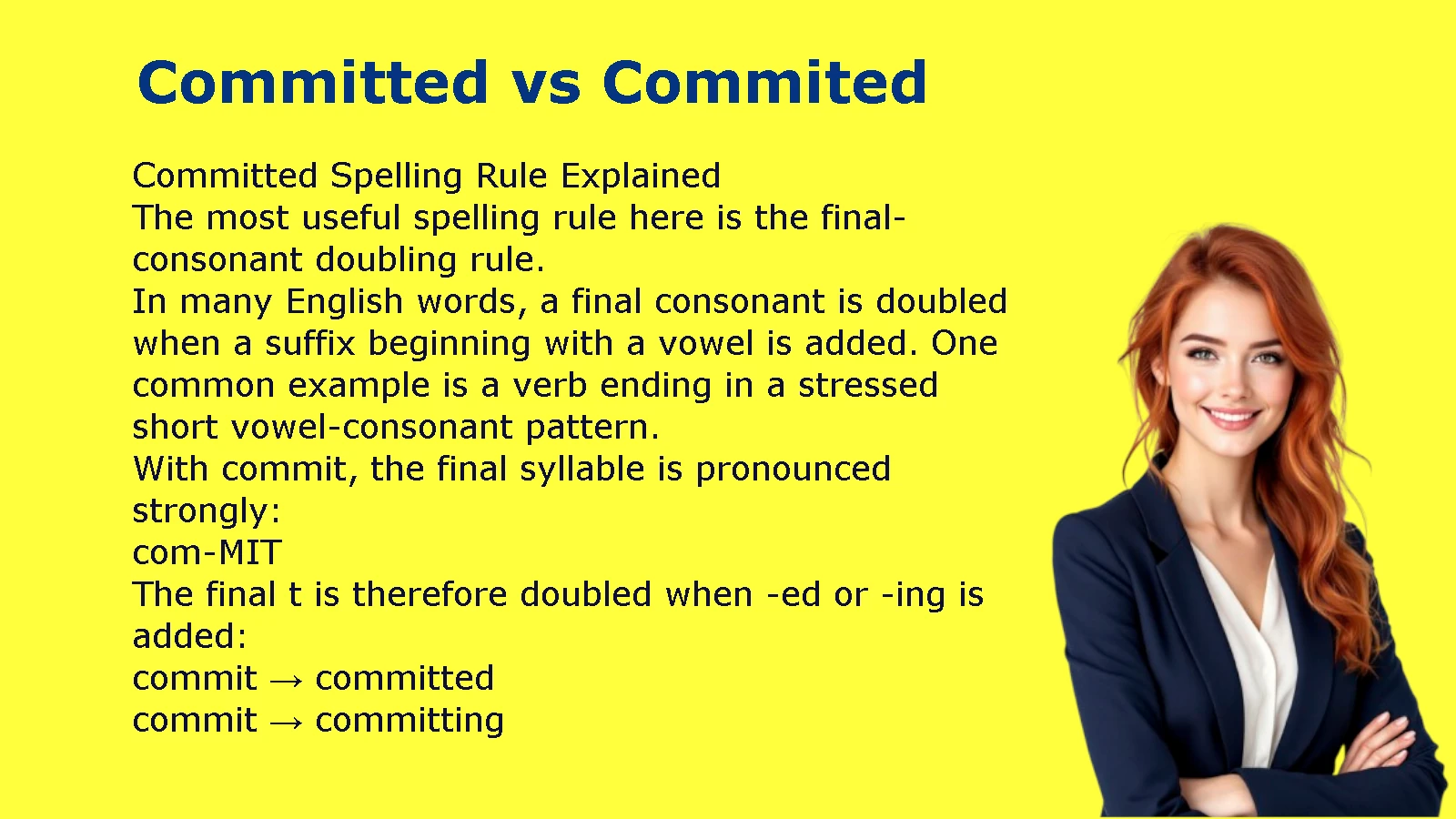
Committed Spelling Rule Explained
The most useful spelling rule here is the final-consonant doubling rule.
In many English words, a final consonant is doubled when a suffix beginning with a vowel is added. One common example is a verb ending in a stressed short vowel-consonant pattern.
With commit, the final syllable is pronounced strongly:
com-MIT
The final t is therefore doubled when -ed or -ing is added:
- commit → committed
- commit → committing
The same pattern appears in:
- admit → admitted
- omit → omitted
- submit → submitted
- permit → permitted
This is why writing commited or commiting is incorrect.
Why does “committed” have two Ts?
The first t belongs to the base word commit.
The second t results from the spelling change that occurs when the suffix is added.
You can remember it this way:
commit + ed = committed
Or, for the present participle:
commit + ing = committing
The doubled consonant is part of the standard spelling.
Compare “committed” with “opened”
Not every verb doubles its final consonant.
For example:
- open → opened
- clean → cleaned
- play → played
But:
- commit → committed
- admit → admitted
- permit → permitted
The difference depends on the spelling and pronunciation pattern of the base verb. Therefore, you should not apply the rule as “double every final consonant before -ed.”
Instead, learn the relevant pattern for verbs such as commit, admit, omit, submit, and permit.
Committed in American and British English
One useful point for anyone searching committed spelling UK is that there is no American-versus-British spelling difference here.
Both varieties use:
committed
American English:
She is committed to the project.
British English:
She is committed to the project.
The spelling does not change to commited in British English.
This makes the choice simple. Whether you are writing for an American, British, Canadian, Australian, or other English-speaking audience, committed is the standard spelling.
There can be genuine differences between American and British spelling in other words, such as color/colour or organize/organise in relevant usage systems. Committed, however, is not one of those cases.
Committed vs Dedicated
The words committed and dedicated overlap considerably, especially when they describe someone’s attitude toward a goal, job, person, or cause.
For example:
She is committed to her work.
and:
She is dedicated to her work.
Both sentences suggest that she takes her work seriously and gives it substantial effort.
However, the words are not identical in every context.
| Word | Typical emphasis |
| committed | A firm promise, decision, obligation, or strong involvement |
| dedicated | Strong devotion, effort, or loyalty |
| committed to | Often followed by a goal, action, person, or principle |
| dedicated to | Often emphasizes sustained effort or devotion |
Consider these examples:
The company is committed to reducing waste.
This emphasizes a firm organizational intention or obligation.
She is dedicated to helping young students.
This emphasizes devotion and sustained effort.
The two words can often substitute for one another, but the exact nuance depends on the sentence.
Is “committed” stronger than “dedicated”?
There is no universal rule that one is always stronger.
Both words can describe a high level of involvement. The distinction is usually contextual rather than a fixed scale of intensity.
Committed often draws attention to a decision, promise, or obligation.
Dedicated often draws attention to devotion, effort, or loyalty.
Committed in Different Contexts
Understanding the different contexts of committed is important because the word can communicate substantially different ideas.
Committed to a Goal
When someone is committed to a goal, they have made a serious decision to pursue it.
For example:
She is committed to improving her public-speaking skills.
The sentence suggests more than casual interest. She intends to put time and effort into the goal.
Other examples include:
- He is committed to finishing the course.
- The team is committed to reaching its target.
- They remain committed to improving customer service.
- I am committed to becoming a better writer.
The construction committed to + noun or gerund is especially common.
Correct:
She is committed to learning Spanish.
Not:
She is committed to learn Spanish.
After the preposition to in this construction, a gerund such as learning is normally used.
Committed to a Relationship
When someone describes themselves as committed to a relationship, the word generally means that they are seriously devoted to maintaining that relationship.
For example:
They are committed to their relationship and communicate openly about problems.
In relationship contexts, committed can imply loyalty, seriousness, and a willingness to invest time and effort.
You might also see:
- committed partner
- committed relationship
- committed couple
- committed to each other
The precise meaning depends on the context, but the central idea is serious involvement rather than casual participation.
Committed to Work or a Career
A person can also be described as committed to their work or committed to their career.
For example:
Daniel is committed to his profession and continually develops his skills.
Here, committed describes dedication and sustained involvement.
Cambridge specifically gives examples of committed describing people who willingly give their time and energy to something they believe in.
Committed a Crime or Offense
The phrase committed a crime has a different grammatical and semantic function.
Here, committed is the past tense of commit, not the adjective meaning devoted.
For example:
The investigation determined that he had committed the offense.
The structure is:
subject + committed + object
Examples include:
- committed a crime
- committed an offense
- committed fraud
- committed an error
- committed an act
- committed an offense
Cambridge Dictionary specifically lists commit in the sense of doing something illegal or considered wrong and gives constructions such as commit a crime and commit an offense.
Common Mistakes With Committed
The spelling error commited is the most obvious mistake, but learners sometimes make related errors with the word family.
Mistake: Writing “commited”
Incorrect:
We are commited to excellence.
Correct:
We are committed to excellence.
Mistake: Writing “commiting”
Incorrect:
The company is commiting additional resources.
Correct:
The company is committing additional resources.
The same consonant-doubling pattern applies when -ing is added.
Mistake: Confusing “commit” and “committed”
These words have different grammatical forms.
| Form | Example |
| commit | I will commit to the plan. |
| commits | She commits to every project she starts. |
| committed | She committed to the plan yesterday. |
| committing | She is committing more time to the project. |
| commitment | Her commitment is impressive. |
Notice that commitment does not contain the doubled t found in committed.
This is an important distinction:
commit → committed
but:
commit → commitment
Mistake: Assuming “commited” is acceptable because it looks natural
English spelling contains many words where doubling a consonant changes when a suffix is added. Because commit already ends in t, it can be tempting to add -ed without changing anything.
That produces:
commited
But standard spelling requires:
committed
A quick spell-check is useful, but understanding the pattern is even better because it helps you spell related forms correctly.
Committed vs Commited: Easy Way to Remember the Spelling
The simplest memory trick is:
Commit has one T; committed has two.
Think of the word as gaining another t when -ed is added:
commit → committed
You can also remember the phrase:
“I commit, then I’m committed.”
The visual progression is:
C O M M I T
↓
C O M M I T T E D
That extra T is the key.
Use related words as a memory group
Instead of memorizing one word, remember this group:
- commit
- committed
- committing
- commitment
Then pay attention to which forms contain the doubled consonant.
| Word | Spelling |
| commit | one t at the end |
| committed | double tt |
| committing | double tt |
| commitment | single t before m |
This makes the spelling pattern easier to recognize.
A Closer Look at “Commit” and Its Related Forms
The word commit has several important uses in English.
It can mean to promise or agree to something:
The company committed to completing the project.
It can also mean to carry out an action:
He committed an error.
In another construction, someone can commit something to memory. Cambridge describes this as making certain that something is remembered.
For example:
She committed the instructions to memory.
The word can also appear in formal contexts involving official placement or legal proceedings, although those uses are more specialized. Cambridge includes meanings involving officially sending someone to prison or another institution and certain court procedures.
The important spelling point remains unchanged across these meanings:
committed always contains the double t.
Case Study: Choosing the Correct Spelling in Professional Writing
Imagine that an employee is preparing a company report.
The draft contains this sentence:
Our organization is commited to improving workplace safety.
The writer has chosen the right word and the right meaning, but the spelling is incorrect.
The corrected version is:
Our organization is committed to improving workplace safety.
Why does this matter?
A single missing letter does not change the intended meaning, but spelling errors can reduce the polish and credibility of formal writing. In a report, résumé, academic paper, website, or business proposal, the standard form should be used.
The same principle applies to the following:
Incorrect:
The team is commited to meeting the deadline.
Correct:
The team is committed to meeting the deadline.
Incorrect:
She is commited to her studies.
Correct:
She is committed to her studies.
The correction is small, but it is consistent.
Facts About the Word “Committed”
Here are the most useful facts to remember:
- Committed is the standard spelling.
- Commited is a misspelling.
- Committed is the past tense and past participle of commit.
- Committed can also function as an adjective.
- The adjective commonly describes someone who is devoted or strongly involved.
- The verb commit can mean to promise or dedicate something to a purpose.
- Commit can also mean to carry out an action, including an offense.
- The spelling uses double t before -ed.
- The same doubling appears in committing.
- American and British English both use committed.
- Dedicated is sometimes a synonym, but it is not a spelling variant.
- Commited should not be used in standard English writing.
Dictionary.com likewise identifies committed as the past tense and past participle of commit and gives its adjectival sense as being bound or devoted to a person or thing.
Committed Synonyms
The best synonym depends on which meaning of committed you intend.
When “committed” means dedicated
Possible alternatives include:
- dedicated
- devoted
- loyal
- determined
- devoted to
- passionate
- steadfast
- engaged
For example:
She is committed to her students.
Possible alternative:
She is dedicated to her students.
However, the words are not interchangeable in every sentence.
When “committed” means carried out
When committed is the past form of commit, the possible alternatives depend heavily on the object.
For example:
He committed an offense.
Depending on the context, you might say:
He carried out the offense.
For an error:
She committed an error.
could be expressed as:
She made an error.
The correct replacement depends on what was committed.
Committed vs Commited in Common Phrases
Some phrases make the correct spelling especially easy to recognize.
Committed to
She is committed to improving her skills.
Committed relationship
They are in a committed relationship.
Committed employee
He is a committed employee who takes his responsibilities seriously.
Committed to the project
The team remains committed to the project.
Committed a crime
The investigation found evidence that he had committed a crime.
Committed an error
The software update committed an error.
The context changes the meaning, but the spelling never changes:
committed
How to Check Whether You Have Spelled It Correctly
If you are unsure while writing, use a simple three-step check.
Start with the base word
Ask:
What is the base verb?
The answer is:
commit
Add the suffix mentally
Now form the past tense:
commit + ed
Because the final consonant is doubled, you get:
committed
Compare the two forms visually
Look at:
commited
and:
committed
The second form has tt.
If you see only one t before ed, the spelling needs correction.
Committed vs Commited: Common Questions
Is “commited” a correct spelling?
No. Commited is a misspelling. The correct spelling is committed, with two ts before -ed.
Is “committed” spelled with one or two Ts?
Committed is spelled with two consecutive Ts:
committed
Why does committed have two Ts?
The final consonant of commit is doubled when the -ed suffix is added:
commit → committed
The same pattern appears in forms such as admitted, omitted, and submitted.
What does committed mean?
As an adjective, committed can mean strongly dedicated, loyal, or willing to give time and energy to something. As the past tense of commit, it can mean carried out or did something, including an offense or error.
What is the past tense of commit?
The past tense is committed.
For example:
She committed to the project last year.
What is the past participle of commit?
The past participle is also committed.
For example:
They have committed significant resources to the project.
Is committed spelled differently in British English?
No. Committed is the standard spelling in both American and British English.
What is the difference between committed and dedicated?
Both can describe strong devotion or involvement. Committed often emphasizes a firm decision, promise, or obligation, while dedicated often emphasizes devotion and sustained effort.
How do you use committed in a sentence?
You can use committed as an adjective:
She is committed to her career.
You can also use it as the past tense of commit:
He committed an error.
Is “commited to” correct?
No. The correct phrase is:
committed to
For example:
The company is committed to providing excellent service.
Committed vs Commited: Final Answer
The correct spelling is committed.
The incorrect spelling is commited.
The easiest way to remember the difference is to connect the word to its base form:
commit → committed
The final t is doubled before -ed is added.
Remember these three forms:
- commit
- committed
- committing
The spelling is particularly important because committed is a common word used in everyday conversation, professional writing, academic work, business communication, and descriptions of relationships and personal goals.
Whether you mean dedicated, devoted, firmly obligated, or carried out, the spelling remains the same: committed.
So if you are choosing between committed vs commited, choose committed every time.
Correct: committed
Incorrect: commited
Memory tip: commit → committed




