Have you ever read a message, clue, or comment that left you thinking, “What does that mean?” If so, you may have encountered something cryptic. The Cryptic Meaning of a word, message, or statement usually suggests that it is mysterious, puzzling, or difficult to understand.
Cryptic describes something that has a hidden, unclear, or mysterious meaning. It can refer to a person’s words, a written message, a clue, or even a facial expression that seems difficult to interpret.
Examples:
- His cryptic message left everyone wondering what he meant.
- The detective found a cryptic clue hidden in the letter.
The confusion is understandable. People often search for what does cryptic mean, cryptic meaning in text, cryptic meaning in chat, or what does it mean when someone is being cryptic because the word can describe different kinds of unclear or mysterious communication. And here’s the kicker: something cryptic isn’t always meaningless. It may contain a message that you need to think about carefully to understand.
In this guide, you’ll learn the complete Cryptic Meaning, its definition, pronunciation, synonyms, antonyms, correct usage, and examples in sentences. You’ll also discover what cryptic means in texting, how to understand a cryptic message, and the difference between cryptic, mysterious, vague, and ambiguous.
What Does Cryptic Mean?
Cryptic is an adjective that describes something whose meaning is hidden, unclear, mysterious, or difficult to understand.
When something is cryptic, you usually can’t grasp its full meaning immediately. You may need to interpret a clue, understand the context, or read between the lines.
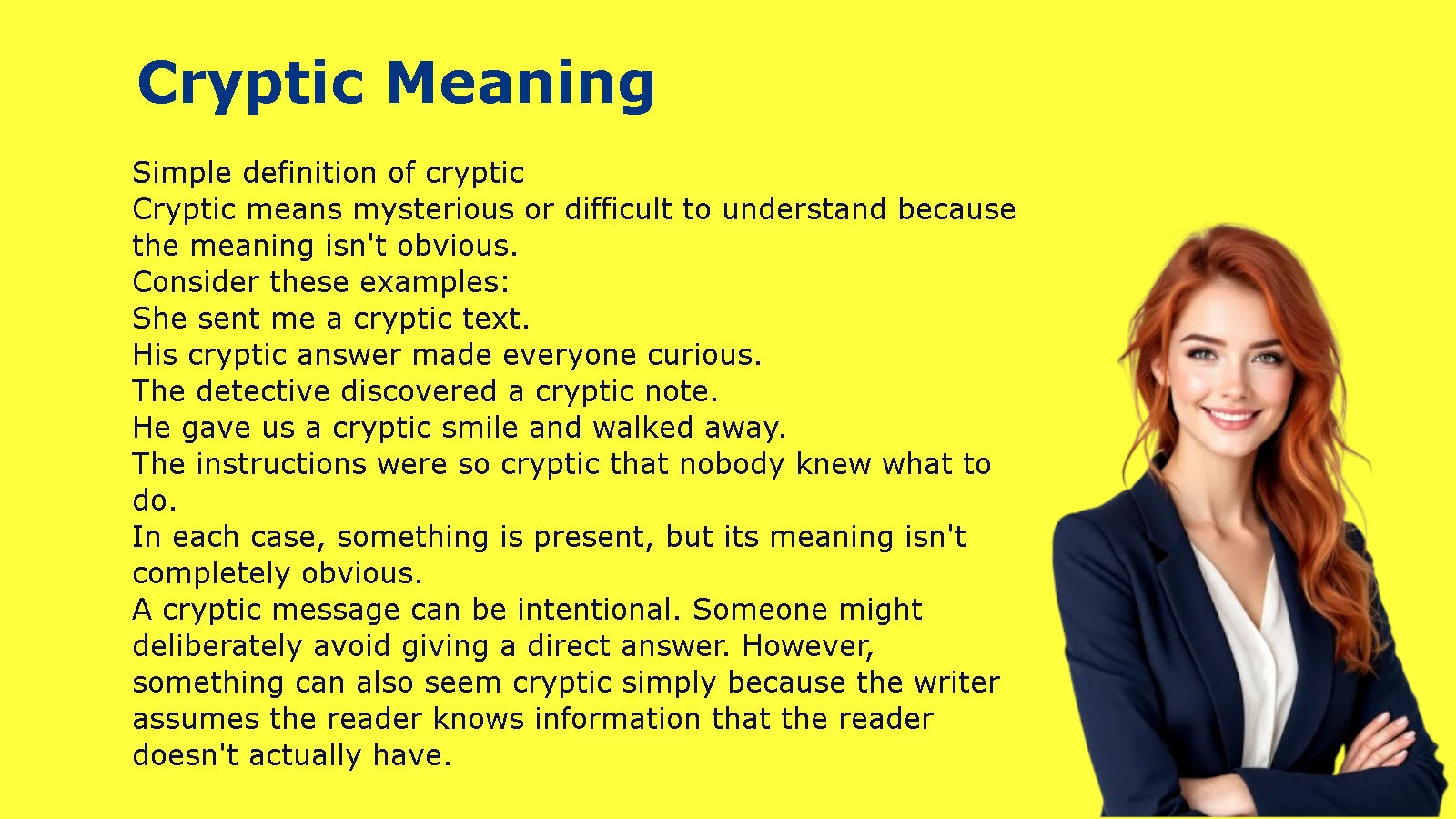
Simple definition of cryptic
Cryptic means mysterious or difficult to understand because the meaning isn’t obvious.
Consider these examples:
- She sent me a cryptic text.
- His cryptic answer made everyone curious.
- The detective discovered a cryptic note.
- He gave us a cryptic smile and walked away.
- The instructions were so cryptic that nobody knew what to do.
In each case, something is present, but its meaning isn’t completely obvious.
A cryptic message can be intentional. Someone might deliberately avoid giving a direct answer. However, something can also seem cryptic simply because the writer assumes the reader knows information that the reader doesn’t actually have.
Cryptic Meaning in Simple Words
The easiest way to understand cryptic is to think of a message that makes you wonder what is really being said.
Imagine receiving this text:
“It’s finally happening.”
That’s not necessarily cryptic by itself. But if you don’t know what “it” refers to, the message becomes mysterious. You might ask, “What’s happening?”
Now imagine your friend refuses to explain and simply responds:
“You’ll see.”
That response is more clearly cryptic because it hints at information without revealing it.
A cryptic statement often has one or more of these qualities:
- Hidden meaning
- Indirect wording
- Unexplained references
- Mysterious hints
- Unusual brevity
- Puzzling language
- Information that requires interpretation
The important point is that cryptic doesn’t always mean meaningless. Quite the opposite. A cryptic statement often suggests that there is a meaning worth discovering.
Cryptic Pronunciation
The US pronunciation of cryptic is:
/ˈkrɪp.tɪk/
You can pronounce it approximately as:
KRIP-tik
The first syllable receives the main stress.
Cryptic pronunciation breakdown
| Part | Sound |
| First syllable | KRIP |
| Second syllable | tik |
| Full pronunciation | KRIP-tik |
| IPA | /ˈkrɪp.tɪk/ |
| Part of speech | Adjective |
Cambridge and Oxford both give the pronunciation as /ˈkrɪptɪk/ for American English.
What Part of Speech Is Cryptic?
Cryptic is primarily an adjective.
An adjective describes or modifies a noun. Therefore, you normally use cryptic before a noun or after a linking verb.
Examples before a noun
- a cryptic message
- a cryptic clue
- a cryptic remark
- a cryptic answer
- a cryptic smile
- a cryptic note
- a cryptic response
Examples after a linking verb
- His answer was cryptic.
- Her explanation seemed cryptic.
- The message sounded cryptic.
- Their response remained cryptic.
Oxford lists combinations such as cryptic message, cryptic remark, and cryptic clue among common uses.
Cryptic Meaning With Examples
The best way to understand a word is to see how people actually use it. The following examples show how cryptic can describe messages, comments, clues, expressions, and situations.
message examples
- I received a cryptic message from my manager.
- Her cryptic text made me think something was wrong.
- He left a cryptic note on the kitchen table.
- The suspect sent a cryptic message before disappearing.
- She posted a cryptic message on social media.
remark examples
- “You won’t be laughing tomorrow,” he said cryptically.
- Her cryptic remark left the entire room silent.
- He made a cryptic comment about leaving soon.
- The politician gave a cryptic answer when reporters asked about the decision.
expression examples
- She gave him a cryptic smile.
- His cryptic expression revealed nothing.
- The actor wore a cryptic look throughout the interview.
Cryptic clue examples
- The crossword included a particularly cryptic clue.
- I couldn’t solve the cryptic clue without looking at the wordplay.
- The detective treated the strange sentence as a cryptic clue.
These examples demonstrate an important feature of the word: cryptic describes the way information is presented, not simply whether the information is difficult.
What Does “Cryptic Message” Mean?
A cryptic message is a message whose meaning isn’t immediately clear.
The person sending it may deliberately hide information, use an indirect expression, provide only part of the story, or refer to something the reader doesn’t understand.
For example:
“The old plan starts tonight.”
If the reader doesn’t know what “the old plan” means, the sentence sounds cryptic.
A cryptic message can be short or long. Length isn’t what makes it cryptic. The hidden or puzzling meaning does.
Common examples of cryptic messages
| Message | Why it sounds cryptic |
| “You’ll know soon.” | Doesn’t explain what will happen |
| “It’s already begun.” | Doesn’t identify what has begun |
| “Ask him about Tuesday.” | Assumes unexplained context |
| “Everything is in place.” | Leaves the situation unspecified |
| “Some things are better left unsaid.” | Hints at information without revealing it |
A message becomes especially cryptic when the writer appears to know more than the reader.
What Does Cryptic Mean in Texting?
In texting, cryptic usually describes a message that feels mysterious, vague, indirect, or incomplete.
For example:
“Why are you being so cryptic?”
Another example:
Person A: Did you hear what happened?
Person B: Not yet. But I think you’ll find out soon.
That reply creates curiosity because it withholds important information.
Common texting phrases
You might hear:
- “Why are you being so cryptic?”
- “That was cryptic.”
- “What does that cryptic text mean?”
- “Your message sounds cryptic.”
- “Stop being cryptic and just tell me.”
In everyday conversation, calling someone’s message cryptic often means, “I know you’re hinting at something, but you’re not telling me clearly.”
Cambridge specifically gives cryptic text, cryptic message, and cryptic remark as natural examples of the word in use.
Cryptic vs. Mysterious vs. Ambiguous vs. Vague
These words overlap, but they aren’t identical. Choosing the right one makes your writing more precise.
| Word | Main meaning | Example |
| Cryptic | Difficult to understand because the meaning is hidden or puzzling | His cryptic reply raised questions. |
| Mysterious | Strange, unknown, or difficult to explain | A mysterious stranger arrived. |
| Ambiguous | Capable of having more than one interpretation | Her answer was ambiguous. |
| Vague | Lacking clear details or precision | He gave a vague explanation. |
| Confusing | Difficult to understand or follow | The instructions were confusing. |
| Obscure | Difficult to understand or not well known | The reference was obscure. |
Cryptic vs. mysterious
Mysterious is broader.
Something mysterious might be unexplained without containing a hidden message. For example:
The house has a mysterious history.
A cryptic statement, on the other hand, often involves communication or meaning that you can’t easily decode.
He gave a cryptic answer about the house.
Cambridge describes mysterious as something strange, unknown, or not understood and lists cryptic as a synonym. The two words overlap, but cryptic often puts more emphasis on the difficulty of interpreting the message or meaning.
Cryptic vs. ambiguous
An ambiguous statement has more than one possible interpretation.
For example:
“I saw her duck.”
This could mean that someone saw her lower her head, or someone saw the bird belonging to her.
A cryptic statement doesn’t necessarily have two or more meanings. Its meaning may simply be hidden or difficult to work out.
Cryptic vs. vague
Vague means lacking specific information.
For example:
“I’ll meet you later.”
That’s vague because later doesn’t tell you when.
A cryptic message might be:
“Meet me where we first talked.”
The statement is specific enough to have a meaning, but the recipient may need to figure out what place the speaker means.
Cryptic vs. confusing
Something can be confusing because it is badly written, poorly organized, or complicated.
A cryptic statement often feels different. It may be confusing because information has been concealed or presented indirectly.
That’s why a person can intentionally be cryptic without being unclear by accident.
Synonyms for Cryptic
Several words can replace cryptic, but each carries a slightly different shade of meaning.
Enigmatic
Enigmatic describes something mysterious and difficult to fully understand.
- She gave an enigmatic smile.
- His personality remained enigmatic.
Cambridge defines enigmatic as mysterious and impossible to understand completely and lists cryptic as a synonym.
Mysterious
Mysterious emphasizes something unknown, strange, or difficult to explain.
- The mysterious letter arrived without a signature.
- His disappearance remains mysterious.
Inscrutable
Inscrutable suggests that someone’s thoughts, feelings, or intentions are extremely difficult to understand.
- He gave an inscrutable expression.
- Her reaction was inscrutable.
Cambridge describes inscrutable as something that is very difficult to understand or get to know, particularly when someone’s thoughts or emotions aren’t revealed.
Puzzling
Puzzling focuses on something that causes confusion or makes you wonder.
- His decision was puzzling.
- She received a puzzling message.
Obscure
Obscure can describe something difficult to understand or something that isn’t well known.
- The reference was obscure.
- The meaning of the passage was obscure.
Oxford notes both senses: something can be obscure because it isn’t well known, or because it is difficult to understand.
Cryptic synonyms at a glance
- Enigmatic
- Mysterious
- Puzzling
- Inscrutable
- Obscure
- Perplexing
- Unclear
- Ambiguous
- Coded
- Hidden
Not all of these work in every sentence. Enigmatic and mysterious are usually closer to cryptic than vague, which focuses more strongly on a lack of detail.
Antonyms of Cryptic
The opposite of cryptic is something that communicates its meaning clearly and directly.
Useful antonyms include:
- Clear
- Obvious
- Explicit
- Direct
- Straightforward
- Plain
- Understandable
- Unambiguous
Compare these examples:
Cryptic:
“You should probably ask Sarah what happened.”
Direct:
“Sarah canceled the meeting this morning.”
The first sentence makes the reader search for information. The second gives the information openly.
How to Use Cryptic Correctly
The most common structure is cryptic + noun.
Common patterns
Cryptic + message
He sent a cryptic message.
Cryptic + remark
Her cryptic remark made everyone curious.
Cryptic + clue
The detective found a cryptic clue.
Cryptic + smile
She answered with a cryptic smile.
You can also place the adjective after a linking verb:
His response was cryptic.
The instructions seemed cryptic.
Her answer remained cryptic.
The adjective describes the nature of the communication or expression.
Cryptically: The Adverb Form
Cryptically is the adverb form of cryptic.
It means in a cryptic or mysterious way.
For example:
“Maybe,” she replied cryptically.
Here, cryptically explains how she replied.
Other examples include:
- He cryptically refused to explain.
- She cryptically mentioned an old friend.
- The director cryptically hinted at a sequel.
- “You’ll find out soon,” he said cryptically.
Oxford lists cryptically as the adverb form of cryptic.
Cryptic vs. cryptically
| Word | Part of speech | Example |
| Cryptic | Adjective | His answer was cryptic. |
| Cryptically | Adverb | He answered cryptically. |
A simple trick helps: cryptic describes a thing, while cryptically describes an action.
Cryptic in Puzzles and Crosswords
The word cryptic has a specialized meaning in cryptic crosswords.
A cryptic crossword is a type of crossword puzzle in which clues aren’t simply straightforward definitions. Instead, clues use wordplay and often contain both a definition and a mechanism that helps produce the answer.
Oxford explains that cryptic crossword clues involve a kind of word puzzle. It also notes that cryptic crosswords traditionally became especially popular in Britain.
Cambridge similarly defines a cryptic crossword as a word game containing difficult clues whose meanings aren’t obvious.
Common cryptic crossword techniques
Cryptic crossword clues can involve:
- Anagrams
- Hidden words
- Double meanings
- Abbreviations
- Reversals
- Word deletions
- Letter substitutions
- Charades, where smaller word parts combine to form an answer
For example, an anagram clue may indicate that letters should be rearranged. The clue isn’t simply asking, “What word means this?” It gives you another puzzle to solve.
That’s why cryptic clue has become a useful phrase beyond crossword puzzles. People sometimes call any puzzling hint a cryptic clue when it requires interpretation.
Cryptic in Science and Other Specialized Contexts
Although everyday English usually uses cryptic for mysterious or difficult communication, the word also appears in technical contexts.
Cryptic coloration
In biology, cryptic coloration refers to coloration that helps an organism remain difficult to detect in its surroundings.
Camouflage provides an intuitive example. An animal whose appearance blends with its environment may be harder for predators or prey to notice.
Here, cryptic doesn’t mean that the animal is sending a mysterious message. It relates to concealment.
Cryptic species
Biologists also use cryptic species for species that can be difficult to distinguish based on appearance even though they represent separate species.
This specialized use demonstrates an important underlying idea of the word: something is present but difficult to detect or recognize.
Cambridge’s corpus examples include technical uses such as cryptic species and cryptic mammals, showing that the adjective extends beyond communication.
Cryptic in codes and hidden information
The same general idea appears in words related to hidden information, including:
- Cryptography
- Cryptogram
- Cryptographic
- Crypt
These words share a historical connection to the idea of something hidden or concealed.
However, cryptic itself doesn’t automatically mean encrypted. A cryptic sentence may be written in perfectly ordinary English. Its meaning is simply hard to interpret.
The Origin and Etymology of Cryptic
The history of cryptic explains why the modern word is associated with hidden meanings.
Oxford traces the word to the early 17th century, from Late Latin crypticus, which came from Greek kruptikos, from kruptos, meaning “hidden.”
That root is closely connected with the broader family of words associated with concealment.
Related words
| Word | Connection |
| Cryptic | Hidden or difficult to understand |
| Cryptography | The practice of protecting information through codes |
| Cryptogram | A message written in a code |
| Crypt | An underground chamber, from the same Greek root family |
| Crypto | A shortened form used in several modern technical contexts |
The shared history helps explain why cryptic can describe both a mysterious statement and something concealed from view.
Common Collocations With Cryptic
Certain combinations sound especially natural in English.
| Phrase | Meaning |
| Cryptic message | A message whose meaning isn’t obvious |
| Cryptic text | A mysterious or puzzling text |
| Cryptic remark | An indirect or puzzling comment |
| Cryptic answer | An answer that doesn’t clearly reveal the meaning |
| Cryptic clue | A puzzling clue, especially in a crossword |
| Cryptic note | A mysterious written message |
| Cryptic smile | A smile whose meaning isn’t clear |
| Cryptic response | An unclear or indirect reply |
| Cryptic statement | A statement that requires interpretation |
| Cryptic crossword | A crossword built around difficult wordplay |
These combinations are useful when you’re trying to make your writing sound natural. Instead of forcing the adjective into an unusual phrase, use cryptic with nouns that commonly involve meaning, communication, clues, or expressions.
Why Do People Give Cryptic Messages?
A cryptic message isn’t always accidental. People sometimes choose indirect language for a reason.
To create suspense
A writer might reveal information gradually to keep readers interested.
“The door was unlocked. She knew exactly why.”
The sentence doesn’t explain everything. That missing information creates suspense.
To avoid saying something directly
Someone might use a cryptic response when they don’t want to answer a sensitive question.
“Let’s just say things are changing.”
The speaker communicates something without explaining the details.
To create curiosity
A social media post might say:
“Big news coming soon.”
The statement isn’t necessarily confusing. It simply withholds information and encourages people to wonder what the news is.
To use humor or playfulness
Friends sometimes communicate cryptically because they share an inside joke.
“Remember the blue umbrella?”
Without context, the message sounds strange. To the people involved, however, it may be perfectly meaningful.
To challenge the reader
Puzzles, riddles, mysteries, and cryptic crosswords deliberately make people work for the answer.
In that setting, being cryptic is part of the point.
A Practical Case Study: Understanding a Cryptic Text
Consider this conversation:
Alex: Are you still going to the party?
Jordan: Not sure. After what happened last time, maybe it’s better to stay away.
Alex: What happened last time?
Jordan: You’ll know when you see the guest list.
Jordan’s final response is cryptic.
Why?
First, Jordan refers to information that Alex apparently doesn’t have. Second, Jordan hints that the guest list contains an important answer. Finally, Jordan doesn’t directly explain what happened.
Notice that the message isn’t meaningless. It actually contains useful information. The problem is that the important meaning remains hidden from the reader.
That’s the heart of the word cryptic.
Common Mistakes When Using Cryptic
Understanding the differences between related words helps you avoid awkward usage.
Mistake: Treating cryptic as a synonym for meaningless
A cryptic statement usually has some meaning. You simply may not understand it immediately.
Less accurate:
The sentence was cryptic because it had no meaning.
Better:
The sentence was cryptic because its meaning wasn’t immediately clear.
Mistake: Using cryptic when vague is more accurate
If someone gives almost no information, vague may be the better word.
He gave a vague answer about the schedule.
If the answer hints at something without directly explaining it, cryptic may be more appropriate.
He gave a cryptic answer about what would happen next.
Mistake: Assuming cryptic always means secret
A cryptic message can conceal information, but secret and cryptic aren’t interchangeable.
A secret is information that someone doesn’t want others to know.
A cryptic message is information that is difficult to understand or interpret.
Mistake: Confusing cryptic with complicated
Something can be complicated without being cryptic.
For example, a detailed scientific explanation might be complicated but completely explicit. A short sentence can be cryptic even when every individual word is easy to understand.
That’s an important distinction.
Is Cryptic Positive or Negative?
Cryptic is generally neutral. The emotional effect depends on the situation.
In a mystery novel, a cryptic clue can sound intriguing.
The detective discovered a cryptic note.
In a workplace conversation, however, a cryptic response might frustrate people.
The manager gave a cryptic answer about the company’s future.
The word can therefore suggest:
- Intrigue
- Mystery
- Cleverness
- Suspense
- Frustration
- Secrecy
- Uncertainty
Context does the heavy lifting.
Cryptic Meaning in Different Contexts
The meaning stays connected to the idea of hidden or difficult information, but the emphasis can change.
| Context | Example | Meaning |
| Texting | a cryptic text | A mysterious or unclear message |
| Conversation | a cryptic answer | An indirect response |
| Literature | a cryptic passage | A passage requiring interpretation |
| Mystery | a cryptic clue | A clue with hidden significance |
| Crosswords | a cryptic clue | A clue using wordplay |
| Biology | cryptic coloration | Concealment through appearance |
| Social media | a cryptic post | A post that hints at something without explaining it |
| Personal expression | a cryptic smile | An expression whose meaning is difficult to read |
This range of uses comes back to one central idea: something is not immediately revealed or understood.
Cryptic vs. Cryptically: Quick Grammar Guide
The difference is simple once you look at how each word functions.
Use “cryptic” to describe something
She wrote a cryptic message.
Here, cryptic describes the message.
Use “cryptically” to describe how someone acts or speaks
She replied cryptically.
Here, cryptically describes the manner of her reply.
More examples:
- Cryptic: His comment was cryptic.
- Cryptically: He commented cryptically.
- Cryptic: She gave a cryptic answer.
- Cryptically: She answered cryptically.
Frequently Asked Questions About Cryptic Meaning
What does cryptic mean in simple words?
Cryptic means mysterious, hidden, or difficult to understand. A cryptic message usually has a meaning that isn’t immediately obvious.
What is an example of something cryptic?
“You’ll understand when the time comes” is a cryptic statement when the speaker doesn’t explain what will happen or when.
Does cryptic mean mysterious?
Yes, cryptic and mysterious overlap. However, cryptic often focuses more specifically on something whose meaning is difficult to interpret or has been concealed.
What does cryptic mean in texting?
In texting, cryptic describes a message that seems mysterious, indirect, incomplete, or difficult to interpret.
For example:
“I know what you did.”
Without context, that text is cryptic because the recipient doesn’t know what the sender means.
Is cryptic the same as vague?
No. Vague means lacking specific details. Cryptic suggests that the meaning is puzzling, hidden, or difficult to interpret.
Is cryptic the same as confusing?
Not exactly. Something confusing may simply be poorly explained or complicated. Something cryptic often seems difficult because its meaning isn’t openly revealed.
What is a synonym for cryptic?
Common synonyms include enigmatic, mysterious, puzzling, inscrutable, obscure, and perplexing. The best choice depends on the context.
What is the opposite of cryptic?
Common antonyms include clear, direct, explicit, obvious, straightforward, and understandable.
What does cryptically mean?
Cryptically is an adverb meaning in a mysterious or difficult-to-understand way.
For example:
“Maybe,” she replied cryptically.
What is a cryptic message?
A cryptic message is a message whose meaning isn’t immediately clear. It may contain hints, indirect language, unexplained references, or deliberately concealed information.
What is a cryptic crossword?
A cryptic crossword is a crossword puzzle in which clues use wordplay and aren’t simply straightforward definitions. Common mechanisms include anagrams and hidden words.
Cryptic Meaning: Key Takeaways
The word cryptic becomes much easier to understand once you focus on its central idea: something is there, but its meaning isn’t immediately revealed.
Here are the essentials:
| Feature | Answer |
| Word | Cryptic |
| Meaning | Mysterious, hidden, or difficult to understand |
| Part of speech | Adjective |
| US pronunciation | /ˈkrɪp.tɪk/ |
| Simple pronunciation | KRIP-tik |
| Adverb | Cryptically |
| Closest synonyms | Enigmatic, mysterious, puzzling |
| Common antonyms | Clear, direct, explicit |
| Common phrases | Cryptic message, cryptic clue, cryptic remark |
| Specialized use | Cryptic crossword, cryptic coloration, cryptic species |
| Word origin | Greek kruptos, meaning “hidden” |
| Example | His cryptic reply left everyone wondering what he meant. |
Ultimately, calling something cryptic means you’re pointing to a gap between what has been said and what can actually be understood.
That’s what gives the word its distinctive meaning. Cryptic doesn’t simply mean difficult. It suggests that the real meaning is concealed, indirect, or waiting to be uncovered.




