Have you ever met someone who can quickly understand a difficult situation or notice something that others completely miss? If so, they may be perspicacious. While Perspicacious Meaning may look like a complicated word, it describes a simple and valuable quality: being very good at understanding things and noticing important details.
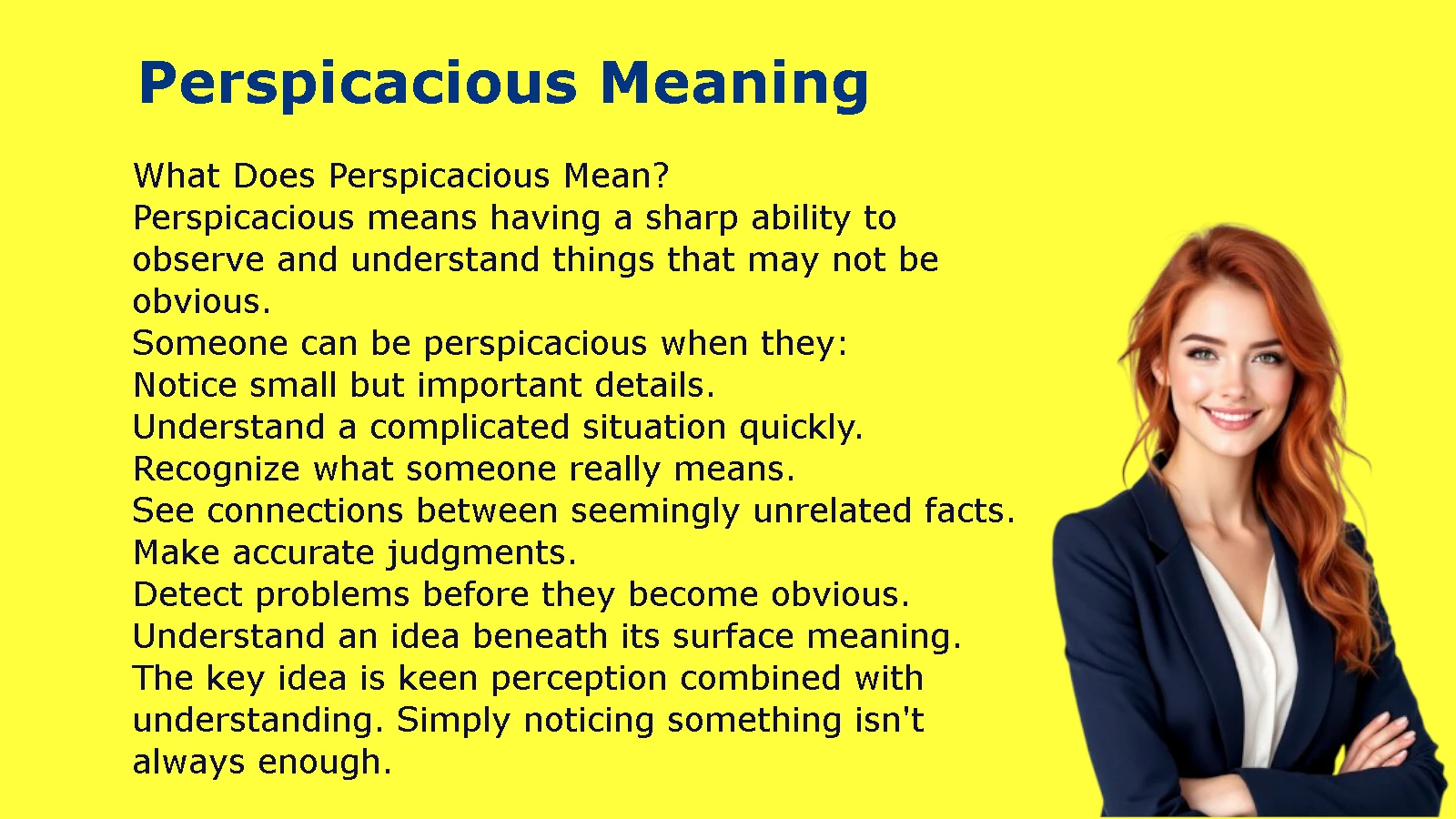
Perspicacious means having a sharp ability to understand, observe, and make good judgments, especially when something is not immediately obvious. It is often used to describe someone who can see through a complex problem, recognize hidden details, or understand what is really happening.
Examples:
- The perspicacious detective noticed a small detail that everyone else had overlooked.
- Her perspicacious comments showed that she understood the problem better than anyone else.
The confusion is understandable. People often search for what does perspicacious mean, perspicacious meaning in English, perspicacious definition, perspicacious meaning and pronunciation, or how to use perspicacious in a sentence because it is an uncommon word that can be easy to confuse with similar terms such as perceptive, insightful, observant, and astute. And here’s the kicker: calling someone perspicacious is usually a strong compliment because it suggests that they can understand things with unusual clarity.
In this guide, you’ll learn the complete Perspicacious Meaning, its definition, pronunciation, word origin, correct usage, synonyms, antonyms, and examples in sentences. You’ll also discover how to use perspicacious in everyday writing, the difference between perspicacious and perceptive, and simple ways to remember what this powerful word means.
What Does Perspicacious Mean?
Perspicacious means having a sharp ability to observe and understand things that may not be obvious.
Someone can be perspicacious when they:
- Notice small but important details.
- Understand a complicated situation quickly.
- Recognize what someone really means.
- See connections between seemingly unrelated facts.
- Make accurate judgments.
- Detect problems before they become obvious.
- Understand an idea beneath its surface meaning.
The key idea is keen perception combined with understanding. Simply noticing something isn’t always enough.
For instance, an observant employee might notice that a coworker has become unusually quiet. A perspicacious employee might notice the change and correctly understand that the coworker is struggling with a particular problem.
That’s the distinction that gives the word its strength.
Merriam Webster defines the word as relating to acute mental vision or discernment, while Cambridge describes someone perspicacious as being quick in noticing, understanding, or judging things accurately.
Perspicacious Meaning in Simple Words
In everyday English, you can think of perspicacious as:
Very good at noticing things and figuring out what they mean.
Here are some simpler alternatives:
- Perceptive
- Insightful
- Sharp
- Discerning
- Astute
- Observant
- Keen
- Shrewd
However, these words aren’t perfect substitutes in every sentence. Perspicacious often suggests that someone can see through a complicated or subtle situation and understand what’s really going on.
What Does a Perspicacious Person Do?
A perspicacious person might hear a politician’s explanation and notice a contradiction that others overlook.
They might read a novel and recognize a character’s hidden motive before the author makes it obvious.
They might examine a business report and spot a trend buried in a large amount of information.
In each case, the person does more than collect information. They interpret it accurately.
Perspicacious Definition
The dictionary definition of perspicacious centers on sharp mental perception, understanding, and judgment.
| Feature | Meaning |
| Word | Perspicacious |
| Part of speech | Adjective |
| Basic meaning | Quick and accurate in noticing, understanding, or judging |
| Tone | Formal and generally approving |
| Pronunciation | /ˌpɝː.spɪˈkeɪ.ʃəs/ in US English |
| Related noun | Perspicacity |
| Related adverb | Perspicaciously |
| Common synonyms | Perceptive, insightful, discerning, astute |
| Typical use | Describing people, judgments, observations, analysis, and remarks |
Oxford gives the meaning “able to understand somebody or something quickly and accurately,” while Cambridge similarly focuses on accurate noticing, understanding, and judgment.
Merriam Webster also notes that perspicacious can describe not only people but also things such as an essay or analysis that displays an ability to recognize subtleties.
Perspicacious Examples in Sentences
The easiest way to understand perspicacious meaning is to see the word in context.
Everyday Examples
- She was perspicacious enough to realize that something was wrong.
- His perspicacious observation helped the team find the real problem.
- The perspicacious student understood the difficult concept after one explanation.
- Her perspicacious nature made her an excellent judge of character.
- The detective’s perspicacious questions revealed an important inconsistency.
- He made a perspicacious comment about the company’s changing priorities.
Academic Examples
- The professor offered a perspicacious analysis of the historical evidence.
- Her perspicacious reading revealed a theme that other students had overlooked.
- The essay provides a perspicacious interpretation of the novel’s final chapter.
Workplace Examples
- The perspicacious manager noticed that the sales decline came from a change in customer behavior.
- His perspicacious assessment helped the company avoid an expensive mistake.
- A perspicacious analyst can often identify a market trend before it becomes obvious.
Literary Examples
- The novel’s perspicacious narrator understands the motives of the other characters.
- Her perspicacious review revealed several details hidden beneath the story’s simple plot.
How to Use Perspicacious in a Sentence
Because perspicacious is an adjective, you normally use it to describe a person, quality, judgment, observation, analysis, or similar noun.
Perspicacious + Person
- a perspicacious analyst
- a perspicacious reader
- a perspicacious observer
- a perspicacious manager
- a perspicacious critic
- a perspicacious student
Example:
The perspicacious analyst recognized the warning signs before the company reported its losses.
Perspicacious + Judgment or Thought
The word can also describe the quality of someone’s reasoning.
- perspicacious judgment
- perspicacious reasoning
- perspicacious analysis
- perspicacious insight
- perspicacious observation
- perspicacious interpretation
Example:
Her perspicacious analysis exposed a weakness in the proposed strategy.
Perspicacious + Remark or Comment
You can use the word when someone’s statement reveals unusual understanding.
That was a perspicacious remark about the company’s long term strategy.
Oxford specifically provides “a perspicacious remark” as an example of usage.
Perspicacious Synonyms
Several words overlap with perspicacious, but each one carries a slightly different shade of meaning.
| Synonym | Basic meaning | How it differs |
| Perceptive | Good at noticing and understanding | The closest everyday synonym |
| Insightful | Shows deep understanding | Focuses on the quality of an insight |
| Discerning | Good at recognizing differences or quality | Emphasizes careful judgment |
| Observant | Notices details | Doesn’t always imply deep understanding |
| Astute | Clever and accurate in judgment | Often suggests practical judgment |
| Shrewd | Clever at judging situations | Can suggest practical or strategic cleverness |
| Sharp | Quick to understand | More informal |
| Keen | Highly alert or perceptive | Broad and less specific |
Perspicacious vs. Perceptive
Perspicacious and perceptive have very similar meanings.
A perceptive person notices things that others don’t. A perspicacious person also tends to understand or judge those things accurately.
For example:
- She is perceptive enough to notice his change in mood.
- She is perspicacious enough to understand why his mood changed.
The second sentence places more emphasis on interpretation.
In everyday conversation, perceptive sounds much more natural. Perspicacious sounds more formal and is less common.
Perspicacious vs. Insightful
Insightful describes something that shows deep understanding.
Her insightful comment changed the discussion.
Perspicacious emphasizes the sharpness of the person’s perception and judgment.
Her perspicacious observation exposed the flaw in the argument.
The difference can be subtle. A comment can be insightful because it provides a deep idea. A comment can be perspicacious because it shows unusually sharp perception.
Perspicacious vs. Intelligent
These words don’t mean exactly the same thing.
Intelligent describes a person’s general mental ability. Perspicacious describes a particular ability to perceive and understand things accurately.
Someone can be highly intelligent without immediately noticing a subtle social cue.
Likewise, someone can show impressive perspicacity in a specific situation without being described as exceptionally intelligent in every area.
Think of it this way:
Intelligence is broad mental ability.
Perspicacity is sharp perception and understanding.
Is Perspicacious a Positive Word?
Yes. Perspicacious is generally a positive word.
Calling someone perspicacious usually means you’re praising their ability to understand something that isn’t immediately obvious.
Cambridge labels the word formal and approving, which reflects this positive sense.
For example:
The perspicacious editor recognized the book’s potential immediately.
That sentence praises the editor’s judgment.
Similarly:
She offered a perspicacious explanation of the problem.
The speaker is saying that her explanation showed unusual understanding.
The word can sound especially complimentary because it suggests that someone has seen beyond the obvious.
Perspicacious Etymology and Word Origin
The history of perspicacious helps explain its modern meaning.
The word comes from the Latin perspicax, meaning something like “sharp sighted” or “clear sighted.” Latin perspicax comes from perspicere, meaning “to look through” or “to see clearly.”
That physical idea of seeing clearly developed into a figurative idea of seeing through a situation.
This makes the word easier to remember.
Imagine someone looking through a foggy window. An ordinary observer might see shapes. A perspicacious observer sees the important details and understands what they mean.
The modern word therefore connects physical sight with mental insight.
Oxford traces the word to the early 17th century and gives the Latin source perspicax, meaning “seeing clearly.” Merriam Webster records its first known use as 1640.
The Root Behind Perspicacious
The Latin root also appears in other English words related to seeing and observation.
The broader family includes words connected with perspective and perspicuous.
That’s useful because the words look similar, but their meanings have separated over time.
Perspicacious Pronunciation
In US English, perspicacious is pronounced:
/ˌpɝː.spɪˈkeɪ.ʃəs/
A simple pronunciation guide is:
per-spi-KAY-shus
The strongest stress falls on KAY.
Cambridge gives the US pronunciation as /ˌpɝː.spɪˈkeɪ.ʃəs/.
Break It Into Parts
You can practice it like this:
per + spi + KAY + shus
Say it slowly at first:
per-spi-KAY-shus
Then say it naturally:
perspicacious
Don’t let the length of the word intimidate you. Once you recognize the KAY sound in the middle, the pronunciation becomes much easier.
Perspicacious Synonyms and Antonyms
Synonyms for Perspicacious
Depending on the context, you can replace perspicacious with:
- Perceptive
- Insightful
- Discerning
- Astute
- Observant
- Shrewd
- Keen
- Sharp
- Penetrating
- Acute
- Sagacious
Merriam Webster groups perspicacious, shrewd, sagacious, and astute together because they all involve sharp perception and sound judgment. It also points out that the words differ in emphasis.
Antonyms for Perspicacious
Possible opposites include:
- Unperceptive
- Unobservant
- Inattentive
- Undiscerning
- Obtuse
- Dull
Common Collocations With Perspicacious
A collocation is a combination of words that commonly appear together.
Some natural combinations with perspicacious include:
- perspicacious observer
- perspicacious reader
- perspicacious analyst
- perspicacious mind
- perspicacious judgment
- perspicacious analysis
- perspicacious insight
- perspicacious observation
- perspicacious remark
- perspicacious comment
- perspicacious critic
- perspicacious interpretation
These combinations reveal an important point about the word. Perspicacious often appears where careful observation and interpretation matter.
A perspicacious reader, for example, doesn’t simply read the words on a page. They notice themes, implications, contradictions, and details that may escape a less careful reader.
Is Perspicacious Formal or Casual?
Perspicacious is formal.
Oxford labels it formal, and Cambridge describes it as formal and approving.
That doesn’t mean you can’t use it in conversation. You can. However, it may sound more polished or literary than ordinary alternatives.
Compare these sentences:
You’re really perceptive.
You’re remarkably perspicacious.
Both praise someone’s sharp understanding. The first sounds natural in casual conversation. The second sounds more formal.
Where Perspicacious Works Well
The word fits particularly well in:
- Academic writing
- Literary criticism
- Professional analysis
- Reviews
- Essays
- Formal discussions
- Descriptions of experts
- Discussions of judgment and interpretation
Where Simpler Words May Work Better
In casual conversation, perceptive, sharp, or insightful may sound more natural.
Instead of:
You’re quite perspicacious about people.
You might simply say:
You’re really good at reading people.
The best word isn’t always the most sophisticated word. Good writing chooses the word that fits the situation.
Perspicacious in Different Contexts
Perspicacious in Everyday English
Although the word has a formal tone, its meaning applies to ordinary situations.
Imagine a friend who realizes that you’re upset even though you keep saying you’re fine. Your friend notices your tone, expression, and behavior. Then they correctly understand what’s happening.
You could describe that friend as perspicacious.
However, in everyday speech, perceptive or good at reading people would probably sound more natural.
Perspicacious in Academic Writing
Academic writing often deals with complex arguments, evidence, and subtle distinctions.
For example:
The researcher provides a perspicacious interpretation of the historical evidence.
Here, the word suggests that the researcher has identified something important that isn’t immediately obvious.
Perspicacious in the Workplace
Business decisions often require people to identify patterns before everyone else sees them.
Consider a sales manager who notices that customers aren’t simply buying fewer products. Instead, customers have shifted toward smaller orders because delivery times increased.
That manager has made a perspicacious observation.
The strength of the word comes from the manager’s ability to move from data → pattern → explanation.
Perspicacious in Literature
Literary critics often examine symbolism, character motivation, irony, and themes.
A reviewer might write:
The critic offers a perspicacious reading of the novel’s final scene.
This means the critic has uncovered a subtle or easily missed aspect of the scene.
A reader can also be perspicacious:
Her perspicacious reading revealed the character’s hidden motive.
Common Mistakes With Perspicacious
The word causes a few predictable problems.
Mistake: Using It as a Synonym for Intelligent Every Time
Perspicacious doesn’t simply mean “smart.”
Wrong idea:
He is perspicacious because he scored highly on the math test.
A high test score may demonstrate intelligence, but it doesn’t automatically demonstrate perspicacity.
Better:
He was perspicacious enough to recognize the flaw in the mathematical argument.
Now the sentence demonstrates sharp perception and understanding.
Mistake: Confusing Perspicacious With Perspicuous
This is probably the most important vocabulary distinction to remember.
Perspicacious describes sharp perception.
Perspicuous describes clarity.
For example:
The perspicacious detective noticed the hidden clue.
The detective has sharp perception.
The detective gave a perspicuous explanation of the clue.
The explanation is clear and easy to understand.
The words share a Latin background, but their modern meanings differ. Merriam Webster specifically highlights this potential confusion.
Mistake: Using It for Something Simply Easy to Understand
Don’t use perspicacious when you mean “clear.”
For example:
The instructions were perspicacious.
This is generally not what you want.
Use:
The instructions were clear.
Or, in a more formal context:
The instructions were perspicuous.
Cambridge defines perspicuous as clear and easy to understand.
Perspicacious vs. Perspicuous
These two words deserve special attention because their spelling can trip up even experienced writers.
| Word | Meaning | Example |
| Perspicacious | Sharp in perception or judgment | The perspicacious detective spotted the inconsistency. |
| Perspicuous | Clear and easy to understand | Her perspicuous explanation made the issue simple. |
Here’s an easy memory trick:
Perspicacious = A for Astute
Perspicuous = U for Understandable
So if you’re describing a sharp person, think perspicacious.
If you’re describing a clear explanation, think perspicuous.
Merriam Webster makes essentially this same distinction, noting that perspicacious applies to astute insight while perspicuous refers to clarity and understandability.
Can Perspicacious Describe Things Other Than People?
Yes.
Although perspicacious commonly describes people, it can also describe things that demonstrate sharp perception or understanding.
For example:
- a perspicacious analysis
- a perspicacious remark
- a perspicacious interpretation
- a perspicacious observation
- a perspicacious essay
This use makes sense because the adjective can describe something that shows keen understanding, not just the person who possesses it.
For example:
Her perspicacious analysis exposed the weakness in the argument.
The analysis itself doesn’t “think.” The adjective means that the analysis shows the author’s sharp understanding.
Merriam Webster specifically notes this broader use for things such as essays and analyses.
What Is the Noun Form of Perspicacious?
The main noun related to perspicacious is perspicacity.
Perspicacity means sharpness of perception or understanding.
Compare:
She is perspicacious.
Here, perspicacious is an adjective describing her.
Her perspicacity impressed the committee.
Here, perspicacity is the noun naming the quality.
Oxford lists perspicacity as the related noun, while Merriam Webster defines it as the state or quality associated with acute perception and discernment.
Perspicacious, Perspicacity, and Perspicaciously
| Word | Part of speech | Meaning |
| Perspicacious | Adjective | Sharp in perception or judgment |
| Perspicacity | Noun | Sharpness of perception or judgment |
| Perspicaciously | Adverb | In a perspicacious manner |
Examples:
- The perspicacious critic noticed the flaw.
- Her perspicacity helped solve the problem.
- He analyzed the situation perspicaciously.
A Practical Case Study: What Does Perspicacious Really Look Like?
Imagine a company notices that customer complaints have doubled.
A basic observer might say:
Customers are unhappy.
An observant employee might notice:
Most complaints come from customers who recently changed plans.
A perceptive employee might add:
The complaints seem related to confusion about the new pricing system.
A perspicacious analyst might go one step further:
The new pricing page presents the cheaper plan first but places its limitations in small print. Customers think they’re getting the same features at a lower price. The resulting mismatch between expectation and reality explains the increase in complaints.
That final explanation demonstrates the quality associated with perspicacious.
It combines observation, interpretation, accuracy, and judgment.
Perspicacious vs. Other Related Words
Several related adjectives describe mental sharpness. The differences are small but useful.
| Word | Main emphasis | Example |
| Perspicacious | Seeing and understanding subtle things | A perspicacious critic spots a hidden theme. |
| Perceptive | Noticing things quickly | A perceptive friend notices a change in mood. |
| Insightful | Offering deep understanding | An insightful essay explains why the problem exists. |
| Discerning | Judging differences carefully | A discerning buyer recognizes quality. |
| Astute | Sharp and practical judgment | An astute investor evaluates the risks. |
| Shrewd | Practical cleverness | A shrewd negotiator knows when to make an offer. |
| Observant | Noticing details | An observant detective notices a missing object. |
| Sagacious | Wise judgment | A sagacious leader considers long term consequences. |
These words overlap. The right choice depends on the exact idea you want to express.
How to Remember the Meaning of Perspicacious
The word becomes easier to remember when you connect it with the idea of seeing through something.
Its Latin roots connect it with perspicere, meaning “to look through” or “look closely.”
Picture a person looking through a foggy window.
Most people see vague shapes.
A perspicacious person looks carefully and figures out what those shapes represent.
That mental image captures the word nicely:
Perspicacious = able to see through confusion and understand what’s really there.
Facts About the Word Perspicacious
Here are the most useful facts at a glance:
- Perspicacious is an adjective.
- It describes sharp perception and accurate understanding.
- The word generally has a positive meaning.
- It has a formal tone.
- Its US pronunciation is approximately per-spi-KAY-shus.
- Its related noun is perspicacity.
- It comes from Latin perspicax, related to perspicere, “to see through.”
- Merriam Webster records 1640 as its first known use.
- It can describe both people and things that demonstrate sharp understanding.
- Perspicacious and perspicuous have different meanings despite their similar spelling.
FAQs About Perspicacious Meaning
What does perspicacious mean in simple terms?
Perspicacious means very good at noticing, understanding, and judging things accurately. A perspicacious person can often recognize subtle details or hidden meanings that others miss.
Is perspicacious a positive word?
Yes. Perspicacious is generally positive and approving. It praises someone’s sharp perception, understanding, or judgment. Cambridge specifically labels the word formal and approving.
Is perspicacious a synonym for intelligent?
Not exactly. Perspicacious focuses on sharp perception and accurate judgment, while intelligent has a much broader meaning.
What is another word for perspicacious?
Common alternatives include perceptive, insightful, discerning, astute, observant, sharp, shrewd, and keen. The closest everyday choice is often perceptive.
What is the opposite of perspicacious?
Depending on the context, possible antonyms include unperceptive, unobservant, inattentive, undiscerning, obtuse, and dull.
What is the difference between perspicacious and perceptive?
Both words describe sharp understanding. Perceptive is more common and usually focuses on noticing things. Perspicacious is more formal and can emphasize accurate understanding or judgment.
What is the difference between perspicacious and perspicuous?
Perspicacious means sharp in perception or judgment. Perspicuous means clear and easy to understand. A person can be perspicacious, while an explanation can be perspicuous.
How do you pronounce perspicacious?
In US English, pronounce it approximately per-spi-KAY-shus. The IPA pronunciation is /ˌpɝː.spɪˈkeɪ.ʃəs/.
Is perspicacious a formal word?
Yes. Dictionaries commonly label it formal. In casual conversation, words such as perceptive, sharp, or insightful may sound more natural.
Can perspicacious describe a thing?
Yes. You can describe an analysis, remark, observation, interpretation, or essay as perspicacious when it demonstrates sharp understanding.
What is the noun form of perspicacious?
The noun is perspicacity. It refers to the quality of being perspicacious or having sharp perception and judgment.
What is the adverb form of perspicacious?
The adverb is perspicaciously, meaning in a way that shows sharp perception or understanding.
Is perspicacious the same as observant?
Not quite. Observant mainly means good at noticing details. Perspicacious goes beyond noticing by suggesting accurate understanding or judgment.
Final Takeaway: Perspicacious Meaning
Perspicacious means quick and accurate in noticing, understanding, or judging things. It describes a person who can see beyond obvious details and recognize what really matters.
The simplest way to remember it is:
Perspicacious = perceptive enough to see through a situation.
Use it when you want to praise someone’s sharp understanding, especially in a formal or thoughtful context.
And remember the easily confused pair:
Perspicacious = sharp and perceptive.
Perspicuous = clear and easy to understand.
Once that distinction clicks, perspicacious becomes much easier to understand, remember, and use correctly.




