Have you ever seen the word “removed” in a message, document, or conversation and wondered exactly what it means? While Removed Meaning may seem straightforward, this word can have different meanings depending on the context, situation, and how it is used.
Removed is the past tense and past participle of remove, meaning to take something away, move something from a place, or make someone or something no longer part of a situation. It can describe physical objects, people, information, files, or even emotional and social distance.
Examples:
- The old furniture was removed from the room.
- The post was removed from the website.
The confusion is understandable. People often search for what does removed mean, removed meaning in text, removed meaning in chat, or what does it mean when something is removed because the word can have different meanings in everyday conversations, social media, workplaces, and formal writing. In some contexts, it simply means something was taken away. In others, it can suggest that someone was excluded, deleted, or separated from something.
In this guide, you’ll learn the complete Removed Meaning, its definition, pronunciation, correct usage, and examples in sentences. You’ll also discover the meaning of removed in texting and social media, common synonyms, different ways to use the word, and the difference between removed, deleted, eliminated, and dismissed.
Removed Meaning
Removed generally means taken away, moved away, separated, or made distant.
The exact meaning depends on how you use the word.
| Meaning of removed | Explanation | Example |
| Taken away | Something has been taken from a place or object | The old table was removed. |
| Taken off | Something has been taken off a person or object | She removed her coat. |
| Forced out | Someone has been made to leave a job or position | He was removed from office. |
| Distant | Something is far away or separate | The village is far removed from the city. |
| Different or disconnected | Something has little connection with another thing | His views are far removed from reality. |
| Separated by generations | A family member is separated by one or more generations | She is my first cousin once removed. |
The simplest way to remember the word is this:
Removed means something has been taken away or is separated from something else.
However, removed doesn’t always describe physical movement. It can describe a position, an idea, a relationship, or a generation as well.
What Does Removed Mean in Simple English?
In simple English, removed means taken away or separated.
For example:
- The stain was removed. → The stain was taken away.
- He removed his shoes. → He took his shoes off.
- She was removed from the team. → She was taken off the team.
- The house is far removed from the city. → The house is far away from the city.
- He is my first cousin once removed. → He and the speaker belong to different generations of the same extended family.
So, when you see removed, look at what comes before and after it. The surrounding words usually reveal the intended meaning.
Removed as the Past Tense of Remove
One of the most common uses of removed is as the past tense of remove.
The verb remove means to take something or someone away from a place, position, object, or situation. Cambridge gives examples involving taking objects away, taking clothing off, and moving people away from a place.
The basic pattern is:
remove → removed
For example:
- Present: I remove the label.
- Past: I removed the label.
The action happened in the past, so removed describes what happened.
Examples of Removed as a Verb
Here are several everyday examples:
- She removed the old sticker from the window.
- He removed his shoes before entering the house.
- They removed the broken chair.
- The technician removed the damaged part.
- The teacher removed the student’s name from the list.
- She removed the photo from her profile.
- The workers removed the debris from the road.
In each sentence, something or someone moves away from its previous place or position.
Removed Can Mean “Took Off”
When you talk about clothing or something attached to an object, removed can mean took off.
For example:
Maria removed her jacket.
This means Maria took her jacket off.
You can also say:
- He removed his hat.
- She removed her gloves.
- They removed the cover.
- The mechanic removed the engine panel.
This use is especially common in formal instructions and written English. Cambridge lists remove with the meaning “to take something off” and provides examples involving clothing and objects.
Removed as a Past Participle
Removed also functions as the past participle of remove.
This becomes important when you use perfect tenses or passive constructions.
Compare these sentences:
| Sentence | Function |
| She removed the file. | Simple past |
| She has removed the file. | Present perfect |
| She had removed the file. | Past perfect |
| The file was removed. | Passive construction |
| The file has been removed. | Present perfect passive |
The word stays the same, but its grammatical role changes.
Removed With “Has,” “Have,” and “Had”
When removed follows has, have, or had, it acts as a past participle.
Examples:
- The company has removed the outdated information.
- They have removed the damaged equipment.
- She had removed the document before the meeting.
- We have removed the unnecessary section.
The difference is mainly about when the action occurred and how it relates to another time or event.
Removed as an Adjective
Although removed comes from the verb remove, it can also work as an adjective.
As an adjective, it can describe something that is distant, separate, or disconnected.
This use appears frequently in the expression:
far removed from
For example:
His lifestyle is far removed from mine.
Here, removed doesn’t mean that someone physically picked him up and moved him somewhere. Instead, it means his lifestyle is very different or distant from the speaker’s lifestyle.
Cambridge describes far removed from as an expression for something that is very different from or not part of another situation or experience.
“Far Removed” Meaning
Far removed means very distant, separate, or different.
The distance can be physical, emotional, social, conceptual, or figurative.
For example:
Notice how the meaning changes slightly with context.
In the first sentence, far removed refers to physical distance. In the second, it refers to a difference between an idea and reality.
Far Removed From Physical Places
When talking about locations, far removed from can mean physically distant.
Example:
The sentence suggests that the farm is located a considerable distance from the city.
Other examples include:
- The house sits far removed from the busy downtown area.
Far Removed From Ideas or Reality
The phrase can also describe a major difference between concepts.
For example:
This doesn’t mean the assumption has physically traveled somewhere. It means the assumption is very different from what is actually true.
This figurative use is common in formal writing because it expresses a strong sense of separation without saying that something is simply “wrong” or “different.”
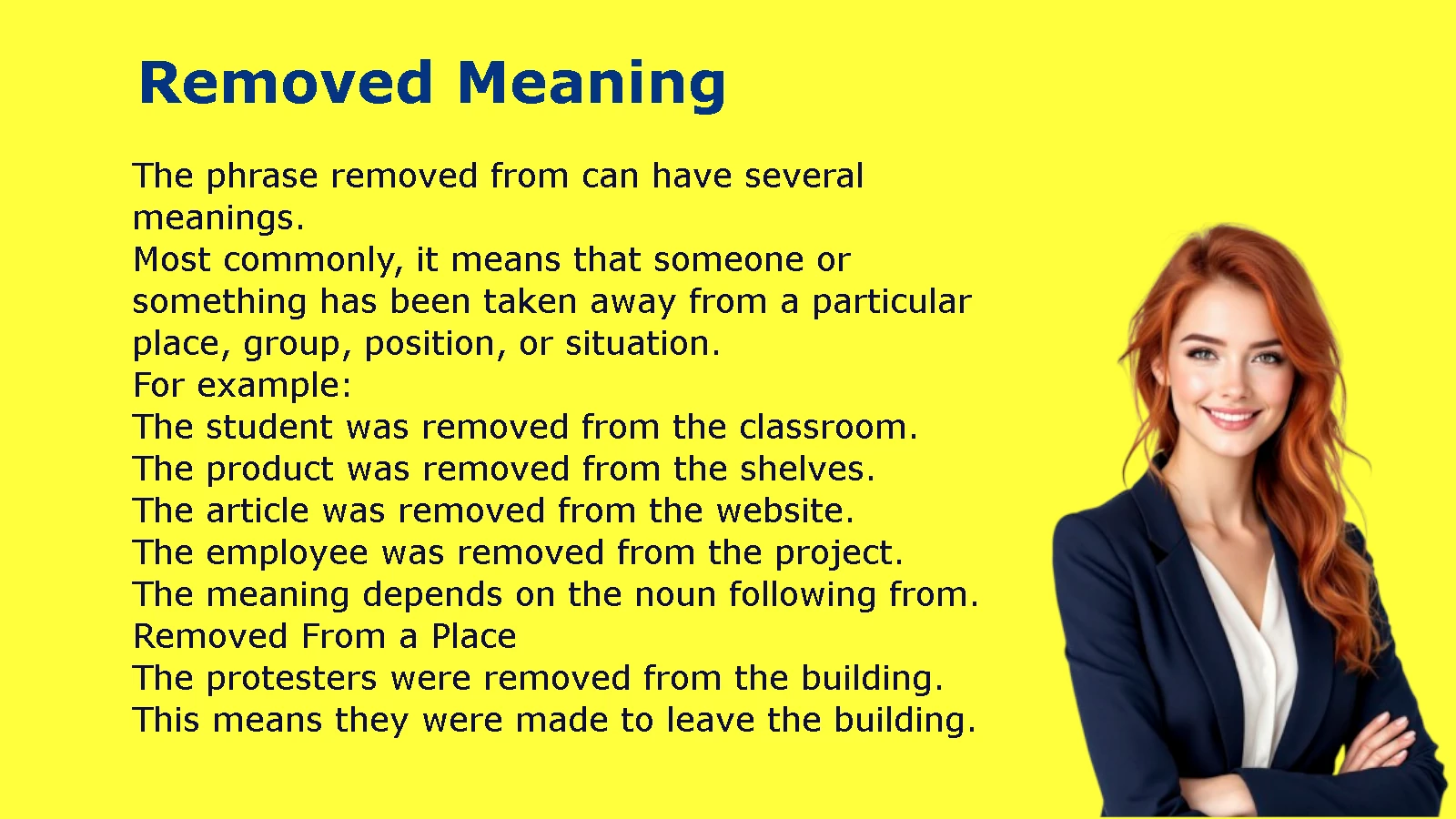
“Removed From” Meaning
The phrase removed from can have several meanings.
Most commonly, it means that someone or something has been taken away from a particular place, group, position, or situation.
For example:
- The student was removed from the classroom.
- The product was removed from the shelves.
- The article was removed from the website.
- The employee was removed from the project.
The meaning depends on the noun following from.
Removed From a Place
Removed From a Group
This means he was no longer part of the committee.
Removed From a Position
Removed From Consideration
You may also encounter:
Her application was removed from consideration.
This means the application was no longer being considered.
Other examples include:
- The proposal was removed from the agenda.
- The candidate was removed from consideration.
- The item was removed from the list.
The common idea remains the same: something no longer occupies its previous place or status.
“Once Removed” Meaning
The phrase once removed has a special meaning when talking about family relationships.
In genealogy, once removed means that two relatives are separated by one generation.
This is where the word can trip people up.
Once removed does not mean “removed from the family.”
Instead, it refers to a generation difference.
What Does “First Cousin Once Removed” Mean?
A first cousin once removed is someone who is one generation above or below you while maintaining a first cousin relationship through the family line.
There are two common ways this relationship can occur:
- Your parent’s first cousin is your first cousin once removed.
- Your first cousin’s child is your first cousin once removed.
That means the relationship works in both directions.
Consider this simplified structure:
Your grandparent
│
┌────┴────┐
Your parent Your parent’s sibling
│ │
You Your cousin
│
Cousin’s child
Your cousin’s child is one generation below you. Therefore, that child is your first cousin once removed.
Likewise, your parent’s first cousin is one generation above you, making that person your first cousin once removed.
The word removed refers to the number of generations separating the two people.
The number before removed tells you the generation gap:
- Once removed = one generation apart
- Twice removed = two generations apart
- Three times removed = three generations apart
The cousin level and the removal level describe different things.
That’s the key.
First Cousin vs. First Cousin Once Removed
These terms are easy to confuse, so a comparison helps.
| Relationship | Generation difference |
| First cousin | Same generation |
| First cousin once removed | One generation apart |
| First cousin twice removed | Two generations apart |
Suppose two siblings each have children. Those children are first cousins because they’re in the same generation.
Now suppose one of those first cousins has a child. That child is one generation below the other first cousin.
Therefore, they are first cousins once removed.
“Twice Removed” Meaning
Twice removed means two generations separate the relatives.
For example, imagine that a person’s first cousin has a grandchild. That grandchild is two generations below the original person.
The pattern is straightforward:
Same generation
↓
First cousin
One generation apart
↓
First cousin once removed
Two generations apart
↓
First cousin twice removed
The word removed tells you about the generation gap. The word first, second, or another cousin number tells you about the cousin relationship itself.
A Simple Family Example
Imagine three generations:
Grandparent
│
├── Parent
│ │
│ └── You
│
└── Parent’s cousin
│
└── Cousin’s child
The exact relationship depends on the family structure, but the important principle remains:
The “removed” number describes how many generations separate the relatives.
That distinction makes genealogy terms much easier to understand.
Removed vs. Remove
The difference between remove and removed is mainly grammatical.
| Word | Form | Example |
| Remove | Base verb | Please remove the label. |
| Removed | Simple past | She removed the label. |
| Removed | Past participle | She has removed the label. |
| Removing | Present participle | She is removing the label. |
Think of remove as the basic action and removed as a form used for a completed past action or in certain adjective constructions.
Remove
Use remove for the base form:
- Please remove your shoes.
- They need to remove the old equipment.
Removed
Use removed for a completed past action:
- They removed the old equipment yesterday.
- She removed the picture from the wall.
Removing
Use removing when the action is ongoing:
- They are removing the old equipment.
- She is removing the picture.
Cambridge identifies removing as the present participle of remove.
Removed vs. Distant
Removed and distant can overlap, but they aren’t always interchangeable.
Distant usually focuses directly on separation or distance.
Removed can emphasize that something has been taken away, separated, or disconnected.
Compare:
The village is distant from the capital.
The village is far removed from the capital.
Both sentences suggest considerable separation. However, far removed can sound more formal and can also work in figurative contexts.
For example:
His opinion is distant from mine.
This is possible but less natural in many contexts.
A more natural expression is:
His opinion is far removed from mine.
Quick Comparison
| Word | Main idea | Example |
| Distant | Far away or not close | They live in a distant town. |
| Removed | Taken away or separated | The file was removed. |
| Far removed | Very distant or very different | His beliefs are far removed from mine. |
Common Phrases With Removed
The word removed appears in several useful expressions.
Far Removed From
Means very distant or very different from.
Removed From Office
Means forced to leave an official position.
Removed From the List
Means taken off a list.
Removed From the Team
Means no longer part of a team.
Once Removed
Means one generation apart in a cousin relationship.
She is his first cousin once removed.
Twice Removed
Means two generations apart in a cousin relationship.
These expressions may look unrelated at first. However, they all share the basic idea of separation.
Removed in Different Contexts
The meaning becomes much clearer when you see the word in different situations.
Removed in Everyday Conversation
Examples:
- I removed my shoes.
- She removed the lid.
- He removed the broken cable.
- They removed the old furniture.
These are straightforward physical actions.
Removed in Work and Business
In professional settings, removed can describe a change in someone’s role or status.
Examples:
- The manager was removed from the project.
- The director was removed from office.
- The employee was removed from the committee.
In this context, the word can carry a more serious meaning because it may involve someone’s authority or employment.
Removed in Technology
Digital platforms frequently use removed when content disappears from a website, account, or system.
Examples:
- The post was removed.
- The video was removed from the platform.
- The file was removed from the folder.
- The comment was removed by a moderator.
Here, removed generally means the content was deleted or taken out of its previous location.
Removed in Family Relationships
In genealogy, removed has a completely different looking but logically related function.
Examples:
- first cousin once removed
- first cousin twice removed
- second cousin once removed
In these expressions, removed tells you the generation difference rather than saying that someone has been taken away.
Usage Case Studies
Understanding a word is easier when you see how context changes its meaning.
Case Study: A Removed Object
Sentence:
The technician removed the damaged battery.
Here, removed is the past tense of remove.
The technician took the battery out of the device.
Meaning: taken away.
Case Study: A Removed Person
Sentence:
The director was removed from office.
Here, removed refers to a person’s position.
The director was forced or formally required to leave the office or position.
Meaning: forced out of a position.
Case Study: A Far Removed Idea
Sentence:
That explanation is far removed from the available evidence.
No one physically moved the explanation.
The sentence says the explanation is very different from or disconnected from the evidence.
Meaning: distant or disconnected in an abstract sense.
Case Study: A Family Relationship
Sentence:
She is my first cousin once removed.
Here, removed has a technical genealogy meaning.
The two relatives are separated by one generation.
Meaning: one generation apart.
These examples show why you shouldn’t rely on one fixed definition. Context controls meaning.
Examples of Removed in Sentences
Removed Meaning “Taken Away”
- The old sign was removed from the building.
- She removed the broken glass carefully.
- The workers removed the damaged flooring.
- He removed the file from the folder.
- The dentist removed the damaged tooth.
Removed Meaning “Taken Off”
- She removed her coat.
- He removed his gloves.
- They removed the cover from the machine.
- The nurse removed the bandage.
Removed Meaning “Forced Out”
- The official was removed from office.
- The manager was removed from his position.
- The director was removed from the board.
Removed Meaning “Distant”
- The community is far removed from the nearest city.
- His lifestyle is far removed from mine.
- The story is far removed from historical reality.
Removed in Family Relationships
- She is my first cousin once removed.
- He is my second cousin once removed.
- She is my first cousin twice removed.
Removed Synonyms
The best synonym depends on the meaning.
| Meaning of removed | Possible synonyms |
| Taken away | taken away, taken out, eliminated |
| Taken off | taken off, detached |
| Deleted | deleted, erased, taken down |
| Forced out | dismissed, ousted, expelled |
| Distant | remote, far away, separate |
| Disconnected | detached, separate, unrelated |
| Very different | distant, disconnected, unlike |
However, these words aren’t perfect substitutes in every sentence.
For example, dismissed can replace removed when someone loses a job, but it doesn’t work for a sentence such as “She removed her shoes.”
Likewise, deleted works well for digital content but doesn’t normally replace removed in family terminology.
Removed Antonyms
The opposite of removed changes with the context.
| Meaning of removed | Possible opposite |
| Taken away | kept, retained |
| Deleted | added, restored |
| Physically distant | nearby, close |
| Separated | connected, attached |
| Forced out | retained, appointed |
| Excluded | included |
| Distant in ideas | similar, related |
For example:
- The file was removed. → The file was retained.
- The village is far removed. → The village is nearby.
- The name was removed from the list. → The name was added to the list.
There isn’t one universal antonym because removed has several meanings.
Common Mistakes With Removed
Although the word is common, several usage mistakes appear often.
Mistake: Treating Removed as Only “Deleted”
Removed can mean deleted, but that’s only one use.
For example:
She removed her jacket.
Here, nothing was deleted.
She simply took her jacket off.
Mistake: Thinking “Once Removed” Means No Longer Related
This is incorrect.
In first cousin once removed, the word removed refers to a one generation difference.
It doesn’t mean the person has been excluded from the family.
Mistake: Assuming “Far Removed” Always Means Physical Distance
It doesn’t.
Consider:
His argument is far removed from the evidence.
The argument isn’t physically located somewhere else. It is very different from or disconnected from the evidence.
Mistake: Confusing Remove and Removed
Use remove for the base verb:
Please remove the box.
Use removed for the past:
She removed the box.
Use removing for an ongoing action:
She is removing the box.
Mistake: Assuming Removed Always Has a Negative Meaning
The word itself isn’t necessarily negative.
For example:
She removed a stain from her shirt.
That’s a positive result.
Likewise:
The doctor removed the damaged tissue.
The context determines whether the action is beneficial, neutral, or negative.
How to Understand Removed From Context
When you encounter removed, ask three quick questions:
- Was something taken away?
- Is something distant or disconnected?
- Is the word describing a family generation?
This simple test can solve most cases.
If Something Was Taken Away
Think:
removed = taken away
Example:
The package was removed from the shelf.
If Something Is Distant
Think:
removed = distant or separate
Example:
The region is far removed from the capital.
If You’re Reading About Family
Think:
removed = separated by generations
Example:
My first cousin once removed lives nearby.
The location of the word in the sentence can also help. Phrases such as “far removed from” usually signal figurative or physical distance, while “once removed” in a family context signals genealogy.
Why Context Matters So Much
A dictionary gives you possible meanings, but the sentence tells you which meaning applies.
Consider the word removed in these three sentences:
The picture was removed from the wall.
His views are far removed from reality.
She is my first cousin once removed.
The same word appears three times.
Yet each sentence uses it differently:
- Taken away
- Very different or disconnected
- One generation apart
That’s why memorizing one definition isn’t enough. Learning the patterns surrounding the word gives you a much better understanding of real English.
Removed Meaning: Quick Reference Table
| Expression | Meaning |
| removed | Taken away, separated, or distant depending on context |
| remove | To take something or someone away |
| removed from | Taken away from a place, group, position, or situation |
| far removed from | Very distant or very different from |
| removed from office | Forced to leave an official position |
| once removed | One generation apart |
| twice removed | Two generations apart |
| first cousin once removed | A first cousin relationship separated by one generation |
| removed from consideration | No longer being considered |
Frequently Asked Questions About Removed Meaning
What does removed mean?
Removed usually means taken away, moved away, or separated. It can also mean distant or disconnected. In family relationships, it describes a difference in generations.
Is removed a verb or an adjective?
It can be both, depending on the sentence.
As a verb form:
She removed the book.
As an adjective:
The village is far removed from the city.
What does “far removed” mean?
Far removed means very distant, separate, or different. It can describe physical distance or an abstract difference.
What does “once removed” mean?
In genealogy, once removed means that two relatives are one generation apart. Cambridge specifically uses the expression for cousins separated by one generation.
What does “first cousin once removed” mean?
A first cousin once removed is a first cousin relationship with a one generation difference. Your parent’s first cousin and your first cousin’s child are common examples.
What does “twice removed” mean?
Twice removed means the relatives are separated by two generations.
What is the difference between remove and removed?
Remove is the base form of the verb. Removed is its past tense and past participle.
- I remove the file.
- I removed the file.
- I have removed the file.
What is another word for removed?
Depending on context, possible alternatives include taken away, deleted, detached, distant, separate, dismissed, ousted, and eliminated.
No single synonym works in every situation.
What is the opposite of removed?
Possible opposites include kept, retained, attached, nearby, connected, included, and restored. The correct opposite depends on the meaning.
How do you use removed in a sentence?
Use removed when something has been taken away or when you’re describing separation or distance.
Examples:
- The stain was removed.
- He removed his jacket.
- The official was removed from office.
- The village is far removed from the city.
- She is my first cousin once removed.
Final Takeaway on Removed Meaning
The removed meaning changes with context, but its central idea is separation.
When removed describes an action, it usually means taken away or taken off. When it appears in far removed from, it means distant, separate, or very different. When it appears in a family expression such as first cousin once removed, it describes a difference of one generation.
The quickest way to understand the word is to look at the phrase around it:
- Removed the object → took it away.
- Removed her coat → took it off.
- Removed from office → forced out of a position.
- Far removed from reality → very different from reality.
- First cousin once removed → one generation apart.
Once you recognize those patterns, removed becomes much less confusing. A single word may wear several hats, but the surrounding context usually tells you which one it’s wearing.




