Have you ever met someone who speaks as if they are better, smarter, or more important than everyone else? That person might be described as pompous. While Pompous Meaning is often associated with arrogance, the word can also describe speech, writing, behavior, or appearance that seems overly important or self impressive.
Pompous is an adjective used to describe someone or something that appears too self important, proud, or grand, especially in a way that feels annoying or unnatural. It can describe a person’s attitude, their choice of words, or even the way they present themselves.
Examples:
- He sounded pompous when he talked about his achievements.
- Her pompous speech made the simple idea seem complicated.
The confusion is understandable. People often search for what does pompous mean, pompous meaning in a sentence, pompous meaning in text, or pompous synonym because the word can describe both a person’s behavior and the way they communicate. And here’s the kicker: someone doesn’t have to be openly rude to sound pompous. Using overly grand language or acting as though ordinary things are beneath them can also come across as pompous.
In this guide, you’ll learn the complete Pompous Meaning, its definition, pronunciation, synonyms, antonyms, and examples in sentences. You’ll also discover how to use pompous correctly, what it means when describing a person or speech, and the difference between pompous, arrogant, pretentious, and other similar words.
Pompous Meaning in Simple Words
Pompous means showing too much self importance or acting as though you are more important, impressive, or knowledgeable than other people.
The word can also describe speech or writing that uses an unnecessarily grand or formal style.
Cambridge defines pompous as being too serious and full of importance. Its American English definition focuses on the idea of thinking you are better or more important than other people.
Oxford similarly describes a pompous person as someone who shows that they think they’re more important than others, especially through long or formal language.
Pompous definition at a glance
| Word | Meaning |
| Pompous | Excessively self important or overly grand |
| Part of speech | Adjective |
| Tone | Usually negative or disapproving |
| Pronunciation | POM pəs |
| US pronunciation | /ˈpɑːm.pəs/ |
| Common synonyms | Arrogant, pretentious, self important, grandiose |
| Common antonyms | Humble, modest, unassuming, down to earth |
In simple terms, pompous describes someone who makes a bigger deal of their importance than the situation calls for.
What Does Pompous Mean When Describing a Person?
A pompous person acts as though their status, knowledge, opinions, or achievements deserve special attention.
That doesn’t necessarily mean the person has accomplished nothing. A highly educated professor can be pompous. So can a successful executive, talented artist, politician, student, or neighbor.
The issue isn’t achievement itself. The issue is how someone presents their importance.
A person might sound pompous if they:
- Constantly talk about their achievements
- Expect people to admire their knowledge
- Talk down to others
- Treat ordinary matters as extremely important
- Use grand language to impress people
- Act as though their opinions carry more weight than everyone else’s
- Take themselves extremely seriously
- Expect special treatment because of their position
- Turn simple conversations into opportunities to display their status
- Struggle to laugh at themselves
For example:
“He became so pompous after receiving the promotion that he stopped listening to his coworkers.”
The sentence doesn’t simply say that he became confident. It suggests that his new position caused him to behave as though he had become more important than everyone around him.
A pompous person vs. a confident person
Confidence and pomposity can look similar at first. The difference becomes clearer when you look at how the person treats other people.
| Confident | Pompous |
| Knows their strengths | Overstates their importance |
| Can accept criticism | May dismiss criticism |
| Respects other people’s abilities | May look down on others |
| Doesn’t need constant admiration | Often seeks recognition |
| Can admit mistakes | May avoid admitting mistakes |
| Speaks clearly | May use grand language to impress |
| Can laugh at themselves | Often takes themselves too seriously |
Confidence says, “I know what I can do.”
Pompousness often says, “You should notice how important I am.”
That’s an important distinction.
Pompous Meaning in Speech and Writing
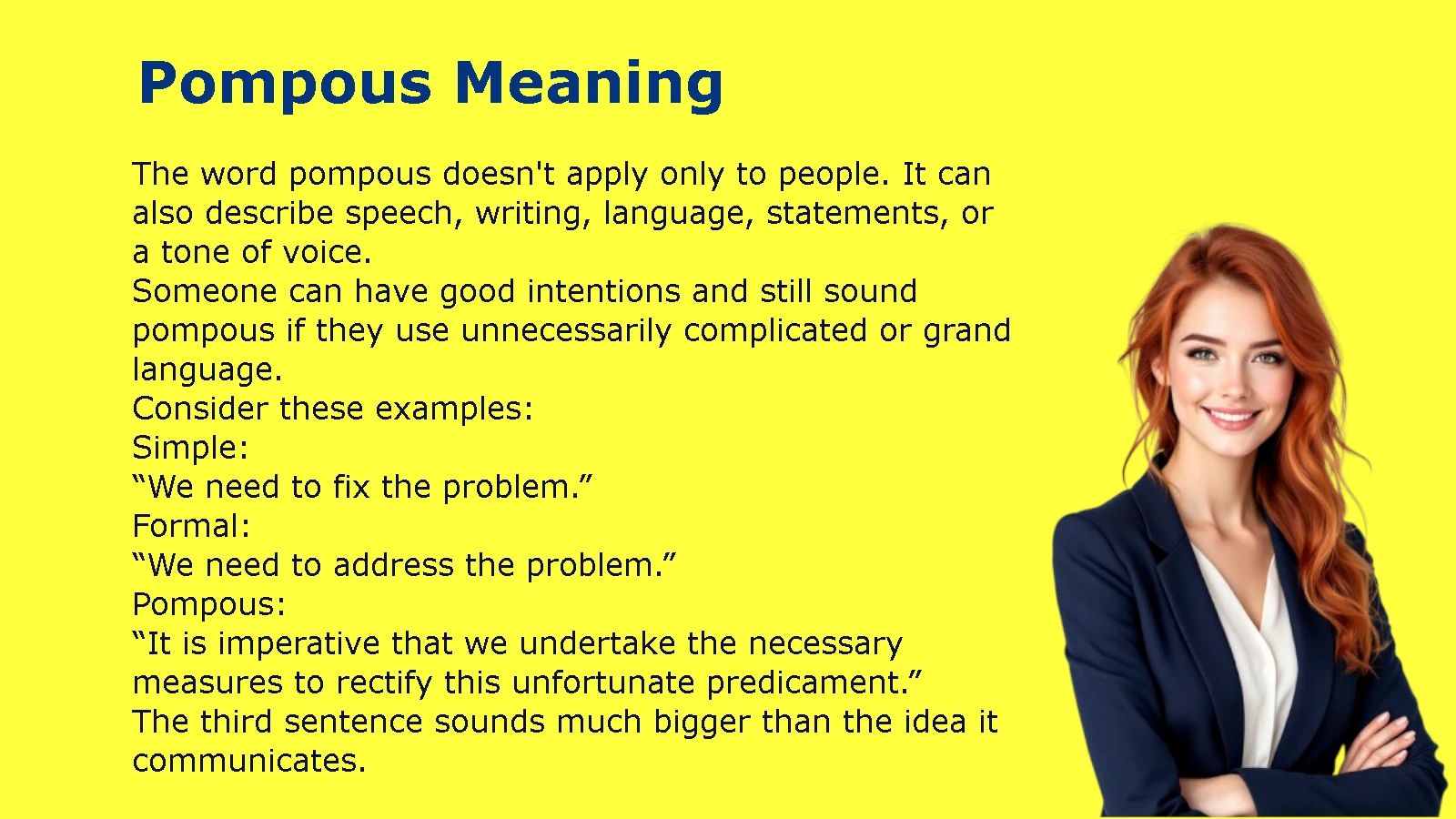
The word pompous doesn’t apply only to people. It can also describe speech, writing, language, statements, or a tone of voice.
Someone can have good intentions and still sound pompous if they use unnecessarily complicated or grand language.
Consider these examples:
Simple:
“We need to fix the problem.”
Formal:
“We need to address the problem.”
Pompous:
“It is imperative that we undertake the necessary measures to rectify this unfortunate predicament.”
The third sentence sounds much bigger than the idea it communicates.
That’s the heart of pompous language. It often uses elaborate wording when a simple expression would work just as well.
Oxford specifically connects pompous with the use of long and formal words.
What makes language sound pompous?
Pompous writing often contains:
- Excessively formal vocabulary
- Unnecessarily long sentences
- Grand claims
- Inflated descriptions
- Abstract language
- Excessive qualifications
- Overly serious wording
- Words chosen to impress rather than clarify
For example:
“I am in receipt of your correspondence.”
This isn’t grammatically wrong. However, “I received your email” is usually clearer and more natural.
Another example:
“We shall endeavor to facilitate the successful completion of the aforementioned task.”
A simpler version would be:
“We’ll help complete the task.”
The second version communicates the same basic idea without making the sentence wear a tuxedo to a grocery store.
Examples of Pompous in Sentences
Seeing the word in context makes its meaning much easier to understand.
Examples describing people
- The pompous professor acted as though nobody else understood the subject.
- His pompous attitude made ordinary conversations exhausting.
- She found the new executive polite at first but increasingly pompous.
- The pompous politician spoke for twenty minutes without answering the question.
- Nobody enjoyed working with the pompous manager.
describing speech
- His speech sounded pompous and self congratulatory.
- The actor’s interview became pompous when he started discussing his supposed influence on modern cinema.
- Her normally friendly tone became pompous during the presentation.
writing
- The article makes a simple idea sound complicated and pompous.
- The introduction is too pompous for such a straightforward subject.
- His essay contains several pompous phrases that could easily be rewritten in plain English.
behavior
- His pompous behavior annoyed everyone at the dinner table.
- The director’s pompous manner made employees uncomfortable.
- She considered the award ceremony unnecessarily pompous.
everyday situations
“Don’t make the announcement sound so pompous. Just tell everyone what happened.”
“He isn’t necessarily rude, but his pompous manner can be difficult to handle.”
“The speech was informative, although parts of it sounded pompous.”
These examples show an important point: pompous doesn’t always mean openly rude. Someone can sound pompous while remaining technically polite.
Pompous vs. Arrogant
Pompous and arrogant overlap, but they aren’t exact synonyms.
Arrogant describes someone who has an exaggerated sense of superiority. Pompous often adds an element of exaggerated seriousness, display, or grand expression.
Cambridge lists arrogant, conceited, haughty, self important, and related words among synonyms or closely related terms for pompous.
Oxford also connects pompous with pretentious.
The difference
| Word | Main idea |
| Arrogant | Believing you are better or more capable than others |
| Pompous | Displaying exaggerated importance or seriousness |
| Pretentious | Trying to appear more impressive, cultured, or important than you really are |
| Conceited | Having an excessively high opinion of yourself |
| Haughty | Acting superior and often showing contempt for others |
| Grandiose | Excessively grand, ambitious, or elaborate |
For example:
“He is arrogant because he thinks nobody can do the job better than him.”
The focus is his belief in his superiority.
“He is pompous because he gives a dramatic speech every time he explains how well he performs the job.”
Here, the focus is his exaggerated presentation of himself.
A person can be both arrogant and pompous, but the words emphasize different aspects of the behavior.
Pompous vs. Pretentious
The difference between pompous and pretentious can be subtle.
Someone is pretentious when they try to appear more impressive, sophisticated, intelligent, cultured, or important than they actually are.
Someone is pompous when they display excessive self importance or use an inflated, overly grand manner.
For example:
“He was pretentious about wine, using obscure terms to make himself sound like an expert.”
The emphasis falls on his attempt to appear sophisticated.
Now consider:
“He was pompous during the meeting, speaking as though everyone should be grateful for his presence.”
The emphasis falls on his inflated sense of importance.
Quick comparison
| Pompous | Pretentious |
| Excessively self important | Tries to seem more impressive |
| Often overly serious | Often concerned with appearance |
| Can involve grand speech | Can involve affected tastes or behavior |
| May suggest superiority | May suggest artificial sophistication |
The two words often overlap. However, pretentious focuses more on trying to create an impressive image, while pompous often focuses on displaying importance or grandeur
By contrast, pompous usually carries criticism.
Compare:
“The ceremony was grand.”
This can sound complimentary.
“The ceremony was pompous.”
This suggests that the ceremony felt overly elaborate, self important, or unnecessarily formal.
The difference often comes down to judgment and excess.
Something can be grand because it is impressive. Something can be pompous because it tries too hard to appear impressive.
Synonyms for Pompous
The best synonym depends on exactly what you want to criticize.
Arrogant
Use arrogant when someone acts as though they are better than other people.
“His arrogant attitude made teamwork difficult.”
Self important
Use self important when someone behaves as though their role or opinions matter more than they actually do.
“She came across as self important during the meeting.”
Pretentious
Use pretentious when someone tries to appear more sophisticated, intelligent, or impressive than they really are.
“The restaurant’s pretentious menu used complicated names for simple dishes.”
Conceited
Use conceited when someone has an excessively positive opinion of themselves.
“He is too conceited to accept advice.”
Haughty
Use haughty when someone behaves with an obvious sense of superiority.
“Her haughty manner discouraged people from approaching her.”
Grandiose
Use grandiose for ideas, claims, plans, language, or descriptions that seem excessively grand.
“The proposal contained grandiose promises that the company couldn’t realistically fulfill.”
Bombastic
Bombastic works particularly well for speech or writing that uses inflated, forceful, or impressive sounding language.
“The candidate’s bombastic speech contained plenty of dramatic claims but few details.”
Pompous synonyms by context
| If you mean… | Useful synonym |
| Thinks they’re better than others | Arrogant |
| Thinks they’re extremely important | Self important |
| Tries to appear sophisticated | Pretentious |
| Thinks very highly of themselves | Conceited |
| Acts superior toward others | Haughty |
| Uses excessively grand ideas or language | Grandiose |
| Uses inflated, impressive sounding language | Bombastic |
| Talks down to others | Condescending |
Merriam Webster’s thesaurus includes terms such as arrogant, pretentious, haughty, self important, patronizing, and condescending among words related to pompous.
Antonyms of Pompous
The opposite of pompous behavior is usually associated with humility, simplicity, and an unassuming manner.
Useful antonyms include:
- Humble
- Modest
- Unassuming
- Down to earth
- Simple
- Straightforward
- Approachable
- Informal
- Plainspoken
For example:
Pompous: “The distinguished gentleman was pleased to bestow his wisdom upon the audience.”
Unassuming: “He was happy to share what he knew.”
The second sentence doesn’t try to make the speaker sound important.
Pompous vs. humble
| Pompous | Humble |
| Emphasizes importance | Doesn’t seek special importance |
| May seek admiration | Doesn’t require admiration |
| Can talk down to others | Treats others as equals |
| Often uses inflated language | Usually communicates naturally |
| Takes self importance seriously | Keeps achievements in perspective |
Pompous Pronunciation
In American English, pompous is pronounced approximately:
POM pəs
The Cambridge pronunciation is /ˈpɑːm.pəs/ for US English. The stress falls on the first syllable.
Break it down like this:
pomp + us
The first part sounds like “pahm”, followed by a short unstressed “pəs.”
The word has two syllables.
Pompous Word Forms
Several related forms appear in English.
Pompous
Pompous is an adjective.
“His pompous speech annoyed the audience.”
Pompously
Pompously is an adverb. It describes an action performed in a pompous manner.
“He pompously dismissed every suggestion.”
Merriam Webster defines pompously as meaning “in a pompous manner.”
Pomposity
Pomposity is a noun that refers to pompous behavior, speech, or manner.
“The pomposity of his presentation distracted from the useful information.”
Cambridge identifies pomposity as the noun referring to pompous behavior or speech.
Pompousness
Pompousness is another noun form.
“Her pompousness became obvious during the debate.”
Both pomposity and pompousness can describe the quality of being pompous.
The History of the Word Pompous
The history of pompous helps explain why the word has such a strong connection with grandeur and display.
Oxford traces the word to Late Middle English, from Old French pompeux, meaning “full of grandeur,” and ultimately to Late Latin pomposus, from pompa, meaning pomp.
Etymonline traces the English adjective to the late 14th century and notes that earlier senses included ideas connected with grandeur, dignity, and ostentatious display.
Merriam Webster records the first known use of pompous in the 14th century.
This history makes the modern meaning easier to understand. Pomp involves display, ceremony, grandeur, or impressive outward presentation. Over time, pompous developed a strong negative sense involving excessive self importance and exaggerated display.
How to Tell If Someone Sounds Pompous
Not every formal speaker is pompous. Not every confident person is arrogant. Context matters.
Still, several clues can help you recognize pompous behavior.
Look for excessive self importance
Does the person repeatedly remind everyone about their position, education, achievements, or influence?
One mention isn’t enough. Constant emphasis can become pompous.
Notice how they treat other people
Pompous behavior often includes an implied hierarchy:
“I know more, therefore my opinion matters more.”
When someone consistently treats others as intellectually or socially beneath them, pompous may fit.
Listen to the language
Does the person use elaborate phrases even when a simple sentence would work?
For example:
“We must commence the process of evaluating the available alternatives.”
could simply become:
“We need to review our options.”
The longer sentence isn’t automatically wrong. If someone repeatedly uses this style to sound impressive, calling it pompous may be appropriate.
Watch for exaggerated seriousness
A person may sound pompous when they treat minor matters as though they involve profound questions of history, morality, or civilization.
For example:
“This coffee order represents a fundamental failure of modern organizational culture.”
That’s a dramatic response to the wrong drink.
Sometimes the humor is intentional. In that case, the speaker may be joking rather than pompous.
Pompous Meaning in Different Contexts
Pompous in everyday conversation
In everyday speech, pompous often describes someone’s personality or manner.
“He’s a little pompous, but he’s harmless.”
Here, the speaker criticizes the person’s self importance without necessarily calling them cruel.
Pompous in the workplace
Workplace communication can become pompous when people use inflated language to make ordinary responsibilities sound more prestigious.
For example:
“We will leverage our organizational synergies to facilitate enhanced operational outcomes.”
A clearer version might be:
“We’ll work together to improve our results.”
Clear language doesn’t make a person less intelligent. In many situations, it demonstrates better communication.
Pompous in academic writing
Academic writing needs precision and appropriate formality. That doesn’t mean every sentence should sound complicated.
Consider:
“This study investigates the relationship between sleep and memory.”
That’s formal and clear.
Now compare:
“The present scholarly investigation endeavors to illuminate the multifaceted interrelationship existing between nocturnal repose and the cognitive faculty of memory.”
The second sentence sounds inflated. It uses elaborate wording without adding useful meaning.
That is the kind of writing people often call pompous.
Pompous in public speaking
A speech can sound pompous when the speaker repeatedly emphasizes historical importance, personal greatness, or lofty ideals without enough substance.
The problem isn’t using powerful language. A serious occasion sometimes calls for serious language.
The problem appears when grand language becomes a substitute for clear ideas.
Case Study: When Formal Becomes Pompous
Imagine a manager announcing a new office schedule.
Version A: Clear
“Starting Monday, the office will open at 8 a.m. Employees can choose to work remotely on Fridays.”
The information is direct.
Version B: Formal
“Beginning Monday, the office will operate from 8 a.m. Employees may work remotely on Fridays.”
Still perfectly reasonable.
Version C: Pompous
“Commencing Monday, our esteemed organization shall embark upon a transformative adjustment to its established operational framework, thereby permitting select members of our valued workforce to pursue remote engagement each Friday.”
The third version contains far more words, but it doesn’t communicate more information.
That’s an important lesson about pompous language:
Complexity isn’t the same as intelligence.
Sometimes the clearest sentence is also the strongest.
Is Pompous a Negative Word?
Yes. Pompous is generally negative or disapproving.
Cambridge explicitly labels the adjective as disapproving. Oxford also labels it disapproving.
Calling someone pompous can therefore sound insulting.
However, the strength of the criticism depends on context.
Compare:
“He can be a little pompous sometimes.”
This sounds relatively mild.
“He’s an unbearable, pompous snob.”
This is much harsher.
Writers also use pompous humorously to poke fun at someone who takes themselves too seriously.
For example:
“The pompous little speech about choosing the perfect sandwich was clearly meant to be funny.”
The word can therefore carry humor, especially when the behavior is exaggerated.
How to Use Pompous Correctly
Because pompous is an adjective, it normally modifies a noun or follows a linking verb.
Before a noun
- pompous speech
- pompous person
- pompous attitude
- pompous behavior
- pompous statement
- pompous writing
- pompous tone
- pompous language
- pompous official
- pompous manner
Examples:
“He gave a pompous speech.”
“The article uses a pompous tone.”
“Her pompous attitude irritated her coworkers.”
After a linking verb
You can also use pompous after verbs such as seem, sound, become, appear, feel, and look.
“His explanation sounded pompous.”
“The speaker seemed pompous.”
“The essay became pompous in the final section.”
Using pompously
Use pompously when you need an adverb.
“He spoke pompously about his achievements.”
“She pompously dismissed the criticism.”
Using pomposity
Use pomposity when referring to the quality or behavior itself.
“The pomposity of the speech made the audience laugh.”
Common Mistakes With Pompous
Mistake: Assuming pompous means simply “formal”
Formal and pompous aren’t synonyms.
A formal sentence can be clear, respectful, and appropriate.
Pompous usually adds the idea of unnecessary grandeur or self importance.
Mistake: Assuming every successful person is pompous
Success doesn’t make someone pompous.
A person can be extremely accomplished while remaining humble and approachable.
Mistake: Using pompous when “arrogant” is more precise
If your main point is that someone believes they’re superior, arrogant may fit better.
If their superiority comes through exaggerated seriousness, grand language, or self important presentation, pompous may be more precise.
Mistake: Confusing pompous with “pomp”
The noun pomp refers to grandeur, ceremony, or impressive display.
Pompous is the adjective.
“The ceremony was filled with pomp.”
“The speaker sounded pompous.”
They are related but don’t perform the same grammatical job.
Pompous vs. Confident: What’s the Difference?
This distinction matters because people sometimes mistake confidence for arrogance.
A confident person can say:
“I’m proud of the work I did on this project.”
That’s not necessarily pompous.
A pompous person might say:
“Few people possess the vision and expertise necessary to achieve what I accomplished.”
The second statement draws attention to the speaker’s supposed exceptional status.
A useful rule
Confidence describes what you believe you can do.
Pompousness describes how excessively you display your importance.
Someone can be confident without belittling anyone. Someone can also be highly knowledgeable without sounding pompous.
The deciding factor is often attitude and presentation.
Pompous Meaning: Quick Reference
| Question | Answer |
| What does pompous mean? | Excessively self important or overly grand in manner, speech, or writing. |
| Is pompous positive or negative? | Usually negative or disapproving. |
| What is a pompous person? | Someone who displays exaggerated importance or superiority. |
| What is pompous language? | Language that sounds unnecessarily grand, formal, or inflated. |
| What is a synonym for pompous? | Arrogant, pretentious, self important, grandiose, or bombastic, depending on context. |
| What is the opposite of pompous? | Humble, modest, unassuming, or down to earth. |
| Is pompous the same as arrogant? | No. They overlap, but pompous often emphasizes exaggerated display or manner. |
| Is pompous the same as pretentious? | Not exactly. Pretentious focuses more on trying to appear impressive or sophisticated. |
| Can writing be pompous? | Yes. Unnecessarily grand or complicated language can sound pompous. |
| How many syllables does pompous have? | Two: POM pəs. |
| What part of speech is pompous? | Adjective. |
| What noun comes from pompous? | Pomposity or pompousness. |
Frequently Asked Questions About Pompous Meaning
What does pompous mean in simple words?
Pompous means acting or speaking as though you are more important, impressive, or superior than you really need to appear. It can describe people, behavior, speech, writing, or attitudes.
Is pompous an insult?
Usually, yes. Pompous normally expresses disapproval. However, speakers sometimes use it mildly or humorously to describe someone who takes themselves too seriously. Cambridge and Oxford both classify the word as disapproving.
What is an example of a pompous person?
A manager who constantly reminds employees about their superior knowledge, dismisses other people’s ideas, and turns simple conversations into grand speeches could be described as pompous.
What is an example of pompous language?
“We must endeavor to facilitate the implementation of the aforementioned initiative.”
A simpler version is:
“We need to implement the plan.”
The first sentence sounds more elaborate than necessary.
What is the difference between pompous and arrogant?
Arrogant focuses on a person’s belief that they are better or more capable than others. Pompous often focuses on how that exaggerated importance appears through speech, behavior, manner, or overly grand presentation.
What is the difference between pompous and pretentious?
Pompous usually involves excessive self importance or grandness. Pretentious usually involves trying to appear more sophisticated, intelligent, cultured, or important than you really are.
What is the opposite of pompous?
Common opposites include humble, modest, unassuming, down to earth, approachable, and plainspoken.
Can writing be pompous?
Yes. Writing can sound pompous when it uses unnecessarily complicated vocabulary, inflated claims, excessive formality, or elaborate phrases that don’t add meaning.
Is pompous the same as confident?
No. Confidence involves having a realistic belief in your abilities. Pompousness involves displaying excessive importance or grandeur.
What is the noun form of pompous?
The main noun forms are pomposity and pompousness. Pomposity commonly refers to pompous behavior or speech.
What is the adverb form of pompous?
The adverb is pompously.
“He spoke pompously about his accomplishments.”
How do you pronounce pompous?
In American English, pompous is pronounced approximately POM pəs, with the stress on the first syllable. Cambridge gives the US pronunciation as /ˈpɑːm.pəs/.
Final Takeaway: What Does Pompous Mean?
The simplest way to remember the pompous meaning is this:
Pompous describes excessive self importance, exaggerated grandeur, or an overly grand way of speaking or behaving.
A pompous person may act as though they’re more important than everyone else. Pompous writing may use complicated words to make a simple idea sound impressive. Pompous behavior may turn ordinary situations into opportunities for grand displays of status or importance.
The word overlaps with arrogant, pretentious, conceited, haughty, grandiose, and bombastic, but each carries a slightly different meaning.
Most importantly, pompous doesn’t simply mean formal, intelligent, successful, or confident. The key idea is excess. When someone pushes their importance, seriousness, sophistication, or grandeur far beyond what the situation requires, pompous often captures the problem perfectly.




