Have you ever come across the word “strands” and wondered exactly what it means? While Strands Meaning may seem straightforward, this word can have different meanings depending on the context in which it is used.
Strands is the plural form of strand. It can refer to thin pieces of something, such as hair, thread, fiber, or material. It can also describe separate parts of something that are connected, such as ideas, stories, or conversations.
Examples:
- She brushed the strands of hair away from her face.
- The rope is made from several strong strands.
The confusion is understandable. People often search for what does strands mean, strands meaning in English, strand meaning, or strands meaning in a sentence because the word can describe physical objects as well as ideas or parts of a larger whole. And here’s the interesting part: the meaning can change quite a bit depending on what comes before or after it.
In this guide, you’ll learn the complete Strands Meaning, its definition, pronunciation, parts of speech, correct usage, and examples in sentences. You’ll also discover the different meanings of strands, common phrases using the word, and how strand differs from related words such as thread, fiber, and string.
What Does “Strands” Mean?
Strands usually refers to two or more thin, long pieces of something, such as hair, thread, wire, fiber, or rope. The word can also describe separate elements that combine to form a larger idea, story, argument, or situation.
Cambridge defines a strand as “a thin thread of something,” while it also uses the word for a part that contributes to a larger story, subject, or situation.
Merriam Webster gives the word a similarly broad meaning. It includes individual fibers, wires, molecular chains, threadlike materials, and elements that are woven into a complex whole.
Strands Meaning in Simple English
In plain English, strands are individual pieces or separate parts of something larger.
Think about a rope. A rope may look like one solid object, but it can contain several strands twisted together. Each strand contributes to the strength and structure of the rope.
The same basic idea works figuratively.
A novel might contain several strands of a plot. Each storyline develops separately, but together they create the complete story.
So, the central idea is:
A strand is one distinct part that can exist alongside or combine with other parts.
When there is more than one, you use strands.
Strands Definition
The noun strand has several closely related meanings. Most of them share the idea of something long, thin, threadlike, or functioning as one part of a larger whole.
| Word | Basic meaning | Example |
| Strand | One thin piece or separate element | A strand of hair |
| Strands | More than one strand | Several strands of hair |
| Strand as a verb | To leave someone or something unable to leave | The storm stranded travelers |
| Strands as a verb | Leaves someone or something unable to leave | The storm strands travelers |
Merriam Webster also recognizes a separate noun strand meaning a shore or beach. That meaning has a different history from the threadlike sense discussed in most everyday uses of strands.
The Core Idea Behind the Word
Although strand appears in many fields, its meanings often connect through one simple concept: a distinct line or part within something larger.
Consider these examples:
- A strand of hair is one part of all the hair on your head.
- A strand of rope is one part of the rope’s structure.
- A strand of DNA is one molecular chain within DNA.
- A strand of a plot is one storyline within a larger narrative.
- A strand of thought is one line of thinking within a broader discussion.
That connection makes the word easier to understand. You don’t have to memorize every definition separately.
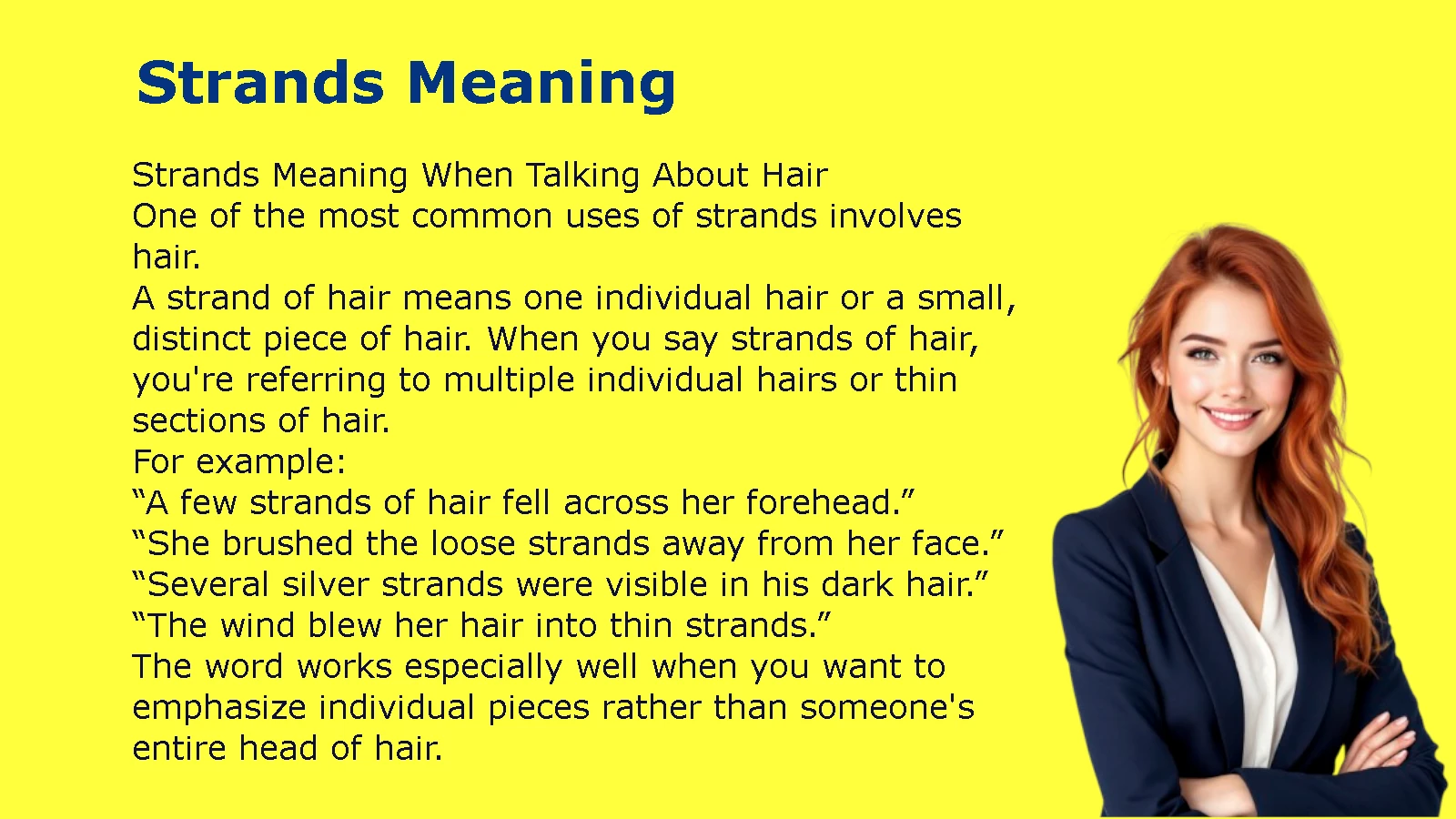
Strands Meaning When Talking About Hair
One of the most common uses of strands involves hair.
A strand of hair means one individual hair or a small, distinct piece of hair. When you say strands of hair, you’re referring to multiple individual hairs or thin sections of hair.
For example:
- “A few strands of hair fell across her forehead.”
- “She brushed the loose strands away from her face.”
- “Several silver strands were visible in his dark hair.”
- “The wind blew her hair into thin strands.”
The word works especially well when you want to emphasize individual pieces rather than someone’s entire head of hair.
Strand of Hair vs. Lock of Hair
These terms overlap, but they aren’t always identical.
A strand of hair usually refers to one individual hair or a very thin piece.
A lock of hair generally suggests a thicker group of hairs gathered together.
| Expression | Typical meaning |
| A strand of hair | One thin piece or individual hair |
| A few strands of hair | Several individual hairs |
| A lock of hair | A thicker group of hair |
| A head of hair | All or most of someone’s hair |
For example, finding one hair on your shirt might lead you to say, “There’s a strand of hair on my jacket.” If someone cuts and saves a noticeable portion of hair, lock of hair may fit better.
Strands Meaning for Thread, Fiber, Rope, and Wire
The physical meaning of strand extends far beyond hair.
A strand can describe an individual fiber, thread, wire, or similar thin material. Several strands may twist, braid, or lie alongside one another to create a stronger or larger structure.
For example, rope can consist of multiple strands twisted together. Wire rope and cable can also contain multiple wires or groups of wires arranged to create a larger structure. Merriam Webster specifically includes fibers, filaments, wires, and molecular chains among the things that can be called strands.
Examples of Physical Strands
You might hear or read:
- strands of thread
- strands of fiber
- strands of wire
- strands of rope
- strands of yarn
- strands of spaghetti
- strands of beads
- strands of pearls
The exact object changes, but the underlying idea remains similar: a long, narrow element that can be viewed separately from the larger group or structure.
Why the Word Fits Rope So Well
Imagine holding a thick rope in your hands. At first glance, it looks like one continuous object. Look closer, however, and you can see individual sections twisted around each other.
Each section is a strand.
This physical image helps explain the word’s figurative uses too. Several separate strands can come together and form something larger, stronger, or more complex.
Strands Meaning in DNA
In biology, strand has a more technical meaning.
DNA is commonly described as a double helix made from two complementary strands. Each strand consists of a long chain of nucleotides. The two strands run in opposite directions and pair through interactions between their bases.
Therefore, when scientists or science writers refer to DNA strands, they aren’t talking about something merely shaped like a piece of thread. They are describing molecular chains with a specific biological structure and function.
For example:
- single strand of DNA
- two strands of DNA
- DNA strand
- double stranded DNA
- single stranded DNA
The word works here because a DNA molecule has a long, chainlike structure. Merriam Webster explicitly gives a strand of DNA as an example of something resembling a strand.
A Simple Way to Understand DNA Strands
Think of a ladder.
The two long sides represent the two DNA strands. The rungs represent paired bases connecting the strands. When the structure twists, it forms the familiar double helix.
That analogy isn’t a complete description of DNA, but it provides a useful starting point for understanding why scientists call them strands.
Strands Meaning in Stories and Plots
Here’s where the word becomes more interesting.
Strands doesn’t have to describe a physical object. Writers often use it to describe separate storylines, themes, or developments that form part of a larger narrative.
For example:
“The novel follows several strands of the story before bringing them together.”
Here, strands means separate storylines or narrative threads.
Cambridge describes this use as a part that combines with other parts to form a whole story, subject, or situation.
Imagine a mystery novel with three characters living in different cities. Each character has a separate storyline. At first, the stories seem unrelated. As the novel progresses, clues reveal that all three characters connect to the same mystery.
Those separate storylines are strands of the plot.
Common Story Related Expressions
You may encounter:
- strands of the plot
- strands of the narrative
- different strands of the story
- multiple narrative strands
- interwoven strands of the story
These expressions suggest that a larger story contains several connected parts.
Strands Meaning in Ideas and Thought
The word also works well when discussing ideas.
A strand of thought refers to a particular line, approach, or school of thinking within a broader discussion.
For example:
- “One strand of thought argues that technology improves productivity.”
- “The essay examines several strands of political thought.”
- “These two strands of research eventually developed in different directions.”
Here, strands doesn’t mean literal threads. Instead, it creates a useful metaphor.
Imagine several threads running through a piece of fabric. Each thread contributes to the finished material. In the same way, several lines of thought can contribute to a larger intellectual discussion.
Strands of Thought vs. Ideas
These expressions aren’t always interchangeable.
Ideas can refer to individual thoughts or concepts.
Strands of thought usually suggests a connected line of reasoning or a recognizable direction within a larger discussion.
For instance:
- “She had several ideas for the project.”
- “The paper explores several strands of thought about education.”
The first sentence focuses on individual suggestions. The second emphasizes broader lines of thinking.
Strands Meaning in Arguments and Discussions
You can also use strands to describe different parts of an argument, debate, or complex issue.
Suppose a company is discussing whether to introduce a four day workweek. The discussion might include separate strands involving:
- employee productivity
- operating costs
- customer service
- employee satisfaction
- scheduling
- workplace culture
These aren’t necessarily unrelated topics. Together, they form different strands of the discussion.
For example:
“The committee brought several strands of the debate together before making its recommendation.”
The sentence suggests that the committee considered multiple connected aspects of the issue.
Strands Meaning in Evidence and Research
In formal writing, strands of evidence can refer to separate lines or categories of evidence that support a conclusion.
For example:
“Researchers considered several strands of evidence before reaching their conclusion.”
This wording suggests that the evidence came from different sources, methods, or observations.
The phrase can be especially useful when a complicated conclusion doesn’t depend on one piece of evidence. Instead, several pieces work together.
Example: A Research Question
Imagine researchers studying why a particular species is declining.
They might examine:
- population records
- habitat changes
- food availability
- disease data
- climate patterns
Each category represents a different strand of evidence. When researchers combine them, they can develop a stronger overall explanation.
The metaphor works because the individual strands become meaningful as part of a larger structure.
Strands Meaning in Conversations and Situations
Complex conversations can contain multiple strands too.
Consider a meeting where people discuss a product launch. The conversation might move between marketing, pricing, staffing, customer feedback, and technical problems.
You could say:
“The conversation developed several different strands.”
That doesn’t mean the participants literally separated pieces of thread. It means the discussion developed along several different lines.
This usage is especially useful when a conversation becomes complicated and contains multiple connected topics.
Strands Meaning in Everyday Examples
The word becomes much easier to recognize when you see it in different sentences.
| Sentence | Meaning of “strands” |
| She brushed several strands of hair from her face. | Individual hairs |
| The rope consists of several twisted strands. | Fiber or rope components |
| Scientists examined both strands of the DNA molecule. | Molecular chains |
| The novel has several strands of the plot. | Separate storylines |
| The article explores different strands of thought. | Lines of thinking |
| Several strands of evidence support the theory. | Different categories or lines of evidence |
| She wore three strands of pearls. | Separate strings or rows |
| The discussion developed several strands. | Separate topics or lines of discussion |
| The cable contains multiple strands of wire. | Individual wire components |
| The recipe calls for separating the strands of pasta. | Individual long pieces |
These examples show an important pattern: the physical and figurative meanings are closely related.
Common Phrases With “Strands”
Certain combinations appear frequently in English.
Strands of Hair
This is one of the most familiar expressions.
Example:
“Loose strands of hair covered her face.”
It means individual hairs or thin sections of hair.
Strands of DNA
This is a scientific expression referring to the molecular chains that make up DNA.
Example:
“The two DNA strands contain complementary sequences.”
Strands of Thought
This phrase refers to distinct lines of thinking.
Example:
“The book examines several strands of philosophical thought.”
Strands of Evidence
This expression describes separate lines or categories of evidence.
Example:
“Multiple strands of evidence point toward the same conclusion.”
Strands of a Story
This refers to separate plotlines or narrative elements.
Example:
“The author gradually connects the different strands of the story.”
Strands of Opinion
This expression can describe different positions or viewpoints within a larger debate.
Example:
“The discussion included several strands of public opinion.”
Strands vs. Strand
The simplest grammatical distinction is straightforward:
Strand is singular.
Strands is plural.
Compare:
- “I found a strand of hair.”
- “I found several strands of hair.”
The same pattern applies to figurative uses:
- “One strand of the argument deserves attention.”
- “Several strands of the argument deserve attention.”
Singular and Plural Examples
| Singular | Plural |
| a strand of hair | several strands of hair |
| one strand of thread | multiple strands of thread |
| one strand of DNA | two strands of DNA |
| one strand of the plot | several strands of the plot |
| one strand of thought | different strands of thought |
| one strand of evidence | several strands of evidence |
The plural form doesn’t change the basic meaning. It simply tells the reader that you’re referring to more than one.
Is “Strands” Ever a Verb?
Yes.
Strands can also function as the third person singular present form of the verb strand.
The verb strand has a very different meaning from the noun strand.
To strand someone means to leave them unable to leave a place or situation. It can also mean causing a ship or another object to run aground.
For example:
- “The storm strands travelers at the airport.”
- “The broken bridge strands drivers on the other side.”
- “The low tide strands the boat on the sand.”
Here, strands does not mean pieces of hair, thread, or ideas.
Noun vs. Verb
| Use | Meaning | Example |
| strand noun | One thin piece or element | A strand of hair |
| strands noun | Multiple thin pieces or elements | Strands of hair |
| strand verb | To leave someone unable to leave | The storm may strand travelers |
| strands verb | Leaves someone unable to leave | The storm strands travelers |
Context usually makes the distinction obvious.
Related Forms of Strand
Understanding the related forms can help you recognize the word in different sentences.
| Word form | Function | Example |
| strand | Singular noun | A strand of thread |
| strands | Plural noun | Several strands of thread |
| strand | Base verb | The storm may strand travelers |
| strands | Third person singular verb | The storm strands travelers |
| stranded | Past tense/past participle | They were stranded overnight |
| stranding | Present participle | The storm is stranding travelers |
Collins lists strands as both the plural form of the noun and the third person singular present form of the verb.
Synonyms for Strands
There isn’t one perfect synonym for strands because the best alternative depends on what you’re describing.
Physical Meanings
Depending on context, possible alternatives include:
- threads
- fibers
- filaments
- strings
- wires
- pieces
- lengths
- locks when talking about hair
- cords in certain contexts
For example, filament can work well for a very thin fiber or threadlike structure. Lock makes more sense for a group of hair. Wire works when you’re describing a metal conductor.
Figurative Meanings
When strands describes ideas or parts of a larger subject, alternatives may include:
- elements
- parts
- components
- aspects
- lines
- themes
- threads
- branches
- directions
However, these words don’t always carry exactly the same meaning.
For example, themes works naturally for literature, while fibers obviously doesn’t. Similarly, components can describe parts of a system, but it may sound too technical for a casual discussion.
Collins lists alternatives such as filament, fiber, thread, component, part, element, and ingredient, depending on which sense of strand you’re using.
Strands vs. Threads
Strands and threads often overlap, but they aren’t identical.
A thread commonly refers to a thin material used for sewing or weaving. A strand has a broader meaning and can describe hair, wire, DNA, pearls, fibers, or an abstract part of something.
Compare:
- “She pulled a thread from her shirt.”
- “A strand of hair was caught in the zipper.”
- “The researchers examined a strand of DNA.”
- “The novel contains several strands of the plot.”
The word strand emphasizes the idea of an individual long, thin element or one part of a larger structure.
Strands vs. Strings
A string can mean a thin flexible material, but it also has many other meanings. It can describe a sequence of characters in computing, a series of events, or a cord used for various purposes.
Strand focuses more strongly on a thin element or one component of a larger structure.
For example:
- a strand of hair
- a strand of DNA
- a string of text
- a string of events
You wouldn’t normally replace one with the other in every situation.
A Closer Look at “Strands” as a Metaphor
The figurative meaning of strands is useful because it gives readers a visual picture.
Imagine a woven piece of fabric.
One thread isn’t the entire fabric. It contributes to the whole. Several threads cross and interact to create something more complex.
English uses this physical idea to talk about abstract subjects.
That’s why phrases such as strands of thought, strands of evidence, and strands of a narrative sound natural.
The metaphor suggests three things:
- Separation: Each strand has its own identity.
- Connection: The strands relate to one another.
- Wholeness: Together, they form or contribute to something larger.
That makes strand particularly useful in analytical writing.
Case Study: Understanding “Strands” in a Novel
Imagine a novel that follows three characters.
The first character investigates a missing person. The second struggles with a family secret. The third works on a newspaper story about a local business.
At first, these seem like separate stories.
As the novel develops, however, the newspaper investigation reveals information connected to the missing person. The family secret then explains why another character disappeared.
By the end, all three storylines meet.
A reviewer might describe these as three strands of the novel’s plot.
The phrase works better than simply saying “three parts” because it suggests that the storylines develop separately before becoming interconnected.
Case Study: Understanding “Strands” in an Argument
Consider a debate about whether a city should expand public transportation.
One strand of the argument focuses on traffic congestion.
Another examines air pollution.
A third considers the cost of construction.
A fourth looks at access for people who don’t own cars.
These are separate strands of the argument. Each one addresses a different aspect of the larger question.
When policymakers bring them together, they can evaluate the issue more fully instead of relying on a single point.
This is one reason the word appears frequently in analytical and academic writing.
Common Mistakes With “Strands”
Although strands is a simple word, several mistakes can cause confusion.
Assuming Strands Only Means Hair
Hair is one of the most familiar uses, but it’s far from the only one.
A strand can describe:
- fiber
- thread
- wire
- DNA
- beads
- pearls
- storylines
- ideas
- evidence
- arguments
So, don’t automatically interpret strands as hair.
Confusing Strand With Stranded
The words look similar but have different functions.
Strand can be a noun meaning a thin piece or a verb meaning to leave someone unable to leave.
Stranded commonly describes someone or something that has been left unable to move or depart.
For example:
- “A strand of hair fell onto her shirt.”
- “The passengers were stranded at the airport.”
Using “Strands” When “Parts” Would Be Clearer
The word strands has a specific image behind it. It works best when the separate parts have some connection to one another.
For instance, strands of a narrative sounds natural because different storylines can weave together.
In a simple instruction such as “The machine has three parts,” using strands might sound unnecessarily figurative unless those parts actually resemble strands or operate as connected lines.
How to Use “Strands” Naturally in a Sentence
A useful pattern is:
strands + of + noun
Examples include:
- strands of hair
- strands of thread
- strands of fiber
- strands of DNA
- strands of evidence
- strands of thought
- strands of opinion
- strands of the narrative
- strands of the plot
This structure makes the meaning clear because the noun after of tells you what kind of strands you’re discussing.
Sentence Examples
Here are additional examples showing natural usage:
- Several strands of hair were caught in the brush.
- The necklace had three strands of pearls.
- The cable contains multiple strands of wire.
- Scientists compared the two strands of DNA.
- The author weaves several strands of the narrative together.
- The report examines different strands of evidence.
- The lecture introduced several strands of philosophical thought.
- The discussion developed along two main strands.
- She carefully separated the strands of thread.
- The wind scattered loose strands of grass across the path.
Strands Meaning and Pronunciation
Strands is pronounced like “strændz.”
The singular strand ends with the consonant sound /d/. When the plural ending is added, the final sound becomes a voiced z sound.
A simple pronunciation guide is:
strands → /strændz/
The vowel sound is the same one heard in words such as hand, land, and stand.
If you’re learning English vocabulary, practicing the singular and plural together can help:
strand → strands
strand of hair → strands of hair
What Does “Strands” Mean in Different Fields?
The word appears across many areas of English because its central idea transfers easily between physical and abstract subjects.
| Field | Meaning | Example |
| Hair care | Individual hairs | Strands of hair |
| Textiles | Threads or fibers | Strands of cotton |
| Engineering | Wires or cable elements | Strands of wire |
| Biology | Molecular chains | DNA strands |
| Literature | Storylines or themes | Strands of the plot |
| Philosophy | Lines of thought | Strands of philosophical thought |
| Research | Separate evidence lines | Strands of evidence |
| Debate | Distinct aspects of an issue | Strands of the argument |
| Jewelry | Strings or rows of beads | Strands of pearls |
The meaning changes with the subject, but the central image remains remarkably consistent.
What Is the Opposite of a Strand?
There isn’t one universal opposite of strand.
The word describes a thin or distinct component, so its opposite depends on the context.
For example:
- A strand of hair contrasts with a whole head of hair.
- A strand of rope contrasts with the complete rope.
- A strand of an argument contrasts with the overall argument.
- A strand of a story contrasts with the complete narrative.
This is another reason context matters when defining the word.
Word Origin of Strand
The word has more than one historical origin because English has separate senses of strand.
The threadlike noun comes through Middle English forms such as strond and strand. Merriam Webster records the first known use of this noun sense in the late medieval period and notes a separate older noun meaning shore or beach.
The beach related strand has Old English and related Germanic roots. The threadlike sense developed along a different historical path.
This explains why strand can mean both a beach and a thin piece of material even though those meanings seem unrelated today.
Frequently Asked Questions About Strands Meaning
What does “strands” mean?
Strands is usually the plural of strand. It refers to multiple thin pieces of hair, thread, fiber, wire, or similar material. It can also mean separate parts of a larger idea, story, argument, or situation.
What does “strands of hair” mean?
Strands of hair means individual hairs or several thin sections of hair.
For example, “She brushed the strands of hair away from her face” refers to individual pieces of hair.
What does “strands of thought” mean?
Strands of thought means separate but related lines or approaches to thinking about a subject.
For example, a book may explore several strands of philosophical thought.
What does “strands of a story” mean?
Strands of a story refers to separate storylines, themes, or narrative developments that contribute to the larger story.
What does “strands of DNA” mean?
Strands of DNA refers to the molecular chains that make up DNA. In the familiar double helix structure, two complementary strands pair together.
Is “strands” singular or plural?
Strands is plural when used as a noun.
The singular form is strand.
- One strand
- Two strands
- Several strands
However, strands can also function as a third person singular verb, as in “The storm strands travelers.”
What is another word for strands?
Depending on the context, possible alternatives include threads, fibers, filaments, strings, elements, components, parts, lines, and themes.
No single synonym works in every situation.
Can “strands” refer to things other than hair?
Absolutely. You can have strands of thread, rope, wire, fiber, DNA, beads, pearls, evidence, thought, and storylines.
What does “strand” mean as a verb?
As a verb, strand means to leave someone or something unable to leave a place. It can also refer to causing a boat or another object to run aground.
For example:
“The snowstorm stranded hundreds of travelers.”
What is the difference between strand and stranded?
Strand can be a noun or verb. Stranded is the past tense or past participle of the verb and commonly describes someone or something left unable to leave.
- “A strand of hair fell out.”
- “The passengers were stranded by the storm.”
Key Takeaway: Strands Meaning
The meaning of strands becomes much easier once you recognize the basic idea behind the word.
A strand is usually one thin, elongated piece or one distinct element within a larger whole. Strands refers to more than one.
You can use the word literally:
- strands of hair
- strands of thread
- strands of wire
- strands of fiber
- strands of DNA
- strands of pearls
You can also use it figuratively:
- strands of thought
- strands of evidence
- strands of opinion
- strands of the plot
- strands of a narrative
- strands of an argument




