Have you ever heard someone say something that left you wondering what they really meant? Ambiguous Meaning can make a word, phrase, sentence, or message difficult to understand because it can have more than one possible meaning. The exact meaning often depends on the context, tone, and way the words are used.
Ambiguous describes something that is unclear, confusing, or open to more than one interpretation. When something has an ambiguous meaning, you may understand it in different ways because the intended message isn’t completely clear.
Examples:
- His answer was ambiguous, so I wasn’t sure what he meant.
- The sentence has an ambiguous meaning because it can be interpreted in two ways.
The confusion is understandable. People often search for what does ambiguous mean, ambiguous meaning in a sentence, ambiguous meaning in English, or what is an example of an ambiguous sentence because the word can be tricky to understand. And here’s the kicker: ambiguity isn’t always caused by difficult words. Even a simple sentence can have two completely different meanings.
In this guide, you’ll learn the complete Ambiguous Meaning, its definition, pronunciation, synonyms, correct usage, and examples in sentences. You’ll also discover the difference between ambiguous and vague, how to identify ambiguous statements, and how context can help you understand the intended meaning.
What Does Ambiguous Mean?
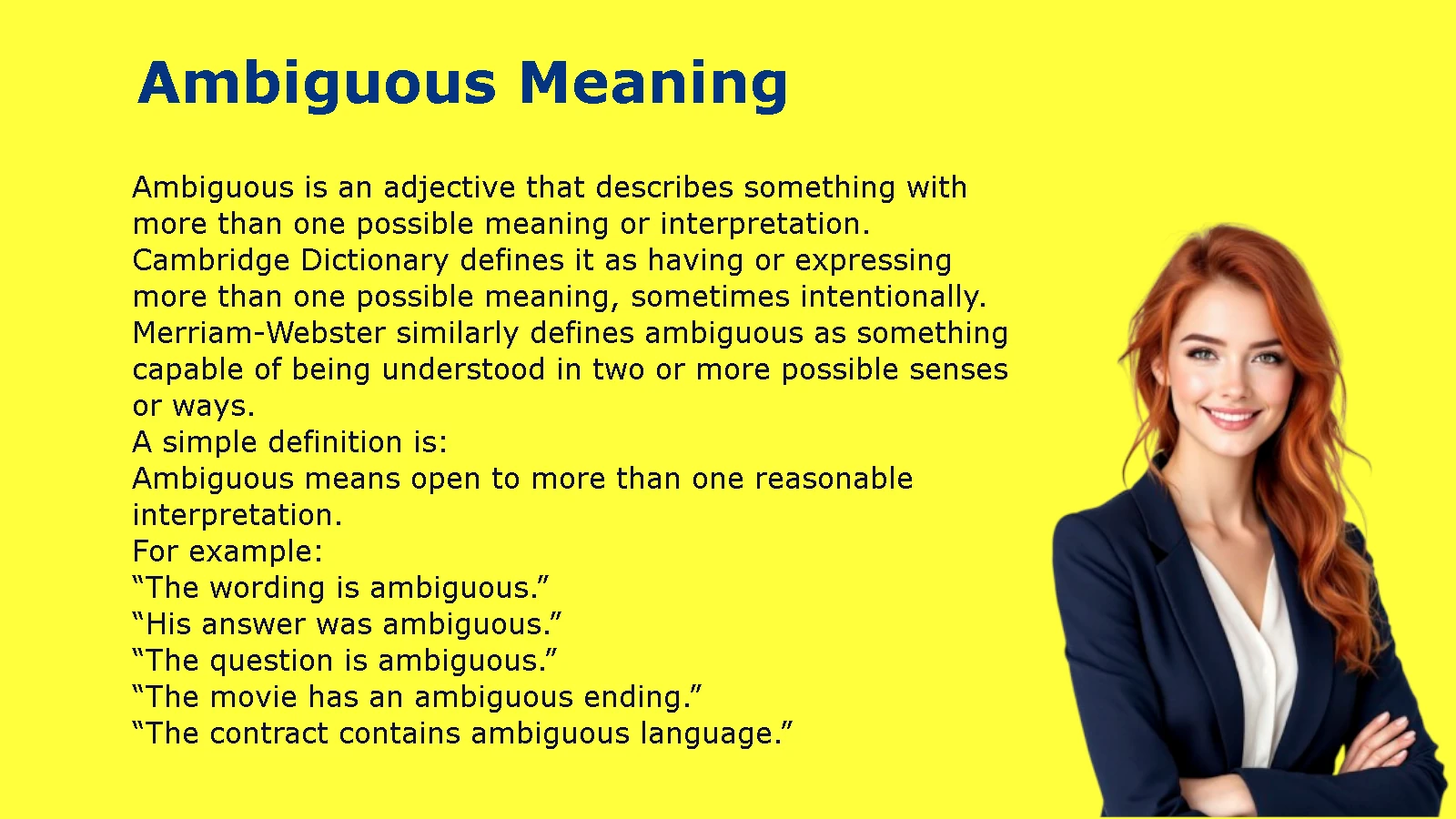
Ambiguous is an adjective that describes something with more than one possible meaning or interpretation. Cambridge Dictionary defines it as having or expressing more than one possible meaning, sometimes intentionally.
Merriam-Webster similarly defines ambiguous as something capable of being understood in two or more possible senses or ways.
A simple definition is:
Ambiguous means open to more than one reasonable interpretation.
For example:
- “The wording is ambiguous.”
- “His answer was ambiguous.”
- “The question is ambiguous.”
- “The movie has an ambiguous ending.”
- “The contract contains ambiguous language.”
In each case, the problem isn’t necessarily that the words make no sense. The problem is that the words can support different interpretations.
Ambiguous Meaning in Simple English
Think of ambiguity as a fork in the road.
A clear sentence points you toward one destination. An ambiguous sentence gives you two or more plausible roads.
For example:
Clear:
“The meeting starts at 3 p.m. in Room 204.”
There isn’t much room for interpretation.
Ambiguous:
“Let’s meet there later.”
Now several questions appear:
- Where is “there”?
- When is “later”?
- Who exactly should meet?
- Does “later” mean in an hour or tomorrow?
The second sentence isn’t necessarily grammatically wrong. It simply lacks enough information to establish one precise interpretation.
What Is Ambiguity?
Ambiguity is the noun form related to ambiguous. It refers to the quality or state of allowing more than one interpretation. Merriam-Webster also uses the word for a word or expression that can be understood in two or more ways.
The relationship is straightforward:
| Word | Part of speech | Meaning |
| Ambiguous | Adjective | Having more than one possible meaning |
| Ambiguity | Noun | The state or quality of being ambiguous |
| Ambiguously | Adverb | In a way that allows multiple interpretations |
| Unambiguous | Adjective | Clear and open to only one reasonable interpretation |
Here are some examples:
- Ambiguous: “The instructions are ambiguous.”
- Ambiguity: “The ambiguity caused a disagreement.”
- Ambiguously: “The question was worded ambiguously.”
- Unambiguous: “The final instructions were unambiguous.”
Cambridge notes that ambiguity can occur when something has multiple possible meanings and may consequently cause confusion.
What Are the Main Types of Ambiguity?
Ambiguity doesn’t come from one source. Language can become ambiguous at different levels. Linguistic research commonly identifies lexical, morphological, syntactic or structural, and pragmatic ambiguity among the major forms.
Understanding these categories makes it much easier to recognize ambiguous meaning in real writing.
Lexical Ambiguity
Lexical ambiguity occurs when a word has more than one possible meaning.
Consider the word bank.
It can mean:
- A financial institution
- The land beside a river
Compare these sentences:
“I went to the bank to deposit my paycheck.”
Here, bank clearly means a financial institution.
Now consider:
“We sat on the bank and watched the water.”
Here, bank means the land beside a body of water.
The word itself creates the potential for ambiguity. Context resolves it.
Other common examples include:
| Word | Possible meanings |
| Bat | A flying mammal / sports equipment |
| Bark | Tree covering / sound made by a dog |
| Date | Calendar day / romantic meeting / fruit |
| Match | Contest / suitable pair / small object used to create fire |
| Light | Illumination / not heavy |
| Watch | Observe / timepiece |
| Park | Public green space / leave a vehicle |
| Spring | Season / jump / coiled device / source of water |
A word with several dictionary meanings isn’t automatically confusing every time you use it. Context normally narrows the possibilities.
Morphological Ambiguity
Morphological ambiguity happens when a word form can be analyzed in more than one grammatical way.
This form of ambiguity is more technical, so it matters most when studying linguistics rather than everyday writing.
For example, a word ending such as -s can have different grammatical functions depending on the word and context. Linguistic research identifies cases where the same surface form can represent different grammatical information.
The important takeaway is simple:
Ambiguity can exist inside the structure of a word, not just in its overall meaning.
Syntactic or Structural Ambiguity
Syntactic ambiguity occurs when the structure of a sentence allows more than one interpretation.
Consider:
“I saw the man with the telescope.”
There are at least two reasonable readings:
- You used a telescope to see the man.
- You saw a man who had a telescope.
The individual words aren’t necessarily the problem. The relationship between the words creates the ambiguity.
Another classic example is:
“Visiting relatives can be boring.”
This could mean:
- Going to visit your relatives can be boring.
- Relatives who visit you can be boring.
The sentence follows normal English grammar in either interpretation.
That’s what makes structural ambiguity interesting. The sentence can be grammatically acceptable while still allowing different readings.
Semantic Ambiguity
Semantic ambiguity concerns the meaning conveyed by words or combinations of words.
For example:
“The chicken is ready to eat.”
This sentence can mean:
- The chicken is ready to eat something.
- The chicken is ready to be eaten.
The grammatical structure doesn’t immediately settle the issue.
Context does the heavy lifting.
If someone says this while preparing dinner, the second meaning probably makes sense. If someone is describing an unusually intelligent chicken, the first interpretation becomes possible.
Referential Ambiguity
Referential ambiguity occurs when it’s unclear what a pronoun or other referring expression points to.
Consider:
“Sarah told Anna that she had won.”
Who won?
- Sarah?
- Anna?
The pronoun she could refer to either person.
A small rewrite removes the ambiguity:
“Sarah told Anna that Sarah had won.”
Or:
“Sarah told Anna that Anna had won.”
This kind of ambiguity matters in everyday communication because pronouns such as he, she, they, it, this, that, and they often depend heavily on context.
Pragmatic Ambiguity
Pragmatic ambiguity emerges from context, intention, or the situation in which someone uses an expression.
For example:
“Can you open the window?”
Grammatically, this looks like a question about ability. In ordinary conversation, however, it usually functions as a request.
Context tells you how to interpret it.
Pragmatic ambiguity can also appear when someone deliberately avoids stating exactly what they mean. A speaker might say:
“That’s one way to look at it.”
Depending on tone and circumstances, that could express agreement, hesitation, criticism, or polite disagreement.
Examples of Ambiguous Meaning
The fastest way to understand ambiguous meaning is to see it in action.
“I saw her duck.”
Possible meanings:
- You saw her lower her head.
- You saw a duck belonging to her.
“The teacher saw the student with the telescope.”
Possible meanings:
- The teacher used the telescope.
- The student had the telescope.
“Visiting relatives can be boring.”
Possible meanings:
- Visiting relatives can be boring.
- Relatives who are visiting can be boring.
“The chicken is ready to eat.”
Possible meanings:
- The chicken is ready to eat food.
- The chicken is ready to be eaten.
“John told Mike that he was late.”
Possible meanings:
- John was late.
- Mike was late.
“The manager discussed the report with the employee.”
This sentence isn’t necessarily ambiguous in every context, but the surrounding situation can leave important questions unanswered. Which employee? What aspect of the report? Was the employee responsible for the report?
That illustrates an important point:
Not every incomplete detail creates true ambiguity. A sentence becomes meaningfully ambiguous when different interpretations can reasonably change what the statement means.
Ambiguous vs. Vague
Ambiguous and vague overlap, but they aren’t identical.
Something is ambiguous when it supports multiple possible interpretations. Something is vague when it lacks enough detail or precision.
Compare these:
“I’ll finish it soon.”
This is vague because soon doesn’t establish a precise time.
Now consider:
“I saw her duck.”
This is ambiguous because the sentence has two plausible interpretations.
| Ambiguous | Vague |
| Multiple possible interpretations | Insufficient detail |
| The issue is often which meaning | The issue is often how specific |
| “I saw her duck.” | “I’ll finish it soon.” |
| Can often be fixed by restructuring | Can often be fixed by adding precise information |
A sentence can also be both vague and ambiguous.
For example:
“We’ll deal with that issue later.”
What does that issue refer to? That’s potentially ambiguous.
What does later mean? That’s vague.
One short sentence can contain both problems.
Ambiguous vs. Ambivalent
This is one of the most important word distinctions to remember.
Ambiguous concerns meaning or interpretation.
Ambivalent concerns mixed or conflicting feelings.
Compare:
“Her response was ambiguous.”
Her response could be interpreted in different ways.
“She felt ambivalent about the decision.”
She had conflicting feelings about the decision.
Merriam-Webster specifically warns readers not to confuse ambiguous with ambivalent. The former generally concerns multiple possible meanings, while the latter commonly describes contradictory feelings.
Quick Memory Trick
Think:
- Ambiguous = What does it mean?
- Ambivalent = How do I feel about it?
That simple distinction prevents a very common vocabulary mistake.
Ambiguous vs. Equivocal
Equivocal and ambiguous can overlap, especially when language leaves room for different interpretations.
However, equivocal often suggests a person is being deliberately noncommittal, evasive, or unwilling to give a definite answer.
For example:
“The instructions were ambiguous.”
The instructions may simply have been poorly written.
“The politician gave an equivocal answer.”
This suggests the speaker avoided committing to a clear position.
Merriam-Webster notes that equivocal can apply to language left open to different interpretations, particularly when it serves to evade or deceive.
Ambiguous vs. Unclear
Unclear is the broader term.
Something can be unclear because:
- It lacks information.
- The wording is confusing.
- The speaker explains it poorly.
- The subject is complicated.
- It has multiple possible interpretations.
Ambiguous usually points more specifically to the last situation: multiple possible meanings or interpretations.
For example:
“The teacher’s explanation was unclear.”
Maybe the explanation was too complicated.
“The teacher’s question was ambiguous.”
The wording may allow students to reasonably understand the question in different ways.
Merriam-Webster makes essentially this distinction: both words can describe something difficult to understand, but ambiguous more specifically suggests that something can be understood in more than one way.
How to Use “Ambiguous” in a Sentence
The word ambiguous works naturally in many contexts.
Everyday Conversation
- “His answer was ambiguous.”
- “Her message sounded ambiguous.”
- “That comment was pretty ambiguous.”
- “The way she phrased it was ambiguous.”
Academic Writing
- “The question is ambiguous because it allows two interpretations.”
- “The study uses an ambiguous definition of the term.”
- “The wording of the prompt could be interpreted in different ways.”
Workplace Communication
- “The instructions are ambiguous.”
- “The deadline seems ambiguous.”
- “The email contains ambiguous wording.”
- “Let’s clarify the ambiguous part of the proposal.”
Legal and Formal Writing
Ambiguity can become particularly important in formal documents because different interpretations can produce different outcomes.
For example:
“The employee must submit the form within five days.”
Questions immediately arise:
- Five calendar days?
- Five business days?
- Five days after receiving the request?
- Five days from the date on the form?
The sentence may look perfectly ordinary, yet the surrounding rules determine whether it has a genuine ambiguity.
That is why precise drafting matters in contracts, regulations, policies, and instructions.
Literature and Film
Ambiguity can be a creative tool.
A writer might deliberately leave:
- A character’s motivation uncertain.
- A narrator’s reliability uncertain.
- A relationship open to interpretation.
- A symbol open to multiple meanings.
- An ending unresolved.
Cambridge specifically recognizes intentional ambiguity in literature, where language or images can suggest more than one meaning at the same time.
In this setting, ambiguity isn’t a flaw. It’s part of the design.
Intentional vs. Unintentional Ambiguity
Not all ambiguity deserves to be eliminated.
Intentional Ambiguity
Writers may deliberately use ambiguous language to:
- Create suspense.
- Encourage discussion.
- Add humor.
- Build mystery.
- Give a poem several interpretations.
- Create a memorable ending.
- Allow readers to participate in meaning-making.
A mystery novel, for example, may deliberately hide whether a character is trustworthy.
A poem might use a word with several meanings because each meaning contributes something different.
In these cases, ambiguity adds depth.
Unintentional Ambiguity
Unintentional ambiguity usually appears because of:
- Poor sentence structure.
- Unclear pronouns.
- Words with multiple meanings.
- Missing context.
- Weak punctuation.
- Imprecise instructions.
- Poorly defined terms.
The consequences can range from a harmless misunderstanding to a serious dispute.
Intentional ambiguity can enrich language. Unintentional ambiguity can derail it.
Why Ambiguous Language Can Cause Problems
A confusing joke is usually harmless.
A confusing work instruction might not be.
Ambiguous language can create problems in:
- Emails: Someone may misunderstand what action you want.
- Instructions: A reader may complete the wrong task.
- Contracts: Different parties may interpret a provision differently.
- Academic questions: Students may answer different versions of the same question.
- Policies: Employees may apply rules inconsistently.
- Customer communication: A customer may misunderstand a price, deadline, or requirement.
- Technical documentation: Users may perform the wrong procedure.
The risk grows when the language affects money, safety, deadlines, rights, or responsibilities.
Cambridge gives examples involving legislation and contracts where ambiguity creates a need for clarification.
How to Identify an Ambiguous Sentence
You don’t need a linguistics degree to spot ambiguity.
Use this quick test.
Look for Words With Multiple Meanings
Ask whether an important word can mean different things.
“She went to the bank.”
Which bank?
Context may answer the question. Without context, the sentence has potential lexical ambiguity.
Check Pronouns
Look closely at words such as:
- he
- she
- they
- it
- this
- that
- them
If two nouns could reasonably match the pronoun, rewrite the sentence.
Examine the Sentence Structure
Ask whether the words can be grouped or connected in more than one way.
“I saw the man with the telescope.”
Who had the telescope?
If both readings make sense, the structure is ambiguous.
Ask Whether Two Interpretations Actually Work
This step matters.
A sentence isn’t ambiguous merely because someone can invent a strange interpretation.
The alternative meanings should be reasonable within the language and context.
Read the Sentence Without Extra Context
Take the sentence out of its paragraph.
If the surrounding text normally supplies the missing information, the sentence may be perfectly clear in context.
Ask Another Reader
This is one of the simplest practical tests.
Give the sentence to someone else without explaining what you intended.
If they interpret it differently, you’ve found a possible ambiguity.
How to Make an Ambiguous Sentence Clear
Once you’ve identified ambiguity, fixing it often takes only a few words.
Replace Ambiguous Words
Ambiguous:
“Send the form to the office.”
Which office?
Clearer:
“Send the form to the admissions office.”
Specific nouns remove guesswork.
Clarify Pronouns
Ambiguous:
“Maria told Jessica that she needed to call the client.”
Who needed to call?
Clear:
“Maria told Jessica that Maria needed to call the client.”
Or:
“Maria told Jessica that Jessica needed to call the client.”
The sentence may sound repetitive, but clarity beats elegance when the distinction matters.
Add Missing Details
Ambiguous:
“I’ll meet you later.”
Clear:
“I’ll meet you at the café at 4 p.m.”
The second version removes uncertainty about both place and time.
Restructure the Sentence
Ambiguous:
“I saw the man with the telescope.”
Clear if you used the telescope:
“Using a telescope, I saw the man.”
Clear if the man had the telescope:
“I saw the man who was carrying a telescope.”
A small structural change can completely remove an alternative interpretation.
Define Important Terms
If a policy uses a word such as day, delivery, completed, or approved, define it when different interpretations could matter.
For example:
“Business day means Monday through Friday, excluding federal holidays.”
A definition like this eliminates unnecessary disputes.
A Practical Case Study: An Ambiguous Workplace Instruction
Imagine a manager sends this message:
“Please send the revised report to John after reviewing it with Sarah.”
At first glance, the instruction seems clear.
But several questions remain:
- Who should review the report with Sarah?
- Does John need the report before or after Sarah reviews it?
- Does “it” refer to the report?
- Has Sarah already reviewed it?
- Which John should receive it if multiple people have that name?
A clearer version might say:
“Please review the revised sales report with Sarah before emailing the final version to John Miller.”
Now the sequence is explicit:
Revise report → Review with Sarah → Email final report to John Miller
The original sentence wasn’t necessarily bad English. It simply left too much room for different interpretations.
A Practical Case Study: An Ambiguous Academic Question
Consider this exam question:
“Discuss the effects of technology on students.”
The question is understandable, but its scope is broad.
Does “effects” mean:
- Academic performance?
- Social behavior?
- Mental workload?
- Communication?
- Sleep?
- Classroom engagement?
- All of these?
The problem here may be less about classic ambiguity and more about lack of specificity.
A clearer question would be:
“Discuss two ways smartphone use can affect high school students’ academic performance.”
This distinction matters because vagueness and ambiguity aren’t the same problem.
Ambiguous Meaning in Literature
Ambiguity can become a strength when a writer wants readers to think beyond one fixed interpretation.
An ambiguous ending, for example, may refuse to answer a central question directly.
Instead of telling readers:
“The character escaped.”
the writer might end with the character walking toward a distant road while leaving the outcome unstated.
Readers then ask:
- Did the character escape?
- Was the journey symbolic?
- Did the character change?
- Is the ending hopeful or tragic?
That uncertainty can make a story linger in the reader’s mind long after the final page.
The same technique appears in poetry, where one word can carry several related meanings. Ambiguity allows language to work on more than one level at once.
Synonyms for Ambiguous
The best synonym depends on the context.
Close Synonyms
- Unclear
- Equivocal
- Uncertain
- Indeterminate
- Open to interpretation
Contextual Alternatives
- Vague
- Obscure
- Confusing
- Indefinite
- Uncertain
- Enigmatic
These words aren’t interchangeable in every sentence.
For example, enigmatic often suggests mystery rather than a straightforward failure of clarity. Vague usually emphasizes insufficient detail. Equivocal can suggest deliberate avoidance.
Merriam-Webster lists words such as obscure, enigmatic, vague, mysterious, and unclear among related terms for ambiguous.
Antonyms of Ambiguous
The strongest opposites include:
- Clear
- Definite
- Explicit
- Precise
- Specific
- Certain
- Unambiguous
For example:
Ambiguous: “Submit the assignment soon.”
Unambiguous: “Submit the assignment by 11:59 p.m. Friday.”
The second sentence gives the reader a specific deadline.
Word Forms of Ambiguous
| Word | Part of speech | Example |
| Ambiguous | Adjective | “The wording is ambiguous.” |
| Ambiguity | Noun | “The ambiguity caused confusion.” |
| Ambiguities | Plural noun | “The contract contains several ambiguities.” |
| Ambiguously | Adverb | “The rule was written ambiguously.” |
| Unambiguous | Adjective | “The instructions are unambiguous.” |
The noun ambiguity dates back to the 14th century, while Merriam-Webster records the first known use of ambiguous in the 15th century. Both words ultimately trace back to Latin forms associated with uncertainty and having more than one possible meaning.
How to Pronounce “Ambiguous”
In American English, ambiguous is pronounced approximately:
am-BIG-yoo-us
The stress falls on the second syllable.
Cambridge gives the American pronunciation as /æmˈbɪɡ.ju.əs/.
The word is an adjective:
“The statement is ambiguous.”
You wouldn’t normally use ambiguous as a noun.
Instead, use ambiguity:
“The statement contains ambiguity.”
Common Mistakes With “Ambiguous”
Using “Ambiguous” to Mean “Complicated”
A complicated explanation isn’t necessarily ambiguous.
For example:
“The scientific explanation was complicated.”
That tells you the idea was difficult to understand.
It doesn’t necessarily mean the explanation had multiple possible meanings.
Confusing Ambiguous With Ambivalent
Remember:
Ambiguous = multiple possible meanings.
Ambivalent = conflicting feelings.
Treating Ambiguous and Vague as Exact Synonyms
A vague sentence may simply lack detail.
An ambiguous sentence can support different interpretations.
The distinction becomes especially important when you’re editing professional or academic writing.
Assuming Ambiguous Always Means Two Meanings
Two interpretations are common, but ambiguity isn’t limited to exactly two.
A word, phrase, or statement can support several reasonable interpretations.
Merriam-Webster’s definition specifically refers to two or more possible senses or ways.
Calling Every Unclear Sentence Ambiguous
Some sentences are simply poorly explained.
Others are incomplete.
Still others are technically clear but difficult because the underlying subject is complex.
True ambiguity requires meaningful room for different interpretations.
Frequently Asked Questions About Ambiguous Meaning
What does ambiguous mean in simple words?
Ambiguous means something can be understood in more than one reasonable way. The intended meaning isn’t clear from the wording or context alone.
What is an example of an ambiguous sentence?
“I saw her duck” is a classic example. It could mean you saw her lower her head, or it could mean you saw a duck belonging to her.
Does ambiguous mean confusing?
Not exactly. Something ambiguous can be confusing because it has multiple interpretations. However, something can be confusing without being ambiguous.
What is the difference between ambiguous and vague?
Ambiguous means multiple interpretations are possible. Vague means something lacks enough specific information or precision.
What is the difference between ambiguous and ambivalent?
Ambiguous describes uncertain or multiple meanings. Ambivalent describes mixed or contradictory feelings.
What is the opposite of ambiguous?
Common opposites include clear, definite, explicit, precise, specific, and unambiguous.
Can a person be ambiguous?
Yes, although the meaning depends on context. You might describe someone’s position, response, behavior, or role as ambiguous when it supports different interpretations.
For example:
“His position on the proposal remains ambiguous.”
Can something be intentionally ambiguous?
Yes. Writers, artists, speakers, and filmmakers may intentionally leave meaning open to encourage interpretation, create suspense, or produce humor. Cambridge explicitly recognizes intentional ambiguity in literature.
What is an ambiguous word?
An ambiguous word has more than one possible meaning. Bank, bat, bark, date, and light are common examples.
What is an ambiguous sentence?
An ambiguous sentence can reasonably be interpreted in more than one way. The ambiguity may come from a word, sentence structure, pronoun, or context.
How can you avoid ambiguity in writing?
Use specific words, clarify pronouns, define important terms, add necessary context, and restructure sentences that allow multiple interpretations.
What does ambiguous mean in literature?
In literature, ambiguity means a word, passage, character, symbol, or event can support more than one interpretation. Writers may use it deliberately to give readers room to think and interpret.
Final Takeaway: Understanding Ambiguous Meaning
Ambiguous meaning isn’t simply another way to say “confusing.” It describes language or situations that allow two or more reasonable interpretations.
The distinction becomes much easier once you understand where ambiguity comes from.
A single word can create it:
“I went to the bank.”
Sentence structure can create it:
“I saw the man with the telescope.”
A pronoun can create it:
“Sarah told Anna that she had won.”
Context can resolve it. A writer can also deliberately preserve it.
The most useful rule is this:
If a statement can reasonably mean more than one thing, it may be ambiguous.
When you’re writing instructions, emails, academic answers, policies, or professional documents, ambiguity can get in the way. Be specific. Name the person, place, object, deadline, or action whenever the distinction matters.
When you’re writing fiction, poetry, comedy, or other creative work, however, ambiguity can be an advantage. Sometimes leaving the door slightly open is exactly what makes the reader want to walk through it.
In short, ambiguous means open to multiple interpretations, while ambiguity is the condition that creates that uncertainty. Once you can spot the difference between ambiguity, vagueness, uncertainty, and ambivalence, you’ll have a much sharper command of the word and the way it works in real English.




