Have you ever heard someone say “Good” and wondered what they really meant by it? While Good Meaning may seem simple, this common word can express many different ideas depending on the context, tone, and situation in which it is used.
Good is an adjective commonly used to describe something positive, pleasant, useful, suitable, high in quality, or morally right. It is one of the most frequently used words in English and can describe people, things, actions, experiences, and situations.
Examples:
- She is a good friend who always helps me.
- That was a good movie.
The confusion is understandable. People often search for what does good mean, good meaning in text, good meaning in chat, or what does good mean in a sentence because the word can carry different meanings depending on how it is used. For example, saying “Good job!” shows praise, while “Are you good?” can mean “Are you okay?” or “Do you need anything?”
In this guide, you’ll learn the complete Good Meaning, its definition, pronunciation, correct usage, and examples in sentences. You’ll also discover the different meanings of good, how it is used in texting and everyday conversations, common phrases with good, and the difference between good and similar words such as great, nice, and well.
What Does “Good” Mean?
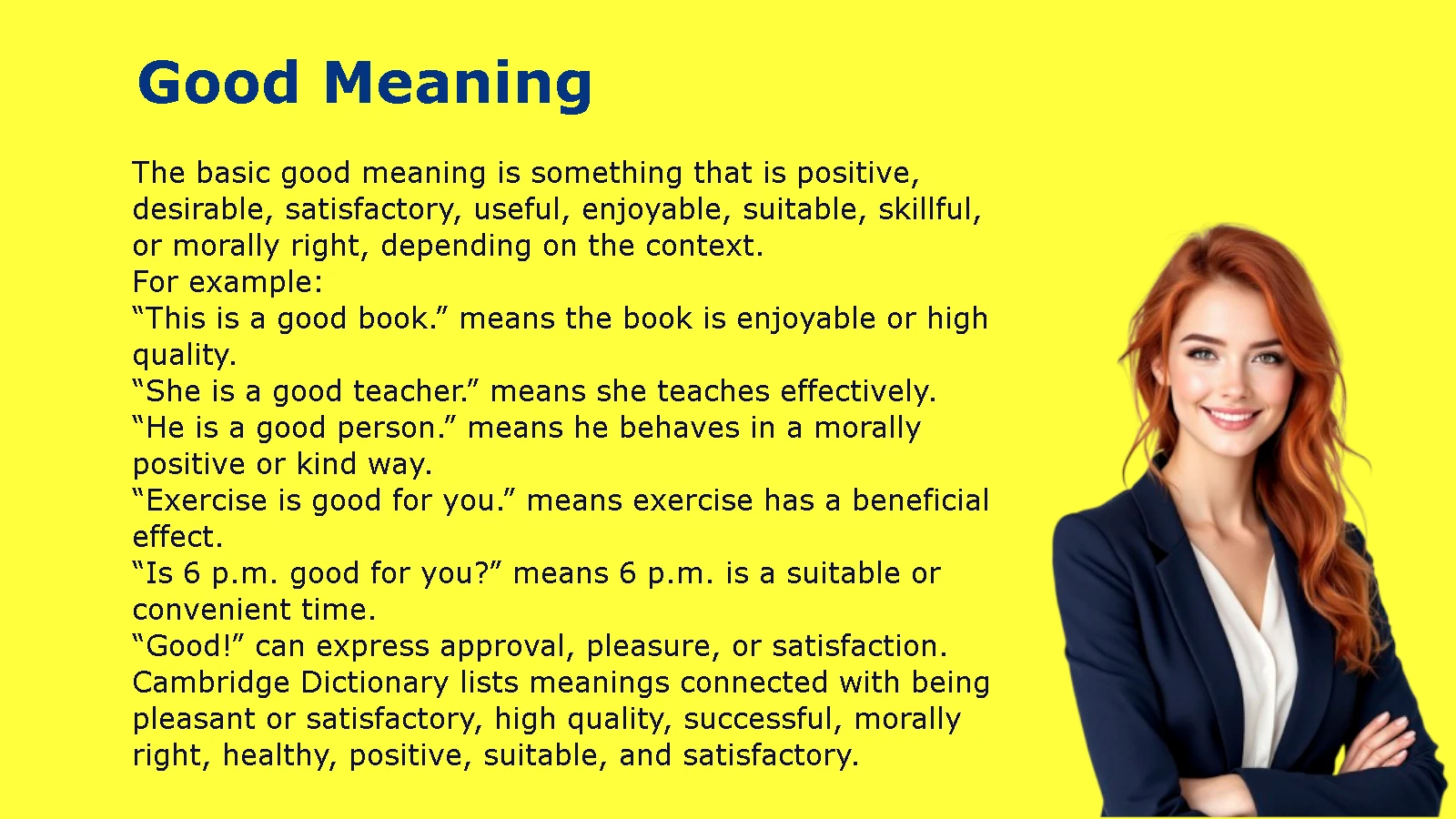
The basic good meaning is something that is positive, desirable, satisfactory, useful, enjoyable, suitable, skillful, or morally right, depending on the context.
For example:
- “This is a good book.” means the book is enjoyable or high quality.
- “She is a good teacher.” means she teaches effectively.
- “He is a good person.” means he behaves in a morally positive or kind way.
- “Exercise is good for you.” means exercise has a beneficial effect.
- “Is 6 p.m. good for you?” means 6 p.m. is a suitable or convenient time.
- “Good!” can express approval, pleasure, or satisfaction.
Cambridge Dictionary lists meanings connected with being pleasant or satisfactory, high quality, successful, morally right, healthy, positive, suitable, and satisfactory.
Merriam Webster similarly includes senses involving favorable character, high or desired quality, suitability, health, praise, and approval.
Good Meaning in Simple English
In simple English, good means something positive or desirable.
However, the exact meaning depends on what good describes.
Think of the word as a flexible tool. The tool stays the same, but the job changes:
Good + book → enjoyable or high quality
Good + person → kind or morally right
Good + swimmer → skilled
Good + for you → beneficial
Good + time → suitable
Good + news → positive or welcome
That context is the key to understanding the word correctly.
Good Meaning in Different Contexts
The word good can carry several meanings in ordinary English. Here’s a quick reference:
| Context | Meaning of “good” | Example |
| Quality | High quality | “She bought a good camera.” |
| Enjoyment | Pleasant or enjoyable | “We had a good time.” |
| Ability | Skilled or capable | “He is a good swimmer.” |
| Morality | Kind or morally right | “She is a good person.” |
| Health | Healthy or in satisfactory condition | “I feel good today.” |
| Benefit | Helpful or positive | “Walking is good for you.” |
| Suitability | Appropriate or convenient | “Is tomorrow good for you?” |
| Behavior | Well behaved | “The children were good.” |
| Approval | Satisfaction or praise | “Good! You finished it.” |
| Quantity | Considerable or substantial | “It took a good hour.” |
| Permanence | Forever in certain expressions | “She left for good.” |
The range is broad, but these meanings aren’t random. They all connect to the central idea of something being favorable, acceptable, desirable, useful, or positive.
Good as an Adjective
The most common grammatical role of good is as an adjective.
An adjective describes a noun or gives information about a person, place, thing, or situation. In phrases such as good food, good news, and good student, the word tells you something positive about the noun.
Good Meaning as an Adjective
As an adjective, good can mean:
- High quality
- Pleasant
- Enjoyable
- Successful
- Skillful
- Kind
- Morally right
- Healthy
- Useful
- Suitable
- Well behaved
For example:
“Maria is a good cook.”
Here, good doesn’t mean that Maria is morally good. It means she has strong cooking skills.
Compare that with:
“Maria is a good person.”
Now good describes her character rather than her cooking ability.
That small change in context completely changes the meaning.
Good as a Noun
Although people often learn good as an adjective, it can also function as a noun.
As a noun, good can refer to a benefit, advantage, help, or moral good. Cambridge Dictionary gives uses such as “do a lot of good” and “for your own good.”
Good Meaning as a Benefit
Consider:
“Exercise does you good.”
Here, good means a beneficial effect.
Another example:
“The decision was made for the good of the community.”
In this sentence, good refers to the benefit or welfare of the community.
Common examples include:
- do some good
- do someone good
- for your own good
- for the good of the team
- more harm than good
Good Meaning as Moral Good
The noun good can also mean what is morally right.
For example:
“The story explores the struggle between good and evil.”
Here, good represents moral goodness rather than quality or usefulness.
This use appears often in literature, religion, philosophy, and discussions about ethics.
Good Meaning When Describing a Person
The meaning of good changes depending on the noun or phrase that follows it.
“A Good Person”
A good person usually means someone who is kind, honest, decent, caring, or morally responsible.
Example:
“Everyone trusted Daniel because he was a good person.”
The phrase focuses on character.
“A Good Friend”
A good friend usually means someone who is supportive, loyal, caring, or dependable.
Example:
“A good friend listens when you need to talk.”
The phrase doesn’t claim that the friend is morally perfect. It describes the qualities that make someone a valuable friend.
“A Good Student”
A good student generally means someone who studies effectively, performs well, participates appropriately, or takes learning seriously.
Example:
“Lena is a good student who completes her assignments on time.”
“A Good Worker”
A good worker can describe someone who is capable, reliable, productive, responsible, or effective.
Example:
“He is a good worker who always meets his deadlines.”
“Good at Something”
The pattern good at + noun or activity means someone has skill or ability in that area.
Examples:
- She is good at math.
- He is good at drawing.
- They are good at solving problems.
- I’m good at remembering names.
Cambridge specifically identifies good at as a standard pattern for talking about things someone does well.
Good Meaning for Quality
One of the most common meanings of good refers to quality.
When you say:
“This is a good restaurant.”
you usually mean the restaurant meets a favorable standard. Perhaps the food tastes great, the service works well, or the overall experience is satisfying.
Similarly:
- a good movie = enjoyable or worthwhile
- a good book = enjoyable, interesting, or well written
- a good product = useful or high quality
- a good school = considered effective or high quality
- a good idea = useful, sensible, or promising
Cambridge defines this sense as being of a high quality or level.
Good Meaning for Ability and Skill
Good can describe someone’s ability to do something well.
This usually appears in patterns such as:
- good at
- good with
- a good + noun
Examples:
“She is good at tennis.”
“He’s good with children.”
“She’s a good designer.”
The first example focuses on a specific skill. The second describes someone’s ability to interact effectively with children. The third describes overall professional ability.
This distinction matters because good doesn’t always describe personality. In “He’s good at chess,” the word refers to skill.
Good Meaning for Health
The word good can also describe health or physical condition.
Examples include:
- “I’m feeling good today.”
- “The doctor says he’s good now.”
- “Fresh vegetables are good for you.”
- “Regular exercise is good for your health.”
Cambridge lists good as meaning healthy or well in certain contexts and also uses it to describe something that has a positive effect on health.
However, the grammar becomes important here because good and well aren’t always interchangeable.
Good Meaning for Suitability
Sometimes good means suitable, convenient, or appropriate.
For example:
“When would be a good time to call?”
The question isn’t asking whether the time is morally good or high quality. It asks whether the time is convenient or appropriate.
More examples:
- “Is Friday good for you?”
- “This would be a good place to stop.”
- “That’s a good time to start.”
- “Today is a good day for a walk.”
Cambridge includes suitable, convenient, or satisfactory among its meanings of good.
Good Meaning in Texts and Chats
In texting, good often becomes shorter and more conversational.
What Does “I’m Good” Mean?
When someone says:
“I’m good, thanks.”
they often mean “I’m fine” or “I don’t need anything.”
For example:
Person A: “Do you want another cup of coffee?”
Person B: “No, I’m good, thanks.”
Here, I’m good means “No, thank you. I have what I need.”
Cambridge’s Essential English Dictionary specifically recognizes the informal use of I’m good when someone asks how you are.
What Does “Good!” Mean in a Text?
A short “Good!” can express approval, relief, satisfaction, or agreement.
For example:
“I finished the report.”
“Good!”
The speaker is showing approval or satisfaction.
The same word can feel different depending on punctuation and context:
- Good. → neutral, firm, or possibly cold
- Good! → enthusiastic or pleased
- Good 😊 → friendly and positive
- Oh, good! → relief or happiness
Tone matters.
Good Meaning in “Good Job”
The phrase good job is a common way to praise someone for doing something well.
Examples:
- “Good job on the presentation.”
- “You solved the problem. Good job!”
- “Good job finishing the project early.”
Here, good communicates approval.
It doesn’t necessarily mean the work was perfect. It simply tells the person that the result or effort deserves positive recognition.
Good Meaning in “Good for You”
Good for you has more than one possible tone.
Genuine Praise
“You passed your exam? Good for you!”
Here, the speaker is expressing genuine happiness or congratulations.
Sarcasm
The same phrase can sound sarcastic:
“You bought another expensive phone? Good for you.”
The words remain positive on paper, but the tone may communicate annoyance or mock praise.
This is a useful reminder that word meaning doesn’t always exist separately from context. In conversation, facial expression, punctuation, timing, and tone can all affect interpretation.
Good vs. Well
One of the most common English mistakes involves good and well.
In general, good works as an adjective while well commonly works as an adverb.
| Word | Typical role | Example |
| Good | Adjective | “She is a good singer.” |
| Well | Adverb | “She sings well.” |
| Well | Adjective for health | “I don’t feel well.” |
Consider these two sentences:
“He is a good driver.”
“He drives well.”
The first sentence describes the driver. The second describes how he drives.
Why “Good at” Is Correct
Use good at when talking about skill:
- good at writing
- good at cooking
- good at sports
- good at English
- good at mathematics
Examples:
“She’s good at explaining difficult ideas.”
“He’s good at fixing computers.”
The adjective good describes the person’s ability.
“I Feel Good” vs. “I Feel Well”
Both phrases exist, but they can emphasize different things.
“I feel good” can describe a positive emotional or physical state.
“I feel well” commonly emphasizes health.
In everyday American English, “I feel good” is completely natural when someone means they feel positive or fine. When the specific meaning is physical health, “I feel well” is also standard.
Good vs. Great vs. Excellent
These words overlap, but they aren’t identical.
| Word | General strength | Example |
| Good | Positive or satisfactory | “The movie was good.” |
| Great | Very good or impressive | “The movie was great.” |
| Excellent | Extremely high quality | “The movie was excellent.” |
Imagine a restaurant review.
If someone says:
“The food was good.”
you know they liked it.
If they say:
“The food was great.”
their enthusiasm is stronger.
If they say:
“The food was excellent.”
they’re giving especially strong praise.
The exact strength depends on the speaker, but good generally sits at the broadest and most flexible level.
Good Synonyms
There isn’t one synonym that can replace good in every sentence. Because the word has many meanings, the best synonym depends on context.
Synonyms for Good Meaning High Quality
- Excellent
- Fine
- Superior
- Outstanding
- High quality
- First rate
Example:
“She bought a good laptop.”
Depending on the intended meaning, high quality or excellent might work.
Synonyms for Good Meaning Kind
- Kind
- Caring
- Helpful
- Compassionate
- Generous
- Thoughtful
- Considerate
Example:
“She’s a good friend.”
A more precise alternative might be:
“She’s a caring friend.”
Synonyms for Good Meaning Enjoyable
- Pleasant
- Enjoyable
- Nice
- Delightful
- Satisfying
- Entertaining
Example:
“We had a good evening.”
You could say:
“We had an enjoyable evening.”
Synonyms for Good Meaning Morally Right
- Virtuous
- Ethical
- Honorable
- Upright
- Righteous
- Decent
These words are more specific than good and often carry a stronger moral meaning.
Common Phrases With “Good”
The word appears in hundreds of common expressions. Some of the most useful ones include the following.
Good Morning
A standard greeting used in the morning.
“Good morning! How are you?”
Good Afternoon
A greeting commonly used during the afternoon.
“Good afternoon, everyone.”
Good Evening
A greeting used in the evening.
“Good evening. It’s nice to meet you.”
Good Luck
A way to wish someone success.
“Good luck with your interview!”
Good Idea
A phrase used to approve or praise a suggestion.
“Let’s leave early.”
“That’s a good idea.”
Good News
Information that produces happiness, relief, or optimism.
“I have good news. Your application was accepted.”
Good Time
This phrase can mean an enjoyable experience or a suitable time.
“We had a good time at the concert.”
But:
“Is 7 p.m. a good time to call?”
Here, it means a suitable time.
Good Enough
Something that meets the required standard even if it isn’t perfect.
“This answer is good enough for the assignment.”
The phrase often suggests that something satisfies a particular need rather than representing the highest possible quality.
Good for You
This can express praise, congratulations, or sarcasm depending on context.
Good to Know
This means that information is useful or helpful.
“Good to know. I’ll remember that for next time.”
For Good
For good means forever or permanently.
“He left the city for good.”
Cambridge identifies this use as meaning forever.
Do Someone Good
Do someone good means to benefit or help someone.
“A short break will do you good.”
This is especially common when talking about health, rest, mood, or general well being.
For Your Own Good
This means something is being done because it is believed to benefit you.
“I’m telling you this for your own good.”
The phrase can sound caring, but it can also sound controlling depending on the situation.
Common Collocations With Good
A collocation is a group of words that commonly appear together.
Learning collocations helps you use good naturally rather than simply memorizing its dictionary definition.
Common “Good + Noun” Combinations
- good idea
- good news
- good time
- good friend
- good job
- good person
- good example
- good reason
- good choice
- good chance
- good relationship
- good experience
- good decision
- good result
- good question
For example:
“That’s a good question.”
This doesn’t necessarily mean the question is enjoyable. It usually means the question is useful, thoughtful, relevant, or well formed.
Good With, Good At, Good For, and Good To
These four patterns look similar, but they don’t mean exactly the same thing.
Good At
Good at means skilled or capable.
“She’s good at mathematics.”
Good With
Good with often means skilled at handling or interacting with someone or something.
“He’s good with children.”
“She’s good with animals.”
Good For
Good for generally means beneficial or suitable.
“Exercise is good for your health.”
“This tool is good for small projects.”
Good To
Good to can describe kind or favorable treatment toward someone.
“She’s always been good to her parents.”
The difference between these expressions becomes much easier to remember when you focus on what follows them.
| Expression | Main meaning | Example |
| Good at | Skilled | “He’s good at chess.” |
| Good with | Handles/interacts well | “She’s good with children.” |
| Good for | Beneficial or suitable | “Fruit is good for you.” |
| Good to | Kind toward someone | “He’s good to his family.” |
Good Meaning and Common Mistakes
Because good has so many uses, learners sometimes apply the wrong pattern.
Mistake: Using “Good” Instead of “Well” for an Action
Incorrect in standard formal English:
“She sings good.”
Better:
“She sings well.”
But:
“She is a good singer.”
Here, good is correct because it describes the noun singer.
Mistake: Confusing “Good at” and “Good in”
When describing skill in an activity or subject, good at is the standard pattern.
“He is good at science.”
“She is good at painting.”
The pattern is especially important because learners may translate the structure directly from another language.
Mistake: Assuming “Good” Always Means Morally Right
In:
“He’s a good mechanic.”
the word refers to skill.
In:
“He’s a good man.”
the meaning can refer to character.
The surrounding noun and context determine the sense.
Is “Good” Always a Positive Word?
Usually, yes. Good generally communicates a favorable idea.
However, context can change the emotional effect.
Compare:
“That’s good.”
“That’s really good!”
“Oh, good!”
“Good.”
The first could sound neutral. The second sounds enthusiastic. The third can express relief. The fourth could sound approving, serious, or even cold.
Sarcasm creates another layer.
For example:
“Good job.”
could be sincere praise. It could also be sarcastic if someone has just made an obvious mistake.
Written communication makes this especially important because readers can’t hear your voice. Emojis, punctuation, and surrounding words can help communicate the intended tone.
Antonyms of Good
The most common opposite of good is bad, but the best antonym depends on the particular meaning.
| Meaning of good | Possible antonym |
| High quality | Poor, bad |
| Morally right | Evil, wrong |
| Helpful | Harmful |
| Enjoyable | Unpleasant |
| Skilled | Unskilled |
| Suitable | Unsuitable |
| Healthy | Unhealthy |
| Successful | Unsuccessful |
| Kind | Cruel, unkind |
| Useful | Useless |
For example, bad is the natural opposite in:
“This is a good movie.”
But harmful works better as the opposite of:
“This habit is good for your health.”
Likewise, unkind is more precise than bad when discussing someone’s treatment of another person.
Good Meaning as an Expression of Approval
One of the simplest uses of good is to show that something meets expectations.
Imagine a teacher checking a student’s completed work.
“Good.”
That one word can communicate approval.
Similarly:
- “Good!”
- “Very good!”
- “Good work!”
- “Good job!”
- “That’s good.”
- “Good thinking.”
The exact level of enthusiasm depends on context and tone.
In this sense, good works almost like a verbal thumbs up.
Good Meaning in Everyday Examples
Here are examples that show how the meaning shifts naturally:
| Sentence | Meaning |
| “That’s a good movie.” | Enjoyable or high quality |
| “She’s a good doctor.” | Skilled or effective |
| “He’s a good man.” | Morally decent |
| “This fruit is good for you.” | Beneficial to health |
| “Is Monday good for you?” | Suitable or convenient |
| “We had a good time.” | Enjoyable |
| “Good!” | Approval or satisfaction |
| “I’m good, thanks.” | Fine or don’t need anything |
| “She is good at tennis.” | Skilled |
| “He’s good with kids.” | Handles children well |
| “A walk will do you good.” | Benefit you |
| “They left for good.” | Permanently |
The same four letters can therefore perform many different jobs.
A Practical Case Study: Understanding “Good” From Context
Consider this short conversation:
Alex: “How was your trip?”
Sam: “It was good.”
Alex: “Was the hotel good?”
Sam: “Yes. The room was clean and the staff were friendly.”
Alex: “Are you good to travel again next month?”
Sam: “Sure. I’m good.”
Notice how good changes meaning three times.
This is why memorizing a single definition isn’t enough. Context gives the word its precise meaning.
Good Meaning in Formal and Informal English
Good works comfortably in both formal and informal English, although some expressions are more conversational than others.
Common in Formal English
- good results
- good evidence
- good reason
- good judgment
- good quality
- good practice
- good example
Common in Informal English
- I’m good.
- Good job!
- Good for you!
- Good stuff!
- That’s good.
- Sounds good.
The word itself isn’t informal. Its register depends largely on the expression and situation.
For example, “good evidence” works perfectly in an academic or professional report, while “I’m good” sounds much more conversational.
Good Meaning: Facts to Remember
A few grammar and usage facts make the word easier to understand:
- Good is pronounced /ɡʊd/ in both US and UK English.
- Its comparative form is better.
- Its superlative form is best.
- Good commonly functions as an adjective.
- It can also function as a noun.
- Good can describe quality, ability, morality, health, suitability, behavior, and usefulness.
- Good at describes skill or ability.
- Good for commonly describes a beneficial effect.
- Good with commonly describes someone’s ability to handle or interact with someone or something.
- Good to can describe kind treatment.
- For good means permanently or forever.
- I’m good can mean “I’m fine” or “I don’t need anything,” depending on context.
Frequently Asked Questions About Good Meaning
What is the simple meaning of good?
The simple good meaning is something positive, desirable, useful, satisfactory, enjoyable, suitable, skillful, or morally right. The exact meaning depends on the sentence.
What does good mean when describing a person?
When describing a person, good can mean kind, morally decent, helpful, trustworthy, skilled, or effective. The phrase determines the meaning.
For example, “a good person” usually describes character, while “a good teacher” describes ability.
What does “I’m good” mean?
“I’m good” commonly means “I’m fine” or “I don’t need anything.”
Example:
“Would you like some more water?”
“No, I’m good, thanks.”
What does “good for you” mean?
“Good for you” can express genuine praise or congratulations. Depending on tone, it can also sound sarcastic.
What is the difference between good and well?
Good is usually an adjective, while well is commonly an adverb.
“She is a good writer.”
“She writes well.”
Well can also function as an adjective when talking about health.
What is the opposite of good?
The most common opposite is bad. More precise opposites include poor, harmful, unpleasant, unkind, unsuitable, unhealthy, and unethical, depending on the meaning.
What are some synonyms for good?
Common synonyms include excellent, fine, pleasant, enjoyable, kind, helpful, beneficial, suitable, skillful, ethical, and outstanding. The correct synonym depends on the context.
What does “good at” mean?
Good at means skilled or capable in a particular activity or subject.
“She’s good at writing.”
What does “good for” mean?
Good for usually means beneficial, useful, or suitable.
“Walking is good for your health.”
What does “good to” mean?
Good to can mean kind or favorable toward someone.
“He has always been good to his family.”
What does “for good” mean?
For good means forever or permanently.
“They moved away for good.”
Is “good” an adjective or noun?
It can be both.
As an adjective:
“She is a good teacher.”
As a noun:
“The decision was made for the good of everyone.”
Final Takeaway: Good Meaning Explained
The word good may look basic, but its meaning reaches far beyond a simple opposite of bad. It can describe quality, enjoyment, ability, character, health, usefulness, suitability, behavior, approval, and moral value.
The easiest way to understand the good meaning is to examine the words around it.
- Good book → enjoyable or high quality
- Good person → morally decent or kind
- Good swimmer → skilled
- Good for you → beneficial
- Good time → enjoyable or suitable
- Good at math → skilled
- Good with children → able to interact well with children
- I’m good → fine or satisfied
- For good → permanently
That’s what makes good such a useful English word. One small word can carry several shades of meaning without changing its spelling. Once you pay attention to the surrounding context, those meanings become much easier to recognize and use naturally.
In short, “good” generally expresses something favorable, positive, useful, suitable, enjoyable, skillful, or morally right. The sentence tells you which meaning applies.




