Have you ever come across the word “definitive” and wondered exactly what it means? While Definitive Meaning may seem straightforward, this word can describe something that is clear, final, authoritative, or conclusive, depending on the context in which it is used.
Definitive is an adjective used to describe something that provides a final answer, settles an issue, or is considered the most reliable or authoritative version of something. For example, a definitive decision is a final decision that is unlikely to change, while a definitive guide is considered thorough and authoritative.
Examples:
- The court made a definitive decision on the case.
- This book is considered the definitive guide to the subject.
The confusion is understandable. People often search for what does definitive mean, definitive meaning in a sentence, definitive meaning in English, or what is the definition of definitive because the word can have slightly different meanings depending on how it is used. In some situations, it means final and conclusive, while in others, it means authoritative or the best example of its kind.
In this guide, you’ll learn the complete Definitive Meaning, its definition, pronunciation, synonyms, antonyms, correct usage, and examples in sentences. You’ll also discover how to use definitive in everyday and formal writing and understand the difference between definitive, definite, and other similar words.
What Is the Definitive Meaning?
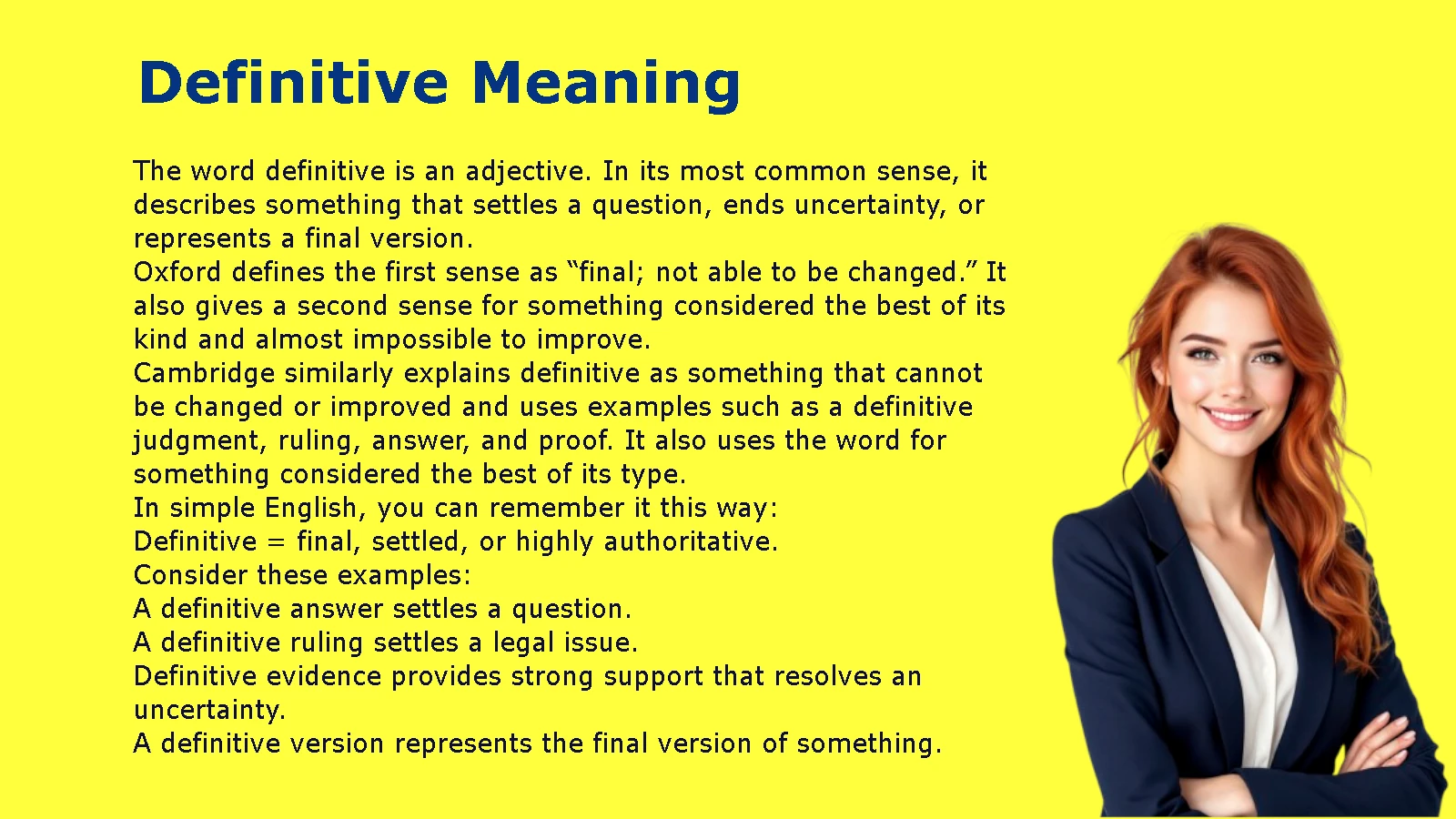
The word definitive is an adjective. In its most common sense, it describes something that settles a question, ends uncertainty, or represents a final version.
Oxford defines the first sense as “final; not able to be changed.” It also gives a second sense for something considered the best of its kind and almost impossible to improve.
Cambridge similarly explains definitive as something that cannot be changed or improved and uses examples such as a definitive judgment, ruling, answer, and proof. It also uses the word for something considered the best of its type.
In simple English, you can remember it this way:
Definitive = final, settled, or highly authoritative.
Consider these examples:
- A definitive answer settles a question.
- A definitive ruling settles a legal issue.
- Definitive evidence provides strong support that resolves an uncertainty.
- A definitive version represents the final version of something.
- A definitive guide is considered the leading or most complete guide on a subject.
The surrounding noun usually tells you which sense applies.
Definitive Meaning in Simple Words
If you want the simplest possible explanation, definitive means “final and conclusive” or “the most authoritative of its kind.”
Imagine that several people are debating which answer is correct. Someone produces reliable evidence that settles the disagreement. That evidence may be called definitive.
Now imagine that dozens of books explain a particular subject. One book covers the subject more thoroughly than the others and becomes widely regarded as the leading reference. People may call it the definitive book on that topic.
Here’s the difference:
| Phrase | Simple meaning |
| Definitive answer | An answer that settles the question |
| Definitive proof | Proof that establishes something conclusively |
| Definitive decision | A final decision |
| Definitive ruling | A ruling that settles an issue |
| Definitive guide | A highly authoritative or comprehensive guide |
| Definitive biography | The leading or most complete biography |
| Definitive version | The final version |
So, when you encounter definitive meaning, don’t think only about “certain.” Think about certainty plus finality or authority, depending on the sentence.
The Two Main Meanings of Definitive
Definitive Means Final or Conclusive
The first major sense refers to something final, settled, or decisive.
When something is definitive in this sense, you don’t expect the matter to remain open for further change or debate. Oxford lists examples such as a definitive agreement, answer, and statement.
For example:
“The company has not reached a definitive agreement.”
This means the company has not yet reached an agreement that is final and settled.
Likewise:
“The investigation did not produce definitive evidence.”
Here, definitive means evidence strong enough to settle the question.
This meaning appears frequently in formal, academic, legal, scientific, and professional writing.
Common examples include:
- definitive answer
- definitive proof
- definitive evidence
- definitive decision
- definitive ruling
- definitive diagnosis
- definitive explanation
- definitive conclusion
- definitive agreement
- definitive statement
The word often signals that uncertainty has reached an endpoint.
Definitive Means the Best or Most Authoritative
The second major meaning has a different focus. Instead of emphasizing finality, it emphasizes quality, authority, completeness, or status.
Oxford describes this use as something considered the best of its kind and almost impossible to improve.
For example:
“She wrote the definitive guide to American folk music.”
The sentence doesn’t necessarily mean that no one will ever write another book. Instead, it presents her guide as the leading or most authoritative work on the subject.
You might also see:
- definitive biography
- definitive history
- definitive study
- definitive guide
- definitive account
- definitive collection
- definitive edition
- definitive reference
Merriam-Webster also lists authoritative and apparently exhaustive as a meaning of definitive.
That explains why a “definitive guide” doesn’t have to be literally the final guide ever written. The phrase often means that the guide is unusually comprehensive, authoritative, or respected.
Definitive Pronunciation
In American English, definitive is pronounced approximately:
dih-FIN-uh-tiv
Its IPA pronunciation is:
/dɪˈfɪn.ə.t̬ɪv/
Cambridge lists this American pronunciation and places the main stress on the second syllable.
Break it into parts:
de + FIN + i + tive
The stressed part is FIN.
Don’t confuse the pronunciation with definite. Although the two words look closely related, they have different endings and slightly different meanings.
What Part of Speech Is Definitive?
Definitive is primarily an adjective.
An adjective describes or modifies a noun. In phrases such as definitive answer or definitive ruling, the word definitive tells you what kind of answer or ruling you’re talking about.
Examples:
- The judge issued a definitive ruling.
- We need a definitive answer.
- Scientists haven’t found definitive evidence.
- The publisher released the definitive edition.
- They signed a definitive agreement.
The related adverb is definitively.
For example:
- The issue has not been resolved definitively.
- The evidence did not definitively establish the cause.
Cambridge defines definitively as doing something in a way that cannot be changed or improved.
Other related forms include definitiveness, although it appears far less often in ordinary conversation.
Definitive vs. Definite
One of the most important parts of understanding the definitive meaning is knowing how it differs from definite.
The words share the same historical root and look almost identical. However, they don’t always work in the same situations.
Definite generally means clear, certain, specific, or without ambiguity. Merriam-Webster defines it in terms such as freedom from uncertainty or ambiguity and having distinct or certain limits.
Definitive, on the other hand, usually suggests finality, conclusiveness, or authority.
Compare these sentences:
“We have a definite date for the meeting.”
This means the date is certain or clearly established.
“We finally received a definitive answer.”
This means the answer settles the question.
The distinction becomes even clearer in a comparison table:
| Word | Main idea | Example |
| Definite | Clear, certain, or specific | We have a definite plan. |
| Definitive | Final, conclusive, or authoritative | We need a definitive answer. |
A definite answer is an answer that is clear or certain.
A definitive answer is an answer that settles the matter.
Those meanings overlap, but they aren’t identical.
An Easy Way to Remember the Difference
Think of definite as describing certainty.
Think of definitive as describing finality or authority.
For example:
- “She gave me a definite time.” → The time is clear.
- “She gave me a definitive answer.” → The answer settles the issue.
That small difference can make a sentence much more precise.
Definitive vs. Definitively
The difference here is grammatical rather than conceptual.
Definitive is an adjective:
“The researchers reached a definitive conclusion.”
Definitively is an adverb:
“The researchers could not prove the cause definitively.”
The adjective modifies a noun. The adverb modifies a verb or describes how something happens.
| Word | Part of speech | Example |
| Definitive | Adjective | This is a definitive answer. |
| Definitively | Adverb | The matter was not settled definitively. |
Cambridge gives examples of definitively in contexts involving proof, diagnosis, and statements that cannot be changed.
Definitive Examples in Sentences
Seeing the word in context makes its meaning much easier to grasp.
Everyday Examples
- “We need a definitive answer before making a decision.”
- “The manager gave us a definitive response.”
- “There isn’t a definitive date for the event yet.”
- “Her statement provided a definitive answer to the question.”
- “The team is still waiting for a definitive decision.”
Academic Examples
- “The research doesn’t provide a definitive explanation for the results.”
- “More evidence is needed before scientists can reach a definitive conclusion.”
- “The study offers useful information but doesn’t give a definitive answer.”
- “The researchers searched for definitive evidence supporting the theory.”
Academic writers often use definitive carefully because scientific findings can involve uncertainty. Calling evidence definitive makes a strong claim.
Legal Examples
- “The court issued a definitive ruling.”
- “The agreement contains the parties’ definitive terms.”
- “The judgment provided a definitive resolution to the dispute.”
- “The case did not produce a definitive answer on that question.”
Legal writing frequently uses definitive because contracts, rulings, and judgments can establish final positions.
Business Examples
- “The two companies signed a definitive agreement.”
- “The board hasn’t made a definitive decision.”
- “Management declined to provide a definitive timeline.”
- “The contract represents the definitive terms of the transaction.”
Here, the word often signals that negotiations or uncertainty have ended.
Books and Reference Works
- “The author wrote the definitive biography of the composer.”
- “This book is considered the definitive history of the region.”
- “The publisher released a definitive edition of the novel.”
- “The website offers a definitive guide to the subject.”
In these examples, definitive usually means authoritative, comprehensive, or regarded as the leading work.
Common Phrases With Definitive
Certain combinations occur so often that learning them can help you understand the word naturally.
Definitive Answer
A definitive answer is a final answer that settles a question.
“The committee couldn’t provide a definitive answer.”
This means the committee still couldn’t settle the issue.
Definitive Proof
Definitive proof means proof regarded as conclusive.
“The investigators found no definitive proof.”
The sentence says that the available evidence didn’t settle the matter.
Definitive Evidence
Definitive evidence is evidence strong enough to establish something conclusively.
This phrase appears frequently in academic and scientific contexts.
Definitive Decision
A definitive decision is a final decision rather than a preliminary or tentative one.
“The company expects to make a definitive decision next week.”
Definitive Ruling
A definitive ruling is a ruling that settles a legal or official question.
Definitive Guide
A definitive guide usually means a guide considered highly authoritative, complete, or comprehensive.
It doesn’t necessarily mean that no better guide can ever appear.
Definitive Version
A definitive version is the final or established version of a document, text, product, or other work.
Oxford specifically gives “the definitive version of the text” as an example.
Definitive Synonyms
The best synonym depends on which meaning you need.
Synonyms for Definitive Meaning “Final”
- final
- conclusive
- decisive
- settled
- conclusive
- determinative
- certain
- absolute
- irrevocable
However, these words don’t always have identical meanings.
For example, conclusive emphasizes evidence that ends doubt. Decisive often emphasizes something that determines an outcome. Final emphasizes that something won’t continue or change.
Merriam-Webster distinguishes these related terms by noting that conclusive often applies to reasoning or proof, while decisive can describe something that ends a controversy, contest, or uncertainty.
Synonyms for Definitive Meaning “Authoritative”
- authoritative
- comprehensive
- thorough
- complete
- exhaustive
- accurate
- leading
- official
- reliable
- classic
Merriam-Webster’s thesaurus groups authoritative, comprehensive, accurate, conclusive, official, complete, and thorough among related words for definitive.
Still, don’t swap these words automatically. A comprehensive guide may cover a subject thoroughly without claiming to be the leading authority. A definitive guide makes a stronger claim.
Antonyms of Definitive
The opposite of definitive depends on the context.
Useful antonyms include:
- uncertain
- inconclusive
- tentative
- provisional
- ambiguous
- unresolved
- indefinite
- debatable
- preliminary
Consider the contrast:
| Definitive | Opposite |
| Definitive answer | Inconclusive answer |
| Definitive decision | Tentative decision |
| Definitive evidence | Inconclusive evidence |
| Definitive agreement | Provisional agreement |
| Definitive conclusion | Unresolved question |
| Definitive statement | Ambiguous statement |
For instance, a tentative decision may change later. A definitive decision suggests that the matter has been settled.
How to Use Definitive Correctly
The safest way to use definitive is to ask what you want to communicate.
If you mean final or conclusive, use definitive when the evidence, decision, agreement, or answer settles something.
If you mean highly authoritative or comprehensive, use it when a work stands out as the leading or most complete example of its type.
Use Definitive for Finality
“The board made a definitive decision.”
The decision is final.
Use Definitive for Authority
“The book is the definitive history of the city.”
The book is presented as the leading or most authoritative history.
Don’t Use Definitive When “Clear” Is Enough
Suppose someone asks when the meeting starts.
“The meeting starts at 10 a.m.”
You could call that a definite time if you want to emphasize certainty.
Calling it a definitive time would sound unusual unless you’re contrasting it with changing or provisional schedules.
Likewise, definitive is stronger than simply saying something is important or useful.
Common Mistakes With Definitive
Mistake: Treating Definitive and Definite as Exact Synonyms
They’re related, but they aren’t interchangeable in every sentence.
Definite focuses more on clarity and certainty.
Definitive focuses more on finality, conclusiveness, or authority.
Mistake: Assuming Definitive Means Perfect
A definitive guide isn’t necessarily flawless.
It means the guide is regarded as highly authoritative, comprehensive, or the best available example of its kind.
That’s an important distinction.
Mistake: Using Definitive for Every Certain Statement
Not everything certain needs the word definitive.
Consider:
“She gave me a definite yes.”
That sounds natural because definite means clear and certain.
“She gave me a definitive yes.”
This can work, but it carries more emphasis. It suggests that the answer settles the issue.
Mistake: Confusing Definitive With Definitively
Remember:
- Definitive answer
- Answered definitively
The first describes the answer.
The second describes how the person answered.
Definitive Meaning in Different Contexts
The word becomes especially easy to understand when you compare its use across different fields.
| Context | Example | Meaning of definitive |
| Law | definitive ruling | Final and authoritative ruling |
| Business | definitive agreement | Final agreement |
| Science | definitive evidence | Conclusive evidence |
| Education | definitive guide | Highly authoritative guide |
| Literature | definitive edition | Established or authoritative edition |
| Biography | definitive biography | Most comprehensive or authoritative biography |
| Everyday speech | definitive answer | Final answer |
| Government | definitive statement | Official or conclusive statement |
The same core idea runs through all these examples: something has reached a high level of certainty, finality, or authority.
A Closer Look at “Definitive Answer”
The phrase definitive answer deserves special attention because it’s one of the most common combinations.
When someone asks for a definitive answer, they usually aren’t asking for another possibility or educated guess. They want the issue settled.
For example:
“Is the event canceled?”
A response such as “It might be” isn’t definitive.
A response such as “Yes, the event has been canceled” is definitive if the speaker has reliable authority to make that statement.
This is why the phrase appears frequently in professional and formal communication.
You might write:
- “We need a definitive answer before proceeding.”
- “The investigation has not yet produced a definitive answer.”
- “Management will provide a definitive answer after reviewing the proposal.”
The word adds weight to the noun answer.
A Closer Look at “Definitive Guide”
The phrase definitive guide uses the second major meaning.
It usually suggests that the guide is:
- highly authoritative
- detailed
- comprehensive
- reliable
- widely regarded as a leading resource
- difficult to improve upon
For example:
“The book became the definitive guide to the region.”
This doesn’t necessarily mean the author has produced the final guide that humanity will ever see. Rather, the book has achieved a high level of authority and completeness.
That’s why definitive guide and definitive answer shouldn’t be interpreted in exactly the same way.
A Closer Look at “Definitive Evidence”
Definitive evidence refers to evidence considered strong enough to settle an issue.
However, context matters. In science, evidence usually gets evaluated according to the quality of the study, methodology, data, replication, and broader body of research. Calling something “definitive” therefore makes a strong claim.
Cambridge provides examples involving the absence of definitive scientific evidence and the difficulty of reaching definitive conclusions.
For example:
“The researchers did not find definitive evidence of a connection.”
This means the evidence wasn’t strong enough to settle the question.
That doesn’t necessarily mean the connection is false. It means the available evidence hasn’t established it conclusively.
Definitive Word Forms
The word has several related forms.
| Word | Part of speech | Meaning | Example |
| Definitive | Adjective | Final or authoritative | A definitive answer |
| Definitively | Adverb | In a definitive way | The issue wasn’t settled definitively |
| Definitiveness | Noun | The quality of being definitive | The definitiveness of the ruling |
The most common forms in everyday English are definitive and definitively.
Origin and Etymology of Definitive
The history of definitive helps explain why the word carries ideas of limits and finality.
Oxford traces it through Old French to the Latin definitivus, related to definire, meaning to set limits, determine, or define. Oxford identifies the word as entering English in the late Middle English period.
Merriam-Webster traces the English adjective to Middle English and Medieval Latin sources. It records the first known use of the adjective in the 14th century.
The connection with “setting limits” makes the modern meaning intuitive. When you define boundaries, you establish where something ends. A definitive decision similarly brings an issue to an endpoint.
Case Study: Definite vs. Definitive in a Business Decision
Imagine a company is choosing a date to launch a new product.
On Monday, the manager says:
“We have a definite launch date: October 15.”
This tells the team that October 15 is the current confirmed date.
Two weeks later, the company signs the final contracts and approves the launch plan. The manager says:
“October 15 is now the definitive launch date.”
The second statement carries more finality. It suggests that the date isn’t merely clear or planned. It has become the established, final date.
The difference is subtle, but it shows why choosing between definite and definitive matters.
Case Study: “Definitive Guide” vs. “Complete Guide”
Suppose a travel writer publishes a 700 page guide covering transportation, neighborhoods, history, attractions, food, and practical advice.
Calling it a complete guide emphasizes its coverage.
Calling it a definitive guide makes a stronger claim. It suggests that the guide isn’t merely detailed. It stands as one of the most authoritative resources available.
That’s why definitive often carries a sense of status, not merely size.
A book can be long without being definitive.
A guide can be comprehensive without becoming authoritative.
The word definitive combines those ideas more strongly.
Facts About the Word Definitive
- Part of speech: Adjective
- American pronunciation: /dɪˈfɪn.ə.t̬ɪv/
- Primary meanings: Final or conclusive; considered the best or most authoritative of its kind.
- Related adverb: Definitively
- Related noun: Definitiveness
- First known use of the adjective: 14th century, according to Merriam-Webster.
- Historical root: Latin definitivus, connected with definire, meaning to define, determine, or set limits.
Quick Test: Is Definitive the Right Word?
Before using definitive, ask yourself these questions:
- Does the thing settle an issue?
- Is it final rather than temporary or tentative?
- Does it provide conclusive evidence or an answer?
- Is it considered unusually authoritative or comprehensive?
- Would “final,” “conclusive,” or “authoritative” fit naturally?
If the answer is yes, definitive may be the right choice.
Try these examples.
Fill in the Blanks
The court issued a ______ ruling that ended the dispute.
Answer: definitive
The researchers couldn’t reach a ______ conclusion because the evidence remained limited.
Answer: definitive
The book is considered the ______ guide to the region.
Answer: definitive
We don’t have a ______ date yet because the schedule may change.
Answer: definite
The last example demonstrates the difference. Definite works better when the main idea is certainty rather than finality.
Frequently Asked Questions About Definitive Meaning
What does definitive mean in simple words?
Definitive means final, conclusive, or authoritative. It can describe something that settles an issue or something considered the best and most complete example of its kind.
Does definitive mean final?
Yes. Final is one of the main meanings of definitive. A definitive decision or agreement is intended to settle the matter and not remain open to change.
What is an example of definitive?
Here are two examples:
- “The court issued a definitive ruling.”
- “This is considered the definitive biography of the author.”
The first uses definitive to mean final or conclusive. The second uses it to mean highly authoritative or comprehensive.
What is the difference between definite and definitive?
Definite usually means clear, certain, or specific. Definitive usually means final, conclusive, or authoritative. Merriam-Webster describes definite in terms of certainty and freedom from ambiguity, while definitive emphasizes final solutions and authority.
Is definitive a positive or negative word?
Definitive is generally neutral. Its tone depends on the sentence.
For example:
“The study provided definitive evidence.”
That sounds positive because the evidence successfully settles a question.
However:
“The investigation produced a definitive finding of wrongdoing.”
The word itself remains neutral. The subject matter determines whether the overall statement sounds positive or negative.
What is another word for definitive?
Depending on the context, possible synonyms include final, conclusive, decisive, authoritative, comprehensive, complete, exhaustive, and settled. They aren’t perfect substitutes in every sentence.
What does “definitive answer” mean?
A definitive answer is an answer that settles a question rather than leaving the issue uncertain or open.
What does “definitive guide” mean?
A definitive guide is a guide considered highly authoritative, comprehensive, or the best of its type. It doesn’t necessarily mean that no other guide will ever be published.
What does “definitive proof” mean?
Definitive proof means proof regarded as conclusive enough to settle an issue.
What does “definitively” mean?
Definitively means in a final, conclusive, or unchangeable way. It is the adverbial form of definitive.
Is definitive stronger than definite?
Usually, yes, when the two words relate to certainty. Definite says something is clear or certain. Definitive often goes further by suggesting that the matter has been settled or that the thing has authoritative status.
Final Takeaway: Definitive Meaning
The easiest way to remember the definitive meaning is to focus on two ideas: finality and authority.
When definitive describes an answer, decision, ruling, agreement, conclusion, or piece of evidence, it usually means final or conclusive.
When it describes a guide, biography, history, study, edition, or other major work, it often means the most authoritative, complete, or highly regarded example of its kind. Cambridge and Oxford both recognize these two central uses.
The distinction between definite and definitive is especially useful:
Definite = clear or certain.
Definitive = final, conclusive, or authoritative.
Once you understand that difference, phrases such as definitive answer, definitive proof, definitive ruling, and definitive guide become much easier to understand and use correctly.




