Have you ever heard an argument that sounded convincing at first but didn’t quite make sense? That’s where Fallacy Meaning becomes important. A fallacy is a mistake in reasoning that can make an argument seem logical or believable even when the conclusion isn’t properly supported.
Fallacy refers to an error, flaw, or weakness in reasoning or argument. Fallacies can appear in everyday conversations, debates, advertisements, news, essays, and social media discussions. Some are accidental, while others may be used deliberately to persuade people.
Examples:
- Saying everyone likes a product because many people bought it is a fallacy.
- His argument contained a logical fallacy.
The confusion is understandable. People often search for what does fallacy mean, fallacy meaning in simple words, fallacy meaning in an argument, or logical fallacy meaning because the word can refer to different types of reasoning errors. And here’s the kicker: an argument can sound perfectly reasonable while still containing a serious fallacy.
In this guide, you’ll learn the complete Fallacy Meaning, its definition, pronunciation, correct usage, and examples in sentences. You’ll also discover common types of fallacies, what logical fallacy means, how fallacies work in everyday arguments, and the difference between a fallacy, a false statement, and a misunderstanding.
What Does Fallacy Mean?
The word fallacy means a false or mistaken idea. It can also mean an error in reasoning that makes an argument unreliable or logically weak.
Cambridge Dictionary defines a fallacy as an idea that many people believe to be true even though it is actually false. It also lists fallacious as the related adjective.
In simple terms:
A fallacy is a mistaken belief or a flaw in reasoning that can make an argument seem more convincing than it really is.
The word has two closely connected uses:
| Meaning | Explanation | Example |
| False or mistaken idea | A belief that isn’t true or correct | “It’s a fallacy that success always comes quickly.” |
| Faulty reasoning | An argument that doesn’t properly support its conclusion | “Everyone likes it, so it must be good.” |
The second meaning appears frequently in discussions about logic and critical thinking.
A fallacy doesn’t necessarily mean that the final conclusion is false. Instead, the problem may lie in how the person reached or supported the conclusion.
For instance:
“The sun is larger than Earth because my teacher said so.”
The conclusion is true. However, the argument doesn’t explain why the conclusion is true. The reasoning depends entirely on the teacher’s statement rather than presenting relevant evidence.
Fallacy Meaning in Simple Words
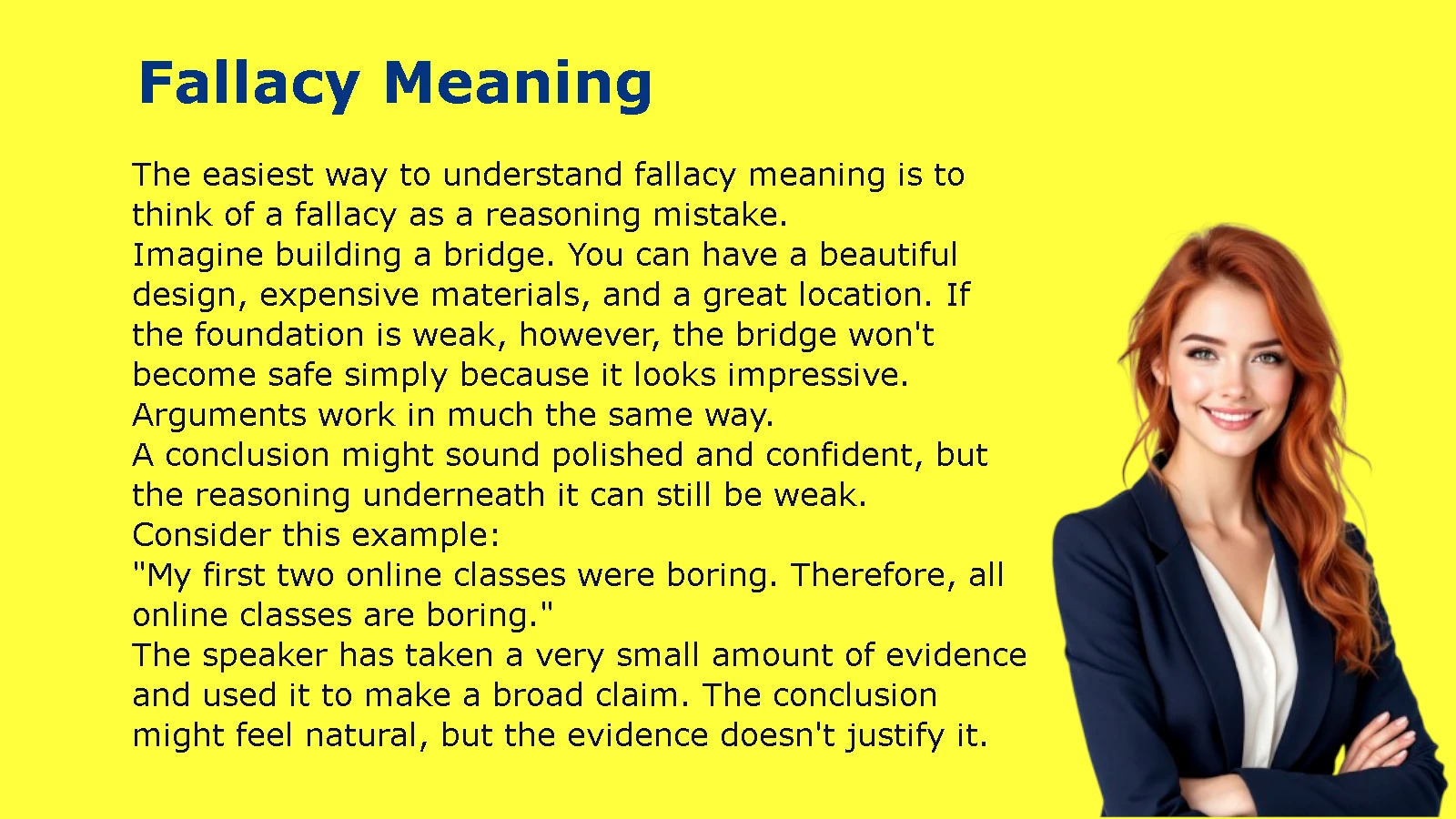
The easiest way to understand fallacy meaning is to think of a fallacy as a reasoning mistake.
Imagine building a bridge. You can have a beautiful design, expensive materials, and a great location. If the foundation is weak, however, the bridge won’t become safe simply because it looks impressive.
Arguments work in much the same way.
A conclusion might sound polished and confident, but the reasoning underneath it can still be weak.
Consider this example:
“My first two online classes were boring. Therefore, all online classes are boring.”
The speaker has taken a very small amount of evidence and used it to make a broad claim. The conclusion might feel natural, but the evidence doesn’t justify it.
That is a hasty generalization.
A Quick Definition
Fallacy: a false or mistaken idea, or a flaw in reasoning that makes an argument logically unreliable.
What a Fallacy Is Not
A fallacy isn’t simply any statement that turns out to be wrong.
Suppose someone says:
“Paris is the capital of Germany.”
That’s a factual error. It isn’t automatically a logical fallacy.
A fallacy concerns the reasoning or inference behind a claim.
For example:
“Paris is the capital of Germany because my friend told me so.”
Now the argument contains a reasoning problem because the speaker treats an unsupported statement from a friend as sufficient evidence.
This distinction matters. Being wrong and reasoning badly aren’t always the same thing.
What Is a Logical Fallacy?
A logical fallacy is a mistake in reasoning that weakens an argument or makes its conclusion unsupported.
Cambridge Dictionary describes a logical fallacy as a mistake in the way someone thinks about something that leads to a wrong judgment or decision.
A basic argument contains:
- Premises — the reasons or evidence.
- Inference — the reasoning connecting those premises.
- Conclusion — the claim the argument tries to establish.
For example:
All mammals breathe air.
Dogs are mammals.
Therefore, dogs breathe air.
The premises support the conclusion.
Now consider this:
Dogs are popular.
My neighbor owns a dog.
Therefore, dogs are the best pets for everyone.
The conclusion doesn’t follow from the premises. Popularity and one person’s choice don’t establish that dogs are the best pets for everyone.
That’s where critical thinking becomes important. Instead of asking only “Is the conclusion true?”, you should also ask:
“Do the reasons actually support the conclusion?”
Formal vs. Informal Fallacies
Logical fallacies aren’t all the same. A useful distinction separates them into formal fallacies and informal fallacies.
OpenStax explains that formal fallacies involve problems with the structure of an argument. Informal fallacies usually arise because the evidence doesn’t adequately support the conclusion.
| Type | Main Problem | What to Examine |
| Formal fallacy | The logical structure is invalid | Does the conclusion follow from the argument’s form? |
| Informal fallacy | The content, evidence, relevance, or assumptions create a reasoning problem | Do the reasons actually support the conclusion? |
Formal Fallacies
A formal fallacy occurs because the structure of the argument doesn’t work.
For example:
If it rains, the streets get wet.
The streets are wet.
Therefore, it rained.
The streets could be wet for many other reasons. Someone could have washed them, a sprinkler could have run, or a pipe could have burst.
The conclusion doesn’t necessarily follow from the premises.
Informal Fallacies
Informal fallacies don’t necessarily involve an invalid structure in the strict formal sense. Instead, the problem often involves irrelevant evidence, weak evidence, unsupported assumptions, ambiguity, or distraction.
OpenStax groups informal fallacies into categories such as relevance, weak induction, unwarranted assumptions, and diversion.
For example:
“You shouldn’t listen to her opinion about school funding because she failed math.”
The person’s math grade doesn’t establish whether her opinion about school funding is correct.
The argument attacks the person rather than addressing the claim.
That’s an ad hominem fallacy.
Common Logical Fallacies With Examples
Fallacies can sound persuasive because they often use familiar patterns of thinking. Learning their names makes those patterns easier to recognize.
Ad Hominem
Ad hominem means attacking the person making an argument instead of addressing the argument itself.
“Don’t listen to John’s idea about saving money. He spends too much.”
John’s personal spending habits might be relevant in some situations, but they don’t automatically prove that his particular financial suggestion is wrong.
The problem: The argument shifts attention from the claim to the person.
Straw Man
A straw man fallacy occurs when someone changes another person’s position into a weaker version that becomes easier to attack.
The second speaker created an exaggerated version of the original position and attacked that instead.
The problem: The argument doesn’t address the actual claim.
Red Herring
A red herring distracts from the original issue by introducing something unrelated.
“Why did the company miss its sales target?”
“Our employees work incredibly hard and deserve more recognition.”
Employee effort might be worth discussing, but it doesn’t answer why the sales target was missed.
The problem: The argument changes direction instead of addressing the question.
OpenStax identifies the red herring as a diversion that ignores the position under discussion and changes the subject.
Hasty Generalization
A hasty generalization occurs when someone draws a broad conclusion from too little evidence.
“I met two rude tourists from that city. People from that city must be rude.”
Two examples can’t reasonably establish a claim about an entire population.
The problem: The evidence is too limited to support the broad conclusion.
OpenStax specifically describes hasty generalization as drawing a conclusion from insufficient evidence.
False Dilemma
A false dilemma presents two options as if they’re the only possibilities when other choices exist.
“Either you support this proposal or you don’t care about the company.”
Someone might care deeply about the company while still disagreeing with the proposal.
The problem: The argument artificially limits the available choices.
Slippery Slope
A slippery slope argument claims that one action will inevitably trigger a chain of increasingly extreme consequences.
“If students can submit one assignment late, soon nobody will meet deadlines and the entire school system will collapse.”
The first event doesn’t automatically guarantee all the later events.
The problem: The argument assumes a chain of consequences without adequately establishing the links between them.
Appeal to Popularity
This fallacy treats popularity as proof.
“Millions of people use this app, so it must be the safest app.”
Millions of users might provide evidence of popularity. They don’t automatically establish safety.
The problem: Popularity and truth aren’t the same thing.
Appeal to Authority
An appeal to authority occurs when someone treats an authority’s statement as sufficient proof.
“A famous actor says this supplement works, so it works.”
The actor’s fame doesn’t establish expertise in nutrition or medicine.
However, appealing to an appropriate expert isn’t automatically fallacious. A qualified expert can provide valuable evidence. The problem occurs when the authority lacks relevant expertise or when the claim requires stronger evidence than the authority’s statement provides.
Circular Reasoning
Circular reasoning occurs when an argument assumes what it is supposed to prove.
“This rule is fair because it’s a fair rule.”
The conclusion simply returns as the reason.
The problem: The argument provides no independent support.
This pattern often hides behind confident wording. Once you strip away the language, however, the argument can turn out to be running in circles.
False Cause
A false cause fallacy assumes that one event caused another without enough evidence.
“I started carrying this lucky coin and then I got a promotion. The coin caused my promotion.”
The events happened in sequence, but that doesn’t establish causation.
OpenStax describes false cause reasoning as assuming a causal relationship between events that aren’t actually causally connected.
Appeal to Ignorance
An appeal to ignorance treats a lack of evidence as proof.
“Nobody has proven that the claim is false, so it must be true.”
Not knowing that something is false doesn’t establish that it is true.
Likewise, not having evidence that something is true doesn’t automatically prove that it is false.
Fallacy Examples in Everyday Life
You don’t need to be in a philosophy classroom to encounter fallacies. They appear wherever people make claims, defend opinions, or try to persuade others.
Fallacy Examples at Work
Imagine a manager says:
“Everyone on the team likes this new process, so it must be the most efficient option.”
The team’s approval might matter. However, it doesn’t prove efficiency.
A better approach would examine measurable results such as:
- Time saved
- Error rates
- Cost
- Productivity
- Customer outcomes
- Employee workload
The key lesson is simple: a positive reaction isn’t automatically proof of effectiveness.
Fallacies in Advertising
Advertising often relies on persuasive techniques. That doesn’t mean every persuasive advertisement commits a fallacy.
Consider:
“Everyone is switching to Brand X.”
Even if that statement is true, widespread use doesn’t prove that Brand X is the best option for every customer.
A stronger evaluation would ask:
- What evidence supports the product’s claims?
- Are the comparisons fair?
- Does the advertisement provide measurable results?
- Is the person promoting the product qualified to discuss it?
Fallacies on Social Media
Social media makes fallacies especially visible because users often respond quickly.
A typical exchange might look like this:
“Your argument about public transportation is wrong because you don’t even own a car.”
That’s an ad hominem response.
The person’s transportation habits don’t necessarily determine whether their argument about public transportation is correct.
Another common pattern is:
“If we accept this small change, next they’ll take away all our rights.”
That may be a slippery slope if the speaker hasn’t established why the first change would inevitably produce those later consequences.
Fallacies in School Essays
Students can accidentally use fallacies when they make broad claims without enough evidence.
For example:
“Most teenagers use social media every day, so social media is harmful to teenagers.”
The first statement doesn’t establish the second.
A stronger essay would provide evidence about specific effects and distinguish between different platforms, usage patterns, age groups, and outcomes.
Fallacy vs. Factual Error
A factual error and a logical fallacy aren’t identical.
Suppose someone writes:
“The Pacific Ocean is smaller than the Atlantic Ocean.”
That’s simply a factual mistake.
Now consider:
“The Pacific Ocean must be smaller than the Atlantic because it looks smaller on this map.”
The claim remains wrong, but the reasoning also contains a problem because the apparent size on a particular map doesn’t establish the actual size of the oceans.
The difference can be summarized like this:
| Concept | What Goes Wrong | Example |
| Factual error | The claim conflicts with reality | “The Pacific is smaller than the Atlantic.” |
| Fallacy | The reasoning doesn’t properly support the conclusion | “The map makes it look smaller, so it must be smaller.” |
| Misconception | Someone holds an incorrect understanding | “A larger-looking object must always be physically larger.” |
This distinction prevents a common mistake: calling every incorrect statement a fallacy.
Fallacy vs. Misconception
The words fallacy and misconception overlap, but they aren’t interchangeable in every context.
A misconception is usually an incorrect belief or understanding.
A fallacy can refer to an incorrect belief, but in logic it more specifically concerns faulty reasoning.
For example:
“I thought bats were birds.”
That’s a misconception.
But:
“Bats must be birds because they fly.”
That’s faulty reasoning. Flying doesn’t determine whether an animal belongs to the class of birds.
The first statement describes what someone believes. The second gives a flawed reason for that belief.
Fallacy vs. Fallacious
These words come from the same root, but they play different grammatical roles.
| Word | Part of Speech | Meaning | Example |
| Fallacy | Noun | A false idea or reasoning error | “The argument contains a fallacy.” |
| Fallacious | Adjective | Based on faulty reasoning or a false idea | “That is a fallacious argument.” |
| Fallacies | Plural noun | More than one fallacy | “The debate contained several fallacies.” |
The easiest way to remember the difference is this:
Fallacy = the error.
Fallacious = describes something containing or relying on the error.
For example:
“The speaker used a fallacious argument.”
But:
“The argument contains a fallacy.”
Fallacy Synonyms and Related Words
Several words can overlap with fallacy, but each carries a slightly different meaning.
| Word | Meaning | How It Differs From Fallacy |
| Error | Something incorrect | Very broad |
| Mistake | An incorrect action, judgment, or belief | Usually less specific to reasoning |
| Misconception | An incorrect understanding | Focuses on belief or understanding |
| Falsehood | Something untrue | Focuses on the claim itself |
| Myth | A widely held but often false belief | Can involve cultural or traditional beliefs |
| Illusion | A misleading perception or appearance | Often involves perception |
| Delusion | A strongly held false belief | Often stronger than ordinary misconception |
Because these terms overlap, context matters.
Calling something a fallacy often draws attention to the reasoning behind a claim, not merely its truth value.
How to Identify a Fallacy
Spotting a fallacy becomes easier when you stop focusing only on the conclusion.
Instead, take the argument apart.
Identify the Main Claim
First, ask:
What is the speaker actually trying to prove?
Strip away emotional language and unnecessary details.
Find the Evidence
Next, identify the reasons given in support of the claim.
Ask:
“What evidence is being used?”
If you can’t find a clear reason, the argument may rely more on assertion than evidence.
Check the Connection
Now ask:
Does the evidence actually support the conclusion?
This is the heart of fallacy detection.
For example:
“She is wealthy, so her opinion about education must be correct.”
Her wealth doesn’t establish her expertise in education.
Watch for Personal Attacks
If someone attacks the person instead of addressing the argument, look for ad hominem reasoning.
Ask:
“Would this criticism still matter if someone else made the same argument?”
If the answer is no, the personal attack may be irrelevant.
Look for Overly Limited Choices
Be cautious when someone says:
“Either you’re with us or you’re against us.”
Real situations often contain more than two possibilities.
Ask whether the speaker has ignored reasonable alternatives.
Check the Evidence Size
One story, one experience, or one example rarely proves a broad claim.
Ask:
“Is there enough evidence to justify this conclusion?”
If not, you may be looking at a hasty generalization.
Separate Correlation From Causation
When one event follows another, don’t immediately assume the first caused the second.
Ask:
- Did the events actually have a causal connection?
- Could another factor explain the outcome?
- Is there evidence beyond timing?
This simple check can prevent many false cause arguments.
How to Avoid Logical Fallacies
Avoiding fallacies doesn’t mean making every argument complicated. In fact, strong reasoning often becomes clearer when you remove unnecessary claims.
Use these practices:
- Define your claim clearly.
- Use relevant evidence.
- Avoid personal attacks.
- Don’t generalize from a tiny sample.
- Distinguish facts from assumptions.
- Consider alternative explanations.
- Represent opposing arguments fairly.
- Don’t treat popularity as proof.
- Don’t confuse correlation with causation.
- Acknowledge uncertainty when the evidence has limits.
- Explain the connection between evidence and conclusion.
A useful test is to imagine someone you respect making the opposing argument.
Would the reasoning still seem weak?
If so, challenge the reasoning itself rather than the person.
A Simple Case Study: How a Fallacy Can Make a Weak Argument Sound Strong
Consider a fictional company deciding whether to adopt a four day workweek.
One manager says:
“We shouldn’t adopt it because our competitor tried it and had problems.”
At first glance, the argument sounds practical. The company has a real example to consider.
But the reasoning needs more investigation.
Step One: Identify the Claim
The claim is:
Our company shouldn’t adopt a four day workweek.
Step Two: Identify the Evidence
The evidence is:
A competitor tried it and experienced problems.
Step Three: Examine the Inference
The competitor’s experience may provide useful information, but it doesn’t automatically prove that the same outcome will happen here.
The two companies might differ in:
- Industry
- Staffing
- Customer demands
- Work schedules
- Management
- Implementation
- Employee roles
- Performance measures
If the manager treats one company’s experience as decisive proof, the argument may involve hasty generalization.
Step Four: Improve the Argument
A stronger argument would examine the competitor’s results, compare the two companies, identify why problems occurred, and determine whether those conditions would exist here.
The conclusion might remain the same.
The difference is that the reasoning becomes stronger.
That’s an important lesson about fallacies: identifying a fallacy doesn’t automatically tell you the opposite conclusion is correct. It tells you that the argument needs better support.
Why Understanding Fallacies Matters
Fallacies matter because modern life is full of arguments.
You encounter them when you:
- Read a news article
- Watch an advertisement
- Scroll through social media
- Discuss politics
- Compare products
- Write an essay
- Make a business decision
- Debate a friend
- Evaluate a claim online
Logic helps you slow down when an argument feels persuasive.
OpenStax describes logic as a way to understand reasoning and distinguish sound reasoning from mistakes.
That skill becomes especially useful when a message triggers a strong emotional response.
A dramatic claim can make you want to agree immediately. A personal attack can make you want to defend yourself. A confident speaker can make weak evidence feel stronger than it is.
Recognizing fallacies gives you a moment to pause.
Instead of asking only:
“Do I agree with this?”
ask:
“Why should I believe this?”
That small change can dramatically improve the quality of your decisions.
Fallacy in a Sentence
Seeing the word in context makes its meaning easier to remember.
- It is a fallacy to assume that expensive products are always better.
- The argument relies on a common logical fallacy.
- The belief that success happens overnight is a fallacy.
- She identified a fallacy in the speaker’s reasoning.
- The conclusion may be correct, but the argument contains a fallacy.
- Popularity alone doesn’t prove quality, so that argument contains a fallacy.
- His claim sounded convincing until the fallacy became clear.
Notice that fallacy can describe either a mistaken idea or a problem with reasoning.
What Is the Plural of Fallacy?
The plural of fallacy is fallacies.
The spelling changes from -y to -ies:
fallacy → fallacies
Examples:
- “The debate contained several fallacies.”
- “Students should learn how to recognize common fallacies.”
- “The article identifies three fallacies in the argument.”
The word is pronounced /ˈfæl.ə.si/ in US English. Cambridge Dictionary gives the same pronunciation for the US form.
What Is the Adjective Form of Fallacy?
The adjective form is fallacious.
Fallacious means based on a fallacy or faulty reasoning.
Examples:
- “The claim is fallacious.”
- “The writer presented a fallacious argument.”
- “That conclusion relies on fallacious reasoning.”
The distinction is straightforward:
Fallacy is a noun.
Fallacious is an adjective.
Is a Fallacy the Same as a Lie?
No.
A lie involves intentionally presenting something false as true.
A fallacy concerns a false idea or faulty reasoning. Someone can use a fallacy without deliberately trying to deceive anyone.
For example, a person might sincerely believe:
“I met three dishonest salespeople, so all salespeople are dishonest.”
The person may genuinely believe the conclusion. The reasoning is still a hasty generalization.
This distinction matters because people don’t always use fallacies intentionally. They can arise from:
- Incomplete information
- Bias
- Emotional reactions
- Poor assumptions
- Limited experience
- Misunderstanding
- Overconfidence
Sometimes the problem isn’t deception. It’s simply bad reasoning.
Is a Fallacy Always False?
Not necessarily.
A fallacious argument can sometimes reach a true conclusion.
For example:
“The Earth is round because my favorite singer says it is.”
The conclusion is true. The reason offered doesn’t establish it.
This is why evaluating an argument requires more than checking whether its conclusion happens to be correct.
A good question is:
“Does the evidence provide a valid or sufficiently strong reason for accepting the conclusion?”
If it doesn’t, the reasoning may contain a fallacy even when the conclusion turns out to be true.
Common Fallacies at a Glance
| Fallacy | Core Error | Example |
| Ad hominem | Attacks the person | “He’s ignorant, so his argument is wrong.” |
| Straw man | Misrepresents an argument | “You want fewer tests, so you don’t want students to learn.” |
| Red herring | Diverts the discussion | Answering a question with an unrelated issue |
| Hasty generalization | Uses too little evidence | “Two customers complained, so everyone hates the product.” |
| False dilemma | Pretends only two options exist | “Either agree or admit you don’t care.” |
| Slippery slope | Assumes an unsupported chain of consequences | “One exception will destroy the entire rule.” |
| Appeal to popularity | Treats popularity as proof | “Everyone uses it, so it must work.” |
| Appeal to authority | Relies improperly on authority | “A celebrity said it, so it must be true.” |
| Circular reasoning | Assumes the conclusion | “It’s true because it’s true.” |
| False cause | Assumes causation without enough evidence | “It happened after X, so X caused it.” |
| Appeal to ignorance | Treats lack of evidence as proof | “Nobody disproved it, so it’s true.” |
Key Takeaways About Fallacy Meaning
The fallacy meaning is broader than simply “a mistake.”
A fallacy can describe a false or mistaken idea. In logic, it can describe a flaw in reasoning that makes an argument unreliable or unsupported.
The most important points to remember are:
- Fallacy is a noun.
- Its plural form is fallacies.
- Fallacious is the adjective form.
- A logical fallacy involves a problem with reasoning.
- Formal fallacies concern the structure of an argument.
- Informal fallacies often involve weak evidence, irrelevant reasons, unsupported assumptions, or diversion.
- A fallacy isn’t necessarily a lie.
- A fallacy doesn’t always make the conclusion false.
- A factual error isn’t automatically a logical fallacy.
- Common examples include ad hominem, straw man, red herring, hasty generalization, false dilemma, slippery slope, circular reasoning, and false cause.
- Recognizing fallacies helps you evaluate arguments instead of accepting claims simply because they sound persuasive.
Ultimately, understanding fallacy meaning gives you a practical tool for better thinking. When an argument sounds convincing, don’t stop at the conclusion. Look underneath it. Examine the evidence, test the assumptions, and ask whether the reasoning actually carries the weight placed on it.




