Have you ever read a statement, noticed a few clues, and figured out what someone really meant without them saying it directly? That is where Inference Meaning comes into play. While inference may sound like a complex academic term, it is something you use every day when you draw a conclusion from facts, clues, or context.
Inference means a conclusion or idea that you reach based on the information and evidence available to you rather than something stated directly. It is commonly used in reading, communication, science, logic, and everyday situations.
Examples:
- From the dark clouds, I made the inference that it might rain.
- The teacher asked students to make an inference from the clues in the story.
The confusion is understandable. People often search for what does inference mean, inference meaning in English, inference meaning in reading, or inference meaning with examples because the word can be easy to confuse with assumption, interpretation, or conclusion. And here’s the kicker: an inference is not simply a guess. It is a conclusion supported by clues or evidence.
In this guide, you’ll learn the complete Inference Meaning, its definition, pronunciation, correct usage, and examples in sentences. You’ll also discover how inference works in reading and everyday communication, the difference between inference and assumption, and how to make a strong inference from available evidence.
Inference Meaning
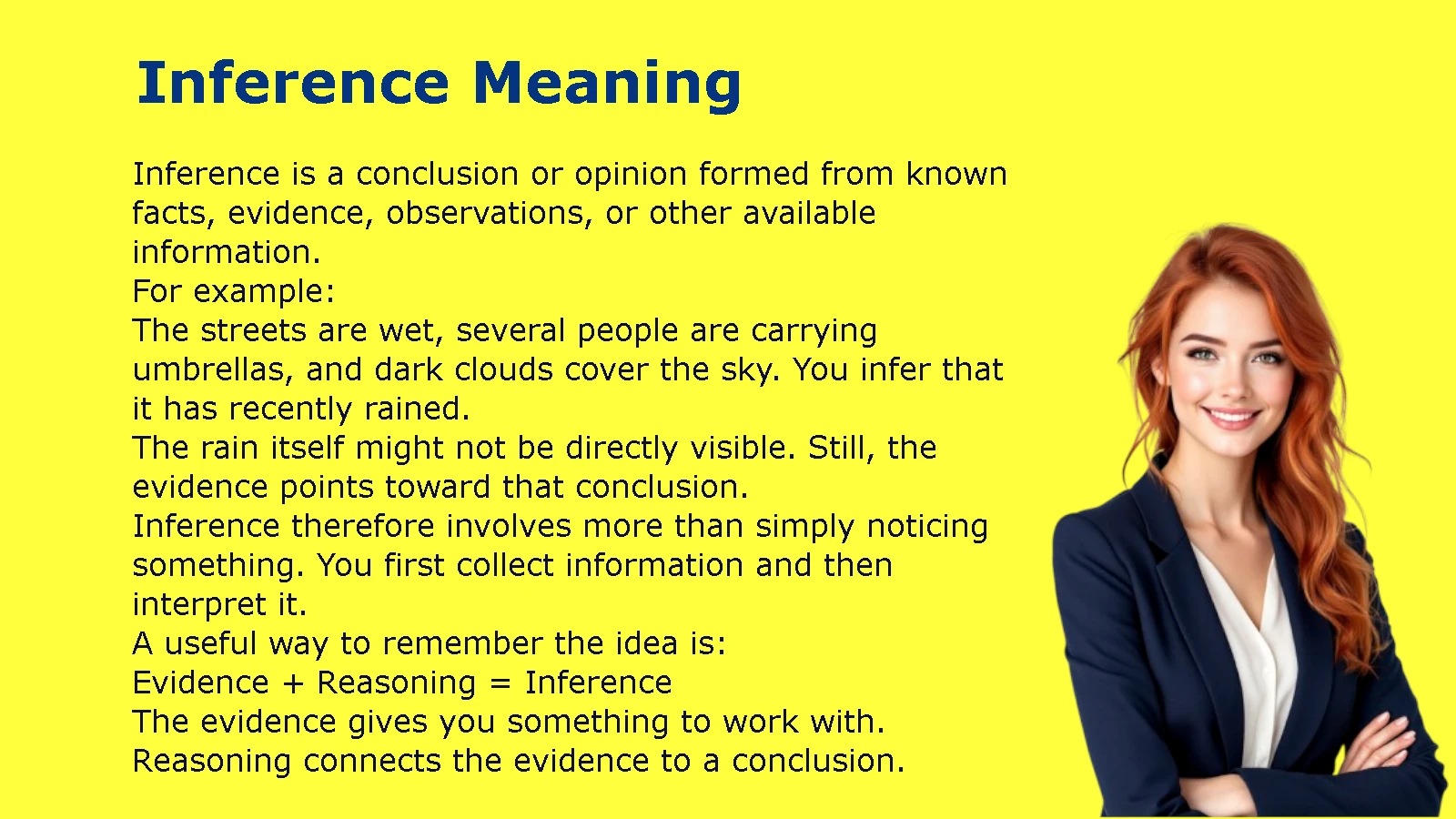
Inference is a conclusion or opinion formed from known facts, evidence, observations, or other available information.
For example:
The streets are wet, several people are carrying umbrellas, and dark clouds cover the sky. You infer that it has recently rained.
The rain itself might not be directly visible. Still, the evidence points toward that conclusion.
Inference therefore involves more than simply noticing something. You first collect information and then interpret it.
A useful way to remember the idea is:
Evidence + Reasoning = Inference
The evidence gives you something to work with. Reasoning connects the evidence to a conclusion.
An inference doesn’t always turn out to be correct. New evidence can change your conclusion. That’s an important part of the concept because an inference differs from a proven fact.
Simple Definition of Inference
In simple words, inference means figuring something out from clues and evidence.
Consider this example:
Maria walked into the house carrying a wet coat and dripping umbrella.
The sentence doesn’t say, “It is raining outside.”
You can still infer that it is probably raining.
The writer gave you enough clues to reach that conclusion without stating it directly.
What Does Inference Mean in Simple Words?
Think of inference as connecting the dots.
Suppose you walk into a room and see:
- An empty plate
- Crumbs on the table
- A half empty glass
- A chair pulled away from the table
That’s inference.
However, inference isn’t the same as making a random guess. A reasonable inference should have some connection to the evidence.
For example, if you see an empty plate and conclude that someone in the room just won the lottery, you don’t have enough evidence. That’s speculation.
The stronger your evidence, the stronger your inference tends to be.
Inference Definition and Word Forms
The word inference is a noun. Its related verb is infer.
Inference as a Noun
An inference is the conclusion reached through reasoning.
Examples:
- Her inference was based on the available evidence.
- The reader made an inference about the character’s feelings.
- We can draw an inference from these results.
- His conclusion was a reasonable inference from the facts.
Infer as a Verb
Infer means to reach a conclusion from facts, evidence, or premises.
Examples:
- From his silence, I inferred that he was upset.
- We can infer that demand increased from the sales figures.
- The detective inferred that someone had entered through the back door.
- From the character’s actions, readers can infer her true intentions.
The distinction is easy:
You infer something, and the result is an inference.
Inferred
Inferred is the past tense and past participle of infer.
For example:
The scientist inferred that the change resulted from environmental conditions.
How Does Inference Work?
Inference usually follows a straightforward chain of reasoning.
Identify the Evidence
First, identify what you actually know.
Evidence might include:
- Facts
- Statements
- Observations
- Measurements
- Actions
- Patterns
- Descriptions
- Historical information
- Data
Don’t jump to the conclusion yet. Start with what you can reasonably establish.
Connect the Clues
Next, look at how the pieces of information relate to each other.
One clue may not tell you much. Several related clues can create a stronger picture.
For example, imagine that a store has:
- Dark windows
- Locked doors
- No employees inside
- A sign saying “Closed”
Together, those clues strongly support the inference that the store isn’t open.
Use Background Knowledge
Your existing knowledge also matters.
If you know that people usually carry umbrellas to protect themselves from rain, seeing someone carrying an umbrella gives you useful context.
Without background knowledge, the same observation might mean much less.
Reach a Conclusion
After considering the evidence and context, you reach a conclusion.
That conclusion becomes your inference.
Check the Inference
Finally, ask whether another explanation could fit the same evidence.
This step prevents weak reasoning.
For instance, someone wearing a jacket doesn’t prove that they’re cold. They might be wearing it because they like the jacket, expect cold weather later, or need to follow a dress code.
A good inference leaves room for reasonable alternatives when the evidence isn’t conclusive.
Inference Examples in Everyday Life
You make inferences constantly, often without realizing it.
| Situation | Evidence | Possible Inference |
| The sidewalk is wet | Puddles and dark clouds | It probably rained |
| A restaurant has no lights on | Locked doors and empty tables | The restaurant is closed |
| Someone keeps checking the clock | Repeated glances at the time | They may be in a hurry |
| A phone keeps ringing | Repeated incoming calls | Someone is trying to reach the owner |
| A student has an open textbook | Notes and highlighted pages | The student is studying |
| A car has a flat tire | Tire appears deflated | The car can’t safely continue driving |
| Someone brings a coat | Cold weather outside | They expect to need protection from the cold |
| The refrigerator is empty | No food remains inside | Someone may need to buy groceries |
Notice the wording in these examples.
The evidence doesn’t always prove the conclusion. Instead, it makes the conclusion reasonable.
That’s the heart of inference.
Inference Examples in Reading
Reading requires inference because authors don’t explain every detail.
A skilled writer often gives readers clues and lets them work out the meaning themselves.
Consider this short example:
James stared at the test paper. He checked the clock twice, erased three answers, and sighed before putting his pencil down.
The passage never says that James feels nervous.
Still, you can infer that he may feel uncertain, worried, or frustrated.
The clues are his repeated clock checking, erasing answers, and sighing.
Character Inference
Readers can infer a character’s:
- Feelings
- Motives
- Attitudes
- Personality
- Relationships
- Intentions
For example:
Lisa placed the gift behind her back and smiled when her brother entered the room.
You might infer that Lisa is hiding a surprise.
Setting Inference
Authors don’t always name a location directly.
Instead, they may describe:
- Buildings
- Weather
- Clothing
- Sounds
- Transportation
- Landscape
- Architecture
If a story mentions snow covered streets, heated cabins, thick coats, and frozen lakes, you can infer that the setting is a cold environment.
Plot Inference
Readers also infer what might happen next.
Suppose a character:
- Packs a suitcase
- Checks a train schedule
- Buys a ticket
- Says goodbye to friends
You can reasonably infer that the character plans to travel.
This kind of inference helps readers predict events without the author spelling everything out.
Inferring the Author’s Meaning
Sometimes a writer communicates an idea indirectly.
For example, a story might repeatedly show a character helping strangers even when nobody rewards them. You may infer that the story emphasizes kindness, generosity, or compassion.
The author may never state the theme in a single sentence.
The pattern communicates it.
Inference vs. Assumption
Inference and assumption often appear similar, but they aren’t identical.
An inference uses evidence to reach a conclusion. An assumption accepts something as true without enough supporting evidence.
| Inference | Assumption |
| Uses evidence | May lack evidence |
| Involves reasoning | May rely on expectation |
| Can change when new evidence appears | May continue despite contrary evidence |
| Seeks a reasonable conclusion | Treats an idea as true without establishing it |
| Can have different levels of certainty | Often hides uncertainty |
Consider this situation:
Your coworker doesn’t answer your message for several hours.
You could assume:
“They’re ignoring me.”
But that’s not necessarily supported by the evidence.
A more careful inference might be:
“They may be busy or unavailable.”
The second conclusion leaves room for other explanations.
That’s better reasoning.
Inference vs. Conclusion
The words inference and conclusion overlap because both involve reaching an idea after considering information.
Still, they emphasize slightly different parts of reasoning.
An inference focuses on what you derive from evidence or clues. A conclusion can refer more broadly to the final judgment reached after considering information.
For example:
The researcher observed that temperatures rose steadily during the experiment.
From this evidence, the researcher might infer that the tested material responds to increasing temperature.
After reviewing all the results, the researcher might state a broader conclusion about the experiment.
In everyday English, the two words can sometimes work almost interchangeably. Context determines the best choice.
Inference vs. Observation
This distinction becomes especially important in science and reading comprehension.
An observation describes what you directly notice or measure.
An inference explains what you conclude from that observation.
Consider:
Observation: The ground is wet.
Inference: It probably rained recently.
The first statement reports what you can observe.
The second interprets that observation.
Another example:
Observation: The plant’s leaves are drooping.
Inference: The plant may need water.
The inference makes sense, but other explanations could exist. The plant could also have a disease, heat stress, root damage, or another problem.
That’s why good reasoning separates what you know from what you think the evidence means.
Types of Inference
Different fields use inference in different ways. Several major forms are especially useful for understanding the concept.
Deductive Inference
Deductive inference moves from general information toward a specific conclusion.
For example:
- All mammals breathe air.
- Whales are mammals.
- Therefore, whales breathe air.
If the premises are true and the reasoning follows validly, the conclusion follows necessarily.
Deductive reasoning often appears in mathematics, formal logic, and structured arguments.
Inductive Inference
Inductive inference moves from specific observations toward a broader conclusion.
For example:
- You observe that the sun has risen every morning you have experienced.
- You conclude that it will probably rise tomorrow.
The evidence supports the conclusion, but it doesn’t provide absolute logical certainty.
Induction plays a major role in science because researchers often use repeated observations to identify patterns and develop broader explanations.
Abductive Inference
Abductive inference involves choosing the most plausible explanation for available evidence.
Imagine that your computer suddenly shuts down.
You check the power cable and discover that it has become unplugged.
You infer that the disconnected cable probably caused the shutdown.
That’s abductive reasoning: finding the explanation that best fits the evidence.
Doctors, engineers, investigators, and many other professionals use this form of reasoning.
Textual Inference
Textual inference occurs when readers derive information that a text doesn’t state directly.
For example:
Mark put on his coat, grabbed his keys, and ran toward the bus stop.
You can infer that Mark plans to leave or travel somewhere.
Textual inference makes reading more than a process of decoding words. It requires readers to connect information and interpret meaning.
Inference in Reading Comprehension
Inference is one of the most important skills in reading comprehension.
A text can contain:
- Explicit information — directly stated information.
- Implicit information — information suggested through clues.
- Background knowledge — information the reader already knows.
Readers combine these elements to understand what the author means.
A useful model looks like this:
Textual clues + Background knowledge → Inference
For example:
The children ran indoors as thunder shook the windows. Their mother quickly closed every window and unplugged the television.
The passage doesn’t explicitly say, “A storm is happening.”
However, the thunder, children running indoors, closed windows, and unplugged television provide enough clues for that inference.
How to Make a Strong Reading Inference
When you read, ask:
- What does the text directly tell me?
- What clues stand out?
- What do the characters do?
- What does their behavior suggest?
- What information does the author leave unstated?
- What background knowledge helps me understand the clues?
- Could another explanation fit the evidence?
The last question matters.
Strong readers don’t simply find the first possible interpretation. They test it.
Inference in Science
Science depends heavily on inference because scientists often study things they cannot observe directly.
Researchers observe measurable effects and use those observations to develop explanations.
For example, scientists may not directly observe every process occurring inside a complex system. Instead, they examine measurable evidence and infer what is happening.
Scientific inference can involve:
- Observing patterns
- Comparing measurements
- Testing hypotheses
- Interpreting experimental results
- Drawing conclusions from samples
- Evaluating competing explanations
A scientific inference should remain open to revision.
If new evidence contradicts an earlier explanation, researchers can modify or reject the inference.
That flexibility separates scientific reasoning from simply holding onto a belief.
Inference in Logic and Reasoning
In logic, inference describes the movement from premises toward a conclusion.
A simplified structure looks like this:
Premise 1
↓
Premise 2
↓
Reasoning
↓
Conclusion
For example:
All employees who completed the training received certificates.
Jordan completed the training.
Therefore, Jordan received a certificate.
The first two statements function as premises. The final statement follows from them.
Real world reasoning can become much more complicated because evidence may be incomplete, uncertain, or conflicting.
That’s why people often need to evaluate not only the conclusion but also the quality of the reasoning that produced it.
Inference in Statistics and Data
Statistics uses inference to move from information collected in a sample toward conclusions about a larger population.
Imagine a company surveys 2,000 customers to learn how its customers feel about a new product.
The company doesn’t necessarily need to ask every customer. Instead, it analyzes the sample and uses statistical methods to infer broader patterns.
Statistical inference can involve:
- Estimating population characteristics
- Testing hypotheses
- Measuring uncertainty
- Comparing groups
- Identifying relationships
- Making predictions
The key idea is uncertainty.
A statistical inference usually isn’t presented as absolute certainty. Instead, researchers quantify how strongly the evidence supports a conclusion.
That distinction matters because a pattern in data doesn’t automatically establish a cause.
Inference in Artificial Intelligence and Machine Learning
The word inference has a specific and increasingly important meaning in artificial intelligence.
In machine learning, AI inference refers to using a trained model to process new data and generate a prediction, classification, response, or other output.
Training and inference serve different purposes.
Training teaches a model patterns from data.
Inference uses the trained model on new input.
For example, a spam detection model may learn patterns from large collections of emails during training. Later, when a new email arrives, the model analyzes it and predicts whether it is spam.
A similar process occurs when:
- An image model identifies an object.
- A speech system converts audio into text.
- A recommendation system predicts content you may like.
- A language model generates a response.
- A forecasting system produces a prediction.
In simple terms:
Training is learning. Inference is applying what was learned.
AI inference can happen in real time or through batch processing. Real time inference matters when a system needs to respond immediately, such as a chatbot, fraud detection system, or interactive application.
Common Examples of Inference Sentences
Seeing the word in context makes its meaning easier to understand.
Examples With “Inference”
- The detective drew an inference from the evidence.
- Her inference was reasonable given the available information.
- The reader made an inference about the character’s motives.
- The data supports the inference that demand increased.
- We shouldn’t treat that inference as an established fact.
Examples With “Infer”
- From his reaction, I infer that he already knew.
- We can infer that the machine stopped working during the power outage.
- Readers can infer the character’s feelings from her actions.
- The researchers inferred that the two variables were related.
“Inferred”
- The cause was inferred from the available evidence.
- Researchers inferred a connection between the two observations.
- The reader inferred that the character was hiding something.
How to Use “Inference” in a Sentence
Several common expressions make the word easy to use naturally.
“Make an Inference”
Readers must make an inference from the clues in the passage.
“Draw an Inference”
The investigators drew an inference from the available evidence.
“Based on the Inference”
The decision was based on an inference rather than direct confirmation.
“Reasonable Inference”
It was a reasonable inference given the circumstances.
“Inference From the Evidence”
The inference from the evidence suggested that the event occurred earlier than expected.
The phrase draw an inference is especially common in formal writing.
Inference Synonyms
Several words can relate to inference, but they aren’t perfect substitutes in every situation.
| Synonym | How It Relates to Inference |
| Deduction | A conclusion reached through reasoning, especially from general principles |
| Conclusion | A judgment reached after considering information |
| Interpretation | An explanation of the meaning of something |
| Judgment | An opinion or decision formed after considering information |
| Assumption | Something accepted as true without sufficient evidence |
| Conjecture | A conclusion or opinion based on incomplete information |
| Surmise | A guess or conclusion based on limited evidence |
| Diagnosis | A conclusion about the nature or cause of a problem based on evidence |
The important point is that inference usually carries the idea of reasoning from evidence.
Calling every guess an inference weakens the distinction.
Common Mistakes When Making an Inference
Even when people understand the basic concept, they can make poor inferences.
Treating an Inference as a Fact
An inference can be reasonable without being certain.
For example:
“She didn’t reply because she’s angry.”
That’s stronger than the evidence may justify.
A better statement might be:
“She may be upset, but we don’t know why she hasn’t replied.”
Ignoring Evidence
An inference should have a foundation.
If nothing supports your conclusion, you’re probably guessing rather than making a well supported inference.
Relying on One Weak Clue
One clue can mislead you.
Someone wearing sunglasses doesn’t necessarily mean it’s sunny. They could be indoors, protecting sensitive eyes, attending an event, or simply wearing sunglasses as an accessory.
Context matters.
Confusing Observation With Inference
Remember:
Observation: The child is crying.
Inference: The child is sad.
The child may indeed be sad. However, crying can result from pain, fear, frustration, anger, or physical discomfort.
The observation is certain within the scenario. The inference requires interpretation.
Ignoring Alternative Explanations
Good reasoning considers other possibilities.
If a plant is dying, lack of water is one possible explanation. Too much water, disease, pests, poor lighting, or damaged roots could also cause the problem.
The strongest inference comes from considering the evidence rather than simply choosing the first explanation that comes to mind.
Inference Meaning in Different Contexts
The word keeps its central idea across fields, but its application changes.
Inference in Everyday Conversation
People constantly infer meaning from tone, timing, facial expressions, and word choice.
If someone says, “Fine,” while avoiding eye contact and speaking sharply, you may infer that “fine” doesn’t actually mean everything is fine.
The words provide one clue. The context provides others.
Inference in Education
Teachers often ask students to make inferences because it shows whether they understand ideas beyond memorized facts.
Students may need to infer:
- Character motivation
- Main ideas
- Cause and effect
- Themes
- Implied meanings
- Likely outcomes
Inference in Literature
Literature frequently depends on indirect communication.
Authors can reveal character traits through actions rather than descriptions. They can establish mood through setting. They can communicate themes through repeated symbols and events.
Inference helps readers uncover these layers.
Inference in Law
Legal reasoning often involves evaluating evidence and determining what conclusions that evidence supports.
However, an inference isn’t automatically proof. The strength of an inference depends on the evidence and the applicable legal standards.
Inference in Technology
Computers can use models and rules to process information and generate outputs.
In machine learning, inference happens when a trained model applies learned patterns to new inputs.
A Practical Case Study: Inferring What Happened
Imagine that a manager arrives at an office early Monday morning and notices:
- A window is open.
- Papers are scattered across the floor.
- A desk drawer is open.
- A security alarm is active.
- Nothing appears to be missing.
What can the manager infer?
A reasonable first inference might be that something unusual happened in the office during the night.
Could the manager immediately infer that someone broke into the building?
Not necessarily.
The open window and scattered papers could support that possibility, but other explanations exist. A storm, maintenance worker, employee, or other event could have produced similar evidence.
The manager therefore needs more information.
This example demonstrates an important principle:
A good inference should match the strength of the evidence.
Don’t make a huge conclusion from a tiny clue.
Facts About Inference
- Inference is a noun.
- Infer is the related verb.
- The word inference dates to the late 16th century. Merriam-Webster records its first known use as 1593.
- The verb infer has an even earlier recorded first use, dating to 1529.
- Inference can involve reasoning from facts, premises, observations, or statistical data.
- An inference isn’t necessarily certain.
- Reading comprehension often requires readers to infer information that authors leave unstated.
- Scientific reasoning frequently involves inference from observations.
- Statistical inference uses sample information to draw conclusions about broader populations.
- AI inference uses trained models to process new inputs and generate outputs.
Inference vs. Guessing: What’s the Difference?
A guess can be almost completely unsupported.
An inference has a reason behind it.
Compare these examples:
Guess: “The package isn’t here because the delivery driver forgot.”
Inference: “The package may not have arrived because the tracking information shows no delivery scan.”
The second statement connects the conclusion to evidence.
That doesn’t make it guaranteed. It makes it evidence based.
Think of inference as an educated bridge between what you know and what you don’t know.
How to Make Better Inferences
You can improve your inference skills by slowing down the reasoning process.
Start With What You Know
Write down the facts before interpreting them.
Separate Facts From Interpretations
Ask yourself:
“Did I actually observe this, or did I conclude it?”
That single question can prevent many reasoning mistakes.
Look for Multiple Clues
Several independent clues often provide stronger support than one ambiguous clue.
Consider Context
A clue can mean different things in different situations.
Test Alternative Explanations
Ask what else could explain the same evidence.
Match Confidence to Evidence
Use words such as:
- Probably
- Likely
- May
- Could
- Suggests
- Indicates
- Appears
when the evidence doesn’t establish certainty.
This makes your reasoning more precise.
Frequently Asked Questions About Inference
What does inference mean?
Inference means reaching a conclusion from evidence, facts, observations, clues, or context. It involves using what you know to understand something that isn’t directly stated or observed.
What is a simple example of inference?
If you see wet streets, puddles, and people carrying umbrellas, you can infer that it has probably rained.
Is an inference always correct?
No. An inference can be wrong when the evidence is incomplete, misleading, or interpreted incorrectly. New evidence can also change a previously reasonable inference.
What is the difference between inference and assumption?
An inference uses evidence and reasoning to reach a conclusion. An assumption accepts something as true without enough supporting evidence.
What is the difference between inference and observation?
An observation describes what you directly notice or measure. An inference interprets that information and produces a conclusion.
What is the verb form of inference?
The verb form is infer.
For example:
“From the evidence, we can infer that the event happened earlier.”
What are the main types of inference?
Common forms include deductive inference, inductive inference, abductive inference, and textual inference. Different fields use these forms in different ways.
What does inference mean in reading?
In reading, inference means using information explicitly provided by the author along with context and background knowledge to understand something the author doesn’t state directly.
What does inference mean in AI?
In AI and machine learning, inference generally means using a trained model to process new input and generate a prediction, classification, response, or other output.
Is inference the same as deduction?
Not always. Deduction is a specific form of reasoning that moves from premises toward a logically necessary conclusion when the premises and reasoning are valid. Inference is a broader term for drawing conclusions from available information.
Final Takeaway: Inference Meaning
The simplest way to understand inference meaning is to think of it as using evidence and reasoning to reach a conclusion.
if you read a character’s actions and understand how that character feels, you infer the emotion. when a scientist studies observations and develops an explanation, inference helps connect the evidence to the explanation. if an AI model processes new information, inference allows it to apply patterns learned during training.
The key is evidence.
Inference isn’t simply guessing. It’s reasoning from what you know toward what you don’t know yet.
When you learn to separate observations from interpretations, consider alternative explanations, and match your confidence to the evidence, your inferences become clearer and more reliable.




