Have you ever heard someone describe an action as “nefarious” and wondered just how bad it really was? While Nefarious Meaning may sound complicated, this word has a clear meaning. It describes something wicked, evil, or morally wrong, especially when someone plans to cause harm or do something dishonest.
Nefarious is an adjective used to describe a person, action, plan, or activity that is extremely wicked or evil. It is often used when talking about criminal, dishonest, harmful, or morally bad behavior.
Examples:
- The detective uncovered a nefarious plan to steal the money.
- The villain was known for his nefarious activities.
The confusion is understandable. People often search for what does nefarious mean, nefarious meaning in a sentence, nefarious meaning in text, or nefarious synonym because the word sounds formal and is not common in everyday conversation. And here’s the kicker: nefarious can describe anything from a dishonest scheme to truly evil behavior, depending on the context.
In this guide, you’ll learn the complete Nefarious Meaning, its definition, pronunciation, origin, synonyms, antonyms, and correct usage. You’ll also discover how to use nefarious in a sentence, what it means in different contexts, and the difference between nefarious, evil, wicked, and other similar words.
What Does Nefarious Mean?
Nefarious is an adjective that means extremely wicked, evil, immoral, or seriously wrong.
In simple terms, if something is nefarious, it’s not merely unpleasant or questionable. It crosses a much darker moral line.
For example:
The criminals developed a nefarious scheme to defraud thousands of customers.
Here, nefarious tells you that the scheme wasn’t an innocent mistake. It was deliberately dishonest and seriously wrong.
Merriam Webster defines nefarious as “flagrantly wicked or corrupt” and gives a nefarious scheme as an example.
Nefarious Definition at a Glance
| Feature | Details |
| Word | Nefarious |
| Part of speech | Adjective |
| Basic meaning | Extremely wicked, immoral, or evil |
| Tone | Formal and strongly negative |
| US pronunciation | /nəˈfer.i.əs/ |
| Common uses | Schemes, activities, plots, purposes, deeds, behavior |
| Adverb | Nefariously |
| Noun | Nefariousness |
The word usually carries a stronger meaning than bad or wrong. It suggests conduct that deserves serious moral condemnation.
Nefarious Meaning in Simple Words
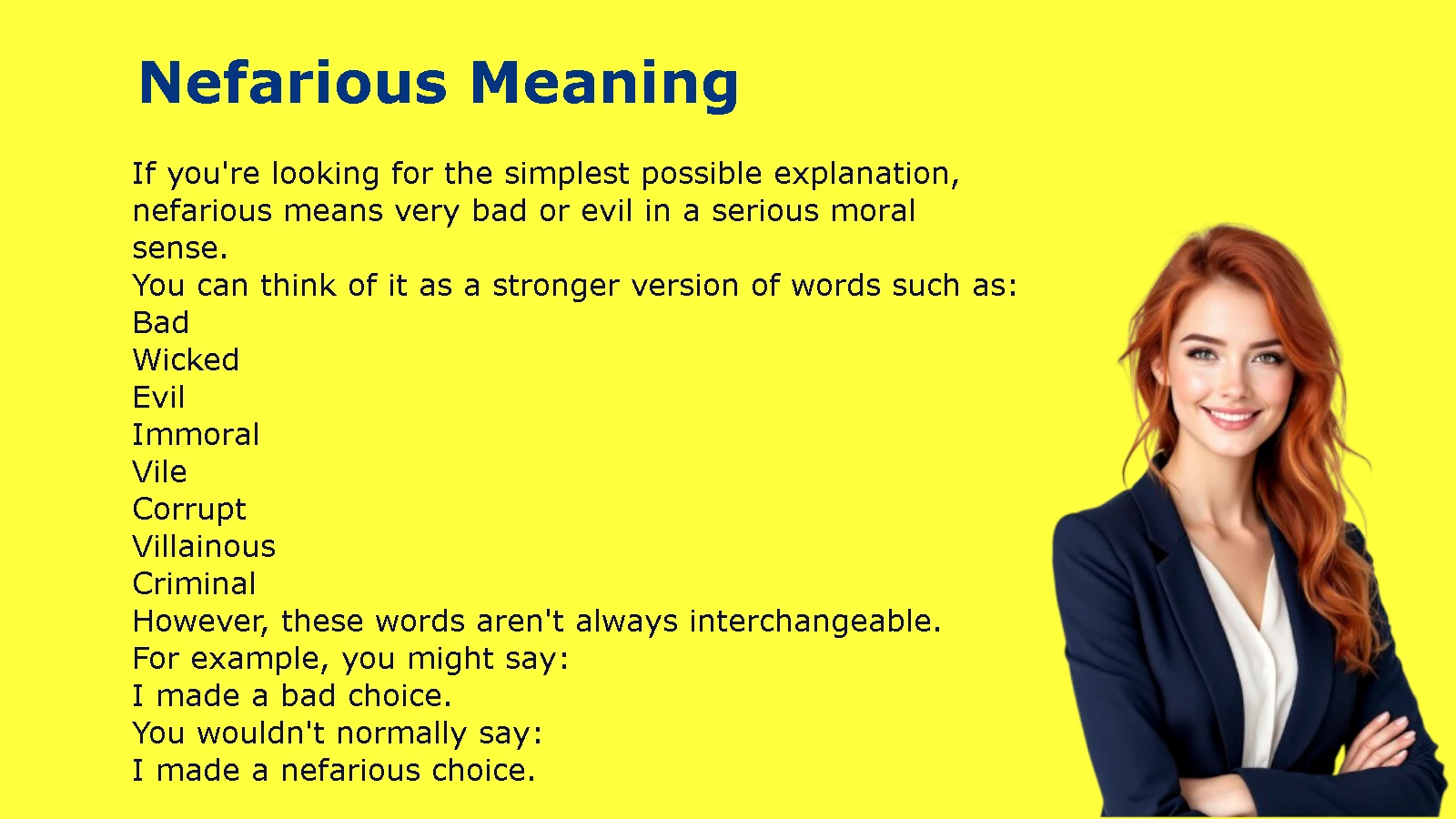
If you’re looking for the simplest possible explanation, nefarious means very bad or evil in a serious moral sense.
You can think of it as a stronger version of words such as:
- Bad
- Wicked
- Evil
- Immoral
- Vile
- Corrupt
- Villainous
- Criminal
However, these words aren’t always interchangeable.
For example, you might say:
I made a bad choice.
You wouldn’t normally say:
I made a nefarious choice.
The second sentence sounds unnecessarily dramatic because nefarious usually works better for serious wrongdoing, especially deliberate misconduct.
Now compare:
The company made a nefarious attempt to hide the financial records.
That sentence makes sense because the action involves deliberate and serious dishonesty.
A Simple Way to Remember Nefarious
Think:
Nefarious = seriously wicked or morally wrong.
If someone is simply annoying, careless, or unpleasant, nefarious is probably too strong. If someone deliberately creates a corrupt scheme to harm others, the word may fit perfectly.
Nefarious Pronunciation
In US English, nefarious is pronounced:
/nəˈfer.i.əs/
An easy pronunciation guide is:
nuh FAIR ee us
The main stress falls on the FAIR sound. Cambridge gives the US pronunciation as /nəˈfer.i.əs/ and the UK pronunciation as /nəˈfeə.ri.əs/.
How to Say Nefarious
Break the word into four parts:
nuh + FAIR + ee + us
So you can say:
nuh FAIR ee us
Don’t worry about making every syllable overly sharp. In natural speech, the middle syllable receives the strongest emphasis.
Is Nefarious a Positive or Negative Word?
Nefarious is strongly negative.
It describes something that is morally wrong, wicked, corrupt, or evil. It doesn’t normally express praise.
For example:
The investigation uncovered a nefarious operation.
The speaker clearly condemns the operation.
However, people sometimes use nefarious humorously when the situation isn’t genuinely evil. A parent might jokingly describe a child’s plan to steal the last cookie as a “nefarious scheme.” The word still carries its original meaning, but the speaker exaggerates it for comic effect.
That playful use works because nefarious has such a dramatic sound and meaning.
Examples of Nefarious in a Sentence
Seeing the word in context makes its meaning much easier to understand.
Examples of Nefarious
- The detective uncovered a nefarious scheme to steal confidential information.
- The organization was accused of engaging in nefarious activities.
- Hackers could use the stolen data for nefarious purposes.
- The villain created a nefarious plot to take control of the city.
- Investigators discovered evidence of nefarious business practices.
- The politician denied any involvement in the nefarious operation.
- The group used the website for nefarious purposes.
- The novel follows a detective who exposes a nefarious conspiracy.
- Authorities suspected that the money supported nefarious activities.
- The company introduced safeguards to prevent the technology from being used for nefarious purposes.
Oxford specifically lists combinations such as nefarious activities, nefarious purposes, and nefarious scheme as natural uses of the word.
What These Examples Have in Common
Notice a pattern: nefarious often appears before nouns that describe actions, plans, goals, or conduct.
Common combinations include:
- nefarious scheme
- nefarious activity
- nefarious purpose
- nefarious plot
- nefarious deed
- nefarious behavior
- nefarious practice
- nefarious plan
That pattern can help you use the word naturally rather than forcing it into a sentence.
Common Phrases With Nefarious
Some combinations appear much more naturally than others.
Nefarious Scheme
A nefarious scheme is a wicked or dishonest plan.
The fraudsters created a nefarious scheme to trick unsuspecting investors.
This is one of the most familiar combinations with the word. Merriam Webster uses a nefarious scheme as a dictionary example, while Oxford lists scheme among its collocations.
Nefarious Activities
Nefarious activities are seriously immoral, dishonest, or criminal actions.
The investigation focused on the group’s nefarious activities.
Cambridge notes that nefarious is especially common when describing activities and defines it as morally bad.
Nefarious Purposes
A nefarious purpose is a harmful, dishonest, or immoral reason for doing something.
The stolen information could be used for nefarious purposes.
This expression frequently appears when people discuss technology, information, fraud, or other tools that could be misused.
Nefarious Deeds
Nefarious deeds are wicked or morally unacceptable actions.
The hero spent years exposing the villain’s nefarious deeds.
This phrase has a literary flavor and often appears in stories, historical writing, and dramatic descriptions.
Nefarious Plot
A nefarious plot is a secret and harmful plan.
The detective discovered the nefarious plot before anyone else could be harmed.
The phrase fits especially well when the wrongdoing involves secrecy, deception, or conspiracy.
Nefarious Synonyms
Several words share the meaning of nefarious, but each has its own shade of meaning.
Cambridge lists words such as evil, vile, wicked, atrocious, villainous, heinous, and depraved among related terms.
Merriam Webster also identifies evil, unlawful, immoral, sinful, vicious, vile, wicked, and villainous as synonyms or closely related words.
| Synonym | Meaning | Difference from Nefarious |
| Evil | Morally very bad | Broader and more common |
| Wicked | Morally wrong or evil | Often less formal |
| Vile | Extremely unpleasant or morally bad | Often emphasizes disgust |
| Immoral | Against accepted moral standards | More direct and neutral |
| Corrupt | Dishonest or morally compromised | Often applies to people or systems |
| Criminal | Connected with crime or illegal behavior | Specifically emphasizes lawbreaking |
| Villainous | Characteristic of a villain | Often associated with fictional or clearly evil characters |
| Vicious | Cruel, violent, or morally depraved | Can emphasize cruelty or violence |
| Heinous | Shockingly evil or wicked | Often stronger and more severe |
| Depraved | Morally corrupt or degraded | Suggests a deeply damaged moral character |
Nefarious vs Evil
Evil is the more common word.
The villain was evil.
The villain carried out a nefarious scheme.
The first statement describes the person’s overall moral character. The second focuses on a particular plan or action.
Nefarious also has a more formal and sometimes dramatic feel. Merriam Webster notes that the word often applies to conduct that is flagrantly wicked or corrupt.
Nefarious vs Wicked
Wicked and nefarious overlap heavily, but wicked works in more everyday situations.
The witch was wicked.
The witch devised a nefarious plot.
The second sentence emphasizes the seriousness and calculated nature of the plan.
Nefarious vs Villainous
Villainous means characteristic of a villain or marked by evil behavior.
The character committed a villainous act.
Nefarious doesn’t require a villain. It can describe a real world business practice, criminal scheme, political action, or other conduct.
Merriam Webster explains that villainous applies broadly to evil, depraved, or vile conduct, while nefarious suggests a particularly flagrant breach of accepted standards of conduct.
Nefarious vs Malicious
This distinction matters.
Malicious focuses on the intention to cause harm.
Nefarious focuses on the serious moral wrongness of the conduct.
Compare:
She made a malicious comment about her coworker.
The sentence emphasizes her intention to hurt someone.
The group organized a nefarious scheme.
Here, the focus falls on the wicked or corrupt nature of the plan.
Something can be malicious without being best described as nefarious. Likewise, something can be nefarious because it is corrupt or criminal even when causing direct personal harm isn’t the central point.
Nefarious Antonyms
The opposite of nefarious depends on the context, but common antonyms include:
- Good
- Moral
- Ethical
- Honest
- Honorable
- Just
- Noble
- Virtuous
- Lawful
- Admirable
- Praiseworthy
Cambridge lists good, honest, honorable, just, noble, admirable, praiseworthy, and laudable among its antonyms.
| Nefarious | Possible Opposite |
| Nefarious behavior | Ethical behavior |
| Nefarious scheme | Honest plan |
| Nefarious activities | Lawful activities |
| Nefarious purposes | Benevolent purposes |
| Nefarious conduct | Honorable conduct |
| Nefarious practices | Fair practices |
The best antonym depends on what you’re describing. Honest works well for dishonest conduct, while ethical works better when discussing professional or moral standards.
Is Nefarious a Formal Word?
Yes. Nefarious is a formal word.
Both Cambridge and Oxford label it formal.
That doesn’t mean you can’t use it in conversation. It simply means that everyday speakers often choose simpler alternatives.
For instance:
Casual:
They were doing something really bad.
Formal or dramatic:
They were involved in nefarious activities.
The second sentence sounds more serious. It also carries a stronger sense of deliberate wrongdoing.
Where Nefarious Works Well
You’ll commonly see the word in:
- Journalism
- Formal writing
- Fiction
- Crime reporting
- Political commentary
- Business discussions
- Discussions about corruption
- Technology and cybersecurity
- Historical writing
- Legal or investigative contexts
It also works surprisingly well in humorous writing because of its dramatic tone.
How to Use Nefarious Correctly
Nefarious is an adjective, so it normally modifies a noun.
The basic pattern is:
nefarious + noun
For example:
- nefarious scheme
- nefarious plan
- nefarious activity
- nefarious purpose
- nefarious deed
- nefarious behavior
- nefarious practice
- nefarious plot
Correct Usage
Investigators uncovered a nefarious scheme.
The software could be used for nefarious purposes.
The organization faced accusations of nefarious activities.
An Awkward Use
I made a nefarious mistake on my homework.
This sounds strange because an ordinary homework mistake doesn’t usually involve serious wickedness.
A better sentence would be:
I made a careless mistake on my homework.
Save nefarious for situations that genuinely involve serious wrongdoing or use it deliberately for humorous exaggeration.
Can Nefarious Describe a Person?
Yes, nefarious can describe a person.
You might encounter expressions such as:
- a nefarious individual
- a nefarious criminal
- a nefarious businessman
- a nefarious character
- a nefarious schemer
For example:
The detective finally identified the nefarious mastermind behind the operation.
Still, nefarious often sounds more natural when it describes the person’s conduct, plan, or activities rather than the person directly.
Compare:
The company was involved in nefarious activities.
The company was run by a nefarious executive.
Both sentences work. The first focuses on behavior. The second makes a stronger judgment about the person.
Is Nefarious Always Illegal?
No.
This is an important distinction.
Nefarious can describe something that is immoral or seriously wrong without necessarily establishing that it violates a specific law.
Oxford’s definition includes “criminal; extremely bad,” while Cambridge emphasizes that something nefarious is morally bad.
So:
The company used a nefarious business practice.
This tells you that the practice is seriously unethical. It doesn’t automatically prove that the company broke a particular law.
By contrast:
The criminals developed a nefarious plan to rob the bank.
Here, the context clearly involves criminal behavior.
This distinction prevents an important mistake: nefarious does not automatically mean legally proven criminal.
Nefarious Meaning in Different Contexts
The word changes slightly in emphasis depending on the situation.
| Context | Example | What Nefarious Means |
| Crime | A nefarious scheme | A wicked or criminal plan |
| Business | Nefarious practices | Seriously unethical conduct |
| Technology | Nefarious purposes | Harmful or dishonest uses |
| Fiction | A nefarious villain | An extremely wicked character |
| Politics | Nefarious activities | Seriously corrupt or unethical actions |
| Everyday humor | A nefarious cookie stealing plan | Playfully exaggerated wrongdoing |
Nefarious in Technology
Technology provides a particularly natural setting for this word.
For example:
Hackers stole the information and used it for nefarious purposes.
Here, nefarious describes harmful or dishonest use of information.
Oxford specifically gives the example of people hacking an account and using the information for nefarious purposes.
The word doesn’t mean that technology itself is evil. Instead, it describes how someone uses it.
Nefarious in Business
You might read:
Regulators investigated the company’s nefarious business practices.
In this context, nefarious suggests conduct that seriously violates accepted standards of honesty or fairness.
Possible examples include:
- deliberate deception
- fraudulent schemes
- corrupt practices
- serious manipulation
- dishonest dealings
The exact conduct must come from the context. The adjective itself doesn’t identify a particular crime.
Nefarious in Fiction
Fiction loves this word.
A villain might have:
a nefarious plan to control the kingdom.
That’s because nefarious immediately creates a strong moral contrast between the villain and the hero.
The word can also add a playful, old fashioned dramatic quality:
The villain stroked his beard while explaining his nefarious plan.
In serious nonfiction, the word can sound formal. In a comic book or adventure story, it can sound intentionally theatrical.
Nefarious Word Forms
The word has two common related forms.
Nefariously
Nefariously is the adverbial form of nefarious. It means in a wicked, immoral, or corrupt manner.
The funds were obtained nefariously.
Here, the adverb describes how something happened.
Nefariousness
Nefariousness is the noun form. It refers to the quality or state of being nefarious.
The investigation revealed the nefariousness of the operation.
Merriam Webster lists nefariously and nefariousness as related forms of nefarious.
| Word | Part of Speech | Meaning |
| Nefarious | Adjective | Extremely wicked or immoral |
| Nefariously | Adverb | In a wicked or immoral manner |
| Nefariousness | Noun | The quality of being nefarious |
Nefarious Etymology and Origin
The history of nefarious explains why its meaning centers on serious wrongdoing.
The word comes from the Latin adjective nefarius, which developed from nefas, meaning an offense, crime, or something contrary to divine or moral law. The Latin elements include ne, meaning “not,” and fas, referring to what is right or permitted under divine law.
That gives the word an interesting underlying idea: something that is not right or not permitted by moral or divine law.
Merriam Webster records 1567 as the first known use of nefarious in English.
Oxford traces the English word to the early 17th century and likewise connects it to the Latin nefarius and nefas.
Nefarious Word History at a Glance
| Stage | Form | General idea |
| Latin | nefas | Wrongdoing or violation of divine law |
| Latin | nefarius | Wicked or unlawful |
| English | nefarious | Extremely wicked, immoral, or criminal |
The modern meaning still reflects that original connection to conduct that falls far outside accepted moral standards.
When Should You Use the Word Nefarious?
Use nefarious when the situation involves serious wrongdoing and you want a strong, formal description.
It works especially well when describing:
- A criminal scheme
- A corrupt operation
- A dishonest plan
- Serious unethical behavior
- A harmful secret purpose
- A villain’s plot
- Deliberate wrongdoing
- Corrupt business practices
- Misuse of information or technology
When Nefarious Is Too Strong
Not every bad thing deserves this word.
For example:
My friend forgot my birthday.
Calling that nefarious would sound absurd unless you’re clearly joking.
Likewise:
The restaurant was slow.
That’s frustrating, but it isn’t normally nefarious.
A useful rule is:
If “very bad” doesn’t capture the seriousness of the conduct, ask whether “nefarious” fits. If the problem is merely inconvenient, annoying, careless, or disappointing, choose a simpler word.
Nefarious in Everyday Conversation
Although nefarious is formal, you can use it casually when you want a humorous or dramatic effect.
Imagine someone secretly eating the last slice of pizza:
“Who carried out this nefarious act?”
The speaker isn’t accusing anyone of serious evil. The humor comes from treating a tiny offense as though it were a major crime.
This is a common way to make formal vocabulary sound playful.
Serious vs Humorous Use
| Situation | Example | Effect |
| Serious | The group planned a nefarious scheme. | Strong condemnation |
| Formal | The software was used for nefarious purposes. | Serious and professional |
| Fictional | The villain revealed his nefarious plot. | Dramatic |
| Humorous | Someone committed the nefarious crime of eating my fries. | Exaggerated and playful |
The underlying meaning remains negative. Only the context and scale of the situation change.
Common Mistakes With Nefarious
Understanding what nefarious doesn’t mean can be just as useful as learning its definition.
Using Nefarious for Ordinary Mistakes
A mistake isn’t automatically nefarious.
She made a nefarious spelling error.
That sounds unnatural because there’s no suggestion of wickedness.
Instead:
She made a serious spelling error.
Assuming Nefarious Always Means Illegal
As discussed earlier, nefarious can describe something morally wrong without establishing a specific legal violation.
The company used nefarious tactics.
The sentence strongly condemns the tactics. It doesn’t tell you which law, if any, the company broke.
Treating Nefarious as a Noun
Nefarious is an adjective.
You can say:
a nefarious plan
You shouldn’t normally use it alone as a noun:
The nefarious was discovered.
Instead, use a noun such as:
The nefarious scheme was discovered.
Confusing Nefarious With Malicious
These words overlap, but they aren’t identical.
- Malicious emphasizes an intention to harm.
- Nefarious emphasizes serious moral wickedness or corruption.
Choosing between them depends on what you want to emphasize.
Case Study: Understanding Nefarious in Context
Consider this fictional situation:
A company secretly collects customer information without permission. It then sells that information to third parties while telling customers that their data remains private.
Calling this a nefarious practice makes sense because the behavior involves deliberate deception and serious ethical wrongdoing.
Now change the situation.
A company accidentally sends an email to the wrong customer because an employee selects the wrong address.
That’s a mistake. It might be serious. It might require corrective action. But calling it nefarious would suggest deliberate wrongdoing that the facts don’t support.
What the Comparison Shows
| Situation | Best description |
| Accidental email error | Careless mistake |
| Deliberate deception of customers | Potentially nefarious practice |
| Secret plan to steal customer funds | Nefarious scheme |
| Employee arrives late once | Minor misconduct |
| Organized fraud | Nefarious activity |
The key factor isn’t simply whether something caused a problem. Intent, seriousness, corruption, and moral wrongdoing matter.
A Short Story Using Nefarious
At midnight, the detective discovered a hidden folder on the suspect’s computer. Inside, she found financial records, coded messages, and a detailed plan to trick investors.
“This isn’t a business proposal,” she said. “It’s a nefarious scheme.”
The phrase fits because the plan involves deliberate deception and serious wrongdoing. Calling it merely a “bad plan” would miss the moral weight of what the detective uncovered.
That difference illustrates why writers choose stronger vocabulary when ordinary words don’t carry enough force.
Nefarious Meaning: Quick Answer
Nefarious means extremely wicked, immoral, corrupt, or evil. It usually describes serious wrongdoing, especially activities, schemes, plans, purposes, or behavior. For example, “The criminals created a nefarious scheme to steal the money.”
Quick Reference
| Question | Answer |
| What does nefarious mean? | Extremely wicked, immoral, or evil |
| What part of speech is nefarious? | Adjective |
| How do you pronounce nefarious? | nuh FAIR ee us |
| Is nefarious positive or negative? | Strongly negative |
| Is nefarious formal? | Yes |
| What is a synonym for nefarious? | Evil, wicked, vile, villainous |
| What is an antonym for nefarious? | Good, honest, moral, ethical |
| Can nefarious describe a person? | Yes |
| Can nefarious describe a plan? | Yes |
| What is the adverb? | Nefariously |
| What is the noun? | Nefariousness |
| Does nefarious always mean illegal? | No |
Frequently Asked Questions About Nefarious Meaning
What does nefarious mean in simple terms?
Nefarious means extremely bad, wicked, or immoral. It describes conduct or plans that involve serious wrongdoing.
Does nefarious mean evil?
Yes, nefarious can mean evil. However, it often sounds more formal and specifically describes seriously wicked or corrupt conduct.
Is nefarious a bad word?
Nefarious has a strongly negative meaning, but it isn’t a swear word. It’s a formal adjective used to criticize serious wrongdoing.
Is nefarious formal or informal?
Nefarious is formal. Cambridge and Oxford both label it as a formal word.
What is the best synonym for nefarious?
Depending on context, strong synonyms include evil, wicked, vile, villainous, immoral, corrupt, vicious, and heinous. No single synonym works perfectly in every sentence.
What is the opposite of nefarious?
Common opposites include good, moral, ethical, honest, honorable, just, noble, and virtuous.
Can nefarious describe a person?
Yes. You can describe someone as nefarious, especially when the person engages in seriously wicked or corrupt behavior.
Can nefarious describe a plan?
Absolutely. Nefarious plan and nefarious scheme are natural combinations.
The criminals created a nefarious plan to defraud investors.
What is the noun form of nefarious?
The noun form is nefariousness, meaning the quality or state of being nefarious.
What is the adverb form of nefarious?
The adverb is nefariously, meaning in a wicked, immoral, or corrupt way.
The money was obtained nefariously.
What does “nefarious purposes” mean?
Nefarious purposes means harmful, dishonest, immoral, or wicked purposes.
For example:
The stolen data could be used for nefarious purposes.
This means someone could use the data for seriously harmful or dishonest reasons.
What does “nefarious activities” mean?
Nefarious activities are actions that are seriously immoral, wicked, corrupt, or potentially criminal. Cambridge specifically uses nefarious for morally bad activities.
Is nefarious stronger than bad?
Yes. Bad can describe anything from a minor mistake to serious wrongdoing. Nefarious carries a much stronger moral judgment and generally suggests serious wickedness or corruption.
What is the difference between nefarious and malicious?
Malicious emphasizes the desire or intention to cause harm. Nefarious emphasizes the seriously wicked or corrupt nature of an action, plan, or behavior.
Final Takeaway: Nefarious Meaning
The simplest way to remember nefarious is “extremely wicked or morally wrong.”
It’s a strong adjective with a formal tone. You’ll most often see it attached to words such as scheme, activity, purpose, plot, deed, practice, and behavior. Dictionaries consistently connect the word with serious moral wrongdoing, corruption, or evil.
The word also has a long history. English nefarious ultimately comes from Latin nefarius and nefas, a root associated with crime and conduct contrary to what was considered right or divinely lawful. Merriam Webster records its first known English use as 1567.
So when you encounter a nefarious scheme, picture more than a bad idea. Picture a deliberate plan that crosses a serious moral line.
Nefarious = extremely wicked, immoral, corrupt, or evil.




