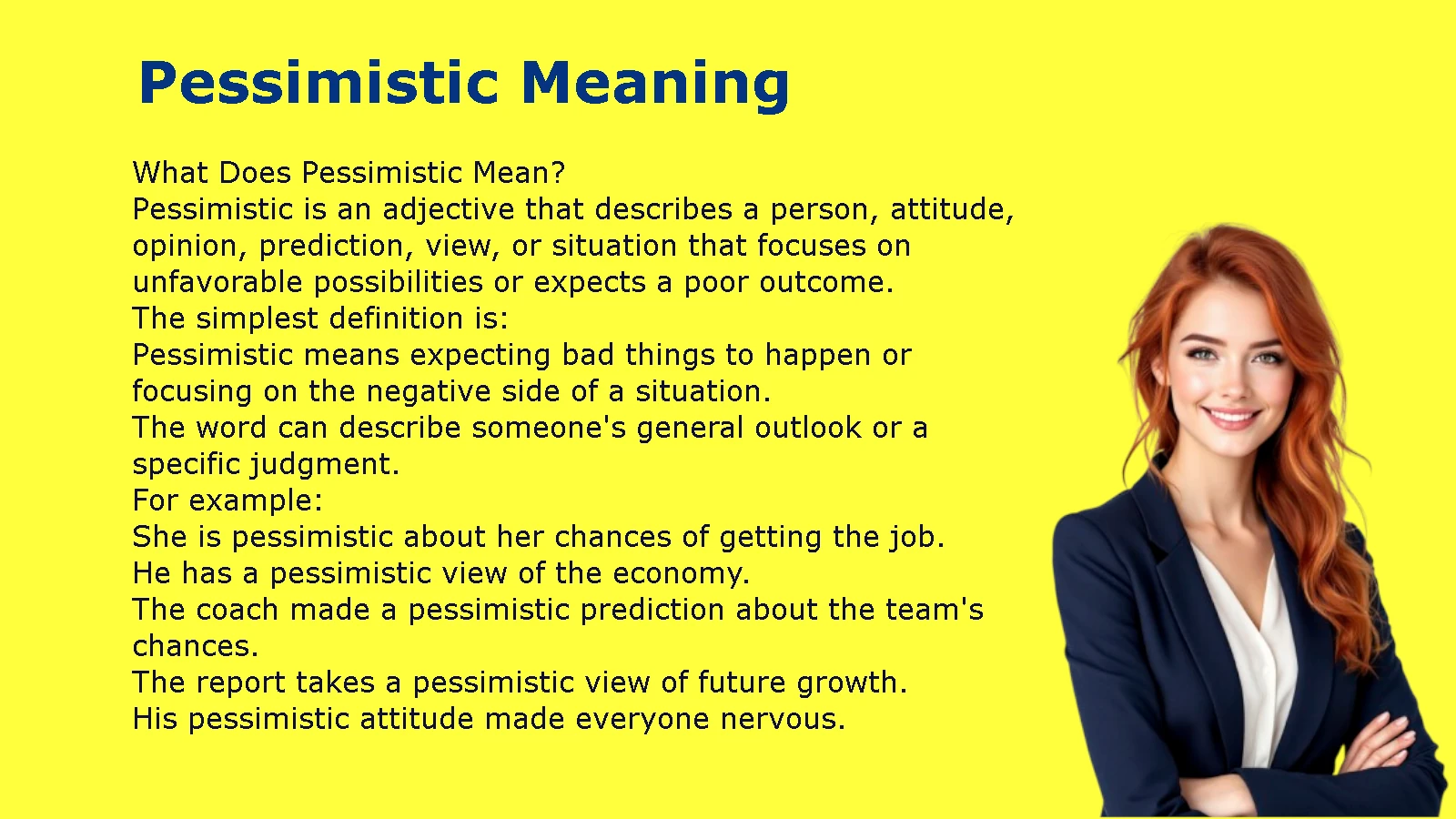
Have you ever expected something to go wrong before it even happened? If so, you may have experienced a pessimistic mindset. While Pessimistic Meaning may seem simple, the word can describe a person’s attitude, expectations, or way of looking at difficult situations.
Pessimistic is an adjective used to describe someone who expects negative outcomes or focuses more on problems than possibilities. A pessimistic person may assume that things will not work out, even when there is a chance of success.
Examples:
- She is pessimistic about getting the job.
- He has a pessimistic view of the future.
The confusion is understandable. People often search for what does pessimistic mean, pessimistic meaning in text, pessimistic meaning in a sentence, or what is a pessimistic person because the word can describe thoughts, attitudes, predictions, and behavior. And here’s the kicker: being realistic about a problem is not always the same as being pessimistic.
In this guide, you’ll learn the complete Pessimistic Meaning, its definition, pronunciation, correct usage, and examples in sentences. You’ll also discover pessimistic meaning in everyday language, what it means to be a pessimistic person, the difference between pessimistic and optimistic, and how to use the word correctly.
What Does Pessimistic Mean?
Pessimistic is an adjective that describes a person, attitude, opinion, prediction, view, or situation that focuses on unfavorable possibilities or expects a poor outcome.
The simplest definition is:
Pessimistic means expecting bad things to happen or focusing on the negative side of a situation.
The word can describe someone’s general outlook or a specific judgment.
For example:
- She is pessimistic about her chances of getting the job.
- He has a pessimistic view of the economy.
- The coach made a pessimistic prediction about the team’s chances.
- The report takes a pessimistic view of future growth.
- His pessimistic attitude made everyone nervous.
Notice something important in these examples. Pessimistic doesn’t necessarily mean that the speaker is wrong.
A manager might make a pessimistic forecast because sales have fallen for several months. A student might feel pessimistic after struggling with every practice test. A traveler might be pessimistic about reaching the airport on time after getting stuck in traffic.
In each case, the word describes a negative expectation or outlook.
Pessimistic Meaning in Simple Words
In everyday English, pessimistic means expecting the worst.
Imagine that you have an important job interview tomorrow. You have prepared your answers, researched the company, and practiced several times. Still, you keep thinking, “They’re probably going to reject me.”
That’s pessimistic thinking.
Now imagine a friend says, “You’ve prepared well. You have a good chance of getting the job.”
That’s an optimistic outlook.
The difference looks like this:
| Outlook | Typical expectation |
| Pessimistic | “This probably won’t work.” |
| Realistic | “There are risks, but let’s look at the evidence.” |
| Optimistic | “This could work out well.” |
Pessimism focuses on the possibility of failure, loss, difficulty, or disappointment. It doesn’t automatically mean someone is irrational or foolish. Sometimes a pessimistic assessment reflects genuine risks.
What Is the Part of Speech of Pessimistic?
Pessimistic is an adjective.
An adjective describes or modifies a noun. You can use pessimistic before a noun or after a linking verb.
Before a noun
- a pessimistic attitude
- a pessimistic prediction
- a pessimistic outlook
- a pessimistic forecast
- a pessimistic assessment
- a pessimistic view
- a pessimistic response
After a linking verb
- She is pessimistic.
- They seem pessimistic.
- He became pessimistic.
- The investors remain pessimistic.
Oxford lists pessimistic as an adjective and commonly uses the structure pessimistic about something.
Pessimistic Pronunciation
The US pronunciation of pessimistic is approximately:
pes-uh-MIS-tik
Cambridge gives the US pronunciation as /ˌpes.əˈmɪs.t̬ɪk/. The main stress falls on the MIS syllable.
The related noun pessimism is pronounced approximately:
PES-uh-miz-um
The noun pessimist sounds approximately like:
PES-uh-mist
These forms belong to the same word family.
Pessimistic Word Family
Understanding the related words makes the meaning easier to remember.
| Word | Part of speech | Meaning |
| Pessimistic | Adjective | Expecting bad outcomes or emphasizing negative possibilities |
| Pessimism | Noun | A tendency to expect bad outcomes |
| Pessimist | Noun | A person who tends to expect bad outcomes |
| Pessimistically | Adverb | In a pessimistic manner |
For example:
- Pessimistic: “She has a pessimistic outlook.”
- Pessimism: “His pessimism affected the team’s morale.”
- Pessimist: “He’s a pessimist who expects problems.”
- Pessimistically: “She spoke pessimistically about the project’s future.”
Oxford defines pessimism as a feeling that bad things will happen or that something won’t succeed.
Examples of Pessimistic in a Sentence
The fastest way to understand a word is to see it in real situations. Here are examples across everyday contexts.
Pessimistic Examples About School
- I feel pessimistic about my chances of passing the final exam.
- Maria was pessimistic after receiving a low score on her practice test.
- The student sounded pessimistic about getting into her first-choice college.
- Don’t be so pessimistic before you’ve even seen your results.
These examples show expectations about future outcomes.
Pessimistic Examples About Work
- The manager was pessimistic about the company’s sales figures.
- Our team has a pessimistic outlook after losing several major clients.
- He gave a pessimistic assessment of the project’s deadline.
- The employees sounded pessimistic about receiving bonuses this year.
Here, pessimistic describes an unfavorable expectation about work or business.
Pessimistic Examples About Relationships
- She became pessimistic about their chances of resolving the disagreement.
- He’s pessimistic about finding someone who shares his interests.
- After several arguments, they developed a pessimistic view of the relationship.
The word doesn’t mean that the relationship will definitely fail. It describes the expectation that it might.
Pessimistic Examples About Money
- Analysts gave a pessimistic forecast for the company’s earnings.
- He is pessimistic about saving enough money this year.
- The report presents a pessimistic picture of future revenue.
A financial forecast can be pessimistic without being certain. Forecasts deal with possibilities, not guarantees.
Pessimistic Examples About Everyday Life
- Don’t be pessimistic about the weather. The forecast could change.
- She was pessimistic about finding a parking spot downtown.
- He sounded pessimistic when he talked about the trip.
- I’m usually optimistic, but I’m feeling pessimistic about this particular situation.
That last example highlights an important point: a person can be optimistic in general but pessimistic about one specific situation.
Pessimistic Examples in Conversation
In casual conversation, pessimistic often appears when someone thinks another person is expecting too much trouble.
Example 1
“Do you think we’ll finish the project today?”
“Honestly, I’m pessimistic. We still have three major tasks left.”
Example 2
“I think you’ll get the job.”
“I hope so. I’m trying not to be too pessimistic.”
Example 3
“Why are you already worried about the trip?”
“Because I’m pessimistic about the weather.”
These examples sound natural because the word describes an expectation rather than simply labeling someone as “bad” or “negative.”
Common Sentence Patterns With Pessimistic
One of the most useful structures to remember is:
Pessimistic about + noun
Examples:
- pessimistic about the future
- pessimistic about the outcome
- pessimistic about my chances
- pessimistic about the economy
- pessimistic about the project
- pessimistic about the results
Oxford specifically lists pessimistic about something as a common construction.
You can also use pessimistic with that clauses:
- She is pessimistic that the plan will succeed.
- He was pessimistic that the team could recover.
However, pessimistic about is often the cleaner and more natural choice when you’re naming the subject of the concern.
Pessimistic + noun
Another common pattern is:
pessimistic + noun
Examples:
- pessimistic outlook
- pessimistic view
- pessimistic attitude
- pessimistic prediction
- pessimistic forecast
- pessimistic assessment
- pessimistic scenario
For example:
The company issued a pessimistic forecast for the coming year.
The adjective tells you what kind of forecast the company issued.
What Is a Pessimistic Person?
A pessimistic person, or pessimist, tends to expect bad outcomes or emphasize unfavorable aspects of a situation.
Cambridge defines a pessimist as someone who thinks bad things are more likely to happen or who emphasizes the bad part of a situation.
For example:
James is a pessimist. He always expects something to go wrong.
A pessimist might say:
“The restaurant will probably be terrible.”
An optimistic person might say:
“I’m sure we’ll have a great meal.”
A realistic person might say:
“The reviews are mixed, so we’ll see.”
These statements reveal three different approaches to the same uncertain situation.
Importantly, being a pessimist doesn’t mean being negative about every single thing. Someone can have a generally positive personality and still take a pessimistic view of a particular event.
Pessimistic vs. Optimistic
Optimistic is the clearest opposite of pessimistic.
Cambridge defines optimistic as hoping or believing that good things will happen in the future. Oxford similarly defines it as expecting good things to happen or expecting something to succeed.
The contrast becomes clearer in a side-by-side example.
| Pessimistic | Optimistic |
| Expects a bad outcome | Expects a good outcome |
| Focuses on unfavorable possibilities | Focuses on favorable possibilities |
| “This probably won’t work.” | “This could work.” |
| “We’ll probably lose.” | “I think we’ll win.” |
| “I don’t think I’ll get the job.” | “I think I have a good chance.” |
| “The situation will probably get worse.” | “The situation could improve.” |
A Simple Glass Example
The familiar “half-full or half-empty” comparison can help illustrate the basic difference.
If a glass contains half its water, an optimistic person might focus on what remains. A pessimistic person might focus on what has already disappeared.
The analogy isn’t a complete definition of pessimism, though. The more precise distinction concerns expectation and emphasis.
Pessimistic often points toward an expectation that something will go badly or an emphasis on the unfavorable side of a situation.
Pessimistic vs. Realistic
These words often get confused because realism can include negative information.
However, pessimistic and realistic don’t mean the same thing.
A realistic person tries to judge a situation according to the available evidence. A pessimistic person tends to expect an unfavorable outcome or emphasize negative possibilities.
Consider a job interview.
Pessimistic
“There are 200 applicants. I probably won’t get the job.”
Realistic
“There are many applicants, so the competition will be strong. I’ll focus on giving my best interview.”
Optimistic
“I have a strong application, so I think I’ll get the job.”
The realistic response doesn’t ignore the competition. It simply avoids assuming either success or failure.
That’s an important distinction. Pessimism isn’t automatically realism.
Likewise, optimism isn’t automatically unrealistic. A positive expectation can sometimes rest on strong evidence.
Pessimistic vs. Negative
Negative has a broader meaning than pessimistic.
Something can be negative without involving a prediction about the future.
For example:
- “The movie was boring.”
- “The customer gave negative feedback.”
- “The test result was negative.”
- “She made a negative comment about the proposal.”
None of these necessarily involves pessimism.
By contrast:
“I don’t think this proposal will ever succeed.”
This statement is pessimistic because it expresses an unfavorable expectation.
A useful rule is:
Negative = unfavorable in some way.
Pessimistic = expecting or emphasizing an unfavorable outcome.
There is overlap between the two words, but they aren’t interchangeable in every sentence.
Pessimistic vs. Cynical
Cynical and pessimistic can overlap, but they point to different ideas.
Pessimism focuses on bad outcomes or a gloomy view.
Cynicism often focuses on distrust of people’s motives, sincerity, or intentions.
Consider these examples:
Pessimistic: “The project will probably fail.”
Cynical: “The manager doesn’t actually care about the project. He’s only pretending to support it.”
The first statement predicts failure. The second questions someone’s motives.
Someone can be pessimistic without being cynical.
For example, a project manager might believe that a deadline is unrealistic because the team has too much work. That person isn’t necessarily distrustful of anyone.
Pessimistic Synonyms
Several words can overlap with pessimistic, but each carries its own shade of meaning.
| Synonym | Main idea | Example |
| Gloomy | Dark or lacking hope | “She has a gloomy outlook.” |
| Bleak | Little hope for improvement | “The future looked bleak.” |
| Negative | Unfavorable or focused on problems | “He has a negative attitude.” |
| Hopeless | Believing there is little or no chance | “She felt hopeless about the situation.” |
| Doubtful | Unsure or lacking confidence | “He’s doubtful that the plan will work.” |
| Discouraged | Losing confidence because of difficulties | “She felt discouraged after the rejection.” |
| Despondent | Very low in spirits | “He became despondent after the loss.” |
These words shouldn’t be treated as perfect substitutes.
For example, doubtful can simply mean uncertain. A doubtful person doesn’t necessarily expect failure. Hopeless is usually stronger than pessimistic because it suggests that success seems impossible or nearly impossible.
What Is the Opposite of Pessimistic?
The direct opposite of pessimistic is optimistic.
Other context-dependent opposites include:
- hopeful
- positive
- confident
- encouraging
- upbeat
- cheerful
However, optimistic is the most precise antonym because it directly contrasts expectations of bad outcomes with expectations of good outcomes. Both Cambridge and Oxford identify optimistic as the opposite of pessimistic.
Pessimistic vs. Hopeful
These words also form a useful contrast.
Pessimistic:
“I don’t think things will improve.”
Hopeful:
“I believe things can improve.”
Hope doesn’t always mean certainty. Someone can remain hopeful while recognizing serious problems.
Pessimistic About the Future
The phrase pessimistic about the future is common because the word naturally describes expectations about what may happen next.
For example:
Many employees were pessimistic about the future of the company.
This means they expected unfavorable developments or lacked confidence in the company’s future.
You can also say:
- pessimistic about the economy
- pessimistic about future growth
- pessimistic about the chances of success
- pessimistic about the outcome
- pessimistic about the next few months
Oxford provides examples such as being “deeply pessimistic about the future,” which shows how naturally the word combines with about.
Pessimistic Attitude vs. Pessimistic Prediction
These expressions sound similar, but they describe different things.
A pessimistic attitude is a broader way of approaching situations.
A pessimistic prediction is a specific expectation about what will happen.
For example:
Sarah has a pessimistic attitude toward new projects.
This suggests a general pattern.
But:
Sarah predicted that the new project would fail.
This describes one particular prediction.
Someone can make one pessimistic prediction without having a generally pessimistic attitude.
Pessimistic Outlook vs. Pessimistic Opinion
An outlook usually describes a broader perspective or expectation.
He has a pessimistic outlook on life.
An opinion can be much narrower.
She has a pessimistic opinion about the proposed changes.
An outlook tends to describe a pattern of thinking. An opinion can concern one particular issue.
Pessimistic Forecast and Pessimistic Assessment
The word also appears frequently in professional and formal English.
A pessimistic forecast predicts an unfavorable future result.
The company released a pessimistic sales forecast.
A pessimistic assessment evaluates a situation in an unfavorable way.
The committee gave a pessimistic assessment of the project’s chances.
These phrases appear naturally in business, economics, politics, education, sports, and other fields where people discuss uncertain outcomes.
A Practical Case Study: Three People, One Situation
Imagine a small business has launched a new product. Sales during the first month are lower than expected.
Three employees respond differently.
The pessimist
“This product is going to fail. Nobody wants it.”
The employee focuses on the worst likely outcome.
The realist
“Sales are below our target. We need to examine the customer feedback and adjust the marketing strategy.”
The employee acknowledges the problem and looks for evidence.
The optimist
“Sales will take off soon. We just need to give it more time.”
The employee expects improvement.
The actual outcome could surprise all three.
That’s the key lesson: pessimistic, realistic, and optimistic describe perspectives or expectations. They don’t guarantee the future.
Is Being Pessimistic the Same as Being Realistic?
No.
A pessimistic person may correctly identify a serious risk. That doesn’t automatically make the person’s entire prediction realistic.
Likewise, a realistic person may deliver good news when the evidence supports it.
Suppose a company has strong sales, healthy cash reserves, growing demand, and a successful product. Saying, “This company will probably collapse next month,” would be pessimistic. It wouldn’t necessarily be realistic simply because failure is theoretically possible.
The strongest assessment considers evidence, uncertainty, and competing possibilities.
That distinction matters because people sometimes use realistic as a polite synonym for pessimistic. The two words aren’t interchangeable.
Is Pessimistic Always a Bad Thing?
Not necessarily.
In everyday conversation, pessimistic usually carries a negative tone. Yet considering potential problems can sometimes help people prepare.
For example, before a long trip, someone might ask:
- What if the car breaks down?
- What if the flight gets delayed?
- What if the hotel loses the reservation?
Thinking about these possibilities doesn’t automatically mean someone has a pessimistic personality. It can simply mean the person is planning for risks.
The difference lies in the broader pattern and attitude.
A useful approach is:
Recognize risks without assuming disaster.
That balance sits between blind optimism and constant pessimism.
Common Phrases With Pessimistic
Here are natural combinations worth remembering:
- pessimistic about the future
- pessimistic about the outcome
- pessimistic about one’s chances
- pessimistic about success
- pessimistic about the economy
- pessimistic outlook
- pessimistic attitude
- pessimistic view
- pessimistic prediction
- pessimistic forecast
- pessimistic assessment
- pessimistic scenario
- pessimistic interpretation
- pessimistic tone
Example Sentences
- Investors are pessimistic about the company’s future.
- She has a pessimistic outlook on life.
- The coach gave a pessimistic assessment of the team’s chances.
- His pessimistic prediction turned out to be wrong.
- The report uses a pessimistic scenario to estimate potential losses.
These combinations make the word easier to use naturally instead of forcing it into a sentence.
How to Use Pessimistic Correctly
When you want to use pessimistic naturally, remember these basic structures.
Use “pessimistic about”
They are pessimistic about the results.
Use it before a noun
It was a pessimistic prediction.
Use it after a linking verb
She seems pessimistic.
Use the noun “pessimism”
His pessimism affected the team’s mood.
Use “pessimist” for a person
He’s a pessimist who expects problems at every turn.
Avoid treating pessimistic as a noun.
Incorrect:
He is a pessimistic.
Correct:
He is pessimistic.
Or:
He is a pessimist.
The adjective describes the person. The noun names the person.
Common Mistakes With Pessimistic
Mistake: Treating pessimistic as a synonym for sad
Someone can feel sad without expecting a bad future.
Sad describes an emotional state.
Pessimistic describes an outlook or expectation.
Mistake: Assuming every negative statement is pessimistic
A statement such as “The food is cold” is negative, but it isn’t necessarily pessimistic.
Pessimism usually involves a broader negative expectation or emphasis.
Mistake: Assuming pessimistic means certain failure
It doesn’t.
If someone says:
“I’m pessimistic about our chances.”
They aren’t saying failure is guaranteed. They’re expressing an unfavorable expectation.
Mistake: Confusing pessimistic with cynical
A pessimistic person expects bad outcomes.
A cynical person may distrust people’s motives.
Those ideas can overlap, but they aren’t identical.
Pessimistic Meaning: Quick Comparison
| Word | Core meaning |
| Pessimistic | Expects or emphasizes negative outcomes |
| Optimistic | Expects or emphasizes positive outcomes |
| Realistic | Judges a situation based on likely facts and conditions |
| Negative | Unfavorable or focused on the bad side |
| Cynical | Distrustful of people’s motives or sincerity |
| Hopeful | Believes a positive outcome remains possible |
| Doubtful | Lacks confidence or certainty |
This comparison helps prevent subtle meaning errors.
Frequently Asked Questions About Pessimistic Meaning
What is the simple meaning of pessimistic?
Pessimistic means expecting bad things to happen or focusing on the negative side of a situation. For example, someone who expects to fail before taking an exam is being pessimistic.
What is an example of pessimistic?
“I’m pessimistic about my chances of getting the job.”
The speaker expects an unfavorable result.
What is the opposite of pessimistic?
The direct opposite is optimistic. An optimistic person expects good things to happen or believes that a situation is likely to succeed.
Is pessimistic positive or negative?
Pessimistic generally has a negative meaning because it describes an expectation or outlook centered on unfavorable possibilities.
What is a pessimistic person?
A pessimistic person, or pessimist, tends to expect bad things to happen or emphasizes the negative side of situations.
Is pessimistic the same as negative?
No. The words overlap, but negative has a broader meaning. Pessimistic specifically relates to expecting bad outcomes or taking a gloomy view of a situation.
What is the noun form of pessimistic?
The main noun related to the adjective is pessimism.
Example:
Her pessimism made it difficult for the team to stay motivated.
Pessimist is the noun for a person who tends to be pessimistic.
What is the adverb form of pessimistic?
The adverb is pessimistically.
Example:
He spoke pessimistically about the project’s future.
Oxford lists pessimistically as the adverb form of pessimistic.
Can someone be pessimistic about one thing but optimistic about another?
Yes.
Someone might be optimistic about a new job while feeling pessimistic about the housing market. These words can describe a person’s outlook toward a particular situation rather than their entire personality.
Does pessimistic mean someone is always wrong?
No.
Pessimism describes an expectation or outlook. Sometimes a pessimistic prediction is correct. Other times it isn’t.
What is a pessimistic outlook?
A pessimistic outlook is a general expectation that future events will produce unfavorable results or that problems are more likely than positive outcomes.
For example:
He has a pessimistic outlook on the economy.
This means he expects the economic situation to develop poorly.
Final Takeaway: Pessimistic Meaning
The pessimistic meaning is straightforward: expecting bad things to happen or emphasizing the negative side of a situation.
The word is an adjective, so you can use it to describe a person, attitude, outlook, prediction, assessment, forecast, or view. One of its most common structures is pessimistic about, as in “pessimistic about the future” or “pessimistic about her chances.”
Remember the core contrast:
Pessimistic → expects the negative.
Optimistic → expects the positive.
Realistic → evaluates what seems likely based on the evidence.




